Act I
The first person to step on the portrait did not even look down.
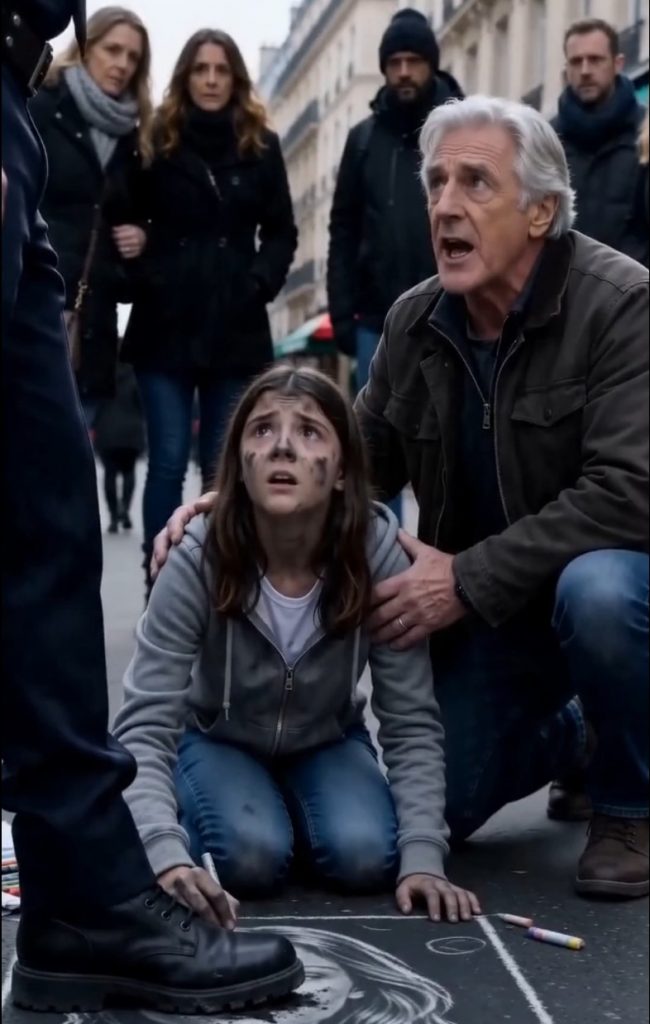
A black boot struck the face drawn on the pavement, smearing one carefully shaded cheek across the wet asphalt. The little girl holding the marker froze, her hand still hovering above the ground, her breath caught somewhere between anger and tears.
Around her, Paris kept moving.
Coats brushed past. Umbrellas tilted under the grey sky. Waiters carried cups to the green café tables beneath red umbrellas. A street musician played a soft, sad melody on an old acoustic guitar, and the sound disappeared beneath footsteps, traffic, and the low murmur of people who had somewhere better to be.
The girl crouched on the sidewalk with chalk dust on her sleeves and black marker stains on her fingers.
Her name was Amara.
She was eleven years old.
Her face was smudged with soot from the bridge where she slept sometimes when the shelter was full. Her long dark hair fell across her cheeks as she stared at the ruined line across the portrait’s eye.
She wiped it gently with her thumb.
It only made the smudge worse.
A man nearby laughed without meaning to be cruel. A woman pulled her purse closer. Someone lifted a phone, but not to help.
Then an elderly man in a dark jacket stepped into the stream of pedestrians and knelt beside her.
“She’s just a child,” he said, looking up at the crowd.
His voice was not loud, but it had weight.
People slowed.
The man turned back to Amara, softening.
“May I see?”
Amara did not answer. She bent over the drawing again, working carefully, rebuilding the damaged eye with tiny strokes of black and grey. Her fingers moved with impossible precision over the rough asphalt.
Slowly, a face appeared.
A girl.
Not Amara.
A younger girl with a gentle smile, bright eyes, and a delicate diamond heart pendant at her throat.
The old man’s expression changed.
Then a police officer walking past the café stopped dead.
He looked down at the pavement.
Then he turned sharply toward the blonde woman standing just behind him in a white pantsuit and gold butterfly necklace.
“Wait,” the officer said. “I know this girl.”
The woman in white lowered her gaze.
At first, she looked annoyed by the commotion.
Then confused.
Then the color left her face.
Amara added one final detail to the necklace: a tiny crack across the heart-shaped stone.
The woman staggered back as if struck.
Amara lifted her hand and pointed directly at her.
“I know this girl!”
The police officer stared at the woman.
The woman’s lips parted.
Her voice came out in a broken whisper.
“She disappeared eight years ago.”
And suddenly, the ruined drawing on the pavement became the most important thing in the city.
Act II
Amara did not remember the first time she drew the girl.
That frightened her more than hunger.
Hunger had rules. It came, it hurt, and if she was lucky, it passed for a few hours.
But the girl in the portrait came from somewhere deeper.
A dream.
A locked room.
A lullaby hummed through a wall.
A hand touching her hair.
A woman’s voice saying, “Don’t forget the heart, little bird.”
Amara had been found near Gare du Nord when she was four years old, feverish and silent, clutching a broken chain in one fist. No one knew her real name. No one reported her missing in a way that matched her. The charity workers called her Amara because she would not answer to anything else.
For years, she moved between shelters, foster apartments, temporary rooms, and streets that taught her how to disappear before anyone could make her.
But she could draw.
Not like a child.
Not like someone copying what she saw.
Amara drew memories she did not understand.
Faces in windows. A blue bedroom with painted clouds. A white staircase. A woman’s hand wearing a gold butterfly ring. A diamond heart pendant cracked at the edge.
The social workers called it trauma art.
The tourists called it beautiful.
Amara called it proof.
Proof that before the shelters, before the cold, before adults asked questions she could not answer, there had been another life.
A warm one.
A hidden one.
The old man who knelt beside her that day was named Henri Morel. He ran the café on the corner and had watched Amara draw there for two months. He gave her hot chocolate when business was slow and pretended the leftover croissants were mistakes.
He had seen her draw landscapes from memory. Dogs. Mothers. Police cars. Churches.
But never that face.
Not until the woman in white appeared across the street.
The woman’s name was Celeste Armand.
Everyone in Paris society knew her.
She owned galleries, funded museums, appeared in magazines beside auction houses and ministers, always dressed in white or cream, always wearing the same delicate gold butterfly necklace at her throat.
People thought the butterfly was a signature.
They did not know it was a wound.
Eight years earlier, Celeste’s daughter, Lucie, vanished from a private garden party outside Paris. She had been six years old, dark-haired, bright-eyed, wearing a pale blue dress and a diamond heart pendant her father had given her before he died.
The necklace was never found.
No ransom came.
No body.
No confession.
Only one witness: a housekeeper who claimed she saw Lucie leave willingly with a woman wearing a grey coat.
Celeste spent three years searching publicly.
Then, slowly, she became quieter.
The newspapers moved on. Friends stopped asking. Detectives retired. Charities praised her strength.
But every morning, Celeste still touched the butterfly at her throat before leaving the house.
The butterfly had belonged to Lucie’s baby bracelet.
It was all she had left.
Or so she believed.
Until she looked down at the wet pavement outside a café and saw her missing daughter’s face drawn by a girl with soot on her cheek.
Act III
The police officer’s name was Adrien Lefevre.
Eight years earlier, he had been a junior officer assigned to crowd control during the first search for Lucie Armand. He remembered the missing posters. The mother collapsing outside the estate gates. The small photograph of a smiling child wearing a diamond heart.
Some cases never leave a city.
They sink into it.
Adrien crouched beside the drawing.
“Where did you see this girl?” he asked Amara.
She did not look at him.
She looked at Celeste.
“I told you. I know her.”
Celeste stepped closer, trembling.
“How?”
Amara’s face tightened, as if the question hurt.
“I see her when I sleep.”
Henri placed a protective hand near her shoulder.
“Careful,” he warned softly, not to Amara, but to everyone around her.
A small crowd had gathered now. Phones were lifted. Whispered guesses moved beneath the café umbrellas.
Celeste knelt in front of the portrait, ignoring the damp pavement beneath her expensive white suit.
Her eyes fixed on the necklace.
“The crack,” she whispered.
Adrien looked at her.
“What crack?”
Celeste’s fingers went to her own throat.
“The pendant cracked the morning before she vanished. Lucie dropped it on the bathroom tile. We never released that detail.”
The air changed.
Amara looked down at the portrait, suddenly afraid of what she had made.
“I didn’t mean to draw it wrong.”
Celeste’s eyes filled.
“You didn’t.”
Adrien turned to Amara.
“Do you have the chain?”
The girl stiffened.
Henri frowned. “What chain?”
Amara hesitated.
Then she reached beneath her hoodie and pulled out a piece of thin gold chain tied with thread. Hanging from it was not a pendant, only a broken clasp and one tiny diamond chip caught in the setting.
Celeste made a sound like her heart had forgotten how to beat.
She reached out, then stopped herself.
“May I?”
Amara looked ready to run.
Henri spoke gently.
“It is still yours unless you choose to show her.”
Amara stared at the woman in white.
Something softened.
She lifted the chain.
Celeste took it with both hands.
The moment the gold touched her palm, she began to cry.
Not beautifully.
Not quietly.
Like a mother whose grave had opened and returned a breath.
Adrien spoke into his radio.
“We need a child protection unit here. And a detective from cold cases. Now.”
Amara flinched at the word detective.
Celeste saw it.
“No one is taking you away,” she said quickly.
Amara’s eyes hardened.
“People always say that before they do.”
The words broke through the crowd more sharply than any accusation.
Celeste looked at the girl’s smudged face, the worn hoodie, the hands stained with chalk and cold.
For the first time, she stopped seeing the drawing.
She saw the child who had drawn it.
And the truth entered her slowly, painfully.
Not as certainty.
As terror.
“Lucie?” she whispered.
Amara shook her head.
“No. My name is Amara.”
But her voice trembled on the name.
Act IV
The truth did not arrive in one dramatic sentence.
It came in fragments.
A hospital record from eight years earlier under a false name. A foster intake form noting a child found with a broken gold chain. A scar behind Amara’s left ear from a childhood fall Celeste remembered because she had held Lucie through the stitches. A birthmark near the collarbone shaped like a small crescent.
Celeste identified all of it.
Still, Adrien insisted on procedure.
DNA first.
Protection first.
No assumptions. No public claims.
Celeste obeyed every instruction with a discipline that looked almost inhuman, but her hands shook whenever Amara moved too far away.
Amara was taken not to a police cell, not to a shelter, but to a child advocacy center with warm lights and blue chairs. Henri refused to leave until they allowed him to wait in the lobby.
“I found her before any of you cared,” he said.
Adrien did not argue.
For hours, Amara answered questions.
What did she remember?
Who had cared for her?
Who named her Amara?
Did she know a woman named Marianne?
At that name, Amara went still.
The detective noticed.
Marianne Voss had been Celeste’s former personal assistant. She vanished two days after Lucie disappeared, leaving behind a resignation email and an apartment emptied too cleanly.
At the time, police suspected her.
Then the trail died.
Now Amara whispered, “She told me not to draw the house.”
Celeste covered her mouth.
“What house?” Adrien asked.
Amara asked for paper.
This time, she did not draw Lucie.
She drew a staircase.
Then a hallway.
Then a nursery with painted clouds.
Then a woman standing near a locked door, wearing a grey coat.
Celeste stood so fast her chair nearly fell.
“That was our country house.”
Adrien leaned closer to the drawing.
“Where is Marianne now?”
Amara’s fingers tightened around the pencil.
“She died.”
The room went quiet.
“She got sick,” Amara said. “She said she saved me. But she cried when she said it.”
“Saved you from what?” the detective asked.
Amara looked at Celeste.
“From her.”
Celeste went pale.
“From me?”
Amara nodded slowly, confused by her own memory.
“She said you didn’t want me. That you gave me away because I cried too much after Papa died.”
Celeste made no sound.
That made it worse.
Her grief simply emptied her face.
Adrien’s jaw tightened.
The motive emerged later through documents recovered from Marianne’s storage unit.
Marianne had been obsessed with Celeste’s late husband and furious that Celeste inherited his estate. She convinced herself Lucie was neglected, then kidnapped her under the language of rescue. When hiding a child became too difficult, she abandoned Amara near the station with a false story and disappeared into another country.
All those years, Lucie had not been dead.
She had been renamed.
Moved.
Lost.
Taught that her own mother had chosen absence.
When the DNA results came back, Celeste was sitting across from Amara in a quiet room with a box of colored pencils between them.
Adrien entered.
He did not need to speak.
Celeste knew from his face.
She covered her mouth.
Amara stared at him.
“What?”
Adrien’s voice was gentle.
“Your name was Lucie Armand.”
The girl looked at Celeste.
Celeste was crying again, but she did not reach for her. She had learned, in the hardest possible way, that love did not give her the right to grab.
Amara whispered, “You didn’t give me away?”
Celeste shook her head.
“Never.”
The girl’s face crumpled.
“But I waited.”
Celeste pressed one hand to her own chest.
“So did I.”
Act V
Reunion did not look like the photographs people imagined.
There was no instant embrace under flashing cameras. No perfect ending on a Paris sidewalk. No magical restoration of eight stolen years because a test said blood had told the truth.
Amara did not become Lucie overnight.
She kept both names for a while.
Lucie was the child who disappeared.
Amara was the child who survived.
Celeste respected that, even when it hurt.
She did not take Amara straight to the mansion. She did not fill her room with expensive gifts. She did not summon reporters or parade her daughter through the society pages as proof that tragedy had finally been defeated.
Instead, she rented a quiet apartment near the child advocacy center.
She learned what foods Amara hated. She learned that sudden footsteps made her flinch. She learned that Amara drew best when no one praised her too quickly. She learned that motherhood after loss was not a return.
It was an introduction.
Henri visited every Sunday with pastries and pretended not to cry when Amara hugged him first.
Celeste thanked him once in a voice too formal to hold the emotion.
Henri waved it away.
“Do not thank me for noticing a child on the ground,” he said. “Worry about everyone who walked past.”
Celeste did.
She thought about it often.
About the boot smearing the portrait.
About the phones rising.
About how close she had come to walking past her own daughter because wealth teaches people to look forward, not down.
Months later, the city held a small exhibition.
Not in one of Celeste’s elite galleries.
At Henri’s café.
The green chairs were pushed aside. The red umbrellas glowed under evening lights. On the sidewalk, protected now by clear panels, Amara recreated the portrait that had changed everything.
This time, no one stepped on it.
The portrait showed Lucie at six years old, smiling with the cracked diamond heart at her throat.
Beside it, Amara drew herself at eleven.
Same eyes.
Same scar.
Different face.
Not broken.
Changed.
Celeste stood behind her, wearing a simple dark coat and the gold butterfly necklace. Around her wrist was the repaired chain from Lucie’s pendant. The diamond heart itself had not been fully recovered, only the chip and setting, but Celeste had refused to replace it with something perfect.
“Some things should show what they survived,” she said.
Amara pretended not to hear, but later she drew the sentence in the corner of her sketchbook.
Officer Adrien Lefevre came too.
He stood near the edge of the crowd, watching quietly.
Amara walked up to him and handed him a small drawing.
It showed a police officer looking down at a pavement portrait, his face startled, one hand raised as if stopping the whole city.
He smiled.
“Is this how I looked?”
“More shocked,” Amara said.
He laughed.
Celeste watched her daughter tease him and felt something inside her loosen.
Not heal completely.
But loosen.
That night, after the crowd left, Amara sat at one of the café tables with hot chocolate between her hands. Celeste sat across from her.
For a long time, they listened to Henri stack chairs inside.
Then Amara said, “Do I have to call you Maman?”
Celeste’s eyes filled instantly, but she kept her voice steady.
“No.”
Amara looked relieved and guilty at the same time.
Celeste reached across the table, palm up, not touching.
“You can call me Celeste. You can call me nothing for a while. We have time.”
Amara looked at her open hand.
Slowly, she placed her own hand in it.
Small.
Warm.
Alive.
“I remember a song,” she whispered.
Celeste stopped breathing.
“What song?”
Amara hummed a few notes.
A lullaby.
Broken.
Uncertain.
Celeste joined softly, her voice shaking.
By the third line, Amara was crying.
By the fourth, Celeste was too.
The song did not bring back the missing years.
But it proved they had existed.
It proved there had been a mother before the lies, before the station, before the streets, before Amara learned to draw faces because memory needed somewhere to go.
Outside the café, the pavement still held traces of chalk.
Rain would come eventually.
It always did.
It would wash the portrait away, soften the lines, blur the diamond heart until the asphalt looked ordinary again.
But no one who had stood there would forget.
A child drew a missing girl on the ground because the world had given her no paper large enough for the truth.
A stranger knelt when others walked past.
A police officer looked twice.
And a mother in white finally looked down.
That was how Lucie Armand came back.
Not from death.
Not from nowhere.
From the pavement.
From memory.
From the hand of a girl who had never stopped drawing the way home.