Act I
The barking cut through the airport like a siren.
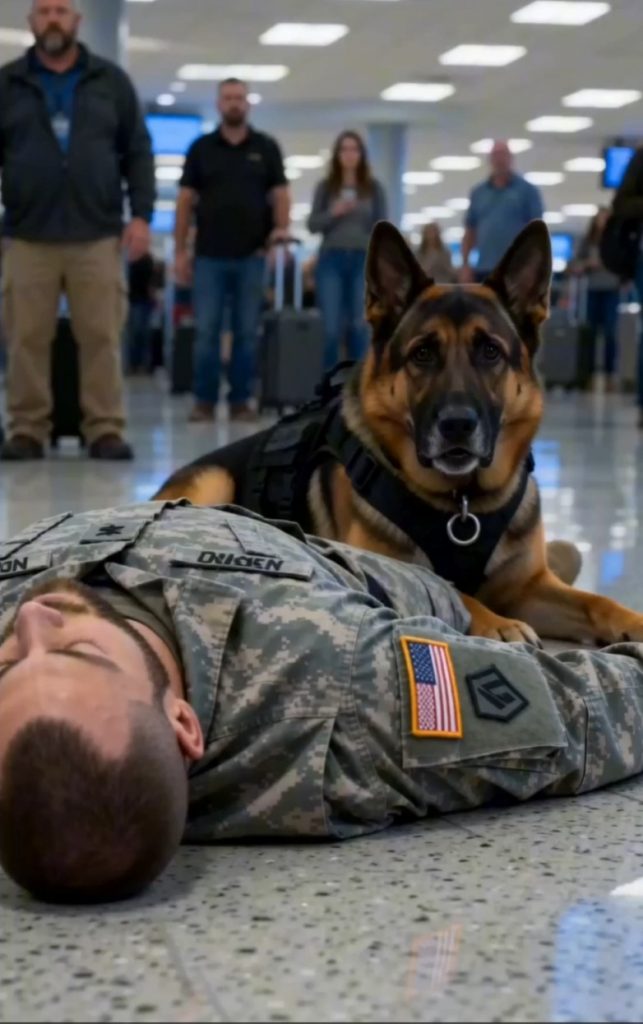
At first, people thought it was just a dog losing control. A large German Shepherd stood over a soldier lying on the polished gray floor, his paws planted wide, his black tactical harness tight across his chest. His teeth flashed every time someone took one step too close.
The soldier did not move.
He was curled on his side beside a black backpack, one arm slack against the cold terrazzo. His camouflage uniform was wrinkled from travel, his boots dusty, his face pale beneath the shadow of a short beard. The American flag patch on his shoulder caught the overhead light every time someone shifted around him.
A woman in a beige cardigan froze with one hand over her mouth. A man dragging a suitcase whispered, “Is he asleep?”
But no one believed that.
Not with the dog barking like that.
The German Shepherd lunged forward, not far enough to bite, but far enough to turn the crowd into a wall of stunned faces. His barks bounced off the glass, the blue flight monitors, the high ceiling. Rolling luggage stopped. Conversations died. Somewhere, a boarding announcement continued in its cheerful voice, completely unaware that the terminal had just stopped breathing.
Then Officer Marcus Reed arrived.
He came in from the left side of the lobby in a tan-gray Hillvale Police uniform, one hand near his radio, the other raised low and steady. He had handled fights, thefts, panic attacks, drunk travelers, and lost children.
But this was different.
The dog saw him instantly.
A deep growl rolled out of the shepherd’s chest. His ears flattened. His body shifted, blocking the soldier completely, as if the man on the floor were not just injured, but under attack.
“Easy,” Marcus said softly. “Easy, boy.”
The dog barked harder.
Marcus stopped.
Behind him, people whispered. Someone said animal control. Someone else said stun gun. A teenage boy lifted his phone, then slowly lowered it when he saw the soldier’s face.
The man wasn’t sleeping.
His lips were dry. His hand lay open near the zipper of the backpack. His chest moved so faintly that Marcus had to stare for several seconds just to see it.
“Sir,” Marcus called. “Can you hear me?”
No response.
The dog stopped barking for one second.
It turned its head down and nudged the soldier’s arm with its snout.
Not angry now.
Desperate.
Then the shepherd looked back up at the crowd, eyes wet and frantic, as if every bark had only meant one thing from the start.
Help him.
Marcus felt the mood shift around him. Fear turned into shame. The people who had backed away now leaned forward, but none of them dared move. The dog would not let anyone close.
Then the dog stopped barking completely.
And in the sudden silence, Marcus heard a voice behind him whisper, “That’s impossible.”
Act II
The voice belonged to a man in a plaid shirt standing near the flight monitors.
He looked like any other traveler at first: mid-forties, tired face, one carry-on bag, boarding pass folded in his hand. But his eyes were not on the unconscious soldier.
They were on the dog’s harness.
Marcus noticed it because the dog noticed it first.
The German Shepherd’s head snapped toward the man. A low growl returned, quieter than before, but sharper. The dog’s entire body seemed to harden.
The man in plaid took one step back.
“Do you know him?” Marcus asked.
The man shook his head too quickly. “No. I just… I thought I recognized the dog.”
Marcus held his gaze for a moment, then turned back to the soldier.
The name tape on the uniform read: HOLT.
Sergeant Caleb Holt had been in airports before. Too many of them. Germany. Kuwait. Baltimore. Dallas. Every terminal had the same strange smell of coffee, disinfectant, and people pretending they weren’t afraid of goodbye.
This time, he was supposed to be coming home for good.
He had not told anyone.
Not his mother in Ohio, who still kept his old bedroom untouched. Not his younger sister, Ellie, who had sent him seven messages in the past week asking if he was eating. Not even the VA liaison who had arranged his final medical review in Hillvale.
Caleb had landed that morning with a sealed envelope inside his backpack and a dog named Ranger who had saved his life more times than anyone would ever know.
Ranger had not always been his.
The German Shepherd had once belonged to Staff Sergeant Daniel Price, Caleb’s closest friend. Daniel was the kind of man who could make a war zone feel almost human. He told terrible jokes. He wrote letters to his wife every Sunday. He carried a tiny pink hair clip in his chest pocket because his daughter had given it to him before deployment and told him it was “for luck.”
When Daniel died overseas, Ranger refused to leave his gear.
For three days, the dog barely ate.
After that, Ranger was reassigned to Caleb, but everyone in the unit knew the truth. The dog had chosen him because Caleb was the last person who had held Daniel’s hand, the last person who had promised to get a message home.
That promise had become heavier than any weapon Caleb had ever carried.
Because Daniel’s death had not happened the way the report said.
There had been missing equipment. A failed inspection. A convoy route changed without authorization. A contractor’s signature where no contractor should have had power. Daniel had questioned it, then suddenly the paperwork had been cleaned up, sealed, and buried under official language.
Caleb had kept quiet at first because grief made cowards out of honest men.
Then he found the flash drive.
It was hidden inside the lining of Daniel’s old field notebook, wrapped in tape and marked with one word: IF.
If I don’t make it.
If they lie.
If someone needs proof.
Caleb carried that flash drive across an ocean.
Now it was inside the backpack beneath his head.
And Ranger knew it.
Marcus crouched lower, careful not to cross the invisible line Ranger had drawn. “I’m not here to hurt him,” he said.
The dog whined.
It was a small sound, almost childlike, and it broke something in the crowd.
A woman pushed forward. “I’m a nurse,” she said. “I can help if you can get the dog calm.”
Marcus glanced at Ranger’s collar. There was a tag attached beneath the metal ring. He could only read part of it from where he stood.
RANGER — MILITARY WORKING DOG
MEDICAL ALERT — DO NOT SEPARATE FROM HANDLER
Medical alert.
Marcus understood then.
The dog wasn’t guarding a criminal. He wasn’t attacking strangers. He was following training under panic, confusion, and love.
Marcus lowered himself onto one knee.
“Ranger,” he said carefully.
The shepherd’s ears twitched.
Marcus tried again. “Ranger. Guard.”
The dog froze.
That command meant something.
Marcus had heard it once before, years earlier, when he was a military police trainee before an injury ended his service early. Guard meant hold position. Guard meant protect, but do not advance.
Ranger’s growl faded into rough panting.
The nurse took one cautious step closer.
Then the man in the plaid shirt turned toward the exit.
And Ranger exploded into barking again.
Act III
This time, the dog was not barking at the crowd.
He was barking at one man.
The plaid-shirted traveler stopped dead near a row of silver benches. His hand tightened around the handle of his carry-on. The crowd parted around him instinctively, leaving him exposed beneath the bright terminal lights.
Marcus saw the sweat at his temple.
“Sir,” Marcus said. “Stay where you are.”
The man forced a laugh. “I have a flight.”
“So did everyone else,” Marcus said.
Ranger stood over Caleb again, but his eyes never left the man. The dog’s body trembled with restraint, every muscle begging to move.
The nurse slipped beside Marcus and placed two fingers against Caleb’s neck. Her face changed.
“He has a pulse,” she said. “Weak, but there. He needs medical now.”
Marcus spoke into his radio. “Medical emergency, main terminal lobby. Adult male soldier unconscious. Military working dog on scene. Need EMS and K9-trained support if available.”
The radio crackled back.
Then Caleb’s fingers twitched.
Ranger felt it first.
He dropped his head and pressed his snout gently against Caleb’s hand. The soldier’s eyelids fluttered, but he did not wake.
The nurse checked his breathing and whispered, “Come on, stay with us.”
Marcus turned back toward the man in plaid. “Name.”
The man swallowed. “Paul. Paul Whitaker.”
That name struck the air harder than the barking had.
Caleb’s hand closed weakly around the strap of his backpack.
Marcus looked down. “You know him?”
Caleb’s lips moved.
No sound came out at first.
Ranger whimpered and nudged him again.
Finally, Caleb forced one word through dry, cracked lips.
“Don’t.”
Marcus leaned closer. “Don’t what?”
Caleb’s eyes opened a sliver.
“Don’t let him take it.”
The terminal went still again.
Paul Whitaker’s face drained of color.
He dropped the boarding pass.
Marcus stood slowly. “Sir, step away from the bag.”
“I don’t know what he’s talking about,” Paul said.
But Ranger did.
The shepherd barked once, deep and thunderous, and Paul flinched like the sound had hit him in the chest.
Marcus moved toward him. “Hands where I can see them.”
Paul lifted both hands, but his eyes darted toward Caleb’s backpack.
It was the smallest glance.
It gave him away.
By the time EMS arrived, the scene had become something larger than a medical emergency. Two officers blocked the exits. The nurse kept Caleb stable. Ranger refused to move more than a few inches from his handler, though he allowed the paramedics in once Marcus repeated the command.
“Guard.”
The word kept him steady.
As they lifted Caleb onto a stretcher, his hand found Marcus’s sleeve.
“My bag,” he rasped.
“I have it,” Marcus said.
Caleb’s gaze sharpened with the last of his strength. “Daniel Price.”
Marcus paused.
That name was not in the crowd. It was not on any airport monitor. But somewhere behind Marcus, Paul Whitaker made a sound so quiet most people missed it.
Ranger did not.
The shepherd turned his head.
Marcus opened the front pocket of the backpack after asking Caleb for permission. Inside were ordinary things at first: a folded sweatshirt, an empty water bottle, a worn paperback, a packet of travel documents.
Then his fingers touched an envelope.
It was sealed, creased, and addressed in careful handwriting.
To Daniel’s wife, if I fail to get home.
Inside the envelope was a flash drive taped to a photograph of three men in uniform.
Caleb Holt.
Daniel Price.
And Paul Whitaker.
But Paul was not wearing plaid in the picture.
He was wearing a contractor badge.
Act IV
Paul stopped pretending after that.
His shoulders sagged, but his eyes went cold. “You have no idea what you’re holding,” he said.
Marcus slid the envelope back into the backpack and zipped it shut. “Then I guess someone official can explain it.”
Paul laughed once, bitter and low. “Official? You think official means clean?”
The crowd listened now with the frightened attention people give to storms and confessions.
Caleb was being checked by paramedics only a few feet away. He was conscious but barely. Ranger stood beside the stretcher with his head level to Caleb’s hand, letting his handler’s fingers rest against his fur.
Marcus kept himself between Paul and the bag.
“You changed the route,” Caleb whispered.
Paul looked at him.
For a second, something like guilt flickered across his face. Then it vanished.
“You don’t know what happened,” Paul said.
“I know Daniel filed a complaint,” Caleb said, each word costing him. “I know the equipment was marked inspected when it wasn’t. I know he found payments going through shell vendors. And I know he recorded you admitting it.”
Paul’s jaw tightened.
The nurse looked from one man to the other, stunned. A woman in the beige cardigan began to cry quietly, though she did not know Daniel Price, had never seen his daughter’s pink hair clip, had never read the last letter he wrote.
Some stories are heavy enough to be felt before they are understood.
Marcus took Paul into custody without drama.
No tackle. No chase. No cinematic fight.
Just a pair of handcuffs closing around the wrists of a man who had spent years trusting paperwork to protect him from the truth.
But the most devastating moment came after.
A woman arrived at the terminal doors with a little girl beside her.
The woman was in her early thirties, with dark hair pulled back and a face that looked like it had learned to stay composed in public. The child held a stuffed rabbit in one hand and a folded sign in the other.
The sign read:
WELCOME HOME, UNCLE CALEB.
Caleb saw them from the stretcher.
His face broke.
Not loudly. Not theatrically. Just a quiet collapse of every wall he had been using to survive.
“Anna,” he whispered.
Daniel Price’s widow stopped when she saw the police, the paramedics, the dog, the backpack.
Then she saw Ranger.
The German Shepherd lifted his head.
For the first time since the barking began, he left Caleb’s side.
Only three steps.
Slow ones.
Anna covered her mouth.
“Ranger?” she whispered.
The dog’s tail moved once.
The little girl stared at him. “Mommy?”
Anna knelt, trembling, and Ranger pressed his head against her shoulder as if the years between them had never existed.
The child reached into her pocket and pulled out a tiny pink hair clip.
Ranger froze.
Caleb saw it and closed his eyes.
Daniel had carried that same clip through dust, fear, bad coffee, and worse nights. He used to say it was the only medal he cared about.
Anna held the clip with shaking fingers. “He told me Daniel gave him one too,” she said, looking at Caleb. “He said you were bringing something home.”
Caleb tried to speak, but his voice failed.
Marcus handed her the envelope.
Anna stared at Daniel’s handwriting on the front.
The entire terminal seemed to understand, all at once, that this was not just evidence.
It was a final act of love.
And when Anna opened the envelope, she found one more thing no one expected.
Act V
There was a letter.
Not the report. Not the flash drive. Not the proof that would reopen a case and destroy a lie that had lived too long.
A letter.
Anna unfolded it with both hands while her daughter leaned against her side. Caleb watched from the stretcher. Ranger sat between them, finally still.
Daniel’s handwriting was uneven, as if written in a hurry.
Anna did not read it aloud at first. She tried. Her mouth opened, but grief stole the words.
So Caleb spoke for him.
“He said he was sorry,” Caleb whispered. “He said he knew you’d be angry because he promised he’d come home.”
Anna pressed the page to her chest.
Caleb swallowed hard. “He said to tell Lily that the pink clip worked. That it got him through every day he had it.”
The little girl looked at the hair clip in her hand, too young to understand all of it, old enough to understand enough.
“And he said,” Caleb continued, voice breaking, “that if Ranger ever came home without him, he wanted him to go where he was loved.”
Ranger lowered his head into Anna’s lap.
For a moment, the busy airport disappeared.
There were no delayed flights. No rolling suitcases. No strangers pretending not to stare. There was only a widow, a child, a soldier who had carried the truth until his body gave out, and a dog who had refused to let the world walk past him.
Marcus stepped away to give them privacy, but not far. The backpack stayed with him until federal investigators arrived. Paul Whitaker sat in a holding area behind glass, no longer a traveler, no longer a man escaping on a flight, no longer protected by distance or silence.
By evening, the story had spread through the airport.
Not the full details. Those would come later through official statements, reopened files, and names spoken under oath.
But people knew the part that mattered.
They knew a dog had barked until strangers paid attention.
They knew a soldier had collapsed while carrying the truth home.
They knew everyone had been afraid of the wrong thing.
Caleb spent two days in the hospital. Exhaustion, dehydration, and the strain of a body that had been pushed beyond its limit. When he woke properly, Ranger was asleep beside his bed, his chin on the blanket, one ear twitching every time Caleb moved.
Anna visited on the second afternoon.
Lily came with her, carrying a drawing of Ranger with a crooked crown on his head.
“He’s a hero dog,” she said.
Caleb smiled for the first time in what felt like years. “He already knows.”
Anna placed Daniel’s letter on the table beside him. “You kept your promise.”
Caleb looked away.
“I was late,” he said.
Anna shook her head. “No. You came home.”
Outside the hospital window, planes crossed the pale sky in slow silver lines. People were leaving. People were arriving. Somewhere, another terminal hummed with ordinary life.
But for Caleb, ordinary life had changed shape.
A month later, the official investigation reopened Daniel Price’s case. Paul Whitaker’s name appeared in documents he had once believed were buried too deep to touch. Other names followed. So did resignations, charges, hearings, and apologies that came too late but still mattered.
Caleb attended the hearing in uniform.
Ranger sat at his left side.
Anna sat behind him with Lily, who wore the pink clip in her hair.
When Caleb was asked why he had carried the evidence himself instead of mailing it, he looked down at Ranger, then back at the panel.
“Because Daniel trusted me,” he said. “And because some things deserve to be delivered by someone who remembers the person behind the file.”
No one argued with that.
Months later, at Hillvale Airport, a small plaque was placed near the main terminal lobby. Most travelers hurried past it. Some stopped. A few read every word.
It did not mention the barking first.
It mentioned the silence people almost chose.
Then it honored the soldier who fell, the soldier who carried him home, and the dog who would not let a crowded room look away.
Caleb visited once, long after the headlines faded.
He stood in the same spot where he had collapsed. The floor was polished again. The blue flight monitors glowed overhead. People moved around him with coffee cups, carry-ons, headphones, and places to be.
Ranger sat beside him, calm now.
No barking.
No panic.
Just presence.
Caleb looked down at him and whispered, “You saved me again.”
Ranger leaned against his leg.
And this time, when people passed, they did not step away in fear.
They smiled.