Act I
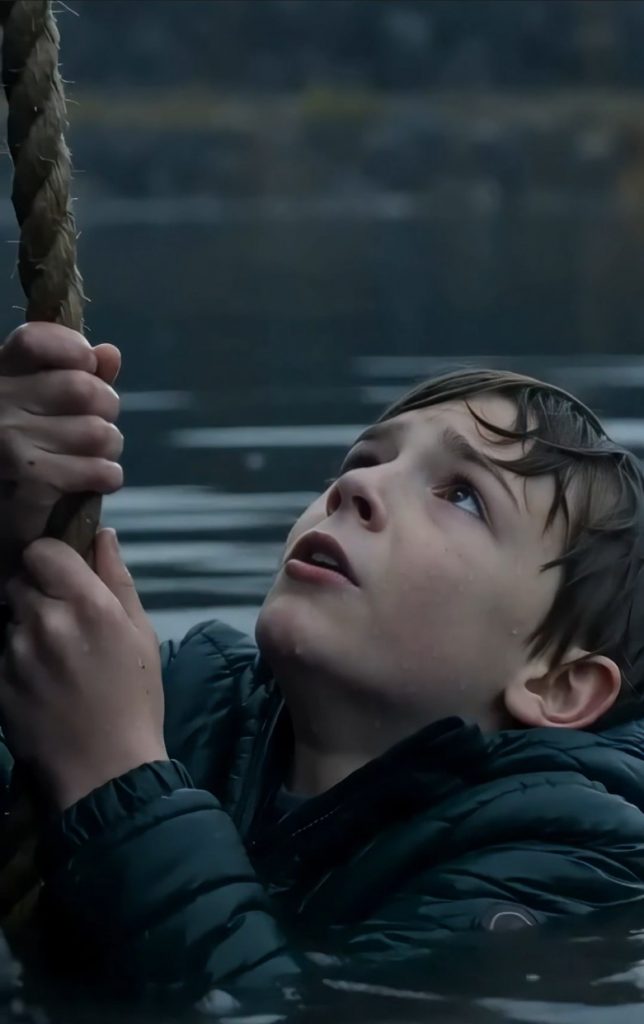
The rope was the only thing between Oliver Reed and the dark water below.
He clung to it with both hands, fingers numb, sleeves soaked, his green puffer jacket dragging him down every time the cold lake slapped against his chest. Above him, the muddy bank rose almost straight up, black and slick from days of rain.
At the top of that crumbling ledge, a massive black-and-tan dog lay flat in the mud.
Atlas had the other end of the rope clenched between his jaws.
His paws dug into the wet earth. His thick fur was pasted to his chest. Every muscle in his body trembled as he pulled backward inch by inch, refusing to release the braided lifeline even as the mud slid beneath him.
Oliver looked up through wet lashes.
“Don’t…” he gasped. “Don’t let go.”
Atlas’s dark eyes stayed locked on him.
The dog made a low, strained sound through the rope, not quite a growl, not quite a whimper. It was the sound of an animal using everything it had left.
Behind them, the quarry stretched empty and gray beneath the morning sky.
No people.
No cars.
No one close enough to hear a child calling for help.
Only the wind moving across the water. Only loose gravel ticking down the bank. Only the rope creaking under the weight of a terrified boy and a dog who had no way to understand failure.
Oliver’s feet kicked weakly against the muddy wall.
The rope jerked.
He slipped an inch.
Atlas’s claws scraped through the mud, and for one terrible second, the dog slid forward too.
Oliver cried out.
Atlas stopped himself at the edge.
His body went rigid.
Then, with a harsh breath, he pulled again.
The rope tightened.
Oliver rose just enough for one forearm to slap against the muddy shelf.
He tried to hold on, but the mud broke under his hand.
“Atlas!” he sobbed.
The dog’s jaws clamped harder.
And somewhere inside that exhausted animal, beneath the mud and panic and cold, an old command came alive.
Hold.
Act II
Most people in town were afraid of Atlas.
They did not say it directly to Oliver, because he was nine and loved the dog with the kind of devotion children give before the world teaches them caution. But Oliver heard the whispers anyway.
Too big.
Too wild.
Not safe around kids.
That dog needs to go.
Atlas had once belonged to Oliver’s father, Daniel Reed.
Daniel had been a volunteer search-and-rescue handler before he got sick. He trained dogs to find lost hikers, stranded drivers, confused elderly people, and children who wandered too far from picnic areas. He believed dogs understood promises better than people did.
Atlas had been his last dog.
Big. stubborn. watchful. built like he had been carved out of storm clouds and mountain dirt.
When Daniel was alive, Atlas seemed noble to everyone. Children asked to pet him. Neighbors smiled when he carried training ropes in his mouth. People called him “the hero dog” because Daniel had taught him to fetch a line, brace his body, and pull until help came.
After Daniel died, the same dog became a problem.
Grief changed the house first.
Then money did.
Oliver’s mother, Claire, worked double shifts at the clinic and came home with her shoes muddy from parking lots and her eyes too tired to hide anything. Bills appeared on the kitchen counter. Repairs waited. The old fence leaned. The truck Daniel used for rescue work sat under a tarp because Claire could not bear to sell it and could not afford to fix it.
Atlas changed too.
He slept outside Oliver’s door instead of by the fireplace. He barked when strangers came too close. He followed Oliver from room to room like a shadow with teeth.
Claire understood why.
The town did not.
One afternoon, Atlas knocked over a neighbor’s trash can while chasing off two teenagers who had been throwing stones at the Reed mailbox. The teenagers told a better story than the dog could. By sunset, everyone had heard that Atlas had “charged” them.
A week later, a woman pulled her little boy behind her at the market and said, loud enough for Claire to hear, “That’s the dog people are talking about.”
Oliver heard it too.
That night, he sat beside Atlas in the kitchen and pressed his forehead into the dog’s thick fur.
“You’re not bad,” he whispered.
Atlas only breathed against him.
The problem was the quarry.
It sat two miles beyond the last houses on Keller Road, an old industrial pit turned reservoir after the company pulled out. The fence around it was bent in three places. The warning signs had faded. Kids dared each other to go there because forbidden places always look more interesting when adults are too busy to fix them.
Daniel had hated that quarry.
Years before, he had written letters to the county about the loose banks and broken gate. He said the land was unstable. He said children would find their way in eventually. He said beauty made danger look harmless.
No one listened.
After Daniel died, Oliver found copies of the letters in a box beneath his father’s desk.
He also found an old photograph.
In it, Daniel stood near the quarry with Atlas as a younger dog, holding a thick braided training rope. On the back, Daniel had written:
Atlas knows the line. Trust him.
Oliver carried that photo in his sketchbook like a secret.
The morning everything happened, Oliver was supposed to be at Mrs. Hanley’s house until school started. But Mrs. Hanley had called in sick, Claire had been called to the clinic early, and Oliver was left with thirty minutes alone before the bus.
He did not mean to go to the quarry.
Not at first.
He only meant to walk Atlas near the old road, the way his father used to. He wanted to draw the sunrise over the water for a school project about “places that matter.”
And he wanted, more than anything, to feel close to Daniel for one quiet morning.
Atlas came with him, carrying the old braided rope in his mouth like he always did when they passed the tarp-covered rescue truck.
Oliver laughed when he saw it.
“You miss Dad too, huh?”
The dog walked beside him, proud and steady.
Neither of them knew the rain had eaten away the bank overnight.
Neither of them knew one wrong step would turn memory into a fight for life.
By the time Oliver saw the crack in the mud, the ground was already falling away beneath him.
Act III
The edge gave out with a soft, awful sigh.
Oliver dropped his sketchbook first.
Then one foot slid.
Then both.
He grabbed at grass, but the grass came loose in his hands. Mud smeared across his jacket. Stones clattered down the slope, bouncing into the black water below.
Atlas barked once.
Oliver tried to crawl backward, but the bank crumbled faster than he could move.
Then he was falling.
The water hit cold enough to steal the breath from his lungs.
For a moment, the world became noise and gray light.
When Oliver surfaced, he was too far below the ledge to reach anything solid. The bank was almost vertical. Every patch of mud he grabbed tore away. His shoes kicked against nothing but slick stone and deep water.
“Atlas!” he shouted.
At the top, the dog paced frantically along the broken edge.
Oliver saw the rope still near Atlas’s paws.
The old training rope.
The one Daniel had used for drills in rivers and ravines.
Oliver remembered his father’s voice from years ago, warm and patient in the backyard.
If you ever can’t climb, don’t fight the water. Hold the line. Let the dog pull. Help with your feet when you can.
Back then, Oliver had laughed because the “water” was only a kiddie pool and Daniel had been pretending the garden hose was a rescue river.
Now his teeth chattered so hard he could barely think.
“Atlas!” Oliver cried. “Rope!”
The dog froze.
For one second, Oliver saw the old training click into place.
Atlas grabbed the rope.
He dragged one end toward the edge, pushing it with his muzzle until it spilled down the muddy wall.
It slapped the water near Oliver’s shoulder.
Oliver lunged for it.
His fingers missed.
The rope drifted away.
“No!” he gasped.
Atlas barked and pulled it back, then shoved it down again.
This time, Oliver caught it with both hands.
The moment his weight hit the line, Atlas nearly slid over.
The dog dropped flat, legs wide, jaws locked around the rope. Mud sprayed from under his paws as he fought for traction.
Oliver kicked weakly.
“Good boy,” he sobbed. “Good boy, Atlas.”
But the bank was too steep.
The water was too cold.
The dog was strong, but Oliver was heavy with soaked clothes and terror.
Atlas pulled.
Oliver rose a little.
Then slid back.
Atlas pulled again.
The rope burned against Oliver’s palms, but he did not let go.
Up on the ledge, Atlas dug his claws deeper. One paw slipped. Then caught. His shoulders bunched. His jaw stayed closed around the rope with a force that looked impossible to sustain.
Oliver could see mud on the dog’s muzzle.
He could see the strain in his eyes.
He could also see something else.
Atlas was old.
Not ancient. Not weak. But older than he had been in the photos with Daniel. There was gray around his muzzle now. His breathing came harder than it used to. Every pull cost him.
“Don’t let go,” Oliver whispered.
Atlas did not.
Above the wind, another sound finally broke through.
A distant voice.
Then another.
Someone had seen the dog running toward the quarry with the rope.
Someone had followed.
But they were still too far away.
And the mud beneath Atlas was beginning to give.
Act IV
Claire Reed heard the word quarry before she heard her son’s name.
She had been halfway through cleaning a scraped knee at the clinic when Mrs. Hanley burst into the hallway, breathless and pale.
“Claire,” she said. “It’s Oliver.”
Everything after that blurred.
Claire ran from the clinic without her coat. She did not remember grabbing her keys. She did not remember the drive. Only the road. The gray sky. Her own voice saying please, please, please to no one.
When she reached the quarry road, two pickup trucks were already pulled crooked near the broken fence.
People were shouting.
Someone pointed down toward the water.
Claire ran.
Then she saw them.
Oliver, clinging to the rope.
Atlas, sprawled at the top of the bank, jaws locked, body shaking.
For one heartbeat, Claire thought she was seeing Daniel again.
Not his face.
His training.
His stubborn faith.
His belief that preparation was a kind of love.
“Oliver!” she screamed.
Oliver turned his head toward her voice.
That tiny movement made him slip.
“Don’t look away!” a man shouted. “Hold the rope!”
Atlas pulled again.
His paws slid forward.
A neighbor named Mr. Barlow dropped to the ground and grabbed Atlas around the hips.
“Hold him!” Claire cried.
Another man threw himself beside Barlow. Then a third. They formed a chain in the mud, one holding Atlas, one holding the first man’s belt, another bracing against a tree root.
But Atlas still held the rope.
No one could pry it from his jaws.
No one tried.
“Pull with him!” Claire shouted.
The men pulled backward when Atlas pulled.
The rope jerked upward in short, brutal inches.
Oliver’s chest reached the muddy shelf.
He tried to hook one arm over the ledge, but the bank crumbled under his elbow.
Atlas growled through clenched teeth and gave another desperate tug.
Claire slid on her stomach toward the edge.
Someone grabbed her ankles.
“Careful!”
“My son is down there!”
“I’ve got you,” the person said. “Reach.”
Claire reached.
Her fingers stretched toward Oliver’s wet sleeve.
Too far.
Atlas pulled again.
This time, Oliver came high enough.
Claire caught his wrist.
The grip was slick with mud and water, but she held on with everything in her.
“I’ve got you,” she sobbed. “Baby, I’ve got you.”
Oliver’s eyes were wide and terrified.
“Atlas,” he gasped. “Don’t let them take Atlas.”
That sentence almost broke her.
Even hanging from the side of a quarry, her son was worried about the dog.
“We won’t,” Claire said. “I promise.”
Together, the adults pulled.
Atlas pulled too, one last time, so hard his whole body shuddered.
Oliver slid over the ledge and collapsed into his mother’s arms.
For a moment, no one spoke.
Claire held him against her chest, rocking him in the mud, feeling him breathe, feeling him shake, feeling the impossible truth that he was alive.
Then the rope went slack.
Atlas released it.
The dog staggered once, then lowered himself beside Oliver, panting heavily, his muzzle coated in mud and rope fibers.
Oliver reached for him.
Atlas pressed his head into the boy’s hand.
By the time the sheriff’s deputy arrived, the rescue was over.
But the fight for Atlas was not.
Because the quarry owner’s manager stepped through the broken fence, looked at the crowd, and said the dog should never have been loose in the first place.
Act V
His name was Martin Vail, and he wore clean boots.
That was the first thing Claire noticed.
Everyone else was covered in mud. Oliver. Atlas. The neighbors who had thrown themselves to the ground. Claire herself, shaking in scrubs stained black from the quarry bank.
But Vail stood near the fence line in a waxed jacket and clean boots, looking irritated by the inconvenience of a child almost drowning on land his company had failed to secure.
“This is private property,” he said.
Claire stared at him.
For a second, she could not even answer.
Oliver was wrapped in a blanket from someone’s truck, still trembling beside her. Atlas lay at his feet, exhausted but alert, eyes following every stranger who came too close.
Sheriff Dana Pike looked at the broken fence.
“Private property with a hole big enough for a child and a dog to walk through.”
Vail’s jaw tightened.
“The dog was uncontrolled.”
“The dog saved my son,” Claire said.
Her voice was hoarse.
Vail glanced at Atlas with distaste. “That animal created additional risk. If it had dragged the boy incorrectly—”
Claire stood.
Everyone heard the shift in her breath.
For months, she had swallowed fear. Swallowed bills. Swallowed gossip about the dog Daniel left behind. Swallowed the loneliness of being treated like a woman who could not manage her own life.
Not now.
“My husband warned your company about that bank,” she said.
Vail blinked.
Claire pointed toward the quarry.
“He wrote letters. He sent photos. He asked for repairs to the fence and signs near the soft edge. You ignored him when he was alive, and you ignored the place after he died.”
The sheriff turned to Vail.
“You received safety complaints?”
Vail’s face lost some of its color. “I would have to check our records.”
Claire reached into Oliver’s muddy sketchbook and pulled out the folded photograph he had carried.
On the back was Daniel’s handwriting.
Atlas knows the line. Trust him.
Claire showed it to the sheriff.
“My husband trained that dog to save people,” she said. “And today, that dog did what everyone else was too far away to do.”
Oliver’s small voice rose from the blanket.
“Atlas remembered Dad.”
No one moved.
Even Vail looked away.
The sheriff crouched beside Atlas, careful and respectful.
“Good dog,” she said quietly.
Atlas blinked at her, then rested his head again near Oliver’s boot.
By afternoon, Oliver was safe at the hospital, warmed, checked, and tucked beneath a white blanket while Claire sat beside him holding one hand and resting the other on Atlas’s head.
The hospital did not usually allow dogs past the entrance.
Sheriff Pike made one call.
No one argued.
Atlas lay on the floor beside Oliver’s bed, too tired to lift his head every time the door opened, but still close enough that Oliver’s fingers could reach his fur.
“Mom,” Oliver whispered.
Claire leaned closer.
“Yeah?”
“Dad said to trust him.”
Claire looked at the dog.
Then at her son.
“I know.”
“I did.”
Her eyes filled.
“You both did.”
Two weeks later, the quarry fence was replaced.
Not patched.
Replaced.
New warning signs went up. The county opened a safety investigation. Daniel Reed’s old letters became evidence, not forgotten paper. Martin Vail stopped giving statements after reporters found out the company had received multiple complaints over the years.
But in town, the story people repeated most was not about the fence.
It was about Atlas.
The same neighbors who had once crossed the street now left treats on the Reed porch. Children drew pictures of him at school. Someone painted a small wooden sign and hung it near the rescue truck Daniel had left behind.
ATLAS REED
GOOD BOY
GUARDIAN
Claire cried when she saw it.
Oliver smiled for the first time without looking tired.
Spring came slowly that year.
The mud dried. The sky brightened. The old rescue truck was finally repaired by half the neighborhood, each person pretending they were only “helping a little.” On the first warm Saturday, Claire drove Oliver and Atlas to the field behind the community center.
Not the quarry.
Never the quarry.
A safe field. Open grass. Sunlight. A rope.
Oliver stood with the braided line in his hands and looked at Atlas.
The dog’s ears lifted.
For a moment, Claire saw Daniel so clearly it hurt.
His hands guiding Oliver’s smaller ones.
His voice saying, again, Hold the line.
Oliver threw the rope across the grass.
Atlas bounded after it, slower than he used to, but proud.
When he brought it back, he placed it at Oliver’s feet and waited.
Oliver knelt and wrapped both arms around his neck.
“You didn’t let go,” he whispered.
Atlas leaned into him.
Claire watched from a few steps away, one hand over her mouth, feeling grief and gratitude twist together until she could no longer tell where one ended and the other began.
The quarry had nearly taken her son.
But the dog Daniel trained, the dog the town had doubted, the dog Oliver had loved when everyone else saw only danger, had held the line when no one else could.
Some heroes run toward fire.
Some wear badges.
Some sign reports and fix fences long after they should have been fixed.
And some sink their claws into the mud, bite down on a rope, and pull until the child they love can breathe again.