Act I
The dog came running like he had chosen her before she ever saw him.
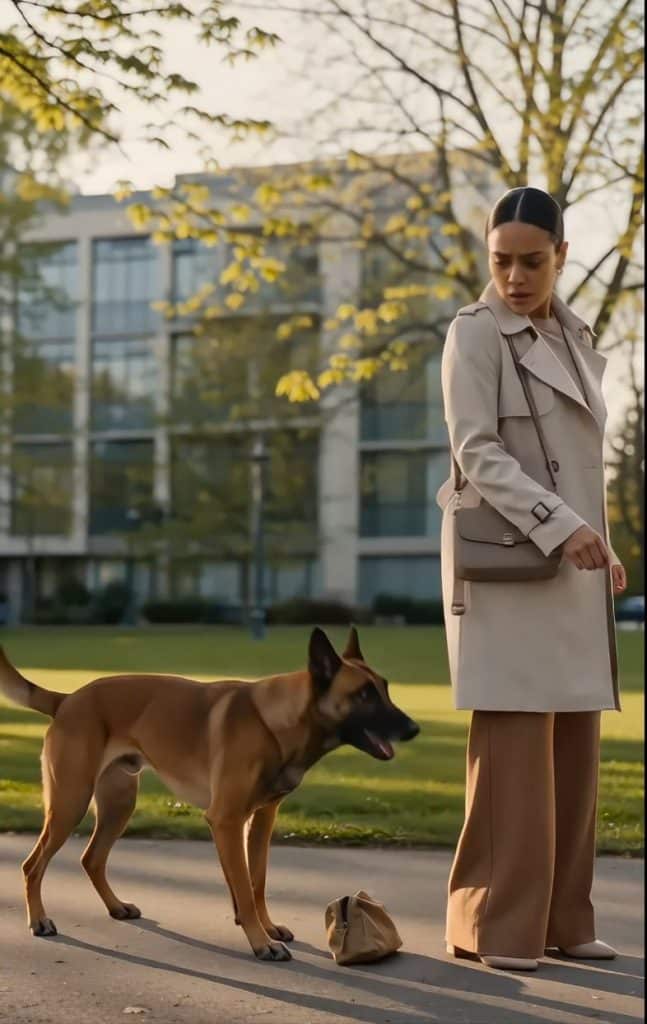
Claws clicked fast against the paved campus path. Sunlight broke through the trees in bright patches, flashing across his tan coat and black muzzle as he carried a small brown canvas bag in his mouth.
Maya Ellis was halfway across the green when she heard the footsteps behind her.
At first, she thought someone was jogging.
Then the dog shot around her and stopped directly in front of her shoes.
He dropped the bag at her feet.
The dull thud made Maya freeze.
The dog barked once.
Sharp. Urgent. Not playful.
Maya looked around the tree-lined walkway. Students moved in the distance. A couple sat on the lawn with coffee. Across the path, brick campus buildings glowed in the afternoon sun.
No one seemed to own the dog.
No one seemed to be looking for him.
“Hey,” Maya said softly. “Where did you come from?”
The dog stared at her with bright, fixed eyes.
Then he nudged the bag with his nose.
Maya’s unease deepened.
She knelt carefully, one hand still holding the strap of her own purse. The canvas bag was worn at the corners, but sturdy, as if someone used it every day. It smelled faintly of dust, paper, and something metallic.
The dog sat in front of her, panting lightly, watching her hands.
“Okay,” she whispered. “You want me to open it?”
His ears lifted.
Maya unzipped the bag.
Inside was a set of brass keys attached to a metal ring.
They clinked when she lifted them into the light.
There were more than a dozen. Big old keys. Small office keys. A car key with cracked plastic. A tiny silver key that looked like it belonged to a filing cabinet. On the ring hung a faded tag with one word written in black marker.
HOLLOWAY.
Maya stared at it.
“Is there someone I should call?” she asked the dog. “Because I have no idea what you want.”
The dog stood immediately.
He barked again, spun toward the path, and ran several steps away before looking back.
Maya remained kneeling, the keys cold in her palm.
The dog barked one more time.
This time, it sounded almost desperate.
Maya rose slowly.
Her afternoon had been ordinary ten seconds earlier. She had been walking back from a campus interview, thinking about rent, her mother’s voicemail, and whether she had sounded too nervous answering the final question.
Now a strange dog had brought her keys.
And he was waiting for her to follow.
Maya looked down the tree-lined path.
The dog took off toward the older side of campus, glancing back twice to make sure she was coming.
So Maya followed.
And with every step, the keys in her hand seemed to grow heavier.
Act II
Maya had not planned to return to Bellweather University.
Not really.
She had told herself the interview was just practical. The museum needed an assistant archivist. She needed a job. Bellweather was only two towns over, and the salary was better than anything she had been offered since finishing graduate school.
But memory does not care about practical reasons.
The campus looked almost the same as it had when she was twelve.
The same old oaks. The same brick buildings. The same long path through the central green where her father used to walk with her after his maintenance shifts.
Her father had not been a professor.
He had been a night custodian, then a grounds assistant, then the man everyone called when something jammed, leaked, broke, sparked, or locked itself from the wrong side.
Samuel Ellis knew every basement corridor on that campus. Every old door. Every stubborn window. Every pipe that groaned before winter.
People noticed him only when they needed him.
Maya had noticed everything.
She remembered him coming home with dust on his boots and bandages on his knuckles. She remembered him carrying old books rescued from trash bins because he said nobody should throw away a book unless it had committed a crime.
Most of all, she remembered Mr. Holloway.
Arthur Holloway had been the campus locksmith for forty years. He was thin, white-haired, and always smelled faintly of peppermint and machine oil. He had taught Maya how to identify keys by sound. Brass was warmer. Steel was sharper. Old warded keys had a hollow music when dropped together.
“Locks tell stories,” he once told her. “Most people only care whether they open. But every lock was put there because someone wanted something protected.”
When Maya’s father died during her first year of high school, Mr. Holloway came to the funeral wearing his brown work jacket. He stood at the back, hands folded over a canvas bag.
The same kind of bag now swinging from Maya’s hand.
After the service, he gave her a small brass key.
“What’s it for?” she asked.
He smiled sadly.
“Nothing yet. Keep it anyway. Sometimes a key matters before you know the door.”
She had kept it for years.
Then life became bills, school, grief, and distance. Bellweather became a place she avoided because every brick seemed to remember a version of her father that she could no longer touch.
She had not seen Mr. Holloway in almost a decade.
Now his name was on the tag in her hand.
And a dog was leading her through campus like he knew exactly where the old man had gone.
The dog cut across the green, passed the library, and headed toward the maintenance road behind the science buildings. Maya had to jog to keep up. Her trench coat pulled tight around her knees. The keys slapped against her palm.
“Slow down,” she called.
The dog did not slow.
He reached the end of the path and stopped near a narrow service gate half-hidden behind a hedge.
Maya looked at the gate.
It was old. Iron. Locked.
A sign on it read:
AUTHORIZED PERSONNEL ONLY.
The dog pressed his nose against the gap beneath it and whined.
Maya lifted the key ring.
“Of course,” she breathed.
She tried three keys before one slid in.
The lock turned.
The gate opened with a dry metal groan.
The dog slipped through before she could stop him.
Maya stepped after him into a part of campus she had not seen since childhood.
The old maintenance quarter.
And somewhere beyond the brick wall, a man was trying to call for help.
Act III
At first, Maya thought she had imagined it.
The dog ran ahead along a cracked service path, past dumpsters, storage sheds, and ivy-covered walls. Behind the main buildings, the campus lost its polished face. The grass grew uneven. Old pipes climbed brick like veins. Forgotten windows reflected the sun in dull, dusty squares.
Then she heard it again.
A faint sound.
Not a shout.
A tap.
Metal against metal.
The dog barked wildly and ran toward a small brick structure near the back of the maintenance yard.
Maya recognized it.
The old pump house.
Her father used to call it “the oven” because it trapped heat in summer and smelled like rust after rain. It had not been used for years, or at least she thought it had not.
The door was shut.
A heavy padlock hung through the latch.
The dog jumped against it, whining and scraping at the wood.
Maya’s fingers shook as she searched the keys.
“Holloway?” she called. “Mr. Holloway?”
For one terrible second, there was nothing.
Then a weak voice answered from inside.
“Maya?”
Her breath caught.
No one on campus called her that with recognition.
Not the museum director. Not the interview panel. Not the students passing beneath the trees.
Only someone who remembered a little girl walking beside her father.
“Maya Ellis?”
She pressed a hand against the door.
“I’m here. I have your keys.”
A faint laugh came from inside, then turned into a cough.
“Good dog,” the voice rasped.
The dog barked, tail moving frantically.
Maya found the right key on the fifth try. The lock opened, but the door would not budge. Something heavy blocked it from the inside.
“Mr. Holloway, I can’t open it.”
“Shelf fell,” he called weakly. “Back room. Don’t push too hard.”
Panic ran cold through Maya’s chest.
“How long have you been in there?”
No answer.
“Mr. Holloway?”
The dog began barking again, sharper now.
Maya pulled out her phone and called emergency services. Then she called campus security. Then she shouted toward the service road until a grounds worker heard her and came running.
Within minutes, the hidden yard filled with noise.
Boots. Radios. Voices. Metal tools.
The firefighters arrived and forced the old door carefully, lifting a collapsed shelf just enough to slide it aside.
Maya stood back with the dog, one hand gripping his collar gently though she had never met him before that day.
When they brought Arthur Holloway out, he looked smaller than memory.
His hair was whiter. His face pale. One arm held close against his chest. Dust covered his brown jacket, and his lips were cracked from hours without water.
But his eyes found Maya immediately.
“Well,” he whispered, “you finally came back.”
Maya covered her mouth.
The dog pulled toward him, trembling with relief.
A paramedic checked Mr. Holloway quickly while another gave him water. He had fallen that morning while retrieving old records from the pump house. His phone had broken. The shelf had come down across the door. No one knew he was there.
No one except the dog.
“What’s his name?” Maya asked.
Mr. Holloway reached weakly toward the tan dog.
“Biscuit,” he said.
Maya almost laughed through her tears.
“Biscuit brought me your keys.”
“He knows good people,” Mr. Holloway murmured.
Then his hand tightened slightly around Maya’s.
“I was looking for something,” he whispered.
“What?”
His eyes shifted toward the canvas bag.
“For you.”
Act IV
The paramedics wanted to take Mr. Holloway immediately.
He argued, which made everyone feel slightly better.
“I am not leaving until someone gets the folder,” he said.
A firefighter told him he needed medical attention.
Mr. Holloway told the firefighter he had been opening jammed doors before the young man was born.
Maya leaned close.
“Tell me where it is. I’ll get it.”
He studied her face.
For a moment, he did not look like a frightened old man rescued from a locked room. He looked like the locksmith from her childhood, the keeper of forgotten doors and quiet truths.
“Back table,” he said. “Green folder. Your father’s name.”
Maya went still.
The pump house smelled of dust, rust, and old paper. A firefighter guided her in carefully. The fallen shelf had been pushed aside, spilling tools and folders across the floor.
On the back table sat a green folder tied with string.
SAMUEL ELLIS was written across the front.
Maya touched the letters.
Her father’s name.
The handwriting was Mr. Holloway’s.
She carried the folder outside.
Mr. Holloway relaxed the instant he saw it.
“Been meaning to send that,” he said. “Kept putting it off. Then they said they were clearing the old records next week.”
Maya knelt beside him.
“What is this?”
“The truth,” he said.
The word landed softly, but it opened something deep.
Inside the folder were photographs, maintenance logs, handwritten notes, and a yellowed letter from the university president’s office dated fourteen years earlier.
Maya read only pieces at first.
Electrical fault.
Emergency response.
Samuel Ellis entered restricted basement corridor after alarm.
Prevented fire from reaching residential wing.
Posthumous commendation recommended.
Her hands began to tremble.
Posthumous commendation.
She looked at Mr. Holloway.
“They told us Dad died because he made a mistake.”
Mr. Holloway’s face tightened.
“They told you a lie that was easier for them.”
Maya could barely breathe.
For years, she had carried the quiet shame of that official story. Equipment failure. Unauthorized access. Human error. The university had sent flowers, a check, and carefully worded condolences. No ceremony. No plaque. No mention of the students sleeping above the basement corridor her father had entered.
“He saved them?” she whispered.
“Twenty-six students,” Mr. Holloway said. “Fire marshal knew. Facilities knew. I knew.”
“Then why—”
“Insurance. Liability. Reputation.” His voice was bitter now, tired from more than the fall. “Your father was a custodian. They thought his name would be easier to bury than their wiring failures.”
Maya looked toward the campus beyond the service gate.
The polished lawns.
The buildings.
The museum where she had smiled through an interview that morning.
All of it had been built, in part, on a silence her family had been forced to carry.
Mr. Holloway touched the folder.
“I tried to fight it. Your mother was grieving. The university pushed hard. Then records disappeared. People retired. I kept copies.”
“And today?”
“I heard they were cleaning out old maintenance archives. Shredding what they called obsolete files.” His eyes moved to Biscuit. “I came to get this before it vanished.”
Biscuit pressed his head against the old man’s knee.
“He got out through the loose side window,” Mr. Holloway said. “Smart boy. Took my bag. Found you.”
Maya looked at the dog.
Biscuit looked back as if the matter had been obvious from the start.
The paramedic finally insisted Mr. Holloway had to go.
This time, he did not argue.
As they lifted him onto the stretcher, he caught Maya’s wrist.
“Don’t let them lock your father away twice.”
Maya gripped the green folder to her chest.
“I won’t.”
And for the first time since returning to Bellweather, she was not walking through her father’s past.
She was carrying it back into the light.
Act V
The museum director called Maya the next morning.
She did not answer.
By then, she was sitting in a hospital room beside Arthur Holloway, with Biscuit asleep under his bed and the green folder open across her lap.
Mr. Holloway had a fractured wrist, dehydration, and a doctor who did not appreciate sarcasm. Otherwise, he would recover.
He seemed more concerned about Biscuit’s breakfast.
Maya spent the morning reading every page.
Her father had not simply died in a maintenance accident.
He had responded to an alarm no one else answered. He had entered a restricted corridor because smoke was traveling through an old ventilation shaft toward a student residence hall. He had shut down a faulty panel manually, buying enough time for evacuation before the fire spread.
The official report called his action unauthorized.
The handwritten notes called it heroic.
Maya took photos of every page.
Then she called the one person at Bellweather who had seemed genuinely interested in truth during her interview: Dr. Elaine Porter, the new head of university archives.
By sunset, Dr. Porter was in the hospital room.
She read silently.
Her face changed as she turned the pages.
“This was hidden in facilities records?”
“Copies,” Maya said. “Mr. Holloway kept them.”
Dr. Porter looked at the old locksmith.
He gave a small shrug.
“Locks are not the only things people try to hide behind.”
The university tried to move slowly at first.
Institutions always do when truth arrives carrying evidence.
There were meetings. Legal reviews. Carefully phrased emails. A suggestion that the matter required “contextual investigation.”
Maya gave them forty-eight hours.
Then she released the documents to the local paper.
The headline appeared Sunday morning.
CUSTODIAN BLAMED FOR ACCIDENT ACTUALLY SAVED STUDENTS, RECORDS SHOW.
By Monday, former students began coming forward.
One remembered the evacuation. Another remembered smoke in the hallway. A third said she had always wondered why nobody talked about the worker who ran into the basement that night.
By Wednesday, Bellweather University issued a public apology.
Not perfect.
Not enough.
But public.
Two months later, they held a ceremony beneath the same trees where Biscuit had dropped the bag at Maya’s feet.
A bronze plaque was installed outside the residence hall.
SAMUEL ELLIS
Beloved father, dedicated worker, and the man whose courage saved twenty-six lives.
Maya stood in front of it with her mother beside her.
Her mother cried without making a sound.
For years, grief had taught both of them to be quiet. That day, silence felt different. Not like shame. Like reverence.
Arthur Holloway attended in a wheelchair, wearing his brown jacket even though the weather was warm. Biscuit sat beside him with a new blue collar and an expression of deep professional seriousness.
When the university president finished speaking, Maya stepped forward.
She had not planned to say much.
Then she looked at the plaque.
At her father’s name in metal.
At the students, staff, reporters, and strangers gathered under the trees.
And at Biscuit, who had somehow known exactly whom to choose on a sunny afternoon.
“My father fixed things,” Maya said. “Doors. Lights. Pipes. Machines. Problems no one noticed until they stopped working.”
She paused.
“For a long time, the truth about him was treated the same way. Hidden in a back room. Locked behind old doors. Waiting for someone to care enough to find the right key.”
Her voice shook, but it held.
“Mr. Holloway kept that key. Biscuit delivered it. And today, my father gets his name back.”
No one clapped immediately.
The moment was too full for that.
Then the applause rose slowly through the trees.
After the ceremony, Maya knelt beside Biscuit.
“You knew, didn’t you?” she whispered.
Biscuit licked her hand and nosed at her purse, clearly hoping truth came with snacks.
Maya laughed through tears.
A week later, she accepted the archivist job.
Not because Bellweather deserved her.
Because the records did.
She spent her first months creating a worker history project, documenting the custodians, groundskeepers, electricians, locksmiths, and night staff whose labor had kept the university alive while their names remained absent from the walls.
Arthur Holloway became her unofficial advisor.
Biscuit became the department’s unofficial security chief.
He slept under Maya’s desk, barked at rolling carts, and once stole a muffin from a visiting dean with no visible remorse.
Every afternoon, Maya walked him along the tree-lined path.
The same path where he had found her.
Sometimes she carried the old brass key Mr. Holloway had given her after her father’s funeral. For years, she had not known what it opened.
Now she understood.
It had not been for a door.
It had been for a day.
A day when she would finally be ready to return.
A day when a dog with a canvas bag would run through sunlight, drop the truth at her feet, and refuse to let her keep walking away.
One afternoon, as the campus bells rang in the distance, Maya stopped beside her father’s plaque.
Biscuit sat beside her.
The trees moved softly overhead.
Students passed without knowing the full story, but that was all right. The name was there now. The truth was there. Anyone who wanted to know could stop and read.
Maya touched the brass key in her pocket.
Then she looked down at Biscuit.
“Come on,” she said. “Let’s go check the archives.”
The dog stood immediately, ears up, tail moving.
Together, they walked back through the dappled light.
And this time, Maya did not feel like she was returning to a place that had stolen something from her.
She felt like she was guarding what had finally been found.