Act I
The helicopter blades were already spinning when Noah Vale came running across the lawn.
From a distance, he looked like a mistake in the middle of all that perfection.
The estate grass was cut so cleanly it looked painted. The hedges stood in sharp green walls. The black-and-gold helicopter waited in the sun like a toy built for kings, its open door facing the mansion and its rotors whipping the air into violent circles.
Beside it stood Victor Ashbourne, one of the richest men in the state, dressed in a charcoal suit and silver tie, one hand raised to shield his eyes from the wind.
His wife, Celeste, stood next to him in a shimmering gold dress that flashed under the morning light.
They were supposed to be leaving for the island.
At least, that was what everyone had been told.
A weekend away. A private flight. Champagne on arrival. Photographers waiting on the helipad because Celeste Ashbourne had turned even a marriage into a brand.
Then Noah appeared from the direction of the stables.
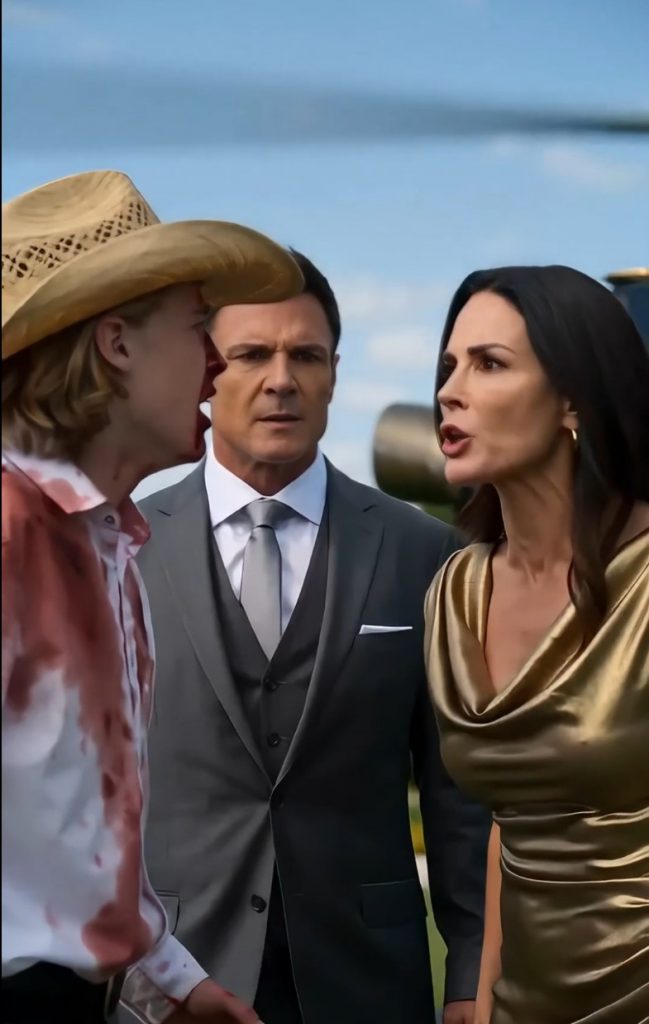
His straw hat was nearly falling off. His white shirt was streaked with dark red marks. Blood smeared his mouth and forehead, and every breath seemed to tear through him as he sprinted over the lawn.
The bodyguard near the helicopter reached for his earpiece.
Victor turned sharply.
Celeste’s face hardened before Noah even spoke.
Noah stumbled to a stop several yards away, one hand pressed to his side, shoulders heaving. He could barely stand, but he pointed toward the helicopter with a shaking arm.
“Sir!” he shouted over the roar of the blades. “Don’t get on that helicopter!”
Victor froze.
Noah swallowed hard, forcing the words out through pain.
“Your wife planted a bomb inside!”
The rotor wash tore across the lawn.
For one second, nobody moved.
Then Celeste exploded.
“What the hell are you talking about, you crazy stable boy?” she screamed, stepping toward him. “Go back to the barns where you belong!”
The insult cracked through the air with almost as much force as the accusation.
Noah did not flinch.
He had flinched enough that morning. In the tack room. Behind the feed bins. On the floor while two men in black gloves told him to keep his mouth shut if he wanted to keep breathing.
Now he looked past Celeste and straight at Victor.
The billionaire’s face had changed.
At first, it had shown irritation. The kind rich men wore when servants interrupted their schedule. But now his eyes were narrowing, moving from Noah’s bloodied face to his wife’s furious one.
Celeste saw the doubt.
Her mouth tightened.
“Victor,” she said, softer now, sharper too. “Don’t listen to him. He’s unstable. He was caught stealing from the barns this morning.”
Noah almost laughed.
The sound came out broken.
“Then ask her,” he said.
Celeste turned toward him with murder in her eyes.
Noah straightened as much as his body allowed. Blood touched his lower lip, but his voice steadied.
“If you don’t believe me, sir,” he said, “ask her to get on that chopper with you right now.”
The world seemed to drop into silence.
Even the helicopter sounded far away.
Victor looked at his wife.
“Celeste,” he said. “Get in.”
Her face emptied.
Not slowly.
All at once.
The color drained from her cheeks. Her mouth opened, but no sound came out. Her eyes flicked to the helicopter door, then to Noah, then back to Victor.
And in that terrified silence, the truth stepped into the sunlight.
Act II
Noah Vale had been born in a room above the Ashbourne stables.
Not because he was family.
Because his mother worked there.
Mara Vale had groomed Victor Ashbourne’s horses for twenty-six years. She knew every mare’s temper, every stallion’s injury, every loose board in every stall. She could calm a panicked horse with one hand and shame a drunk millionaire into silence with one look.
Noah learned to walk by holding on to stall doors.
He learned to read from old racing forms and veterinary manuals. He learned early that wealth had a smell: leather, cut grass, expensive cologne, and the faint rot of people who were used to getting away with things.
Victor Ashbourne was different, or so Noah once believed.
He was stern, private, and impossible to impress, but he treated Mara with respect. When Noah was ten and broke his arm falling from a pony he was not supposed to ride, Victor drove them to the hospital himself.
“You’ve got nerve,” Victor told him in the waiting room.
Noah, pale with pain, whispered, “Is that bad?”
Victor almost smiled.
“Depends what you do with it.”
For years, Noah worshiped him quietly.
Not like a father. He knew better than to dream that high. But like proof that powerful men did not have to be cruel.
Then Celeste came.
She arrived at the estate five years earlier in white sunglasses and a silk scarf, stepping out of a car that cost more than the stable staff made in a decade. She was beautiful in a way that made people forgive the first insult because they were still admiring her face.
The second insult came easier.
The third became habit.
She called the staff by the wrong names. She complained that the stables smelled “medieval.” She asked Victor why he kept “old employees” around when agencies could send younger ones in matching uniforms.
Mara ignored her.
That made Celeste hate her more.
Noah was seventeen the first time Celeste humiliated him in front of guests. A horse had splashed mud on her dress during a charity polo event, and she slapped a crop against his chest hard enough to leave a welt.
“Control the animals,” she hissed.
Noah looked at the horse, then at her.
“I was trying.”
The guests laughed.
Celeste smiled.
Victor saw only the end of it and told Noah to apologize.
He did.
But something changed that day.
Not in Noah’s loyalty to the estate. He still loved the horses. Still rose before dawn. Still carried feed, mucked stalls, wrapped legs, checked gates, and listened to Mara’s quiet warnings about pride.
Something changed in the way he saw Victor.
Good men, Noah learned, could still choose blindness when blindness made their lives easier.
Two years later, Mara got sick.
Victor paid for private doctors. Celeste complained about the cost.
When Mara died, the entire staff attended the funeral. Victor sent flowers and stood at the back of the church, silent and grave. Celeste did not come.
Afterward, Noah thought he would be dismissed.
Instead, Victor told him he could stay on as assistant stable manager.
“You know the horses better than anyone,” Victor said.
Noah heard what he did not say.
You belong here, but not too much.
So Noah stayed.
He worked harder than anyone. He kept his head down. He avoided the mansion unless summoned. He watched Celeste grow bored with wealth and hungry for control.
Then came the rumors.
Victor was changing his will.
Victor was restructuring his companies.
Victor had found irregularities in the private foundation Celeste claimed to manage.
Noah heard pieces of it from drivers, housekeepers, accountants smoking near service doors. He never cared much for estate gossip, but he knew horses, and he knew people. Fear had a scent too.
Celeste began visiting the stables more often.
Not to ride.
To watch.
One week before the helicopter flight, Noah saw her speaking with a man near the equipment shed after midnight. The man was not staff. He wore black gloves, kept his face turned from the security light, and left through the old service road instead of the main gate.
The next morning, one of the helicopter mechanics did not show up.
By then, Noah had learned not to ignore strange things around rich people.
He began paying attention.
And on the morning Victor was supposed to leave for the island, Noah found the mechanic’s phone buried under fresh hay behind the tack room.
The screen was cracked.
The last message was from an unknown number.
Make sure he boards alone.
That was when Noah heard the voices outside.
Act III
The two men caught Noah before he reached the service office.
One grabbed him from behind. The other drove a fist into his stomach hard enough to fold him against the wall. His hat fell. His phone skidded under a cabinet. He tried to shout, but a hand clamped over his mouth.
“Wrong place, barn boy,” one of them muttered.
They dragged him into the tack room.
He fought like Mara had taught him. Not cleanly. Not bravely. Desperately. He kicked over a saddle rack, drove his elbow into someone’s ribs, and knocked over a bucket of grooming tools that crashed loud enough to send two horses screaming in their stalls.
The taller man slammed him against the wall.
For a moment, the room blurred.
Then Noah saw Celeste through the half-open door.
She stood outside on the cobblestones, gold dress gleaming beneath a cream coat, one hand holding her phone. She looked annoyed, not frightened.
That was what Noah remembered most.
Not his own pain.
Her boredom.
“Did he see anything?” she asked.
The shorter man said, “Enough.”
Celeste exhaled.
“We don’t have time for this. Lock him in the feed room until after takeoff.”
Takeoff.
The word cut through Noah’s fog.
He thought of Victor walking toward the helicopter. Victor, arrogant and blind, but not deserving death. Victor, who had paid for Mara’s treatments. Victor, who had once told a scared boy that nerve only mattered depending on what he did with it.
Noah threw himself forward.
The fight lasted less than a minute.
It felt longer.
He got hit twice. Maybe three times. He tore loose when one of the horses kicked its stall door with enough force to make everyone turn. He grabbed a bridle hook from the wall, swung wild, and ran.
He did not run toward the staff quarters.
He did not run toward help.
There was no time.
He ran toward the lawn.
Across the estate, the helicopter rotors were already turning.
Now, standing in front of Victor and Celeste with blood on his shirt, Noah saw the trap closing.
Celeste had recovered slightly from the challenge. Her terror had flashed too openly, but she was skilled at rebuilding masks.
She gave Victor a wounded look.
“You cannot seriously be entertaining this,” she said. “He is covered in blood, screaming about fantasies, and you’re asking me to perform for him?”
Victor did not answer.
The bodyguard stepped forward.
“Sir, we should move away from the aircraft until security clears it.”
Celeste snapped her head toward him.
“No one asked you.”
That was another mistake.
Victor noticed.
Noah took a breath.
“Where’s Mr. Bell?” he asked.
Victor’s eyes shifted to him.
“Who?”
“The mechanic,” Noah said. “Harold Bell. He was scheduled this morning. He didn’t show. His phone was in the stables.”
Celeste laughed sharply.
“This is absurd.”
Noah looked at Victor.
“Check the passenger list.”
Celeste’s face tightened again.
Victor held out his hand to the bodyguard.
“Give me the tablet.”
“Victor,” Celeste warned.
He ignored her.
The bodyguard passed it over.
Victor swiped once, then again. His jaw tightened.
Noah did not need to see the screen to know what he had found.
The island manifest had been changed at 6:12 that morning.
Victor Ashbourne, passenger.
Pilot, confirmed.
Celeste Ashbourne, canceled.
Victor looked up slowly.
“You told me you were coming.”
Celeste’s smile trembled.
“I had a migraine. I told Anton to adjust it. I was going to tell you once you boarded so you wouldn’t cancel your meetings.”
“You were standing beside the door.”
“For appearances.”
Noah wiped blood from his mouth with the back of his hand.
“Then get in now.”
Celeste turned on him.
“You filthy little—”
Victor’s voice cut through hers.
“Enough.”
The word was quiet, but it struck everyone still.
The rotors continued to beat the air.
Noah could feel the vibration through his boots.
Victor looked at the bodyguard.
“Shut it down.”
For the first time, Celeste truly panicked.
Act IV
“No,” she said.
One small word.
Too fast.
Too sharp.
Victor stared at her.
The pilot, visible through the windshield, looked confused. The bodyguard moved toward him, signaling with both hands. Slowly, the rotor sound began to change, the violent blur overhead settling into a lower mechanical churn.
Celeste grabbed Victor’s arm.
“We are already late,” she said. “You can have security look at it on the island.”
Victor looked down at her hand on his sleeve.
Then he looked back at her face.
“Why would I inspect the helicopter after flying in it?”
Her fingers loosened.
Noah could barely stay upright now. Pain throbbed through his ribs, and each breath tasted metallic. But he watched Victor’s expression sharpen with every second.
The billionaire was not a man who liked being frightened.
But he liked being fooled even less.
Security arrived from the mansion in two black carts. Staff gathered at a distance near the hedges, whispering. Someone must have called the estate manager because Mrs. Alden came hurrying across the lawn with her keys swinging from one hand and her face pale.
Victor pointed to the helicopter.
“No one goes near the cabin until the security team clears it.”
Celeste stepped back.
Only one step.
Noah saw it.
So did Victor.
“Take my wife to the terrace,” Victor said.
The bodyguard moved toward her.
Celeste lifted her chin.
“Touch me and you’re fired.”
Victor’s voice turned colder.
“He works for me.”
There it was.
The first crack in the world Celeste had built.
For years, she had lived as if marriage had made every person on the estate hers to command. The drivers. The cooks. The gardeners. The stable hands. Even Victor’s silence.
Now, in front of the helicopter she had expected to watch lift into the sky, she discovered the difference between borrowed power and owned power.
The security team began their inspection from a distance. They did not rush. They did not dramatize. They moved with controlled precision while the rest of the estate held its breath.
Noah looked away.
He had no desire to see proof of how close death had come.
Instead, he watched Victor.
The man’s face was no longer confused or suspicious. It was settling into something harder. Not rage. Not yet. Rage wasted energy.
Victor Ashbourne was calculating.
A security officer returned after several tense minutes and spoke quietly into Victor’s ear.
Victor closed his eyes.
Just once.
When he opened them, the warmth had vanished from his face.
“Call the police,” he said.
Celeste made a sound.
Not a word.
Just a small, wounded gasp, as if she were the betrayed one.
Victor turned toward her.
“How much?” he asked.
She stared at him.
“How much was my life worth?”
The question moved across the lawn like cold water.
Celeste’s eyes shone suddenly, not with remorse, but with terror at being seen.
“You don’t understand,” she whispered.
“No,” Victor said. “I think I finally do.”
That was when Mrs. Alden reached Noah.
“Oh my God,” she said, seeing the blood. “Sit down, child.”
“I’m fine.”
“You are absolutely not fine.”
Noah tried to argue, but his knees weakened. Mrs. Alden caught his arm with surprising strength and guided him onto a low stone bench near the hedge.
Victor watched.
Something in his expression shifted again.
Not toward Celeste this time.
Toward Noah.
“You came across the lawn like that,” Victor said.
Noah swallowed.
“Yes, sir.”
“Why?”
The question was strange enough that Noah almost did not understand it.
“Because you were going to get on.”
Victor stared at him.
Celeste laughed once, bitter and shaking.
“Don’t be sentimental, Victor. He did it for money. They always do.”
Noah looked at her.
For a moment, his mother’s voice rose in his memory.
Never let them make you ashamed of honest hands.
He stood again, even though Mrs. Alden protested.
“I did it because my mother served this estate longer than you’ve been pretending to love him,” Noah said.
Celeste flinched.
“And because whatever Mr. Ashbourne is, he didn’t deserve to die for trusting you.”
Victor turned slowly toward his wife.
The final mask fell from her face.
Act V
The police arrived before noon.
By then, the helicopter had been secured, the grounds sealed, and Celeste Ashbourne had stopped pretending.
She sat on the terrace in her gold dress, surrounded by officers, looking strangely small without the noise of rotors and luxury around her. Her lipstick remained perfect. Her hair had not moved out of place. But her eyes kept drifting toward Victor, searching for the man who had once softened whenever she touched his sleeve.
That man was gone.
The investigation moved quickly because wealthy people often believed secrecy could be bought, then forgot that payments leave trails.
Harold Bell, the missing mechanic, was found alive in a locked storage room near the south service road, injured but conscious. He confirmed that he had been threatened and replaced before dawn. The two men from the stables were arrested trying to leave through the back gate in a maintenance van.
By sunset, Celeste’s private accounts were frozen.
By the next morning, her lover was named.
Anton Valez.
Victor’s personal investment adviser.
The man who had helped Celeste move money through shell charities, falsify foundation records, and prepare for a future in which Victor’s death looked like a tragic mechanical failure instead of murder.
The newspapers called it the Ashbourne Helicopter Plot.
Noah hated that name.
It made everything sound elegant.
There had been nothing elegant about blood on stable floors, a missing mechanic, or a woman in gold screaming class insults at the boy who had just saved her husband’s life.
Noah spent two nights in the hospital.
Victor came on the second evening.
He looked out of place beside the narrow bed, too polished for the room, too controlled for the emotion sitting between them.
Noah’s face was bruised. His ribs were wrapped. His straw hat sat crushed on the chair beside him.
Victor looked at the hat.
“I’ll replace that.”
Noah shrugged.
“It’s just a hat.”
“No,” Victor said. “It isn’t.”
Silence followed.
Victor was not good at apologies. Men like him were usually trained to make payments instead.
But this time, he tried.
“I should have listened sooner,” he said.
Noah looked toward the window.
“Yes, sir.”
“I should have seen what she was doing to the staff.”
“Yes, sir.”
“I should have protected your mother better when she was alive.”
That made Noah turn back.
Victor’s jaw tightened.
“Mara warned me about Celeste,” he said. “More than once. I dismissed it as friction between household and family.”
“She was family,” Noah said.
Victor lowered his gaze.
“Yes,” he said. “She was.”
For a moment, the hospital room filled with all the things money had not fixed. Mara’s tired hands. Her quiet warnings. Noah at seventeen, humiliated in front of guests. Victor looking away because looking away was easier.
Then Victor pulled an envelope from inside his suit jacket.
Noah’s expression hardened.
“I don’t want hush money.”
Victor almost smiled, but it was too sad to last.
“I know.”
He placed the envelope on the bedside table.
“Your mother left something in my office safe. She gave it to me the year before she died and told me I would know when to give it to you.”
Noah stared at the envelope.
Inside was a letter.
Mara’s handwriting was strong, slanted, familiar enough to make his chest ache before he read a single word.
My Noah,
If Mr. Ashbourne is giving you this, then something has happened that forced him to open his eyes.
Don’t be cruel to him for being late. Be honest. It hurts more, and it heals cleaner.
Noah let out a broken breath.
The letter told him what Mara had never said while alive.
That Victor had offered to send Noah to college. That she had refused at first because she did not want charity mistaken for ownership. That she had changed her mind when she realized Noah’s love for the horses came from talent, not limitation.
She had been saving.
So had Victor.
There was a fund in Noah’s name.
Enough for veterinary school.
Noah read the line three times.
Veterinary school.
The dream he had buried under manure, feed bills, grief, and the quiet belief that people like him did not get to leave unless they were thrown out.
At the bottom, Mara had written one final sentence.
You were never born to stay small beside their big house.
Noah turned his face away.
Victor did not speak.
That was wise.
A week later, Noah returned to the estate.
Not to work.
To pack.
The stables were different now. Quieter. The horses sensed absence the way animals always did. Celeste was gone. Anton was gone. The two hired men were gone. But Mara’s old brush still hung from the same hook. Her initials were scratched into the wooden handle.
Noah took it down carefully.
Victor found him there near sunset.
“I’d like you to stay,” he said. “As manager. Full authority. New staff. Better pay.”
Noah looked around the stable where he had grown up.
For most of his life, staying had felt like loyalty.
Now it felt like fear in a familiar coat.
“No,” he said.
Victor nodded slowly.
Not surprised.
Maybe not even disappointed.
“Veterinary school, then?”
Noah looked at his mother’s brush.
“Yeah.”
“Good.”
They stood in silence as the horses shifted softly in their stalls.
Then Victor said, “The estate will always have a place for you.”
Noah looked at him.
This time, he heard the difference.
Not ownership.
Respect.
“Thank you,” Noah said. “But next time I come back, I’m using the front gate.”
Victor’s mouth curved faintly.
“As you should.”
Months later, Celeste’s trial filled every screen in the country.
The footage from the lawn became famous: Noah bleeding in the sunlight, Celeste screaming, Victor asking her to board, and the exact second her face betrayed what her mouth refused to confess.
People replayed that moment endlessly.
They called Noah a hero.
He disliked that too.
Heroes sounded clean.
Nothing about that day had been clean.
But he accepted one interview after Mrs. Alden told him his mother would haunt him if he kept hiding from praise just because it made him uncomfortable.
When the reporter asked why he ran toward the helicopter instead of saving himself, Noah thought for a long moment.
Then he said, “Because someone had to tell the truth before it took off.”
That line spread farther than he expected.
Years later, when Noah returned to the Ashbourne estate as Dr. Noah Vale, the lawn looked exactly the same.
Perfect grass.
Trimmed hedges.
Blue sky.
No helicopter.
Victor was older then. Slower. Less polished in the way grief and betrayal often make honest people less interested in shine. He met Noah at the front steps, not the stables.
A mare was in trouble with a difficult birth, and Noah worked through the night to save her and the foal.
At dawn, when both animals were safe, Noah stepped out of the stable covered in sweat, hay, and exhaustion.
Victor handed him coffee.
“You came back through the front gate,” he said.
Noah smiled faintly.
“I said I would.”
They stood together as the sun rose over the estate.
For the first time, Noah did not feel like the boy from above the stables looking up at a world that would never claim him.
He felt like a man who had run bleeding across a perfect lawn, faced a woman who thought class could bury truth, and forced a billionaire to see what loyalty looked like when it wore a straw hat and a bloodstained shirt.
People remembered the question that exposed Celeste.
Ask her to get on that chopper with you.
But Noah remembered what came before it.
The choice.
The breath.
The pain.
The moment he could have hidden in the barns where she said he belonged, and instead ran straight toward the machine that was supposed to carry a man to his death.
That was the real inheritance Mara left him.
Not the money.
Not the letter.
Not even the dream that finally became his life.
It was nerve.
And Noah had learned exactly what to do with it.