Act I
The rain made everything look colder than it was.
It slid down the brownstone steps, gathered in the cracks of the sidewalk, and turned the pavement into a dark mirror beneath the gray city sky. Cars hissed past the curb. Somewhere nearby, a dog barked from behind a window.
But the man beneath the black umbrella did not look up.
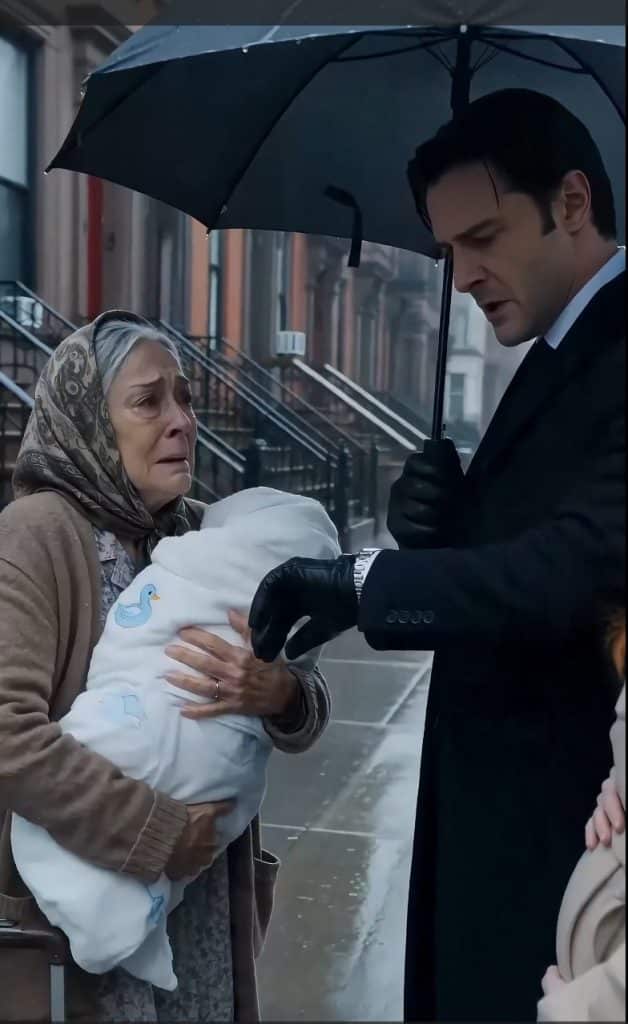
Adrian Vale checked his watch as if time itself belonged to him.
“You had six months,” he said. “Leave.”
The old woman in front of him did not move.
She stood exposed to the rain with a patterned scarf tied around her gray hair, a brown cardigan clinging to her shoulders, and an old leather suitcase hanging from one hand. In her other arm, she held a white blanket-wrapped bundle against her chest like it was the only warm thing left in the world.
Beside Adrian, his pregnant wife, Clara, shifted uneasily.
“Adrian,” she said softly.
He did not look at her.
“This building is being cleared,” he said to the old woman. “You were notified. You were offered relocation money. You refused to sign. That is not my problem.”
The old woman’s eyes moved from his face to the black luxury car parked at the curb behind him.
Something in her expression changed.
Not fear.
Recognition.
Adrian saw it and stiffened.
“Don’t look at my father,” he said. “He has nothing to do with this.”
The old woman gave a tired little breath, almost a laugh, but it carried no humor.
“He has everything to do with this.”
Rain struck the umbrella harder. Adrian’s jaw tightened.
Clara looked down at the bundle in the old woman’s arms. One corner of the white fabric had loosened, revealing a small blue duck stitched into the cloth.
Her hand went instinctively to her belly.
“That blanket,” Clara whispered.
Adrian turned sharply. “What?”
Clara reached forward, not touching the woman, only brushing the edge of the embroidery with trembling fingers.
The old woman let her.
Then she lifted her rain-soaked face and looked at Adrian with the sorrow of someone who had carried one sentence for too many years.
“I made this,” she said, “the night I gave birth to you.”
The street seemed to fall silent around him.
Adrian’s face hardened before his heart had time to understand.
“My mother died when I was born,” he shouted.
The old woman did not flinch.
“No,” she said quietly. “That’s what your father paid me to say.”
And behind Adrian, the door of the black car opened.
Act II
For thirty-six years, Adrian Vale had believed his life began with death.
That was the first story his father ever gave him.
Your mother loved you. She held you once. Then she was gone.
Richard Vale told it beautifully. He had always known how to turn tragedy into control. In interviews, he spoke of raising his son alone with noble restraint. At charity galas, he accepted applause for building a business empire while carrying “a private grief.”
Adrian grew up inside that story.
It explained the portrait over the fireplace. A pale woman with dark hair, painted from a photograph, smiling at something beyond the frame. It explained why his father never allowed questions about the hospital. It explained why the nursery wing of their old estate stayed locked until Adrian was ten.
Dead mothers could not disappoint you.
Dead mothers could not explain themselves.
So Adrian built his life around the silence she had left.
He became polished because Richard valued polish. He became ruthless because Richard called kindness a weakness rich people could not afford. He learned to remove obstacles quickly, whether they were failing investments, unreliable staff, or elderly tenants standing in the way of redevelopment.
That morning, the obstacle had a name.
Mara Bennett.
She was the last tenant in a brownstone Adrian’s company had purchased eight months earlier. Everyone else had taken the money and left. Mara refused, not because she wanted more, but because she insisted on meeting him.
Not his assistant.
Not his attorney.
Him.
For weeks, she had sent letters.
Adrian never answered them.
Then she appeared outside the building with a suitcase, a blanket, and eyes that made Clara uneasy before a word was spoken.
Clara Vale was not raised in the Vale world. She had married into it and learned quickly that wealth could make cruelty look efficient. Since becoming pregnant, she had begun noticing the family differently.
The way Richard corrected Adrian with a glance.
The way Adrian laughed less when his father entered a room.
The way every family story seemed to pass through Richard first, as if memory itself needed his approval.
Now Clara watched her husband standing in the rain, rigid with fury, while an old woman held a baby blanket like proof.
Adrian turned toward the black car.
Richard Vale stepped onto the sidewalk.
He was seventy-two, white-haired, immaculate in a black suit that looked untouched by weather. His driver hurried to open an umbrella above him, but Richard waved the man back.
For once, he seemed to forget appearances.
His eyes were fixed on Mara.
“Mara,” he said.
Her name sounded like something dragged from a locked room.
Adrian stared at him.
“You know her?”
Richard’s face closed.
“Get in the car.”
The command was old, familiar, automatic.
For most of Adrian’s life, it would have worked.
But something had shifted. The rain. The blanket. Clara’s silence. Mara’s shaking hands around the bundle.
Adrian did not move.
“Answer me,” he said.
Richard’s gaze flicked to the sidewalk, to the suitcase, to the open brownstone door behind Mara.
“This is not a conversation for the street.”
Mara’s voice was soft, but it cut through the rain.
“You made it a street conversation when you sent officers to remove me from the last place I had proof.”
Adrian looked at the suitcase again.
For the first time, he noticed the brass initials stamped into the leather.
M.B.
And tied to the handle, protected in a plastic sleeve, was a faded hospital wristband.
The name on it made his breath stop.
Baby Boy Bennett.
Act III
Adrian had seen many lies in business.
Forged signatures. Inflated numbers. Contracts designed to trap desperate people.
But he had never imagined his own life might be one of them.
Mara set the suitcase upright on the sidewalk. Her fingers were stiff from the cold as she opened the latches. Inside were clothes, old photographs, a blue tin box, and a folder wrapped carefully in plastic.
Richard stepped forward. “Enough.”
Clara moved between them before Adrian did.
“No,” she said.
Her voice was quiet, but there was a new steadiness in it.
Richard looked at her as if noticing, perhaps for the first time, that she was not merely Adrian’s wife. She was the mother of the next Vale child.
Mara opened the folder.
The first photograph showed a younger version of her sitting on a hospital bed, exhausted and smiling through tears. In her arms was a newborn wrapped in a white blanket with a blue duck embroidered near the corner.
The same blanket she held now.
Adrian could not look away.
“That could be anyone,” Richard said.
Mara nodded. “That is what you told me people would say.”
She took out another paper.
A birth certificate.
Then another.
A hospital discharge record.
Then a letter, yellowed at the edges, written in Richard Vale’s sharp, slanted handwriting.
Adrian reached for it.
Richard caught his wrist.
For a moment, father and son stood frozen in the rain, the old power between them trying to hold.
Adrian pulled free.
He read the first line.
Mara, you will leave New York tonight.
His vision blurred.
The letter went on. Richard had written that the baby would have a better life without scandal. That Adrian would be raised as a Vale. That Mara would be paid enough to disappear and punished if she ever returned.
At the bottom was a sentence Adrian read three times because his mind rejected it each time.
You will tell anyone who asks that the child died with you.
Clara covered her mouth.
Adrian lowered the letter slowly.
“Why?” he asked.
Richard’s face tightened, but the answer did not come from him.
Mara gave it instead.
“Because I was not the woman your family chose.”
Rain ran down her cheeks, but she did not wipe it away.
“I worked in your grandmother’s house. I was twenty-two. I loved your father’s son before he became what he is now. He promised me marriage in private and denied me in public.”
Richard’s expression twisted. “You were paid.”
“I was threatened.”
The words landed hard.
Mara held the blanket tighter.
“They told me I would ruin your life. They said no court would listen to a poor girl against a Vale. They said if I loved you, I would let you grow up where money could protect you.”
Adrian stared at her.
“And you left?”
Mara’s mouth trembled.
“I tried not to.”
She reached into the suitcase and pulled out a stack of unopened envelopes, all returned, all marked with stamps from years past.
“I wrote every birthday. Every Christmas. Every time I moved, I sent my address. The letters came back. Then they stopped coming back because someone made sure they never reached you.”
Adrian looked at Richard.
The old man’s silence was the closest thing to confession.
Act IV
The rain became heavier, turning the street into silver lines around them.
People had begun watching from windows. A woman under a red umbrella slowed near the curb, then hurried away when she felt the tension.
Adrian barely noticed.
His entire world had narrowed to three people: the woman who had given birth to him, the father who had buried her alive in his memory, and his wife, standing between the past and the child they had not yet met.
Richard finally spoke.
“I did what had to be done.”
Adrian laughed once.
It was a broken sound.
“You told me she was dead.”
“I gave you a life.”
“You stole one from me.”
Richard’s eyes flashed. “I protected the Vale name.”
There it was.
Not love.
Not grief.
A name.
Adrian looked back at Mara, at the rain soaking her cardigan, at the cheap shoes darkened by puddles, at the suitcase that held the evidence of a lifetime spent trying to be believed.
Six months.
He had given her six months to leave.
She had waited thirty-six years to return.
Clara stepped closer to Mara and gently took the white blanket from her arms. The bundle was not a baby, only layers of memory folded around documents, photographs, and a tiny silver rattle engraved with initials Adrian did not recognize.
A.V.B.
Adrian Vale Bennett.
His name before his father erased half of it.
Clara held the rattle in her palm and began to cry silently.
“Adrian,” she said, “our child is due in seven weeks.”
He looked at her.
Her hand rested on her belly, and the meaning struck him with unbearable force.
What kind of father would he become if he walked away now?
The kind who repeated what had been done to him?
Or the kind who stopped it?
Richard moved toward the car. “This has gone far enough.”
“No,” Adrian said.
Richard stopped.
Adrian turned to the building. The brownstone door was still open. Inside, movers had stacked boxes near the entryway. Men hired by his company waited awkwardly in the hall, unsure whether to continue clearing out an old woman’s life.
Adrian walked past his father and climbed the first step.
“Put everything back,” he told them.
One mover blinked. “Sir?”
“Everything.”
Richard’s voice cracked like a whip. “Adrian.”
Adrian turned.
All his life, that tone had made him straighten, obey, become smaller in expensive clothing.
Not this time.
“This eviction is canceled,” Adrian said.
Richard’s face went pale with rage. “You have no idea what you’re doing.”
“I think I finally do.”
Mara stood at the bottom of the steps, gripping the railing as if her knees might fail.
Adrian descended slowly.
For the first time, he looked at her without anger shielding him.
He saw the shape of his own eyes in her face.
He saw the curve of his mouth in hers.
He saw not a stranger asking for money, but a woman who had carried proof because no one had allowed her to carry him.
His voice dropped.
“What did you name me?”
Mara pressed a hand to her chest.
The question almost undid her.
“Julian,” she whispered. “For my father.”
Adrian closed his eyes.
The name entered him like a key turning in a door he never knew existed.
Then Richard said the one thing that could still destroy the moment.
“She gave you up.”
Act V
Mara flinched as if the words had struck her.
Adrian opened his eyes and saw the old lie trying to rise again, stronger now because it wore the shape of his deepest fear.
She left you.
She chose money.
She was not there.
Richard knew exactly where to cut.
But Clara stepped forward before Adrian could answer.
“No,” she said.
Everyone looked at her.
She held one of the returned envelopes in her hand. The ink had faded, but the address was still readable. The Vale estate. Adrian’s name. A birthday date from twenty-nine years earlier.
Clara’s voice shook with fury.
“She didn’t give him up. You intercepted her.”
Richard’s face hardened. “You are out of your depth.”
“I’m a mother,” Clara said. “That is depth enough.”
The street went quiet except for the rain.
Adrian took the envelope from Clara and turned it over. The seal had never been opened. A child’s name was written across the front in careful handwriting.
To my Julian, on your seventh birthday.
His hands trembled.
He did not open it there.
Some things deserved warmth, light, and privacy. Not a sidewalk. Not rain. Not the stare of the man who had hidden them.
Adrian looked at Richard.
“You are leaving.”
Richard’s mouth tightened. “This is my car.”
“This is my company now,” Adrian said. “My building. My decision. And from this moment, my family records are being reviewed by independent counsel.”
Richard’s expression shifted.
For the first time, fear entered it.
Not grief. Not regret.
Fear of exposure.
Adrian understood then that the lie had not survived because it was strong. It survived because everyone around Richard had been trained to be afraid of opening the door.
The door was open now.
Richard stepped back toward the car, his authority shrinking beneath the rain. He looked once at Mara, but whatever he saw in her face made him turn away.
The driver closed the door after him.
The black car pulled from the curb and disappeared into traffic, leaving only the sound of wet tires and a life finally unburied.
Adrian stood on the sidewalk, breathing like a man who had been underwater.
Mara did not rush toward him.
She did not ask to be called Mother. She did not reach for forgiveness she had not yet been given. She simply stood there, holding the edge of the blanket, waiting for him to decide what truth he could bear.
That restraint broke something in him.
He stepped forward.
“I don’t know how to do this,” he said.
Mara’s eyes filled again.
“Neither do I.”
The honesty was small.
It was enough.
Clara placed the blue-duck blanket in Adrian’s hands. The fabric was old, soft at the edges, carefully repaired in several places. One stitch near the duck was uneven, as if the woman sewing it had been tired, young, and hopeful.
Adrian touched it with his thumb.
This had touched him before any suit, any watch, any title, any version of himself his father approved of.
Before he was Adrian Vale, he had been someone’s baby.
Someone had loved him in a hospital room and been punished for it.
He looked at Mara.
“Come inside,” he said.
Her lips parted.
“I don’t want your pity.”
“You won’t have it.”
“Then what?”
Adrian swallowed.
“A chance,” he said. “If you still want one.”
For a moment, the old woman could not speak.
Then she nodded.
Clara took Mara’s suitcase before Adrian could reach for it. Together, they walked up the brownstone steps, leaving wet footprints behind them.
Inside, the movers stepped aside.
Adrian paused in the doorway and looked back at the street where his father’s car had been.
All his life, he had believed power meant deciding who stayed and who disappeared.
Now he understood the truth.
Real power was bringing someone back.
Weeks later, the brownstone was no longer scheduled for demolition.
Adrian converted it into protected housing under Mara Bennett’s name, with a community legal clinic on the ground floor for tenants who had spent their lives being ignored by men in expensive coats.
The newspapers called it a sudden moral shift.
Richard called it betrayal.
Clara called it inheritance.
But Adrian knew better.
It was repair.
Slow, imperfect, painful repair.
He and Mara did not become a family overnight. There were too many missing years between them, too many birthdays sealed in unopened envelopes. Some afternoons, he sat at her kitchen table and read the letters one by one, unable to finish without walking to the window.
Mara never pushed.
She made tea. She told him about the name Julian. She showed him a photograph of her father holding a violin. She admitted she had once stood outside his school gates from across the street, just to see if he looked happy.
Adrian wept at that.
Not loudly.
Not dramatically.
Just with one hand over his eyes, a grown man grieving the child who had waited for a dead mother while his living one stood beyond the fence.
When Clara gave birth, the baby was wrapped first in the white blanket with the blue duck.
Mara stood near the hospital door, uncertain whether she belonged in the room.
Adrian turned from the bed and held out his hand.
“Come meet your granddaughter,” he said.
Mara covered her mouth.
Clara smiled through tears.
Outside, rain tapped gently against the hospital window, softer now than it had been that day on the sidewalk.
Adrian looked down at his daughter, then at the woman who had made the blanket, then at the wife who had refused to let another generation inherit silence.
For the first time in his life, the story of his beginning did not end with death.
It began with truth.