Act I
The little girl came out of the trees like a ghost.
Officer Daniel Mercer saw the white nightgown first, a pale shape moving through the fog beyond the red-and-blue flash of his cruiser lights. For half a second, his mind refused to understand what he was seeing.
Then she stumbled into the road.
Barefoot. Shivering. Clutching a worn brown teddy bear so tightly its stitched face was pressed against her chest.
Daniel shoved the cruiser door open.
“Hey!” he called, already moving toward her. “Hey, sweetheart, come here.”
The girl did not answer.
She ran straight for him with uneven, terrified steps, her blonde hair tangled around her face, her breath breaking into small panicked sobs. The fog swallowed the woods behind her, thick and blue under the flashing lights.
Daniel dropped to one knee before she reached him.
She collapsed into his arms.
Her skin was cold.
Too cold.
“Okay,” he murmured, keeping his voice low even as every instinct in him sharpened. “I’ve got you. You’re safe now.”
The girl shook so hard her teeth clicked. She did not let go of the teddy bear. Her eyes kept darting over Daniel’s shoulder toward the trees, as if something might step out behind her.
Daniel looked into the woods.
Nothing.
Only fog, black trunks, and the faint whisper of leaves.
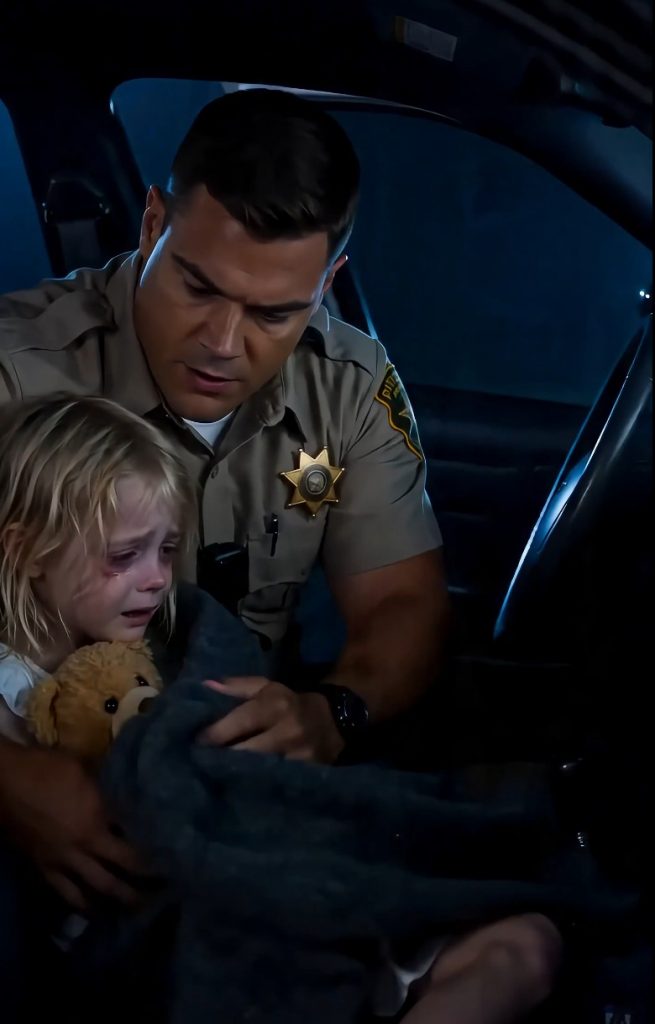
He carried her to the passenger seat and wrapped the dark gray emergency blanket around her shoulders. The cruiser’s dashboard painted her face in soft blue light. She looked no older than five.
“What’s your name?” he asked.
Her lips trembled.
No sound came out.
“That’s okay,” Daniel said. “You don’t have to talk yet.”
He reached for his radio, then stopped.
The blanket had slipped from her arm.
On the inside of her forearm was a dark mark.
Twelve small squares.
Four rows of three.
Daniel stared.
He had seen that pattern before.
Not in person. Not like this.
On a case file. On a photograph sealed in an evidence folder. On the arm of a child who had disappeared from a county fair eight years ago and was never found.
The girl noticed him looking and pulled her arm back with a sharp, frightened gasp.
Daniel forced himself to soften his face.
“I’m not going to hurt you,” he whispered.
Static cracked through the radio.
Daniel froze.
A voice came through, calm and gravelly.
“Unit 44, this is Captain Vance.”
Daniel slowly lifted the handset.
Before he could answer, Vance spoke again.
“What do you see out there?”
Daniel looked through the windshield into the fog.
And this time, something moved between the trees.
Act II
Daniel Mercer had been parked on that road for forty-three minutes.
Dispatch called it a traffic closure.
A tree had fallen across Route 19 after an evening storm, blocking the northbound lane three miles outside town. Daniel had been told to sit on the shoulder, keep his lights on, and wait for county works to clear it.
Routine.
Except nothing about the night had felt routine.
The fog came in too thick, too fast, sliding out of the woods until the cruiser lights looked trapped inside their own glow. The radio had gone patchy. His phone had dropped signal twice. Even the engine sounded too loud in the silence.
Then Captain Vance called him directly.
Not dispatch.
Vance.
“Stay where you are,” the captain had said earlier. “Eyes open.”
“For what?”
A pause.
“Anything that doesn’t belong.”
Daniel had worked under Captain Roland Vance for seven years. Vance was not warm. He did not explain before he had to. But he had instincts the whole department respected, and when Vance’s voice turned flat, Daniel listened.
So he stayed.
He watched the fog.
He thought about his daughter.
That was the part he never admitted on duty. Every child in trouble became Sophie for one dangerous second. Sophie with her missing front tooth. Sophie asleep in dinosaur pajamas. Sophie calling him brave because she thought uniforms worked like armor.
Daniel knew better.
Uniforms did not protect you from fear.
They only taught you how to stand still inside it.
His divorce had left him with every other weekend and a quiet apartment full of toys that waited for a child who was not always there. He was good at chasing suspects, calming wrecks, knocking on doors no one wanted opened.
He was less good at being alone.
That night, parked under the fog, Daniel had been thinking about calling Sophie in the morning.
Then the girl appeared.
Now she sat beside him in the cruiser, wrapped in his blanket, staring down at her teddy bear as if it had the answer to every question she could not speak aloud.
Daniel looked again at her forearm.
The twelve-square mark was not fresh. It had the dark, flat look of ink or dye pressed into the skin and left there. Not random. Not childish.
A label.
That thought made his stomach tighten.
“Captain,” Daniel said into the radio, his voice low. “I have a child. Female, about five. Barefoot, nightgown, shock symptoms. She came out of the woods east of my position.”
Static.
Then Vance answered.
“Does she have a mark?”
Daniel’s hand tightened on the radio.
He looked at the girl.
She was watching him now.
Terror had made her silent, but not unaware. She understood that the mark meant something. She understood adults had power over what happened next.
Daniel turned slightly away so she would not see his face change.
“Yes,” he said. “Twelve squares. Inner forearm.”
The radio went quiet.
Too quiet.
Then Vance said, “Lock your doors.”
Daniel did.
The girl flinched at the sound.
“It’s okay,” he told her. “That’s to keep you safe.”
Vance came back on the radio.
“Do not leave the cruiser. Do not let anyone approach her. Backup is six minutes out.”
Daniel stared into the fog.
“Captain, what is this?”
Another pause.
When Vance answered, his voice had lost its usual distance.
“It’s the case that was never supposed to come back.”
Then a shape emerged from the tree line behind the girl’s footprints.
Act III
At first, Daniel thought it was a branch moving in the wind.
But there was no wind.
The fog shifted, and a figure appeared between the trees.
Tall. Slow. Standing too still.
Daniel’s hand moved to his holster.
The girl saw the figure and made the first clear sound since he found her.
A small, broken whimper.
“No.”
Daniel turned to her.
The word had barely been a whisper, but it carried more fear than any scream.
“Do you know who that is?” he asked.
She pulled the teddy bear up to her chin.
“No.”
It was the answer a child gives when the truth is too dangerous.
Daniel did not press.
Outside, the figure vanished into the fog again.
Daniel grabbed the radio. “Captain, I have movement east side. Possible adult male in the trees.”
“Do not engage alone,” Vance said immediately. “Hold position.”
“He’s watching the cruiser.”
“I said hold position.”
Daniel hated the order because it was correct.
He had a terrified child in the passenger seat. He did not know how many people were in the woods, whether the figure was armed, or what the girl had escaped from.
His job was not to chase the shadow.
His job was to keep her alive until help came.
He angled the cruiser slightly, putting more metal between the passenger side and the trees. Then he reached into the back and pulled out a small stuffed fleece from his emergency kit. His daughter had once asked why he kept “kid stuff” in a police car.
Because sometimes the world forgets children are children, he had told her.
He handed the fleece to the girl.
She stared at it.
“It’s clean,” he said softly.
She did not take it at first.
Then, slowly, she tucked it around the teddy bear.
That tiny act nearly broke him.
“What’s your bear’s name?” Daniel asked.
The girl swallowed.
“Penny.”
“Penny’s a good name.”
Her eyes flicked toward him.
“My name is Daniel,” he said. “I’m going to help you.”
She watched him for a long time, deciding whether help was a word she could trust.
Then she whispered, “He said police were bad.”
Daniel kept his face still.
“Who said that?”
Her fingers tightened around Penny.
“The man with the keys.”
Daniel felt the night close around the cruiser.
The man with the keys.
Not father. Not uncle. Not teacher.
A child’s description of someone who controlled doors.
Before Daniel could ask another question, Captain Vance’s voice returned, lower now.
“Unit 44, listen carefully. Eight years ago, three children vanished across two counties. All three had the same twelve-square marking in later evidence photographs. We never found the source.”
Daniel looked at the girl.
Vance continued.
“Two months ago, an informant gave us a location connected to an old facility near Route 19. We couldn’t confirm it. Tonight’s storm may have forced someone to move.”
Daniel’s pulse hammered.
“The old Ashford property,” he said.
The girl’s head snapped up.
That was confirmation enough.
Daniel looked into the fog again.
And beyond the trees, far back where no house lights should have been, a faint yellow glow blinked once through the mist.
Act IV
Backup arrived without sirens.
Two cruisers first. Then county deputies. Then Vance himself in an unmarked black SUV, headlights cutting through the fog like knives.
Daniel kept the girl in the locked cruiser until Vance approached from the front with both hands visible.
The captain’s face was older than his voice ever sounded on the radio. Rain clung to his gray hair. His jaw was set hard.
He looked through the passenger window at the child.
For one second, all the command left his eyes.
“Is that her?” Daniel asked.
Vance did not answer directly.
Instead, he held up an old photograph inside a plastic sleeve.
A missing poster.
A toddler with blonde curls and a round face, holding the same brown teddy bear.
Penny.
Daniel looked from the photograph to the girl.
The years had changed her, but not enough.
“Her name is Emma Rourke,” Vance said. “She disappeared four years ago from a campground outside Mill Creek.”
Daniel stared at him.
Four years.
The girl in his passenger seat was five.
That meant most of her life had been stolen before she was old enough to remember another one.
Daniel swallowed the anger before it reached his voice.
“Her parents?”
“Alive,” Vance said. “Still looking.”
Inside the cruiser, the girl watched them through the glass.
Emma.
Daniel repeated the name silently.
He wondered if she knew it.
He wondered if hearing it would hurt or heal.
Vance turned to the deputies. “No lights past the bend. We move on foot. Child stays here with Mercer until medics arrive.”
Daniel nodded.
But Emma suddenly pressed her hand against the window.
Her small palm left a fogged print on the glass.
Daniel opened the door only a crack.
“What is it?”
She looked past him toward the trees.
“There are more,” she whispered.
Every adult nearby went still.
Daniel crouched beside the door. “More children?”
Emma nodded once.
“How many?”
She looked down at her forearm, at the twelve-square mark.
Then she held up three trembling fingers.
Vance closed his eyes for half a second.
When he opened them, the captain was all steel.
“Move,” he ordered.
The search team entered the woods.
Daniel stayed with Emma, though every part of him wanted to go with them. He heard branches break under boots. Radios clicked in low whispers. The fog swallowed the officers almost immediately.
Emma began to shake again.
Daniel wrapped the blanket tighter around her.
“You did something very brave,” he said.
She shook her head. “I ran.”
“That counts.”
“They told us the road was gone.”
Daniel frowned. “Who did?”
“The man with the keys.”
Her voice dropped.
“He said if we went into the fog, the road would eat us.”
Daniel felt sick.
Fear had been the fence.
The woods had no wall strong enough to hold children who knew the way out. So someone had built a wall inside their minds.
He kept his voice gentle.
“The road didn’t eat you.”
Emma looked at him.
“No,” she whispered. “Penny knew the lights were safe.”
Daniel glanced at the teddy bear.
Its worn brown fur was torn near one ear. Something small glinted inside the seam.
He leaned closer.
Not a toy button.
A tiny metal tag.
Stamped on it were two letters.
ER.
Emma Rourke.
Someone had marked the bear so a lost child could someday be known.
Then a shout cracked through the fog.
Act V
The rescue took seventeen minutes.
It felt like seventeen years.
The first child came out carried in Deputy Harris’s arms, wrapped in a jacket, eyes wide but alert. A boy about seven. Then another, a little older, limping but awake. Then the third, a girl with dark braids who would not let go of Vance’s sleeve.
Behind them, officers moved quickly through the trees, securing the path, calling for medics, speaking into radios with the clipped urgency of people trying not to show emotion until the work was done.
No one brought the man with the keys out where Emma could see him.
Daniel was grateful for that.
She had already seen enough.
When the medics arrived, Emma refused to leave the cruiser until Daniel promised Penny could come too. He promised. Then she refused again until he promised he would not disappear while she was inside the ambulance.
So he climbed in beside her.
Vance did not object.
At the hospital, nurses warmed her with blankets. A doctor examined the mark on her arm and confirmed what Daniel had suspected: it was ink, pressed repeatedly over time, not a wound. A symbol used to sort, to scare, to erase names.
But Emma had a name.
Emma Rourke.
By sunrise, her parents arrived.
Her mother reached the hospital corridor first, running in slippers, hair unbrushed, face already broken with hope and terror. Her father followed close behind, holding the missing poster Vance had given them years earlier, folded and refolded until the paper had softened like cloth.
Daniel stood outside Emma’s room.
He had faced armed men with steadier hands than he had in that hallway.
Vance spoke to the parents quietly. Carefully. No grand promises. No dramatic reveal. Just the truth, offered gently enough not to shatter them before they reached the door.
When Emma’s mother saw the teddy bear, she made a sound Daniel would never forget.
Not a cry.
Not a scream.
A mother recognizing the last thing she had placed in her child’s arms.
Emma sat upright in the hospital bed, small beneath the blankets. Her eyes were uncertain, guarded, frightened by the size of the feeling coming toward her.
Her mother stopped at the doorway.
She did not rush.
Some instinct wiser than grief held her back.
“Emma,” she whispered.
The girl looked at Daniel.
He nodded once.
“You’re safe,” he said.
Emma turned back to the woman in the doorway.
The teddy bear shifted in her lap.
“My bear’s name is Penny,” she said softly.
Her mother covered her mouth.
“I know,” she whispered. “I gave her to you.”
Emma stared at her.
Then her small face crumpled.
Her mother crossed the room in three steps, and this time Emma reached for her.
Daniel looked away.
Vance stood beside him, silent.
For once, the captain did not seem cryptic or distant. He looked like an old man who had carried too many unsolved cases and had finally been allowed to put one down.
“They found the other families?” Daniel asked.
“They’re being notified now.”
Daniel nodded.
His chest hurt.
The kind of hurt that came after fear, when the body realized it had survived but the heart was still catching up.
Later that morning, Vance told him the Ashford property had been hidden behind layers of false ownership and abandoned records. The storm had knocked out power, tripped an old alarm, and cracked open a service door no one was supposed to reach.
Emma had seen the flashing cruiser lights through the trees.
She ran toward them because Penny had the tag.
Because some part of her remembered that lights on a road meant people.
Because a little girl in a nightgown had been braver than any adult had the right to ask her to be.
Weeks passed before Daniel saw her again.
He was called to the station lobby on a rainy Thursday afternoon. Emma stood there holding her mother’s hand, wearing pink sneakers, a yellow sweater, and a new coat too large for her narrow shoulders.
Penny was tucked under one arm.
Emma looked healthier, but still serious in the way children become when the world has asked them to understand too much.
She walked up to Daniel and handed him a folded drawing.
It showed a police car in blue crayon, red lights above it, and a little girl running from a forest. Beside the car stood a tall stick figure with a gold star on his chest.
At the bottom, in careful letters, someone had helped her write:
Thank you for opening the door.
Daniel stared at the words for a long moment.
Then he crouched.
“You did the hard part,” he said. “You found the lights.”
Emma shook her head.
“Penny found them.”
Daniel smiled. “Then Penny gets credit too.”
For the first time, Emma smiled back.
Small. Brief. Real.
That night, Daniel called Sophie before bedtime.
He told her he loved her twice. Then a third time when she laughed and said she knew already. After the call, he sat in his quiet apartment and looked at Emma’s drawing propped against the lamp.
The fog from that road would stay with him.
So would the mark on her arm.
So would Vance’s voice asking, What do you see out there?
Daniel knew the answer now.
He had seen fear.
He had seen cruelty hidden behind trees and locked doors.
But he had also seen a child run barefoot through the dark with nothing but a teddy bear and the memory of light.
And when the world opened the right door, she ran straight through it.