Act I
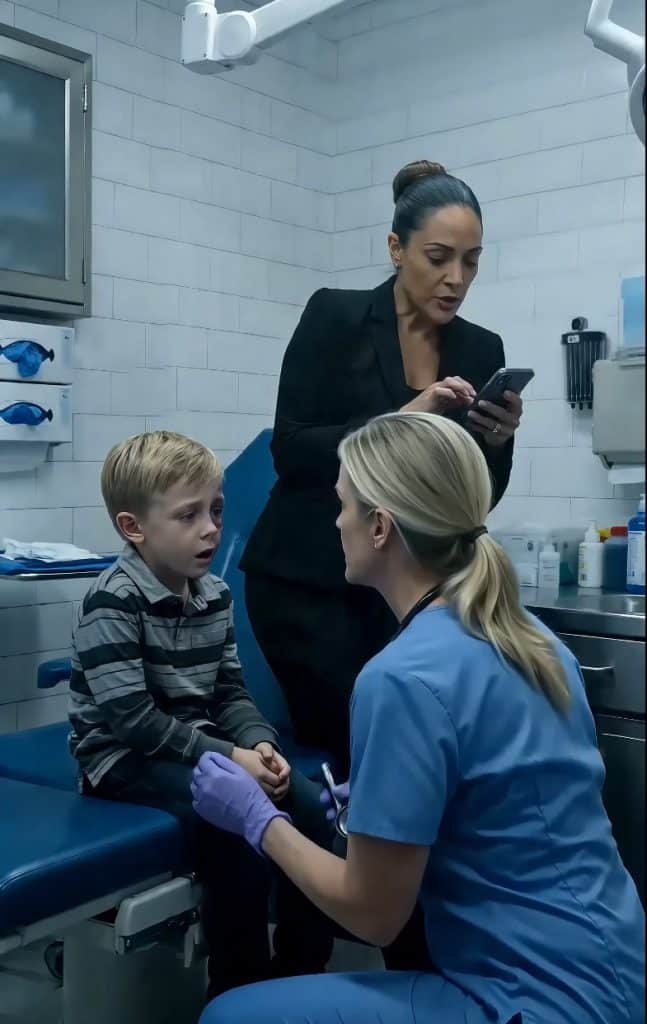
The woman dragged the little boy into the emergency room like he was an inconvenience.
His sneakers slipped against the white tile as he tried to keep up, one small hand clamped in hers, his other arm tucked against his chest. The fluorescent lights made everything look too bright, too clean, too exposed.
Especially his face.
The left side of his cheek was swollen badly, shadowed in dark purple and gray beneath the skin. Pale lines spread across the swelling in a way that made Nurse Claire Donovan stop mid-step.
The woman did not stop.
She wore a black blazer, a light blue shirt, and a wedding ring that flashed every time she lifted her phone. Her dark hair was pulled into a tight bun so smooth it looked severe.
“It’s just a toothache,” she said before anyone asked.
Claire looked at the boy.
He could not have been more than six.
His striped shirt hung loose on his small shoulders. His eyes were glassy with pain and fear, but he did not cry. He did not point. He did not cling to the woman.
He simply sat where she pushed him, folding himself into the blue medical chair as if he had learned that taking up less space made adults less angry.
Claire lowered herself in front of him.
“Hey, buddy,” she said gently. “I’m Claire. Can you tell me your name?”
The boy’s eyes flicked toward the woman.
The woman was already looking at her phone.
“Ethan,” she said.
Claire noticed the boy did not react to the name.
“Ethan,” Claire repeated softly. “I’m just going to take a quick look, okay?”
The woman sighed. “Can we hurry this up? I have a conference call in twenty minutes.”
Claire kept her eyes on the child.
His breathing was uneven. His hands trembled in his lap. When Claire lifted the penlight, he flinched so hard she almost lowered it.
“I won’t hurt you,” she whispered. “Open up, buddy.”
The boy obeyed.
Slowly.
Carefully.
Claire angled the light toward his mouth.
Then she saw it.
Not the toothache.
Not at first.
Tucked behind his lower lip, pressed carefully out of sight, was a tiny folded piece of paper, damp at the corner and covered in shaky pencil marks.
Claire’s hand froze.
The boy stared at her.
His eyes begged before his mouth could.
Claire shifted the penlight just enough to read the first line.
She is not my mom.
The room went silent inside Claire’s head.
Behind her, the woman snapped, “Just give him antibiotics.”
Claire did not move.
Because if the woman saw the note, the boy might never leave that room alive.
Act II
Claire Donovan had worked emergency pediatrics for eighteen years.
She had seen fear in every form.
Toddlers screaming at thermometers. Teenagers pretending not to cry. Parents pacing until their shoes squeaked against the floor. Grandmothers praying into folded hands.
But the quiet children frightened her most.
The ones who watched adults before answering. The ones who understood too much. The ones who had learned that pain was safer when swallowed.
This boy was one of them.
Claire lowered the penlight slowly and smiled as if she had seen nothing more alarming than an irritated gum.
“We’ll need the doctor to evaluate him,” she said.
The woman finally looked up. “For a toothache?”
“For swelling like this, yes.”
The woman rolled her eyes. “He’s dramatic. He’s always dramatic.”
The boy’s gaze dropped.
Claire saw it.
That tiny collapse.
Not surprise. Familiarity.
“What’s your name?” Claire asked the woman, keeping her voice even.
“Marissa Vale.”
“And you’re his mother?”
Marissa paused half a beat too long.
“Yes.”
Claire turned toward the counter and reached for a chart. With her body blocking the boy from Marissa’s view, she slipped the folded note gently from behind his lip and palmed it inside her purple glove.
The boy’s eyes filled with tears.
Claire gave him the smallest nod.
I saw it.
He understood.
Marissa tapped her phone sharply. “Is this necessary?”
Claire opened the chart. “When did the swelling start?”
“This morning.”
The boy’s eyes moved up again.
Not true.
Claire wrote anyway.
“Fever?”
“No.”
“Any injury?”
“No.”
“Any medications?”
“I said it’s a toothache.”
Claire’s pen stopped.
She had learned over the years that dangerous adults often spoke in conclusions instead of answers. They did not describe symptoms. They gave instructions. They wanted the story accepted quickly, before anyone noticed the pieces that did not fit.
Claire stepped back.
“I’m going to get the physician.”
Marissa grabbed the boy’s shoulder. “We’re not waiting all day.”
The boy stiffened.
Claire turned toward the nurse’s station.
“Diane,” she called, her tone carefully normal. “Can you page Dr. Patel? And ask security to help clear room three?”
Diane looked up.
Claire touched two fingers to her wrist.
A quiet signal.
Not one used often. Not one written on signs. A hospital language made for moments when saying the truth out loud could make things worse.
Possible child endangerment.
Diane’s expression did not change, but her hand moved immediately to the phone.
Claire walked into the medication alcove and opened the note.
The pencil writing was uneven, cramped, and heartbreakingly careful.
My name is Noah Pierce. She calls me Ethan. Please call my dad. I was taken from school.
Claire gripped the counter.
For one second, she forgot how to breathe.
Then she turned back toward the room.
Marissa Vale was watching her.
And the boy had begun to cry without making a sound.
Act III
Noah Pierce.
Claire knew the name.
Not from the hospital.
From the news.
Three weeks earlier, a boy had vanished from the pickup line outside Brookside Elementary. Cameras showed him stepping toward a silver car after a woman leaned from the driver’s seat and spoke to him. The police said the woman appeared familiar to him.
The city searched for days.
Flyers went up in grocery stores, gas stations, church windows. A photograph of a smiling blonde boy in a striped shirt circulated everywhere.
Noah Pierce.
Six years old.
Missing.
Claire looked through the glass partition at the boy in room three.
The swelling had changed his face enough that most people would not recognize him at a glance. But now that she knew, she saw it.
The same eyes.
The same small shoulders.
The same way he held one hand curled near his chest.
Marissa stood beside him, phone pressed to her ear now, speaking low and fast.
“No,” she said. “They’re making this complicated. I told them I just need medication.”
Claire moved before fear could slow her down.
Dr. Patel arrived from the trauma hallway, already reading Claire’s expression.
“What do we have?”
Claire handed him the note.
His face hardened.
“Security?”
“On the way.”
“Police?”
“Diane is calling.”
Inside the room, Marissa ended the call and reached for Noah’s arm.
“We’re leaving.”
Claire stepped into the doorway.
“We can’t discharge him.”
Marissa’s eyes narrowed. “I didn’t ask you to discharge him.”
“His condition requires urgent evaluation.”
“It requires antibiotics.”
Dr. Patel came in behind Claire. “Ma’am, I’m the physician on duty. Your son is not leaving until we determine what’s causing that swelling.”
Marissa gave a brittle laugh. “My son?”
The word slipped out wrong.
Too sharp. Too defensive.
Noah heard it.
His face crumpled.
Marissa recovered quickly. “I mean, of course he’s my son. And I know what he needs.”
Claire knelt beside the chair, placing herself between Marissa and the boy.
“Noah,” she said softly.
His eyes widened.
Marissa went still.
Claire kept her voice calm. “You’re safe. We know your name.”
The boy broke then.
Not loudly.
Just a small, wounded sound that came from somewhere deeper than pain.
Marissa grabbed her purse.
“This is absurd.”
Two security officers appeared at the hallway entrance.
Diane stood behind them with the phone still in her hand.
“Police are three minutes out,” she said.
Marissa’s polished face changed.
For the first time since she entered the hospital, she looked afraid.
Not for Noah.
For herself.
Act IV
Marissa Vale did not run.
She tried something more practiced.
She became offended.
“This is kidnapping,” she said, raising her voice so the entire emergency room could hear. “You are holding a mother against her will because of some confused child’s scribble.”
Claire rose slowly.
“No one is holding you,” she said. “But Noah is staying.”
Marissa stared at her.
The difference mattered.
Predators understood control. Claire had just removed it.
Dr. Patel began giving calm medical orders. Nurses moved in with practiced efficiency. The room changed around Noah, not into chaos, but into protection.
A warm blanket. Monitors. A careful exam. A smaller chair for Claire so she could stay at his eye level.
Noah kept watching the door.
“She said if I talked, Dad would stop looking,” he whispered.
Claire felt the words like a hand around her heart.
“Your dad never stopped looking,” she said.
His eyes searched her face.
“Promise?”
Claire swallowed.
“Yes.”
The police arrived with a detective who had clearly been waiting for this case to become a miracle or a body. When Diane handed him the note, his jaw tightened so hard the muscles moved.
“Where did you find him?” the detective asked Marissa.
She folded her arms. “I brought my child for care.”
“He is not your child.”
“I have papers.”
“Then we’ll review them.”
“They’re at home.”
“Of course they are.”
Marissa’s gaze darted to Noah. “He wanted to come with me.”
Noah shrank back into the chair.
Claire stepped closer to him.
The detective noticed.
“Ms. Vale,” he said, “turn around.”
Her mask cracked.
Only for a second.
But in that second, Claire saw the truth beneath the blazer and the smooth hair and the wedding ring. Not panic for a sick child. Not regret.
Rage at being interrupted.
As officers escorted her from the room, Marissa twisted back toward Noah.
“You think they’ll keep you?” she snapped. “You think anyone keeps difficult children?”
Noah flinched as if the words had struck him.
Claire’s voice cut through the room, low and firm.
“Get her out.”
The door closed behind Marissa.
For a moment, no one spoke.
Then Noah began to shake.
Claire sat beside him and held out her hand, palm up, not forcing touch.
He stared at it.
Slowly, he placed his small fingers in hers.
Dr. Patel’s expression softened, but his voice stayed professional. “Noah, we’re going to help your cheek now. You were very brave telling Nurse Claire.”
Noah looked at the closed door.
“I couldn’t talk,” he whispered. “So I wrote it.”
Claire looked at the folded note on the counter, now sealed in an evidence bag.
A scrap of paper.
A pencil stub.
A child’s last plan.
And it had worked.
Act V
Noah’s father arrived forty-seven minutes later.
Claire heard him before she saw him.
Not because he was loud, but because the hallway changed. Officers moved aside. Diane’s voice softened. Someone said, “Mr. Pierce, this way.”
Then a man appeared at the entrance to the pediatric bay with a face broken by hope he was afraid to trust.
James Pierce looked like he had not slept in weeks.
His jacket was half-zipped. His hair was disheveled. His hands shook at his sides as if he did not know whether he was allowed to reach for the child in the bed.
Noah saw him.
For one second, the boy did nothing.
Then his swollen face crumpled.
“Dad?”
James crossed the room and stopped just short of the bed, catching himself before he grabbed too tightly, before grief made him forget the doctors.
“I’m here,” he said, voice breaking. “I’m right here, buddy.”
Noah reached for him.
That was all permission needed.
James folded over his son, one arm around him, the other hand trembling against the back of his head. He cried without shame, his face pressed into Noah’s hair.
“I looked everywhere,” he whispered. “Everywhere.”
Noah clung to him. “She said you stopped.”
“Never.”
Claire looked away.
Some reunions were too sacred to watch directly.
Later, they learned the rest.
Marissa Vale had been a temporary aide at Noah’s school two years earlier. She knew the pickup routines. She knew the names parents used. She knew enough to make one frightened child believe there had been an emergency.
After taking him, she cut his hair, changed his name, moved him between short-term rentals, and told him his father had chosen not to come.
The swelling had finally forced her into a hospital.
Even then, she tried to control the story.
Just a toothache.
Just antibiotics.
Just enough treatment to keep moving.
But Noah had found a pencil in one of the rentals. He had torn a corner from an old receipt and written the truth the only way he could. When Marissa warned him not to speak at the hospital, he hid the note where she would not think to look.
Inside his own silence.
Dr. Patel treated him. Specialists were called. The emergency passed slowly, hour by hour, under careful hands and watchful eyes. Noah slept with his father sitting beside the bed, refusing to leave even when nurses brought him coffee he forgot to drink.
When Noah woke the next morning, Claire was checking his chart.
He looked at her with one eye still puffy, his voice small but clearer.
“Did you read it?”
Claire smiled gently. “I did.”
“Was it messy?”
“A little.”
His mouth curved just enough to be almost a smile.
“I was scared.”
“I know.”
“I thought she’d find it.”
“She didn’t.”
Noah looked toward his father, asleep awkwardly in the chair with one hand still wrapped around the bedrail.
“He didn’t stop?”
Claire followed his gaze.
“No,” she said. “He never stopped.”
Noah was quiet for a while.
Then he whispered, “Can he keep me?”
The question nearly broke her.
Claire sat beside him.
“He already did,” she said. “He kept looking. That counts.”
Months later, a framed photograph appeared on the bulletin board in the emergency staff room.
Noah stood between his father and Nurse Claire, wearing a red sweater and a shy smile. His cheek had healed. His hair had grown back unevenly in the way children’s hair always does after adults try to change them.
In his hand, he held a new notebook.
Claire had given it to him on the day he left the hospital.
On the first page, she had written:
Your words matter.
Noah had stared at that sentence for a long time.
Then he asked if he could write something underneath.
Claire handed him a pen.
In careful letters, he wrote:
They saved me.
Claire kept the original note sealed in evidence only in memory, because the real one belonged to the case now. But she never forgot the weight of it in her gloved hand.
So small.
So fragile.
So powerful.
People thought hospitals saved lives with machines, medicine, and surgeons under bright lights.
And sometimes they did.
But sometimes saving a life began with noticing what did not fit.
A mother who would not look up.
A child who answered to the wrong name with silence.
A swollen cheek dismissed too quickly.
A nurse who did not ignore the fear in a boy’s eyes.
And a folded note hidden in the only place left where the truth could survive.