Act I
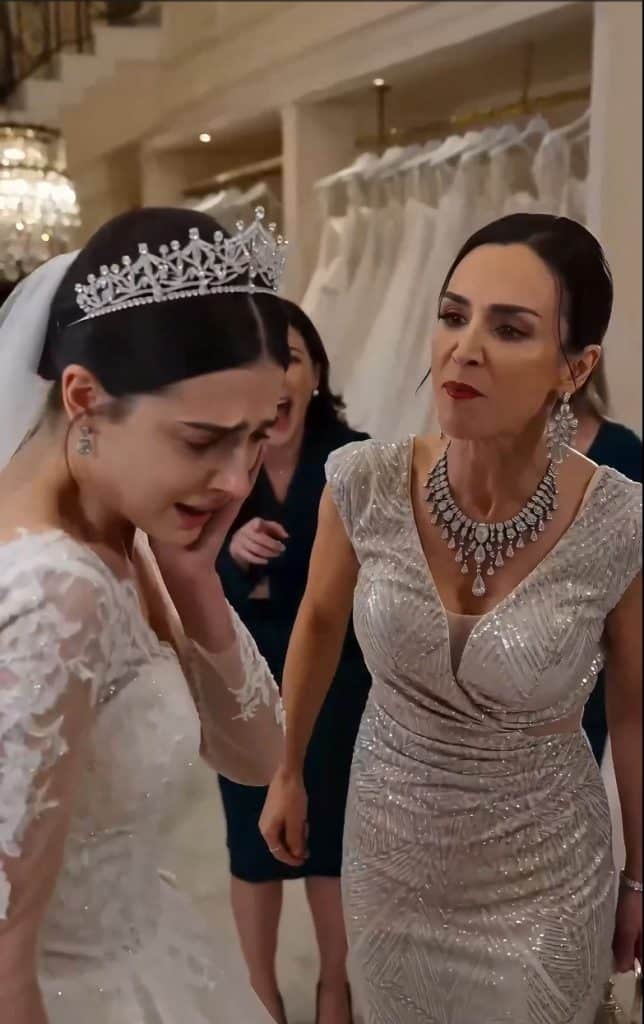
The slap echoed beneath the chandeliers like a gunshot made of diamonds.
For one frozen second, nobody in the bridal boutique moved. Not the stylists standing near the racks of silk gowns. Not the two young women in dark cocktail dresses covering their mouths to hide their laughter. Not the bride in the white lace dress, one hand pressed to her cheek, her silver tiara trembling in her hair.
Only Vivienne Blackwell smiled.
She stood in front of the bride wearing a silver sequined dress that glittered under every crystal chandelier, a diamond necklace heavy enough to look like armor around her throat. Her hair was pulled into a tight bun. Her posture said she owned every inch of the marble floor.
And for the past ten minutes, everyone had believed her.
“You look ridiculous,” Vivienne said, leaning close enough for the bride to smell her expensive perfume. “That dress is worth more than your life.”
Emma Hart’s eyes filled again, but she forced herself not to step back.
The gown around her was soft, delicate, almost painfully beautiful. White lace sleeves, a fitted bodice, a long train spread over the marble like spilled moonlight. It was the kind of dress Emma had once only seen in magazines while standing outside shop windows with her mother.
Now she was wearing it.
And still, somehow, she had never felt smaller.
Vivienne’s two companions laughed behind her.
One whispered, “She probably thought trying it on made her special.”
The other snickered. “Poor thing.”
Emma’s cheek burned where the slap had landed. She heard the stylists breathing but not speaking. She saw the boutique manager looking down at her tablet, pretending not to notice the assault that had happened in the middle of her showroom.
That hurt almost as much as the slap.
Vivienne lifted one manicured hand and pointed toward the door.
“You poor, lonely girl should get out of this shop before you embarrass yourself any further.”
Emma swallowed.
She could have told them the truth then.
She could have said the appointment was real. The dress had been reserved. The deposit had been paid. She could have said her father was the man signing papers upstairs at that very moment.
But humiliation has a strange way of locking the throat.
And Emma had spent years learning how to survive rooms where people assumed silence meant weakness.
Vivienne stepped closer.
“My son may have lost his mind,” she said coldly, “but I will not let him marry a nobody in a dress she can’t afford.”
The room blurred.
That was what this was really about.
Not the dress.
Not the boutique.
Not even the wedding.
This was about Vivienne Blackwell proving, in front of witnesses, that Emma Hart did not belong in her world.
Then footsteps rang from above.
Fast. Sharp. Controlled.
Everyone turned toward the grand staircase.
A man in a black suit descended quickly, one hand on the polished rail. He crossed the marble floor without looking at Vivienne, without acknowledging the women who had been laughing, without stopping for the boutique manager.
He stopped in front of Emma.
Then he bowed.
“Miss Hart,” he said, voice formal and steady. “Your father has signed the purchase agreement.”
The laughter died so quickly the silence felt physical.
Emma slowly lowered her hand from her cheek.
Vivienne blinked.
“What purchase agreement?”
The assistant looked at Emma, waiting for her permission to answer.
And for the first time all afternoon, Emma lifted her chin.
“Buy it back?” she whispered, tears still shining in her eyes. “Buy what?”
Vivienne’s face began to lose color.
Emma looked around at the chandeliers, the gowns, the marble floor, and the woman who had just struck her in a room full of cowards.
Then her voice became calm.
“The entire store.”
Act II
Emma Hart had not been born into marble floors.
She had been born above a dry cleaner in Queens, in a narrow apartment where the pipes complained every winter and her mother kept a jar labeled “Dream Dress” on the kitchen shelf.
There was never much money in that jar.
A few folded bills. Coins from coat pockets. Birthday cash Emma tried to donate before her mother laughingly pushed it back into her hand.
“It’s not for me,” her mother used to say. “It’s for the day you walk into your own future and know you’re worthy of beautiful things.”
Her mother, Clara Hart, had been a seamstress.
Not a famous one. Not at first.
She repaired gowns for rich women who barely looked at her. She hemmed bridesmaid dresses overnight. She fixed torn lace with hands so careful that even the most arrogant clients came back, though they rarely remembered her name.
But Clara had a gift no one could deny.
She could look at a bride and understand the person beneath the satin. The nervous girl pretending to be confident. The widow remarrying quietly at fifty. The daughter trying to please a mother who had already chosen everything for her.
Clara did not just alter dresses.
She restored women to themselves.
Years later, one of her original designs made its way into a small bridal magazine. Then another. Then a private investor appeared, offering to help Clara open a boutique of her own.
The name was supposed to be Maison Hart.
Clara signed papers. She cried when she picked the marble. She let eight-year-old Emma dance under the unfinished chandelier and promise she would get married there one day.
Then Clara got sick.
Everything changed fast after that.
The investor became impatient. Documents appeared. Signatures were questioned. Ownership shifted while Clara lay in a hospital bed too weak to fight.
By the time Emma was twelve, Maison Hart had become Belladonna Bridal, an exclusive luxury boutique owned through a shell company connected to the Blackwell family.
Vivienne Blackwell had never sewn a stitch in her life.
But she understood how to own things other women built.
Clara died that spring.
Emma’s father, Thomas Hart, disappeared into work and grief. He sold what little they had left, moved Emma into a smaller apartment, and spoke of the boutique only once.
“I’ll get it back,” he told her.
Emma did not believe him.
Not because he lied.
Because the world did not usually give back what it stole.
For years, Thomas Hart worked quietly. Too quietly. He did not chase fame or attend parties. He built a logistics company from a rented office, then expanded it into ports, freight networks, private aviation, luxury supply chains, and finally acquisitions.
By the time the world realized Thomas Hart was no longer poor, he was already powerful.
But he never changed the apartment key on his old keychain.
He never remarried.
And he never stopped keeping a file marked Clara.
Emma grew up with two truths.
One: people treated you differently when they thought you had nothing.
Two: money could buy doors open, but it could not make people kind.
That was why she never told Daniel Blackwell who her father really was when they met.
Daniel was Vivienne’s son, though anyone who knew them both wondered how. He was quieter than his mother, kinder, almost embarrassed by the Blackwell name. He met Emma at a hospital charity event where she was helping fit donated gowns for terminally ill brides who wanted one beautiful photo before treatment took everything.
Daniel watched Emma kneel on the floor for an hour pinning lace by hand.
Afterward, he asked why she did it.
Emma said, “Because dignity shouldn’t depend on money.”
He fell in love with her before he knew what family she came from.
At least, that was what Emma had believed.
But in the weeks before the wedding, Daniel began changing.
He missed calls. Delayed plans. Said his mother was under stress. Said the Blackwell name came with obligations Emma could not understand.
Then Vivienne requested one final dress fitting at Belladonna Bridal.
Emma should have known.
The boutique had once been her mother’s dream. Vivienne knew that. Of course she knew. Women like Vivienne did not choose battlegrounds by accident.
She chose the one place where Emma’s heart was already exposed.
And she brought an audience.
Vivienne’s two shadows, Marissa and Claire, arrived first in dark dresses and diamond earrings, touching gowns they had no intention of buying. Then Vivienne entered like a queen inspecting a servant.
Daniel was not there.
That absence told Emma more than any insult could.
Still, she put on the dress.
She stood under the chandelier her mother had once chosen.
And when Vivienne slapped her, the past and present collided so violently that Emma almost forgot who she had become.
Almost.
Because upstairs, behind a closed glass office door, Thomas Hart was signing the final page of the purchase agreement.
And downstairs, Vivienne Blackwell was about to discover that the poor girl she had humiliated was not poor at all.
She was the daughter of the woman Vivienne had stolen from.
Act III
Vivienne stared at Emma as if the bride had spoken in a foreign language.
“The entire store?” she repeated.
Her voice cracked slightly on the last word.
That tiny crack was enough.
The boutique manager finally looked up from her tablet. The stylists exchanged quick, nervous glances. Marissa and Claire stepped back as though distance could erase their laughter from the room.
The assistant remained beside Emma.
His name was James Alden, and he had worked for Thomas Hart for eleven years. He was the kind of man who could make billion-dollar news sound like a weather report.
“The transfer was executed at 2:14 p.m.,” James said. “Belladonna Bridal is now under Hart Family Holdings.”
Vivienne’s mouth opened.
Nothing came out.
Emma touched her cheek once, gently. The sting was still there. So were the tears. She did not wipe them away.
Let them see, she thought.
Let them see exactly what they did before they knew who they were doing it to.
Vivienne recovered with impressive speed.
“This is absurd,” she snapped. “I know the owners.”
“My father knows them better,” Emma said.
Vivienne’s eyes sharpened.
“Your father?”
Emma looked toward the staircase.
Thomas Hart stood at the top.
He was not flashy. That was the first thing everyone noticed. No jeweled watch. No entourage. No need to announce himself with noise.
He wore a dark suit, simple and perfectly tailored, his silver hair combed back, his face calm in a way that made the room uneasy.
He descended slowly.
With every step, Vivienne seemed to shrink.
Thomas stopped beside Emma and looked at her cheek.
His expression did not change much.
But his eyes did.
“Who touched my daughter?” he asked.
Nobody answered.
The boutique’s air felt suddenly thin.
Vivienne forced a laugh. “Thomas, surely we can discuss this privately.”
Emma turned toward her father.
“You know her?”
Thomas did not look away from Vivienne.
“Yes.”
The word carried years inside it.
Vivienne lifted her chin, trying to gather the scraps of her dignity.
“Your daughter was causing a scene.”
Thomas glanced at the silent staff.
“In her mother’s boutique?”
The room shifted.
Emma’s breath caught.
Vivienne’s face went rigid.
James reached into his folder and removed a second set of documents.
Not purchase papers.
Older ones.
Copies of original designs. Lease agreements. Investment contracts. A transfer record signed the week Clara Hart entered the hospital.
Thomas held them without trembling.
“For fifteen years,” he said, “I wondered how a woman on pain medication signed away her company two days after she lost the ability to hold a pen.”
Vivienne went pale.
Marissa whispered, “Oh my God.”
Thomas continued, voice low and precise.
“I wondered why the notary vanished. Why the investor moved abroad. Why every design Clara created suddenly appeared in catalogues owned by your family.”
Vivienne’s diamond necklace glittered under the chandelier, but it no longer looked like armor.
It looked like evidence.
“You have no right to say that here,” she hissed.
Thomas looked around the boutique.
“I own here now.”
The words landed with quiet force.
Emma stared at her father.
He had told her he would get the boutique back. She had thought that meant buying the building, recovering a name, placing flowers where her mother once stood.
She had not known he had been building a case.
James handed Emma a thin folder.
Her fingers shook as she opened it.
Inside was a photograph she had never seen before.
Clara Hart stood in the unfinished boutique years ago, younger, smiling, one hand resting on a mannequin draped in lace. Beside her stood a little girl in sneakers and pigtails, grinning beneath the half-installed chandelier.
Emma.
On the back, in her mother’s handwriting, were five words.
For Emma, when it’s hers.
Emma pressed the photograph to her chest.
For a moment, revenge did not matter.
Money did not matter.
Vivienne did not matter.
Only her mother did.
Then Vivienne made the mistake of speaking again.
“You can buy walls,” she said, voice shaking with rage, “but you can’t buy class.”
Emma looked up slowly.
“No,” she said. “But apparently your family tried to buy my mother’s life’s work with a forged signature.”
And this time, nobody in the room laughed.
Act IV
Vivienne turned on the boutique manager first.
“Call security.”
The manager froze.
James calmly lifted his phone.
“Security now reports to Hart Family Holdings.”
The lackeys looked as if the marble beneath them had opened.
Vivienne’s eyes flashed with panic, then fury.
“This is slander.”
Thomas nodded slightly.
“That is what your lawyers said in 2013.”
Emma looked at him.
“What happened in 2013?”
Thomas’s jaw tightened.
“I wasn’t strong enough yet.”
The honesty hurt him. Emma could see it.
“I had suspicions,” he said. “Not proof. Not resources. Not people willing to risk their positions for the truth.”
He glanced at James.
“That changed.”
James opened another folder.
“In the last six months, we obtained archived communications from the original investment firm, testimony from a former Blackwell accountant, and a handwriting analysis comparing Clara Hart’s medical consent forms to the alleged transfer signature.”
Vivienne stepped backward.
Thomas’s voice lowered.
“The signature was forged.”
The boutique became impossibly still.
Emma felt the words enter her like light through a locked room.
Forged.
Not misunderstood. Not legally complicated. Not lost to bad luck.
Stolen.
Her mother had not given up the boutique. She had not changed her mind. She had not surrendered the dream she built stitch by stitch while telling Emma beautiful things were not reserved for other people.
Someone had taken it.
And that someone was standing in front of her wearing diamonds.
Vivienne’s face twisted.
“You have no idea what your mother was facing,” she snapped at Emma. “She was drowning in debt. She would have lost everything anyway.”
“She was in a hospital bed,” Emma said.
“She was weak.”
The sentence came out too quickly.
Everyone heard it.
Thomas went still.
Emma’s tears stopped.
Not because the pain disappeared.
Because something colder took its place.
“You mean vulnerable,” Emma said.
Vivienne shut her mouth.
But the damage was done.
The boutique manager took another step away from her. One stylist covered her lips in horror. Marissa and Claire stood silent now, their earlier cruelty curdling into fear.
Then the front doors opened.
Daniel Blackwell walked in.
His tuxedo jacket was unbuttoned, his hair damp from the rain outside, his face tense as he looked from his mother to Emma.
“Emma,” he said.
Her heart moved before she could stop it.
Then she remembered the unanswered calls. The delays. The silence when his mother grew crueler. The way he had let Emma walk into this boutique alone.
Daniel saw her cheek.
His face changed.
“Who did that?”
Emma waited.
Vivienne said nothing.
Nobody did.
Daniel turned slowly toward his mother.
“Tell me you didn’t.”
Vivienne’s mouth hardened.
“I was protecting you.”
The words landed like a door closing.
Daniel looked sick.
“From my fiancée?”
“From a trap,” Vivienne said. “From a girl and her father trying to humiliate this family.”
Thomas gave a bitter smile.
“You did that yourself.”
Daniel stepped toward Emma.
“I didn’t know she would come here. I swear.”
Emma wanted to believe him.
That was the worst part.
Love does not vanish just because someone disappoints you. Sometimes it remains standing in the room, bruised and confused, asking what to do with the truth.
“Did you know this boutique belonged to my mother?” Emma asked.
Daniel hesitated.
Only a second.
But a second can ruin a life.
Emma closed her eyes.
“You knew.”
“I found out last week,” he said quickly. “I was going to tell you after the wedding.”
“After?”
“My mother said the legal history was messy. She said bringing it up would only hurt you.”
Emma laughed once, but there was no humor in it.
Vivienne reached for her son’s arm.
“Daniel, don’t let them manipulate you.”
He pulled away.
For the first time, Vivienne looked genuinely wounded.
That should have made Emma feel something.
It didn’t.
James stepped forward.
“Miss Hart, there is one more matter requiring your decision.”
Emma looked at him.
“The Blackwell Foundation gala contract,” he said. “Mrs. Blackwell booked this boutique for a private bridal showcase next month. The deposit is refundable only at ownership discretion.”
Vivienne’s eyes widened.
That event mattered. Emma could see it instantly.
The gala was not just a party. It was a stage. Donors, press, social ranking, whispered alliances. Vivienne had planned to display power in the very boutique her family had stolen.
Emma looked around.
At the gowns.
At the chandeliers.
At the staircase her mother once dreamed beneath.
Then she looked at Vivienne.
“Cancel it.”
Vivienne inhaled sharply.
Emma’s voice stayed calm.
“And refund nothing.”
Act V
The first person to apologize was not Vivienne.
It was one of the stylists.
She stepped forward with tears in her eyes, hands clasped in front of her black uniform.
“Miss Hart,” she whispered, “I should have stopped it.”
Emma looked at her for a long moment.
“Yes,” she said.
The stylist lowered her head.
That was all Emma gave her.
Not cruelty. Not comfort. Just the truth.
The boutique manager resigned before Thomas could fire her. James accepted the resignation with professional calm and asked for her access card. Marissa and Claire slipped toward the door, but Emma’s voice stopped them.
“Leave the gowns.”
They froze.
Both had been holding garment bags for dresses they had planned to try on after watching Emma be humiliated.
Claire flushed red.
“We were just—”
“Laughing,” Emma said.
Neither answered.
They placed the garment bags down and left without another word.
Vivienne remained.
That was her nature. She could lose a room and still pretend she was choosing to stay.
Daniel stood a few feet away from Emma, his face pale with regret.
“I’m sorry,” he said.
Emma looked at him.
“I know.”
He swallowed. “Can we fix this?”
The question was soft.
It hurt more because of that.
Emma looked down at the wedding dress. Her mother would have loved the lace. She would have adjusted the sleeve slightly, tilted her head, and said the waist needed softer shaping because beauty should never look like punishment.
Emma touched the skirt gently.
Then she looked back at Daniel.
“I don’t know.”
His face broke a little.
She did not rush to repair it.
All her life, Emma had been taught to make other people comfortable. Smile through insults. Explain gently. Forgive quickly. Prove she was kind enough to deserve a place among people who had never questioned their own.
But standing in her mother’s boutique, with a red mark on her cheek and the truth finally breathing in the open air, Emma understood something Clara had tried to teach her.
Dignity was not loud.
But it did require a line.
Thomas placed a hand on Emma’s shoulder.
“Whatever you decide,” he said, “this place is yours.”
Emma looked up at the chandeliers.
For years, she had remembered them as magical. Now she saw the dust on some of the crystals, the coldness of the branding, the way wealth had polished away Clara’s warmth.
That would change.
Two months later, Belladonna Bridal closed for renovation.
The newspapers called it a luxury rebrand. Society blogs called it a scandal. Legal analysts called it the beginning of a civil fraud case that could reach deep into Blackwell family holdings.
Emma called it something simpler.
Coming home.
The sign came down on a rainy Tuesday morning.
Vivienne’s chosen name was removed from the entrance, letter by letter, until only pale marks remained on the stone.
A week later, a new sign went up.
Maison Clara.
Inside, the marble stayed, but the room changed.
The gowns were rearranged so brides could move freely instead of feeling watched. The private suites were renamed after seamstresses, not donors. One wall displayed sketches from Clara Hart’s original notebooks, framed beside a photograph of her laughing under the unfinished chandelier.
Emma kept the dress.
Not as a wedding dress.
Not yet.
She kept it in the front window for one month with a small card beneath it.
The Clara Gown. Designed from recovered sketches. Dedicated to every woman told she did not belong in the room.
People came from across the city to see it.
Some came for the scandal.
Others came because they understood.
Women stood in front of the window longer than expected. Mothers cried quietly. Daughters took photos. Former clients of Clara Hart came in carrying old gowns, old stories, old gratitude.
One afternoon, an elderly woman touched the display glass and told Emma, “Your mother fixed my dress in 2002. I had no money left for alterations. She did it anyway.”
Emma smiled through tears.
“That sounds like her.”
Vivienne Blackwell never returned.
Her name did appear in filings, testimony, and articles that turned her polished reputation into something brittle. The forged documents were challenged in court. The Blackwell family settled faster than anyone expected, though Thomas insisted the public correction remain part of the agreement.
Clara Hart’s ownership was restored to the historical record.
That mattered most to Emma.
Daniel came once, near closing.
He stood outside for nearly ten minutes before entering. No cameras. No mother. No excuses prepared.
Emma met him near the staircase.
“I should have told you,” he said.
“Yes.”
“I was afraid of losing you.”
“You lost me when you let me face her alone.”
Daniel nodded, eyes wet.
“I know.”
She expected him to ask again if they could fix it.
He didn’t.
Instead, he placed a small velvet box on the counter.
Inside was her engagement ring.
“I don’t want this to be something I wait for you to give back,” he said. “It should be something you choose again only if you ever want to.”
Emma looked at the ring for a long time.
Then she closed the box.
Not forever.
Not as punishment.
Just as truth.
“Thank you,” she said.
Daniel left quietly.
Emma watched him go, and for the first time, the silence after him did not feel empty.
It felt like space.
That evening, after the staff left, Emma climbed the grand staircase alone. The chandeliers glowed softly above her. The marble reflected the warm light. The boutique no longer felt like a place where she had been slapped.
It felt like a place where the slap had failed.
At the top of the stairs, James had left one final folder for her.
Inside was a copy of the original sketch her mother had made for the boutique’s opening window display. Beneath the drawing, Clara had written a note in the margin.
A bride should never feel like she is asking permission to be beautiful.
Emma pressed her fingers to the words.
Then she looked down at the showroom.
The gowns waited in rows of ivory and silk, not as trophies for rich women, not as weapons for status, but as promises.
Her cheek had healed.
The memory had not.
But neither had it broken her.
Vivienne Blackwell had slapped a poor girl in front of everyone.
What she did not know was that the girl had walked in carrying her mother’s legacy, her father’s promise, and a name that money had tried to erase.
By the time Emma lowered her hand from her cheek, she was no longer asking to belong.
She owned the room.