Act I
The boy tried to make himself smaller than the dust.
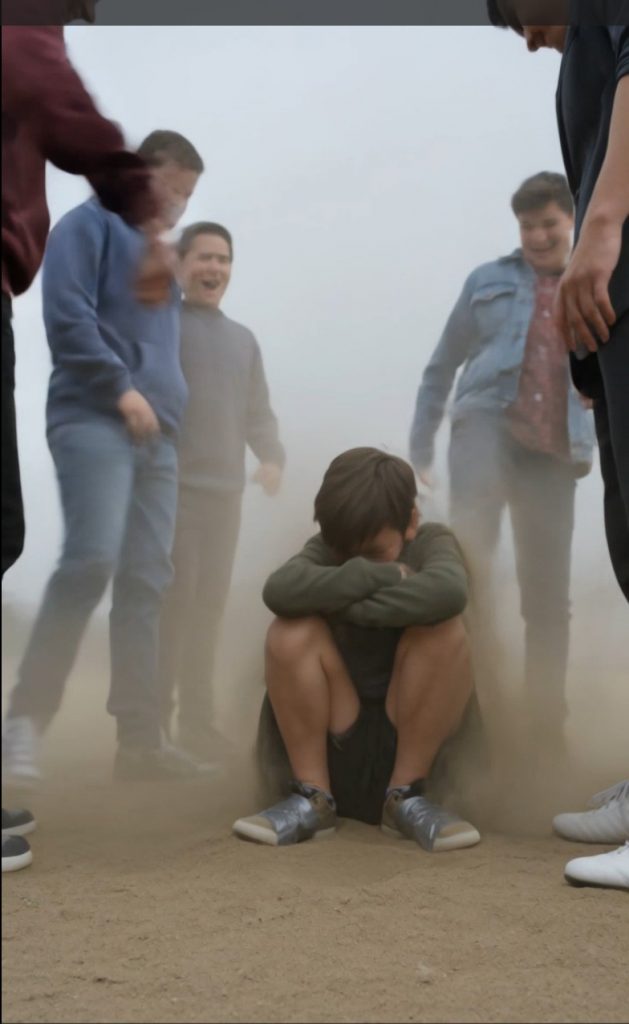
He crouched in the middle of the school athletic field with his knees pulled tight to his chest, one arm raised over his head, the other wrapped around his legs as if he could hold himself together by force. Loose dirt clung to his olive-green jacket. It streaked his face, caught in his hair, and darkened the red mark on his left cheek.
Around him, fifteen teenagers laughed.
They stood in a loose circle on the dry field, their sneakers kicking dust into the air, their phones half-raised, their faces bright with the ugly excitement of a crowd that had forgotten there was a person at the center of it.
“Look at his shoes!”
Someone shouted it, and the laughter got louder.
The boy’s name was Caleb Reed.
He was twelve years old, though at that moment he looked much younger. His shorts were dusty. His knees were scraped from falling. His old sneakers were wrapped in silver duct tape, the tape crossing over the toes and sides in thick uneven strips where the soles had begun to split.
He pulled his feet inward.
That only made them laugh harder.
Then the main bully stepped forward.
Brent Walsh was shirtless despite the cold gray sky, his blue athletic shorts covered in dirt, his white soccer cleats still clean enough to look expensive. He stood over Caleb like he wanted the entire field to see the difference between them.
New cleats.
Old taped shoes.
Power.
Shame.
Brent planted one cleat beside Caleb’s sneaker.
Caleb shook his head.
“Please,” he whispered.
Brent smiled.
Then he stomped down on the duct-taped shoe.
The impact was dull, heavy, humiliating. Dust puffed up around Caleb’s ankle. He flinched and curled tighter, a choked cry catching in his throat as the crowd exploded with cheers.
No teacher came.
No coach blew a whistle.
No one in the bleachers moved.
Beyond the chain-link fence, in the school parking lot, a man in a black suit stood beside a row of parked cars.
He held a brown leather briefcase with both hands.
His face was stern, unreadable, and still.
He watched the circle of teenagers. He watched Caleb in the dirt. He watched Brent grind his clean cleat near the boy’s taped shoes while the crowd laughed like cruelty was entertainment.
The briefcase leather creaked under his grip.
For a moment, it looked like he might enter the field.
Instead, he turned around.
He walked away.
Caleb never saw him leave.
Brent laughed and kicked more dust toward him.
And the boy on the ground believed, with the certainty only humiliation can create, that even the one adult who had seen everything had decided he was not worth saving.
But the man in the suit had not walked away from Caleb.
He had walked away to open the briefcase.
Act II
That morning, Caleb had tried to hide his shoes under the kitchen table.
His grandmother noticed anyway.
Mae Reed noticed everything, even after her hands began to shake and her knees complained every time she climbed the porch steps. She had raised three children, buried two of them, and taken Caleb in after his mother died with nothing but a small bedroom, a fixed income, and a promise she whispered at a hospital bedside.
I’ll keep him safe.
She did her best.
But safety was expensive.
So were shoes.
Caleb had grown too quickly that year. One month his sneakers fit. The next, his toes pressed against the front and the sole split near the side. Mae promised she would buy new ones after the utility bill was paid.
Then the water heater broke.
Then her medication changed.
Then school fees came due for the sports program Caleb didn’t even play in but still had to attend during activity period.
So Mae found silver duct tape in the kitchen drawer and patched the sneakers carefully while Caleb sat across from her pretending not to care.
“They look kind of cool,” he said.
Mae gave him a tired smile.
“Liar.”
He smiled back.
“Creative, then.”
That was Caleb. Always trying to protect the person who was supposed to protect him.
At school, the shoes became a target by second period.
Brent saw them first in the hallway and made a sound loud enough for everyone to turn. By lunch, three boys were calling Caleb “Tape Feet.” By the end of the day, someone had taken a picture.
Caleb made one mistake.
He asked them to delete it.
That was all it took.
They followed him out to the athletic field after class, past the gray bleachers and the equipment shed, into the dry dirt where teachers rarely looked unless practice was scheduled. Brent shoved his shoulder. Someone snatched his backpack. Someone else kicked dirt at his legs.
Caleb tried to leave.
They closed the circle.
The first push knocked him to one knee. The second sent him fully down. He tasted dust and heard laughter before he even understood he was crying.
Then Brent saw the shoes again.
The crowd shifted from teasing to hunger.
That was when the man in the suit arrived.
His name was Jonathan Vale.
He was not a parent.
He was not a teacher.
He was the attorney for the Holloway Education Trust, a scholarship foundation that had spent the last six months quietly investigating Westbridge Middle School after a series of complaints about bullying, missing aid funds, and staff looking away when poor students were targeted.
Jonathan had come with a briefcase full of documents.
Statements.
Emails.
Photos.
Records showing that donated funds meant for clothing assistance had been “reallocated” to athletic upgrades and donor events.
He had planned to meet the principal privately.
Then he saw Caleb through the fence.
A boy curled in dirt.
A crowd laughing.
A clean white cleat coming down on duct tape.
Jonathan stopped walking.
He had spent twenty years in courtrooms watching adults explain why they had not acted sooner. He knew the language of excuses.
We didn’t realize.
We thought someone else handled it.
It was kids being kids.
He also knew that walking into the field alone would stop the moment but not the machine behind it. The boys would scatter. The school would call it a misunderstanding. The principal would promise discipline behind closed doors. The video would disappear. Caleb would return tomorrow to whispers and revenge.
So Jonathan did the hardest thing.
He turned away.
Not because he was leaving Caleb behind.
Because he was done letting Westbridge hide what happened in plain sight.
Act III
Principal Harmon smiled when Jonathan entered the front office.
It was the kind of smile administrators use when they think the meeting is about money.
“Mr. Vale,” she said, rising from her desk. “We weren’t expecting you until four.”
“I’m early.”
“Wonderful. We’re very grateful for the trust’s continued interest in Westbridge.”
Jonathan placed the briefcase on her desk.
The leather made a heavy sound.
Outside the office window, faint laughter still drifted from the field.
Jonathan looked at her.
“There is a boy being assaulted on your athletic field.”
The smile vanished.
Principal Harmon blinked once, as if the sentence had arrived in a language she did not want to understand.
“I’m sorry?”
“A younger boy. Brown hair. Green jacket. Duct-taped shoes. Surrounded by students near the bleachers.”
Her face tightened.
“I’m sure it’s just roughhousing.”
Jonathan opened the briefcase.
“No,” he said. “It is not.”
He removed a tablet and turned it toward her.
The image on screen showed Caleb crouched in the dirt, Brent’s white cleat pressing down near the taped sneaker, the crowd around them laughing.
Principal Harmon stared.
“Where did you get that?”
“From the parking lot,” Jonathan said. “Thirty seconds ago.”
Her voice lowered. “Mr. Vale, I understand your concern, but filming minors on school grounds—”
“Call security.”
She hesitated.
Jonathan’s tone did not rise.
“Now.”
Something in his face made her reach for the phone.
Within two minutes, the assistant principal, the school resource officer, and two coaches were moving toward the field. Jonathan walked behind them, not running, not shouting, the briefcase still in one hand.
The crowd saw the adults first.
The laughter broke apart.
Teenagers scattered backward, suddenly innocent, suddenly confused, suddenly experts at looking like bystanders. Brent stepped away from Caleb with dirt on his cleats and fear beginning to replace the smugness on his face.
Caleb stayed on the ground.
That was what made Jonathan’s chest tighten.
Even when help arrived, the boy did not believe it was for him.
A coach called, “What’s going on here?”
No one answered.
Brent shrugged.
“We were just messing around.”
Caleb’s shoulders curled tighter.
Jonathan stepped through the opening in the crowd and knelt several feet from him, careful not to touch him without permission.
“Caleb Reed?”
The boy looked up, startled.
His face was streaked with dirt and tears.
Jonathan softened his voice.
“My name is Mr. Vale. I’m here to help.”
Caleb glanced past him toward the parking lot.
For one second, recognition flickered.
“You left,” he whispered.
Jonathan absorbed the words like a deserved blow.
“I went to get the people who could make this stop for more than today.”
Caleb did not answer.
He looked at the ground.
The school resource officer turned to Brent.
“Did you stomp on his foot?”
Brent’s face hardened. “No.”
Jonathan stood.
He held up the tablet.
“Then we should all hope the video agrees with you.”
Brent’s confidence cracked.
Behind him, one of the teenagers began to cry.
That was how the truth started.
Not with courage.
With fear.
But sometimes fear is enough to break a circle.
Act IV
By sunset, the school office was full of parents.
Angry parents.
Defensive parents.
Embarrassed parents.
Parents demanding to know why their children were being “treated like criminals” over what they called a “field incident.”
Mae Reed arrived last because she had to wait for a neighbor to drive her.
When Caleb saw her, he broke.
He had held himself together through the nurse checking his cheek, through the principal asking careful questions, through the officer taking notes, through Brent’s mother insisting her son “would never target someone poor.”
But when Mae walked in with her old coat buttoned wrong and worry shaking in her hands, Caleb folded into her arms like a much smaller child.
“I’m sorry about the shoes,” he cried.
Mae held him tighter.
“Oh, baby. No.”
Jonathan stood near the wall, silent.
He had seen adults become ashamed of many things.
But watching a child apologize for being poor never became easier.
Principal Harmon tried to regain control of the room.
“We are conducting a full review,” she said.
Jonathan opened his briefcase again.
“No,” he said. “The review has already begun.”
The room turned toward him.
He placed several documents on the conference table.
“For six months, the Holloway Education Trust has been reviewing complaints from Westbridge families. Multiple students reported bullying tied to clothing, food insecurity, housing, and financial status. Several reports named the same students repeatedly.”
Brent’s father scoffed.
“This is ridiculous.”
Jonathan looked at him.
“Your son appears in four statements before today.”
The man stopped.
Jonathan continued.
“The trust also donated funds last year specifically for emergency student needs, including clothing and footwear. Those funds were not distributed as designated.”
Principal Harmon’s face went pale.
“That is an accounting issue.”
Mae lifted her head.
Her voice was quiet.
“My grandson went to school with duct tape on his shoes.”
No one spoke.
That sentence had more authority than any legal document on the table.
Jonathan turned to Principal Harmon.
“Where did the money go?”
She looked toward the assistant principal.
He looked down.
The silence answered before the paperwork did.
Athletic banquets.
New uniforms.
A donor reception.
A promotional video.
Things that photographed well.
Not shoes.
Not coats.
Not children who needed help quietly enough to stay dignified.
Mae’s hand trembled as she stroked Caleb’s hair.
“He told me the school didn’t have any program like that,” she said.
Principal Harmon closed her eyes.
Jonathan’s expression remained controlled, but his voice sharpened.
“Because someone decided dignity was less important than appearances.”
Brent shifted in his chair.
For the first time, he looked at Caleb, not as a target, but as a consequence.
The resource officer read out the next steps. Suspensions. Formal statements. Review by the district. Possible charges depending on the final report and family decision.
Brent’s mother began to cry.
Mae did not.
She simply looked at the boy who had stomped on her grandson’s taped shoes.
“Why?” she asked.
Brent’s mouth opened.
No joke came.
No excuse.
No crowd to laugh for him.
“I don’t know,” he muttered.
Mae nodded slowly.
“That’s what scares me.”
And in that room, full of adults who had finally arrived too late, her disappointment felt heavier than anger.
Act V
The next morning, every student at Westbridge Middle School saw the empty bleachers.
Not literally empty.
They were still there on the field, gray and cold under the overcast sky.
But they felt different.
The place where Caleb had been surrounded was roped off while district officials took photographs and reviewed security angles from the parking lot. Teachers stood in hallways with faces too serious for a normal school day. Students whispered, but softly now, as if volume itself had become dangerous.
Brent Walsh was not in class.
Neither were several others.
For once, absence belonged to the people who caused the harm, not the boy who survived it.
Caleb stayed home for three days.
Mae made soup he barely ate. She washed his jacket twice and still could not get all the dirt out of the seams. The duct-taped shoes sat by the back door, stiff with dried mud, looking smaller than they had the morning he wore them.
On the fourth day, Jonathan Vale came to the house.
He did not arrive in the black suit this time.
He wore a gray coat and carried the same brown briefcase.
Caleb watched him from the kitchen table.
Mae offered coffee. Jonathan accepted, though he barely touched it.
“I wanted to explain something,” he said to Caleb. “Not as a lawyer. As a man who saw you and walked away.”
Caleb looked down.
Jonathan continued.
“I know what that looked like.”
“It looked like you didn’t care.”
Mae inhaled softly.
Jonathan nodded.
“Yes.”
Caleb looked at him then.
Jonathan opened the briefcase and removed a folder.
“I cared enough to make sure they couldn’t call it teasing. I cared enough to bring proof to people who would have ignored your word if it stood alone. But I should have come back faster. And I am sorry for the minutes you thought you were alone.”
Caleb stared at the folder.
“What’s that?”
Jonathan slid it across the table.
“The Holloway Trust is setting up an emergency support office at your school. Shoes, coats, meals, bus passes. No announcements. No assemblies. No child standing in line to be labeled needy.”
Mae pressed a hand to her mouth.
Jonathan looked at Caleb.
“You should not have needed proof of pain to receive help.”
Caleb opened the folder.
Inside was a letter, written directly to him, confirming that the trust would cover his school supplies, transportation, and clothing needs through graduation. Not charity handed out for pity. Support owed because adults had failed.
At the bottom was another page.
A receipt.
New sneakers.
Already paid for at the store downtown.
Caleb’s face tightened. “I don’t want everyone to know.”
“They won’t,” Jonathan said. “You choose who knows.”
Mae began to cry then, quietly.
Caleb touched the receipt but did not smile.
Not yet.
Healing did not arrive in boxes.
Still, it was something.
A week later, Caleb returned to school wearing new black sneakers with white soles.
They were not flashy.
That helped.
At first, he walked with his head down, expecting someone to notice, someone to laugh, someone to say he thought he was better now. But the hallway only shifted around him. A few students stared. One girl from his math class stepped beside him and said, “I’m glad you’re back.”
He nodded.
His throat hurt too much to answer.
In the weeks that followed, changes came slowly.
The principal was placed on leave. The district announced an audit. A new counselor met with students privately. The emergency support office opened in a small room near the library with a plain sign that read Student Services.
No one called it the poor kids’ room.
Jonathan made sure of that.
The field changed too.
Not because the dirt became softer.
Because people remembered what had happened there.
Teachers began supervising the athletic area during dismissal. Coaches were required to report harassment, not wave it away as team culture. The bleachers were cleaned. The old dust remained, of course. Dust always does.
But the circle did not form again.
At least not around Caleb.
One afternoon in spring, he found his old duct-taped sneakers in the back of the closet. Mae had not thrown them away. She had placed them in a box with newspaper, as if they were evidence from another life.
Caleb carried them to the porch.
Mae looked up from shelling peas.
“You want me to toss them?”
Caleb studied the silver tape.
He remembered the field.
The laughter.
The cleat.
The man behind the fence.
Then he shook his head.
“No. I think I want to keep them.”
Mae waited.
Caleb sat on the porch step.
“Not because of what they did,” he said. “Because of what happened after.”
Mae smiled sadly.
“That’s a hard thing to keep.”
“I know.”
But he kept them anyway.
Years later, when Caleb spoke to younger students as part of Westbridge’s peer mentorship program, he did not show them the video. He did not tell the story like a victory. He never mentioned Brent by name.
He brought the shoes.
The duct tape had yellowed slightly at the edges. The soles were still split beneath the repair. They looked ordinary and heartbreaking on the table in front of him.
“These were mine,” he told the room.
The students grew quiet.
“I used to think the worst part was that people laughed at them,” Caleb said. “But the worst part was that I thought the laughing meant they were right.”
He looked at the students’ faces, some confident, some guarded, some already carrying private humiliations no adult had noticed yet.
“They weren’t.”
Outside, the athletic field sat under a gray sky.
The fence still separated it from the parking lot. Cars still came and went. Somewhere in the distance, dress shoes clicked across pavement, and a briefcase closed with a firm snap.
Caleb had once believed the man in the suit turned away because he did not matter.
Now he knew better.
Sometimes help does not look like a hand reaching down in the first second.
Sometimes it looks like evidence.
A locked briefcase.
A witness who refuses to let adults rename cruelty as a joke.
And sometimes, the first person who walks away is the one coming back with enough truth to make sure the circle never closes around you again.