Act I
The girl hit the pavement before anyone stopped laughing.
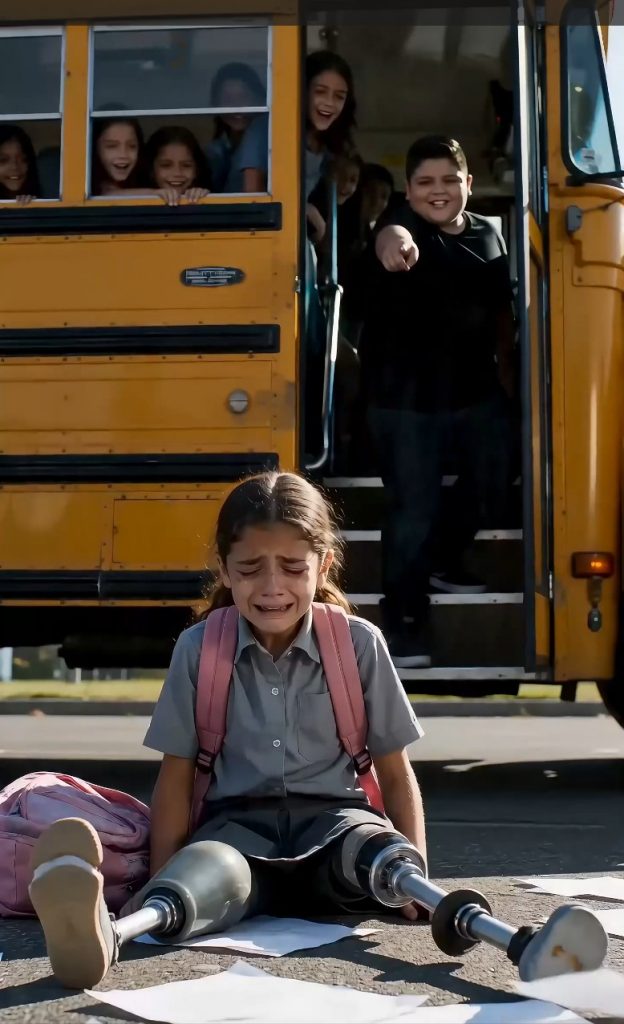
Her papers scattered first, white sheets sliding across the asphalt beneath the open door of the yellow school bus. Then her pink backpack twisted sideways. Then Ava Miller landed hard on one hip, both hands scraping against the parking lot as she tried to catch herself.
For one breath, the whole bus stop froze.
Then Tyler Briggs laughed.
“Move it!” he shouted from the bus steps, still leaning forward from the shove.
He was bigger than most kids in seventh grade, heavy-set and broad-shouldered, wearing a black T-shirt and dark pants. He stood above Ava in the bus doorway like he owned the steps, the aisle, the bus, and every child too scared to speak.
Ava sat on the pavement, stunned.
Her gray shirt was rumpled. Her backpack strap dug into her shoulder. One of her prosthetic legs had come loose in the fall and lay a few feet away beside a math worksheet fluttering in the wind.
The laughter changed after that.
Some students stopped.
Some whispered.
Some looked out the bus windows with wide eyes, not sure whether what they were seeing was still a joke.
Tyler looked down at the prosthetic leg, then back at Ava.
His smirk grew.
“Watch your step!”
A few nervous laughs followed.
Not many.
Enough to hurt.
Ava’s face crumpled. She clutched her hands close to her chest and tried to pull herself toward the prosthetic, but her body would not cooperate. Tears spilled down her cheeks before she could stop them.
The bus driver shouted from somewhere inside, but his voice was swallowed by the engine idle and the chaos of students pressing toward the windows.
Ava looked around for help.
For anyone.
Nobody moved fast enough.
Then the sound came.
A motorcycle.
Low at first.
Then louder.
A heavy black-and-chrome bike rolled into the parking lot, its engine growling across the asphalt until every laugh died. The rider was massive, older, with a long gray beard, broad shoulders, and a dark leather vest covered in patches.
He stopped beside the bus.
One boot hit the ground.
The engine settled into a deep rumble.
Tyler’s smirk disappeared.
The biker swung his leg over the motorcycle and stood slowly, eyes fixed not on the bully, but on the girl crying on the pavement.
Ava looked up through tears.
She knew him.
The biker’s face hardened.
And when he saw her prosthetic lying alone on the asphalt, something in his eyes turned colder than anger.
Act II
Everyone at Westbrook Middle knew Ava Miller.
Most knew her for the wrong reasons.
They knew she walked differently. They knew she sometimes took longer getting onto the bus. They knew she sat near the front because stairs and crowded aisles were difficult when people shoved, rushed, and pretended not to see her.
They knew she had prosthetic legs.
But almost no one knew what that meant.
They did not know she woke before sunrise to stretch because her body hurt more on cold mornings. They did not know she kept extra socks in her backpack because one small wrinkle could ruin an entire day. They did not know she practiced walking in the hallway at home when nobody was watching, counting steps under her breath so she would not look scared in public.
And they did not know she had once loved running.
Before the accident, Ava had been the fastest kid on her block. She raced boys on bicycles, chased her dog through sprinklers, and believed the world was built out of sidewalks waiting for her feet.
Then came the crash.
A drunk driver. A wet road. A hospital stay Ava remembered only in broken pieces: bright lights, her mother crying, a stuffed rabbit tucked beside her pillow, and a big bearded man sitting in the corner every night with his hands folded like he was praying even when he said he was not.
That man was Hank Miller.
Her grandfather.
Most people in town called him Bear.
He owned a motorcycle repair shop near the highway, rode with veterans and mechanics, and looked like the kind of man people crossed the street to avoid until they saw him kneel to fix a kid’s bicycle for free.
After the accident, Bear was the one who built ramps at Ava’s house before she came home. He was the one who found a specialist two counties away. He was the one who took apart her first walker and painted it purple because Ava said hospital gray made her feel “like furniture.”
He never told her to be brave.
He said bravery was too much pressure.
Instead, he told her to be stubborn.
“Stubborn gets you farther,” he said.
Ava became stubborn.
She learned to stand again.
Then walk.
Then climb the bus steps.
That was where Tyler started.
At first, he sighed loudly behind her. Then he called her slow. Then he blocked the aisle with his backpack. Then he began telling younger kids not to sit near her because “she takes forever.”
Ava tried to ignore him.
Her mother reported it twice.
The school said they would monitor the bus.
The bus driver warned Tyler once.
Nothing changed.
That morning, Ava had made one mistake.
She asked Tyler to stop calling her “robot legs.”
He stared at her in the aisle, surrounded by students, and laughed.
Then, when the bus reached the parking lot stop, he shoved her before she could brace herself.
He expected embarrassment.
He expected tears.
He expected another small cruelty to vanish into the noise of dismissal.
He did not expect Bear Miller to be waiting in the lot.
And he did not know Bear had come that day with something wrapped in brown paper and tied to the back of his motorcycle.
A gift Ava was supposed to receive after school.
A pair of running blades.
Act III
Bear walked past Tyler without touching him.
That made the silence heavier.
He did not storm the bus. He did not shout threats. He did not perform the kind of anger boys like Tyler understood. He simply moved toward Ava with slow, controlled steps, his boots landing on the asphalt beside the scattered papers.
Ava tried to wipe her face.
“Grandpa,” she whispered.
Bear crouched in front of her, and the huge man suddenly seemed smaller, folded down to meet her where she was.
“Hey, Bug,” he said softly. “You hurt?”
Ava shook her head, but tears fell harder.
Bear looked at her hands, then at the prosthetic leg nearby, then back at her face.
“You don’t have to lie for me.”
That broke her.
“I tried to get out,” she cried. “He pushed me.”
Bear nodded once.
“I know.”
He reached for her prosthetic carefully, inspecting it with the same attention he gave engines at his shop. Nothing cracked. A scuff. A loosened latch. Repairable.
Then he picked up her papers one by one.
A worksheet.
A permission slip.
A drawing.
He stacked them neatly and placed them beside her backpack before helping her reattach the prosthetic. He moved with practiced care, shielding her from the students’ staring faces.
Only when Ava was sitting upright did Bear stand.
The bus seemed smaller then.
Tyler stood in the doorway, one hand gripping the rail, his earlier confidence draining from his face. The students behind him had gone quiet. Even the bus driver had stepped down to the lower stair, pale and unsure.
Bear looked up at Tyler.
“Did you push her?”
Tyler’s mouth opened.
“No.”
Ava flinched.
Bear’s jaw tightened, but his voice stayed calm.
“That was your one chance to be honest.”
Tyler looked toward the other students.
Nobody laughed now.
Bear turned to the bus driver.
“There a camera on this bus?”
The driver swallowed.
“Yes.”
“Good.”
Tyler’s face changed.
That was the first real crack.
Bear looked back at him.
“You didn’t just push a girl. You pushed someone who works harder to take one step than you work to take a hundred.”
Tyler’s eyes darted away.
Bear continued.
“And then you laughed at the part of her that proves she survived.”
The words landed across the parking lot.
A girl near the bus window began to cry quietly.
One boy lowered his phone.
The bus driver stepped fully onto the pavement.
“Tyler,” he said, voice shaking, “off the bus.”
Tyler stared at him. “What?”
“Now.”
For the first time, the bully looked small.
Not because Bear threatened him.
Because truth had taken away the crowd.
Act IV
The principal arrived five minutes later in a golf cart.
So did the assistant principal.
So did Ava’s mother, Karen, who had been called from the front office and ran across the parking lot still wearing her grocery store name tag.
When Karen saw Ava sitting on the curb beside Bear, her face went white.
“Ava!”
Ava tried to smile.
“I’m okay.”
Karen dropped beside her and pulled her close, one hand shaking against her daughter’s back. Then she saw the papers, the scuffed prosthetic, the children watching from the bus.
Her eyes lifted to Bear.
“What happened?”
Bear did not answer first.
He looked at Ava.
“It’s your story,” he said. “You can tell it, or I can stand here while someone else tries to lie about it.”
Ava looked at Tyler.
He stood near the bus door with the principal beside him, eyes red now, arms folded tightly across his chest. His father had not arrived yet. Without him, without laughter, without the bus steps making him taller, Tyler looked less like a monster and more like a boy who had chosen cruelty until it finally chose consequences.
Ava took a breath.
“He pushed me out,” she said. “And he made fun of my legs.”
Karen closed her eyes.
The principal’s face tightened.
Tyler muttered, “I was joking.”
Bear turned slowly.
Nobody needed him to raise his voice.
“Jokes are supposed to be funny to the person bleeding pride on the pavement.”
The principal looked toward the bus driver. “Pull the footage.”
The driver nodded quickly.
“I already called transportation.”
That was when Tyler’s father arrived.
Frank Briggs stepped out of a pickup truck wearing work boots and a temper that entered before he did. He scanned the scene, saw Bear, saw Tyler, saw Ava, and immediately chose the wrong question.
“What did my son do now?”
Tyler snapped, “Nothing!”
Bear looked at Frank.
The two men recognized each other.
Years earlier, Frank had brought a motorcycle into Bear’s shop, refused to pay the full bill, and told everyone Bear overcharged him. Bear had not argued then either. He simply kept the receipt, the photos, and the signed estimate.
Bear remembered men who avoided accountability.
Frank looked at Ava and then at the prosthetic.
His anger faltered.
The principal spoke quietly. “Your son is accused of pushing Ava out of the bus.”
Frank looked at Tyler.
Tyler looked down.
That was answer enough.
Karen stood, tears bright in her eyes.
“Do you know how many mornings she convinces herself to get on that bus?” she asked. “Do you know what it takes for her to walk into that school after kids like your son make her feel like her body is a joke?”
Frank had no answer.
Ava stared at the ground.
Then Bear walked to his motorcycle and untied the brown paper package from the back.
He carried it over and placed it in front of Ava.
“This was supposed to be for after school,” he said.
Ava wiped her face.
“What is it?”
“Open it.”
With trembling hands, she tore the paper.
Inside were two sleek running blades, polished and fitted with pink accents.
The parking lot went silent again.
Ava’s mouth fell open.
Karen covered her face.
Bear crouched beside his granddaughter.
“You told me last month you wanted to try the spring track clinic.”
Ava whispered, “I said maybe.”
Bear smiled faintly.
“I heard yes hiding under maybe.”
Ava laughed through tears.
A small laugh.
But it changed the air.
Bear looked toward Tyler, then toward the students still watching from the bus.
“This is what you tried to knock down,” he said. “Not weakness. Not something broken. A girl getting ready to run.”
Act V
The video from the bus did not leave much room for excuses.
It showed Tyler blocking the aisle. It showed Ava trying to pass. It showed the shove, the fall, the laughter, and the taunt from the steps.
By the next morning, Tyler was suspended pending a formal disciplinary hearing.
But that was not the part Ava remembered most.
She remembered what happened after everyone left.
After the principal took statements. After Karen signed the incident report. After Frank Briggs walked his son to the pickup in silence. After the bus finally pulled away with the students watching through the windows like they had witnessed something they could not unsee.
Bear stayed in the parking lot with Ava and Karen.
The running blades lay across his motorcycle seat.
Ava sat on the curb, exhausted.
“I don’t want to go back,” she said.
Karen started to answer, but Bear lifted a hand gently.
Not stopping her.
Asking for a moment.
He sat on the pavement beside Ava, ignoring the oil stain near his boot and the way his leather vest creased against the curb.
“I quit school once,” he said.
Ava looked at him.
“You did?”
“Dropped out for three weeks in tenth grade.”
Karen blinked. “Dad, you never told me that.”
Bear shrugged.
“There’s a lot I don’t lead with.”
Ava wiped her nose with her sleeve.
“Why?”
“Kid named Darren made my life miserable. Called me stupid because I couldn’t read fast. One day he shoved my books into a drain after rain. I went home and told my mother I was done.”
“What happened?”
“My mother handed me a wrench and told me if I wanted to quit, I could help fix engines all day for free.”
Ava almost smiled.
“Did you?”
“For three weeks. Then I realized school was easier than my mother’s version of quitting.”
Karen laughed softly despite herself.
Bear’s face gentled.
“But I remember how it felt. Not the books. Not the drain. I remember thinking everyone saw it and nobody cared enough to stop it.”
Ava looked toward the road where the bus had disappeared.
Bear touched the running blades.
“Today, people saw. Tomorrow, they need to care.”
They did.
Not perfectly.
Schools rarely transform overnight because one adult finally tells the truth loudly enough.
But something shifted.
The principal held a bus safety meeting. The transportation office reviewed every report Karen had filed and apologized for how little had been done. The bus driver admitted he had dismissed smaller moments because Tyler always claimed he was joking.
Ava’s class held a disability awareness assembly, though Ava hated the title and told the counselor it sounded like she was “a science project.” Bear came anyway, parking his motorcycle outside the gym.
When he walked in carrying one of Ava’s old prosthetic sockets and one running blade, the students went silent.
Not because he looked scary.
Because Ava walked beside him.
Head up.
Pink backpack on.
Still nervous, but not hidden.
Bear did not give a soft speech.
He gave a real one.
He talked about parts. Alignment. Pressure. Balance. How one careless shove could damage equipment that cost more than most families could afford. How jokes became weapons when they were aimed at someone’s body.
Then Ava stood at the microphone.
Her hands shook.
Karen sat in the front row, crying already.
Ava looked at the students.
“I don’t need you to feel sorry for me,” she said. “I need you to stop making it harder.”
That was all.
It was enough.
The track clinic started two weeks later.
Ava almost backed out in the parking lot.
Her stomach hurt. Her hands were cold. The blades felt strange and powerful beneath her, like they belonged to a braver version of herself.
Bear knelt to check the fit.
“You don’t have to be fast today,” he said.
“What if I fall?”
“Then you’ll be on the ground.”
She stared at him.
He nodded seriously.
“Ground’s not new. You’ve met.”
Ava snorted.
Karen laughed behind her.
Ava took one step onto the track.
Then another.
The first few strides were awkward. The blades pushed back differently than her everyday legs. Her arms windmilled once. Bear walked along the inside lane, close enough to catch her if needed, far enough to let her try.
By the end of the hour, she was not running.
Not exactly.
But she was moving faster than she had in years.
Wind touched her face.
Her breath came sharp and excited.
For one brief stretch of track, the memory of the bus stop loosened its grip.
Months later, Ava rode the bus again.
The first day back, she paused at the steps.
The same yellow paint. The same open door. The same aisle where fear waited in muscle memory.
Then a student inside stood.
“Want the front seat?” the girl asked.
Ava nodded.
No laughter followed.
Tyler eventually returned to school, quieter and watched carefully. He wrote an apology letter, likely because someone made him. Ava read it once, folded it, and put it away. Forgiveness, Bear told her, was not a fee she owed for surviving someone else’s cruelty.
The last day of school, the buses lined up under bright June sun.
Ava stepped down carefully, both feet steady on the pavement.
Bear waited beside his motorcycle, arms crossed, beard moving slightly in the breeze.
“You ready?” he asked.
“For what?”
He nodded toward the empty stretch of sidewalk near the lot.
Ava smiled.
She adjusted her backpack, then began to run.
Not far.
Not fast enough to win a race.
But fast enough that her papers stayed inside her bag, her head lifted, and the same pavement where she had once cried became just another surface beneath her.
Bear watched her go with tears hidden behind sunglasses.
The motorcycle gleamed beside him.
The bus idled behind him.
And Ava Miller, the girl Tyler tried to turn into a joke, ran toward her mother laughing.
Because the bully had been wrong about the fall.
It was not the end of her dignity.
It was the place where everyone finally saw how hard she had been fighting to stand.