Act I
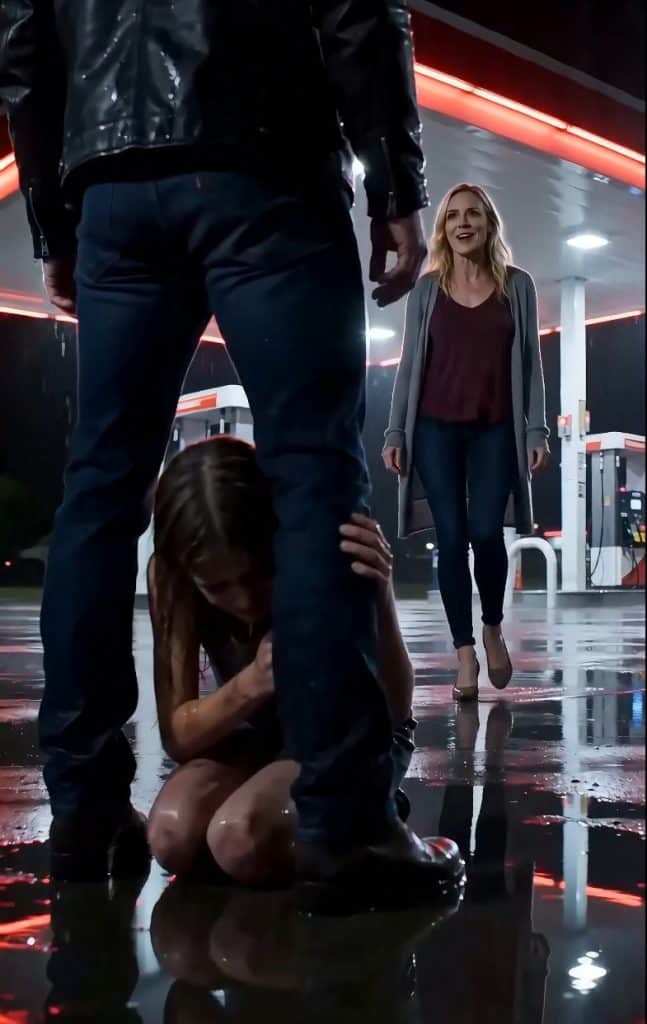
The girl was kneeling in the rain when Mason Cole first saw her.
Not standing.
Not running.
Kneeling.
She was pressed against the side of his leg beneath the red-and-white lights of the gas station canopy, both arms wrapped around his jeans like he was the only solid thing left in the world. Rain soaked through her thin clothes. Her long brown hair clung to her cheeks. Small marks showed on her face and arms, not enough to tell the whole story, but enough to make Mason stop breathing for a second.
Across the pump island, a blonde woman walked toward them with a smile that did not belong in that weather.
“Oh, thank you, sir,” she called, voice sweet as syrup. “My niece is just so clumsy.”
The girl’s fingers tightened around Mason’s leg.
He looked down.
Her lips were trembling.
The woman came closer, her maroon top darkening under the rain, her gray cardigan hanging wet around her shoulders. She wore a simple necklace and a practiced expression of embarrassment, as if the child’s terror was nothing more than a family inconvenience.
“She gets dramatic,” the woman said. “Come on, Emily. Let’s not make a scene.”
The girl shook her head violently.
Mason did not move.
He was a tall man in a black leather jacket, dark jeans, and boots planted in a puddle that reflected the gas station lights. To anyone watching from a distance, he might have looked like trouble.
But the girl behind him had chosen his shadow.
That meant something.
The woman’s smile tightened.
“Sir, I really appreciate you catching her, but I’ll take her now.”
Mason finally spoke.
“Why is she scared of you?”
The woman blinked.
“What?”
The girl looked up at him, eyes wide, voice broken by sobs.
“Please don’t let her put me back in that car.”
The words landed harder than thunder.
The woman’s face changed.
The sweetness vanished first. Then the embarrassment. Then the act.
Her jaw clenched.
“You need to let her go,” she said, voice low and sharp. “Right now.”
Mason shifted his weight, putting more of himself between the woman and the child.
“No.”
The woman lunged.
Her hand shot past his side toward the girl.
Mason moved once.
Fast.
Controlled.
He pushed her back with enough force to stop her, but not enough to chase her. Her shoes slid on the wet pavement, water splashing around her ankles as she stumbled near the pump.
The girl screamed and buried her face against Mason’s leg.
The woman stared at him, furious now.
“You have no idea what you’re doing.”
Mason looked at the car parked near Pump 6.
A dark sedan.
Back door open.
Interior light glowing.
A small pink backpack on the floorboard.
Then he looked back at the girl.
“Yes,” he said quietly. “I think I do.”
Act II
Mason Cole had stopped at the gas station because his truck was running on fumes and his hands were shaking too much to drive another mile.
It was the anniversary of his daughter’s death.
That was the kind of sentence people stepped around, like a crack in the floor. They softened their voices when they said her name. They asked if he was okay with the careful look of people hoping he would say yes quickly.
Her name was Hannah.
She had been eight when she died.
A fever missed by one urgent care doctor, then another. A mother out of town for work. A father who thought he had more time. By the time Mason realized something was terribly wrong, he was carrying her through hospital doors and begging strangers to move faster.
They moved fast.
Not fast enough.
After Hannah, Mason left the fire department. He could still lift wreckage, still cut through doors, still run into smoke, but he could not stand the sound of a child crying for help and not being able to fix the world in time.
So he started driving night routes.
Freight. Long highways. Gas stations. Rain.
Places where no one asked him to be brave.
That night, he was returning from a delivery when he pulled beneath the canopy and saw the dark sedan at Pump 6. The blonde woman stood beside it, arguing into her phone while rain struck the roof. Her voice was sharp enough to reach him through the open window of his truck.
“I said I have her,” she snapped. “No, she won’t talk. Not after tonight.”
Mason looked over.
The back door of the sedan was open.
For a moment, he saw nothing.
Then a small foot touched the wet pavement.
Bare ankle.
Trembling.
The girl slid out of the car like she was afraid the air itself might betray her. She looked around once, saw Mason standing near his truck, and ran toward him without a sound.
She made it three steps before her knees gave out.
By the time the woman noticed, the child was already behind him.
Mason had not asked questions then.
Some things did not need questions.
A child running from a car in the rain was one of them.
Now the woman was standing ten feet away, breathing hard, her fake smile dead on the pavement between them.
“Emily,” she said through clenched teeth. “Get up.”
The girl whimpered.
Mason looked down.
“Is your name Emily?”
The girl shook her head.
The woman’s eyes flashed.
“She gets confused.”
“What’s your name, sweetheart?” Mason asked softly.
The girl hesitated.
Then whispered, “Sophie.”
The woman snapped, “That’s enough.”
Mason kept his gaze on the child.
“Sophie what?”
“Sophie Reed.”
Mason froze.
The name reached into him like a hand from the past.
Reed.
He knew that name.
Everyone in Blackwater County knew it.
Sophie Reed had been on the local news three days earlier. Missing from her grandmother’s house. Eight years old. Brown hair. Last seen carrying a pink backpack.
Police had said it might be a custody issue.
They always said that first when the truth was not yet convenient.
Mason looked toward the sedan again.
The woman’s face had gone pale.
Act III
The woman’s name was Janet Vale.
That was what she told the first people who came running from inside the gas station after Sophie screamed. She said she was the child’s aunt. She said Sophie had behavioral issues. She said Mason had misunderstood a private family matter.
She spoke quickly.
Too quickly.
The clerk, a college kid named Amir, stood near the automatic doors holding the store phone. His eyes moved from Sophie’s wet face to Janet’s outstretched hand.
“Sir,” Amir asked Mason, “should I call 911?”
Janet turned on him.
“No. Absolutely not. This is a family issue.”
Mason did not look away from her.
“Call.”
Amir vanished inside.
Janet’s expression hardened.
“You just made the biggest mistake of your life.”
Mason almost smiled.
“I’ve made bigger.”
Sophie was still clinging to him, but her breathing had changed. It was still panicked, but now there was something else in it.
Hope.
Mason crouched slowly, keeping his body between her and Janet.
“Sophie, where’s your grandma?”
Sophie’s chin trembled.
“She doesn’t know. Janet said Grandma got sick and I had to come quick.”
Janet’s voice cut in.
“That’s enough.”
Sophie flinched.
Mason’s eyes sharpened.
“You don’t talk to her.”
Janet laughed once.
“You think because you’re big, you’re important?”
“No,” Mason said. “I think because she’s scared, I’m not moving.”
Rain hammered the canopy harder.
A car slowed near the entrance, then pulled away. Another driver stood frozen beside Pump 2, phone raised, recording now. Janet noticed and immediately changed her posture.
Her voice softened again.
“Sophie, honey, tell the man you’re okay.”
Sophie shook her head.
Janet’s smile shook with anger.
“Tell him.”
Mason placed one hand gently against Sophie’s shoulder, not holding her, just letting her know he was there.
“She doesn’t have to say what you want.”
That was when Janet made her mistake.
She looked at Sophie and hissed, “Do you want your grandmother to lose the house?”
Sophie went still.
Mason heard it.
So did the man recording.
Janet realized too late that her voice had carried.
The police arrived four minutes later.
Two patrol cars slid into the station lot, lights flashing blue and red across the puddles. Janet immediately raised both hands and began speaking before the officers reached her.
“Thank God. This man has interfered with my niece. She ran out of the car. I was trying to calm her down.”
Officer Lena Ortiz did not answer her first.
She went to Sophie.
Mason stepped back only when Sophie allowed it, though the girl still held two fingers around the hem of his jacket.
Officer Ortiz crouched.
“Hi, Sophie. I’m Lena. Are you hurt?”
Sophie looked at Mason.
He nodded once.
The child whispered, “She said if I told, Grandma would be homeless.”
Janet inhaled sharply.
Officer Ortiz looked up.
“What did you say?”
Sophie pointed to the sedan.
“My dad’s papers are in her car.”
The rain seemed to get quieter.
Mason looked at Janet.
Her face had changed again.
Not angry now.
Afraid.
Act IV
Sophie’s father had died four months earlier.
His name was Daniel Reed, and he had been a county building inspector with a reputation for being impossible to bribe. He checked cheap apartments and luxury homes the same way. He wrote violations for anyone who deserved them, which made him unpopular with men who thought money should soften rules.
Before he died in a construction-site fall, he had been investigating a company called Vale Development.
Janet’s company.
After his death, files disappeared from his office. His laptop vanished. His mother, Ruth Reed, told police Daniel had been scared the week before he died, but grief made her sound fragile and powerful people made themselves sound reasonable.
Then Sophie went missing.
Janet had not taken the child for ransom.
She had taken her because Sophie had seen where her father hid the backup documents.
In a pink backpack.
The same one sitting on the floor of Janet’s sedan.
Officer Ortiz retrieved it with gloves. Sophie watched from behind Mason, shivering under a foil blanket the paramedics had wrapped around her shoulders.
Inside the backpack were normal child things.
A library book.
A pencil case.
A stuffed fox.
And beneath the lining, sealed in a plastic sleeve, a small flash drive and a folded letter in Daniel Reed’s handwriting.
For Mom, if I don’t make it home.
For Sophie, if no one believes Grandma.
Vale is hiding more than bad permits.
Janet stopped talking when Officer Ortiz read the first line aloud.
Then she asked for a lawyer.
People like Janet always knew when the performance was over.
But the night was not finished.
A second car arrived at the gas station just after midnight. An elderly woman stumbled out before it had fully stopped, wrapped in a winter coat over pajamas, face white with terror.
“Sophie!”
The girl broke away from Mason and ran.
Ruth Reed dropped to her knees on the wet pavement and caught her granddaughter with both arms, sobbing into her hair.
“I looked everywhere,” Ruth cried. “I looked everywhere.”
Sophie clung to her.
“She said you were sick.”
“I’m here,” Ruth whispered. “I’m here, baby.”
Mason turned away.
He told himself it was rain on his face.
It was not.
Officer Ortiz watched Janet being placed in the back of a patrol car. The woman sat stiffly, hair damp, cardigan soaked, her face now empty of every mask she had tried on.
Mason expected to feel satisfaction.
Instead, he felt tired.
Because Sophie had been saved, yes.
But she had been saved after being taken.
After being threatened.
After being frightened into believing the truth could cost her grandmother a home.
That was the part people always forgot.
Rescue did not erase the ride.
Still, it mattered.
It mattered that Sophie had run.
It mattered that Mason had stopped.
It mattered that under bright gas station lights, with rain turning the pavement into a mirror, Janet Vale’s lie had finally reflected back at her.
Act V
The flash drive changed the county.
Not overnight.
Truth rarely moves that fast when money stands in front of it.
But Daniel Reed had been careful. The drive contained inspection photos, emails, hidden payment records, and audio from a meeting where Vale Development executives discussed delaying repairs in low-income buildings while bribing officials to clear luxury projects first.
More than that, it contained Daniel’s notes about the site where he died.
Missing rail.
False safety log.
A crew member who later admitted he had been told to “clean up” before investigators arrived.
Janet Vale was charged first for Sophie’s abduction and threats. Then came obstruction, evidence tampering, and conspiracy connected to Daniel Reed’s investigation. Other names followed hers, some spoken in courtrooms, some whispered behind office doors by people trying to save themselves.
Ruth kept custody of Sophie.
No one questioned it after that night.
The house Janet had threatened was protected through Daniel’s estate and a victim assistance fund established after the case made headlines. Ruth cried when the attorney explained she would not lose it.
Sophie did not.
She only asked, “Can we change the locks?”
They did.
Twice.
For a while, Sophie could not pass a gas station without reaching for Ruth’s hand. She hated dark sedans. Hated gray cardigans. Hated the sound of a woman calling her “honey” in that too-sweet voice Janet had used beneath the canopy.
Mason understood.
Fear remembered details kindness forgot.
He visited once at Ruth’s invitation, bringing a small wooden truck he had carved during one of his long routes. He almost did not knock. Standing on that porch, he felt suddenly foolish. Too large. Too awkward. Too much like a stranger who had wandered into a family’s worst night and did not know how to leave properly.
Sophie opened the door.
She looked at him for a long second.
Then she hugged his waist.
Mason froze.
Ruth stood behind her, crying silently.
Sophie looked up.
“You didn’t let go.”
Mason swallowed.
“No.”
“Even when she said to.”
“No.”
“Why?”
He had many answers.
Because you were afraid.
Because she was lying.
Because I once lost a child and could not save her.
But Sophie was eight, and she deserved an answer that did not ask her to carry his grief too.
So he said, “Because you asked for help.”
Sophie nodded like that made sense.
Maybe it did.
Months later, the gas station installed new cameras, brighter lights, and a sign near the doors:
If a child asks for help, call 911 immediately.
Amir, the clerk, kept a copy of the newspaper article behind the counter. He pretended he did not, but everyone knew. Officer Ortiz stopped by sometimes for coffee and checked the lot out of habit.
Mason avoided the place for a while.
Then one rainy night, almost a year later, his route brought him back.
The pavement was wet again. The canopy lights still glowed red and white. Traffic hummed beyond the road. Pump 6 was empty.
Mason parked his truck and sat for a moment with both hands on the wheel.
He could still see Sophie kneeling in the rain.
Still hear her voice.
Please don’t let her put me back in that car.
The memory hurt.
But it did not break him the way he expected.
Instead, it opened something.
A door, maybe.
Not to the past he wanted.
To the person he had been before grief convinced him he was finished being useful.
Inside the station, Amir recognized him immediately.
“Coffee?” the kid asked.
Mason nodded.
“Black.”
Amir poured it, then hesitated.
“She comes by sometimes,” he said.
Mason looked up.
“Sophie?”
“With her grandma. She’s doing better.”
Mason let out a breath he had been holding for a year.
“Good.”
Amir smiled.
“She calls you the wall.”
Mason blinked.
“What?”
“The wall,” Amir repeated. “Because you stood there and wouldn’t move.”
Mason looked out the window toward Pump 6.
Rain rippled through the puddles, turning every light into something trembling and alive.
He thought of Hannah then.
Not the hospital.
Not the loss.
The real Hannah.
Running through sprinklers. Wearing rain boots on sunny days. Asking him if firefighters ever got scared. Laughing when he said yes, all the time.
For years, Mason had believed he failed fatherhood because he could not save the child he loved most.
But that night at the gas station, another child had reached for him.
And he had stayed.
Not because he was fearless.
Because she needed him to be still.
The case against Janet Vale ended with a plea before trial. Ruth said it spared Sophie from testifying, and that was enough. Vale Development dissolved under the weight of investigations and lawsuits. Daniel Reed’s name was cleared, then honored, then finally spoken without the shadow Janet had tried to place over it.
At the county courthouse, a small plaque was installed near the building inspection office.
Daniel Reed
He believed safety was not optional.
Sophie placed the first flower beneath it.
Mason watched from the back.
He did not expect her to see him, but she did. She ran over, Ruth following more slowly behind.
Sophie was taller now. Her hair was brushed into a braid. She wore a yellow raincoat even though the sky was clear.
“Hi, Wall,” she said.
Mason laughed before he could stop himself.
“Hi, Sophie.”
She held out something small.
A keychain shaped like a gas pump, painted red and white.
“I got it for you,” she said. “So you remember.”
Mason took it carefully.
“Remember what?”
She looked at him as if the answer was obvious.
“That stopping matters.”
Mason closed his hand around the keychain.
Across the courthouse lawn, Ruth wiped her eyes.
Sophie went back to her grandmother, skipping once before remembering she was trying to look grown-up.
Mason stayed where he was.
He looked down at the little keychain in his palm.
Then up at the bright morning sky.
The night he met Sophie, the gas station lights had made everything look harsh: rain, fear, lies, a child clinging to a stranger because the person chasing her called herself family.
But sometimes rescue begins in places that look ordinary.
A pump island.
A clerk with a phone.
A man who almost drove away.
A girl brave enough to say the sentence that saved her life.
Please don’t let her put me back in that car.
And a stranger who became a wall until help arrived.