Act I
The desert was so quiet that the water sounded like a confession.
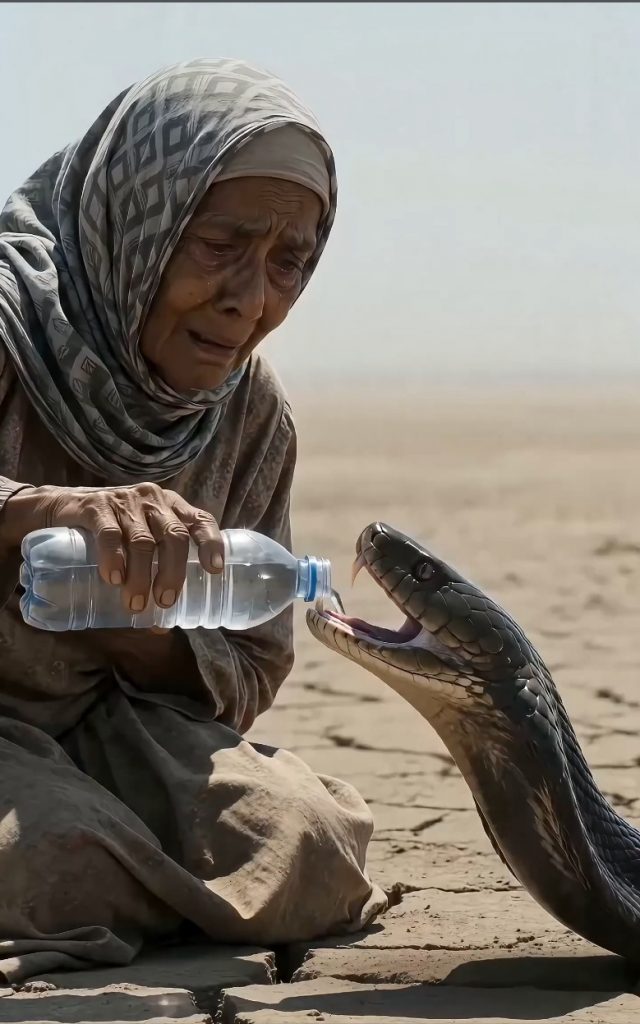
It poured from the plastic bottle in a thin, trembling stream, catching the white sun before falling into the open mouth of the cobra.
Miriam Vale knelt on cracked earth with both knees in the dust, her gray-and-white headscarf shifting in the dry wind. Her floral dress was faded at the hem. Her hands shook, but she did not pull them back.
The snake was enormous.
Dark scales shimmered along its body. Its lighter underside lifted slightly as it tilted its head toward the water, hood half-open, eyes fixed and unreadable. It should not have been there, not in that empty stretch of desert where even scrub grass had given up.
Miriam knew that.
She also knew thirst.
“Easy,” she whispered, though she was not sure whether she was speaking to the cobra or to herself.
The bottle crackled under her tightening grip.
The cobra drank.
For a moment, the world held still.
No trees. No buildings. No passing truck. No one to see the old woman kneeling in the open desert, giving the last of her water to something that could end her life before she had time to call anyone’s name.
Then the stream stopped.
The bottle was empty.
Miriam lowered it carefully.
The cobra rose.
Not a little.
It lifted higher and higher from the cracked ground, hood widening, upper body steady against the burning sky. The old woman froze, mouth parting as the snake turned its head directly toward her.
Her breath caught.
The creature she had helped now faced her like a warning.
Miriam tried to stand slowly, one hand pressed to her chest, the empty bottle crushed in the other. Her legs trembled beneath the long dress as she backed away one step.
The cobra followed with its eyes.
Another step.
The snake rose taller.
Miriam’s heel pressed into a pale patch of ground behind her.
The cobra lunged forward without striking.
Just enough to make her stumble back.
The earth where she had been standing cracked.
A thin line opened across the desert floor.
Miriam stared down, horror rising through her body.
The cobra had not been warning her away from itself.
It had been warning her away from the ground.
Act II
Miriam had come into the desert to say goodbye to a son the town told her to forget.
His name was Elias.
He had been forty-two when he vanished, old enough for gray at his temples, young enough that his mother still imagined him walking through her kitchen door without knocking. He had her stubborn chin and his father’s habit of fixing broken things other people stepped over.
That was what got him in trouble.
The town of San Aurelio sat at the edge of the desert, a place of white houses, tired wells, and promises made during election seasons. For generations, families survived on a line of underground springs that fed farms, goats, small gardens, and one stubborn row of pomegranate trees behind Miriam’s house.
Then the water began to vanish.
Not all at once.
First, the wells dropped.
Then the soil hardened.
Then trucks from the Solano Development Group started passing at night toward the far desert, where no one was supposed to be building anything.
Elias noticed.
He was a civil engineer before he came home to care for Miriam after her stroke. He knew maps. Pipes. Water rights. Hidden valves. He knew that when a village dried up while a private resort project bloomed beyond the ridge, someone had not prayed harder.
Someone had stolen something.
He gathered documents.
Old water surveys. Satellite printouts. Photos of trucks near the dry wash. Receipts from a drilling company paid through a shell business.
Then he disappeared.
The official story was simple.
Elias had left town.
A suitcase was missing. His truck was found near the highway. Someone claimed they saw him at a bus station. The mayor said Elias had been under stress and that spreading accusations would only hurt a grieving mother.
Miriam smiled at everyone who lied to her.
Then she kept searching.
Every Thursday for three years, she walked part of the desert road with a cane, a bottle of water, and a photograph of Elias folded into the pocket of her dress. People told her the heat would kill her. They said grief had made her foolish.
Maybe it had.
But grief had also made her patient.
That morning, she found the first sign.
A strip of blue cloth caught on a thorn near the old dry basin.
Elias had worn a blue scarf when he surveyed in the sun.
Miriam followed the wind-smoothed ground until she saw the cobra beside a cracked hollow. At first, she thought it was already dead. Then its head moved, slow and weak, toward the bottle in her hand.
Every sensible part of her said to step away.
But Miriam had buried too many things without touching them first.
So she knelt.
She gave the creature water.
And when it rose against her, the desert opened its mouth.
Act III
The crack widened with a sound like old pottery breaking.
Miriam stumbled backward, heart hammering, as the pale crust of ground caved in where her foot had been a moment earlier. Dust sank into darkness. Pebbles rattled down into a hidden space beneath the desert floor.
She stood frozen.
The cobra remained raised between her and the opening.
Its hood was still flared, but it did not come closer.
Miriam’s fear shifted shape.
The snake was not chasing her.
It was holding a line.
She backed away farther, one careful step at a time, until the ground beneath her felt solid. Only then did the cobra lower slightly, its head turning toward the hole as if it had known all along what waited below.
Miriam stared into the dark.
At first, she saw nothing.
Then sunlight struck metal.
A pipe.
Not an old pipe from the abandoned irrigation line.
A new one.
Black, thick, and hidden beneath the cracked earth, running under the desert toward the ridge where Solano’s unfinished resort sat behind locked gates.
Her hand went to her mouth.
The water had not vanished.
It had been diverted.
The town had dried while someone fed swimming pools, ornamental fountains, and private gardens behind walls.
Then Miriam saw something else.
Caught on a jagged edge near the opening was a torn piece of blue fabric.
Bigger than the strip she had found earlier.
She sank to her knees, this time farther from the danger, and reached into her dress pocket with shaking fingers.
The photograph of Elias was soft from years of being unfolded.
In it, he wore the same blue scarf.
Miriam’s chest tightened so sharply she could not breathe.
“No,” she whispered.
The cobra shifted.
Not toward her.
Toward the opening.
There was more beneath the ground than a pipe.
Miriam pulled out her old phone. The screen was cracked. The signal flickered in and out. She held it high, walking in a slow circle, eyes never leaving the cobra or the hole.
One bar appeared.
She called the only person in town who had never told her to stop asking questions.
Deputy Lena Ortiz.
When Lena answered, Miriam’s voice was a rasp.
“I found the water,” she said.
A pause.
Then Lena said, “Where are you?”
Miriam looked at the cobra guarding the broken earth like a dark ribbon of judgment.
“At the place my son tried to show everyone.”
Act IV
By sunset, the desert was no longer empty.
Deputy Ortiz arrived first in a county truck, followed by two state investigators, a rescue team, and a water authority engineer who had spent years politely ignoring San Aurelio’s complaints until Miriam’s photos reached his supervisor.
The cobra had moved by then.
Not far.
It lay coiled near a shaded dip in the ground, calmer now, no longer lifted in warning. The rescue team kept its distance and called wildlife specialists from the nearest city. No one approached it carelessly. No one called it a monster.
Miriam stood beneath a temporary shade tarp with a blanket around her shoulders.
She refused to leave.
Lena stood beside her.
“You need water,” the deputy said.
Miriam took the cup only because her hands had started shaking too badly to refuse.
The investigators lowered cameras into the collapsed opening. The first images confirmed the pipe. The second confirmed the hidden valve. The third silenced everyone.
There was a service chamber beneath the desert floor.
Inside were toolboxes, survey markers, and a waterproof satchel wedged beneath a support beam.
Elias’s satchel.
Miriam knew it before they brought it up.
She recognized the strap he had repaired with green thread at her kitchen table. She had teased him for sewing badly. He had said ugly stitches held better because they had something to prove.
Lena placed the satchel on a clean sheet and opened it carefully in front of witnesses.
Inside were copies of permits, maps marked in Elias’s handwriting, photographs of the illegal diversion line, and a small recorder sealed in plastic.
The recorder still worked.
Elias’s voice came through thin and scratched by time.
“If this is found, the diversion line runs under Basin Three. Solano’s contractors built it without public filing. Mayor Rivas signed the temporary access order. They know the town wells are dropping.”
Miriam closed her eyes.
His voice continued.
“I’m going to the state office in the morning. If I don’t make it, don’t let them call me a liar.”
No one spoke.
Not even the men who had arrived ready to treat an old woman’s discovery like a misunderstanding.
Lena’s face was pale.
“Miriam,” she said softly.
The old woman opened her eyes.
“What else is down there?”
Lena hesitated.
That was answer enough.
The search continued into the night.
They did not tell Miriam every detail at once, and she was grateful for that mercy. By morning, investigators confirmed what the town had suspected but never been allowed to prove. Elias had not left. His evidence had been hidden. His name had been buried under a story built by people who needed the water more than they valued the truth.
Mayor Rivas resigned before arrest became public.
Solano executives denied everything until the documents, recordings, payment trails, and buried pipe made denial look smaller than silence.
And the cobra, the wild creature everyone first feared, became the reason the truth had not stayed underground one day longer.
Act V
They restored Elias’s name before they restored the water.
That mattered to Miriam.
The town gathered in the square under a white canopy because the church hall was too small for all the people who came. Farmers. Teachers. Shop owners. Children who had grown up hearing Elias described as unstable, reckless, or gone.
Deputy Ortiz stood at the front and read the official statement.
Elias Vale had uncovered an illegal water diversion scheme.
Elias Vale had attempted to report it.
Elias Vale did not abandon his mother, his home, or his town.
Miriam sat in the first row with her hands folded around the blue scarf they had recovered from the desert. It had been cleaned, but not repaired. The tear remained.
She wanted it that way.
Some things should show what they survived.
When Lena finished, the town stood.
Miriam did not.
Not because she lacked strength.
Because if she stood, she feared her grief would finally climb out of her body and make a sound too large for the square.
Instead, she pressed the scarf to her mouth and let her tears fall into the cloth her son had worn when he went looking for stolen water.
The legal case took months.
The water took longer.
Pipes had to be shut down. Wells tested. Emergency shipments arranged. Solano’s project was seized, its luxury fountains drained before they were ever photographed for brochures. Mayor Rivas blamed consultants. Consultants blamed contractors. Contractors blamed paperwork.
Paperwork blamed no one.
The recorder blamed everyone.
San Aurelio learned that justice was not a single door opening. It was a series of locked gates, each one requiring pressure, witness, and refusal.
Miriam gave interviews only once.
A reporter asked why she had poured water for the cobra.
Miriam looked toward the desert ridge, where the basin shimmered beneath heat.
“Because thirst makes enemies of living things that might have passed each other peacefully,” she said.
The quote spread farther than she expected.
People wanted the cobra to be a symbol. A guardian. A miracle. A punishment sent from the desert.
Miriam would not say that.
“It was a wild thing,” she told them. “It owed me nothing.”
Still, in her private heart, she knew what she had seen.
The cobra had risen.
The cobra had forced her back.
The cobra had kept her from stepping onto the thin crust above the hidden chamber.
Compassion had brought her close.
Danger had saved her life.
A year later, San Aurelio held a small ceremony at Basin Three. Not on the collapsed ground, which had been sealed and marked, but on a safe rise overlooking the desert. They placed a stone there with Elias’s name carved into it.
Beneath his name were the words from his recording:
Don’t let them call me a liar.
Miriam brought one bottle of water.
She did not pour it on the stone.
She poured it into the dry basin nearby, where desert birds sometimes gathered after rain and where small tracks appeared in the dust at dawn.
The cobra never returned while people were watching.
But once, just once, Miriam saw a dark shape move near the far rocks as the sun lowered. It lifted its head, not high, not threatening, only enough to be seen.
Miriam stood still.
The wind moved her scarf.
“I remember,” she said.
The shape slipped back into shadow.
By then, water had begun returning to the town wells. Not as much as before, not yet, but enough for gardens to green at the edges and for the pomegranate tree behind Miriam’s house to bloom again.
She carried one blossom to Elias’s stone.
Then she walked home slowly, no longer searching the desert for a son the world had stolen twice.
Once in life.
Once in reputation.
The desert remained harsh. It always would.
The sun still burned. The ground still cracked. Wild things still moved according to laws older than human guilt.
But San Aurelio no longer bowed its head when people in suits called theft development.
And Miriam no longer let anyone tell her grief had made her foolish.
Grief had made her kneel beside a cobra with a bottle of water in her hands.
Grief had made her brave enough to stay when fear told her to run.
And because she had shown mercy to something dangerous, the desert showed her where the truth was buried.