Act I
The baby had been crying for twenty-three minutes.
The sound filled the airplane cabin like a siren no one could turn off. It rose over the steady engine hum, over the muffled conversations, over the polite coughs and the rustle of snack wrappers. Every passenger in rows twelve through sixteen had heard it long enough to start choosing sides.
Most chose silence.
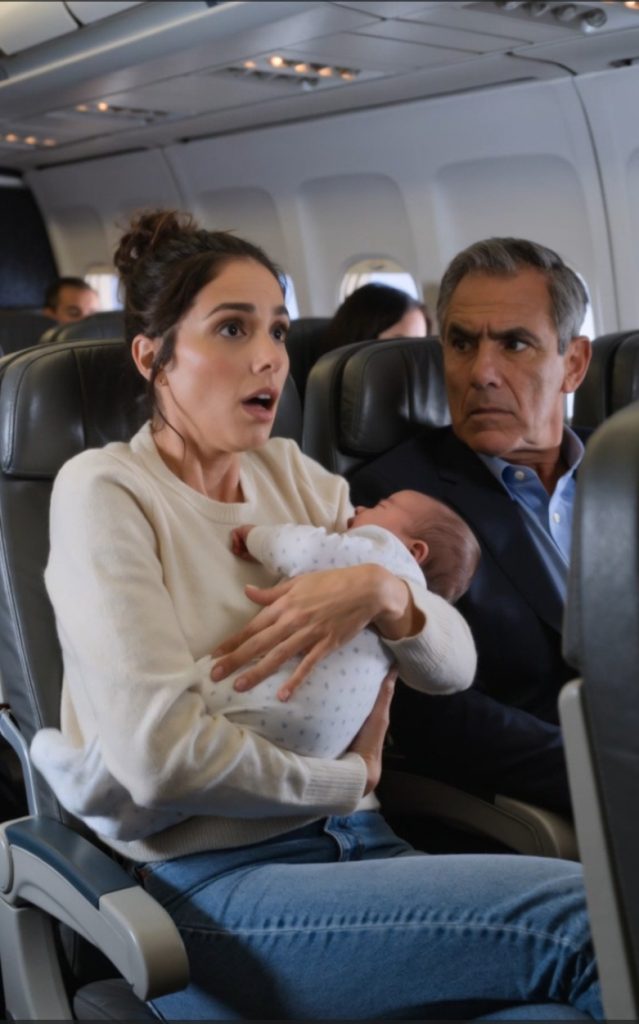
The young mother in seat 14B looked like she was barely holding herself together.
Her brunette hair was twisted into a messy bun that had come loose in pieces around her face. Her cream sweater was wrinkled at the cuffs. One knee bounced anxiously beneath her blue jeans as she cradled the infant against her chest and rocked as much as the narrow economy seat would allow.
“Baby, please stop crying,” she whispered.
It was not the voice of a woman annoyed by her child.
It was the voice of someone begging the world not to hate them.
The older man beside her in 14C kept his eyes closed.
He wore a navy suit jacket over a pale blue shirt, dressed too formally for a midday domestic flight. His gray hair was neatly combed, his jaw tight, his hands folded over one another like he was trying to preserve whatever dignity the crying had not already stolen from him.
He had tolerated five minutes.
Then ten.
At fifteen, his breathing changed.
At twenty, his eyes opened.
He turned slightly, not enough to offer help, only enough to look at the mother with the cold impatience of a man who believed discomfort was something other people created for him.
The baby screamed again.
A sharp, exhausted cry.
The mother flinched as if the sound hurt her too.
“I’m sorry,” she whispered, though no one had spoken to her. “I’m so sorry.”
The older man exhaled through his nose.
He was about to say something.
Not kind. Not useful.
Something polished and cruel enough to make the woman smaller.
But before the words left his mouth, her body changed.
Her eyes widened.
Her lips parted around a sudden gasp.
For one terrible second, she looked surprised by her own breath.
Then her head dropped sideways.
Her body went limp.
The baby kept crying in her arms.
The older man jerked back as the young mother collapsed against his shoulder, her cheek landing against the expensive wool of his jacket.
The irritation vanished from his face.
In its place came confusion.
Then alarm.
Then something deeper.
Fear.
“Miss?” he said, his voice suddenly thin. “Miss, can you hear me?”
She did not answer.
The baby wailed harder, trapped against a mother who no longer moved.
A passenger across the aisle gasped. Someone hit the call button. Far above them, a small orange light blinked in the ceiling.
The older man stared down at the unconscious woman leaning against him.
Then he saw the silver chain around her neck.
A small pendant had slipped from beneath her sweater.
It rested against his sleeve, swinging faintly with the vibration of the plane.
The pendant was shaped like a tiny compass.
On the back, engraved in worn letters, was a name he had not allowed anyone to say in three years.
Daniel.
The older man stopped breathing.
Because the crying baby in this cramped airplane row was not a stranger’s child.
And the unconscious woman on his shoulder had been searching for him.
Act II
His name was Arthur Bellamy, and people used to stand when he entered a room.
Not because he asked them to.
Because power taught people habits.
He had been a renowned pediatric heart surgeon before grief hardened him into something colder. Then he became the founder of the Bellamy Children’s Trust, a medical charity with his name on hospital wings, research grants, and glossy brochures showing smiling infants held by grateful parents.
The public knew him as generous.
His staff knew him as demanding.
His son had known him as impossible.
Daniel Bellamy had been everything Arthur was not. Warm where Arthur was precise. Reckless where Arthur was disciplined. Daniel had hated formal dinners, hospital galas, and the suffocating pressure of being the only son of a famous man.
“You don’t want me,” Daniel once said during their last real argument. “You want a second version of yourself.”
Arthur had responded with silence.
It was one of his specialties.
A week later, Daniel left Boston for the West Coast with a backpack, a camera, and the kind of confidence only twenty-seven-year-olds have before life teaches them about consequences.
Three months after that, he was dead.
A highway accident in Oregon. Rain. A truck that crossed lanes. A phone call at 2:13 in the morning that split Arthur’s life into before and after.
There had been no wife listed in the police report.
No child.
No young woman with a messy bun and a compass necklace.
Arthur buried his son beneath marble and work.
He gave more speeches. Donated more money. Cut more ribbons. He told himself pain could be converted into usefulness if a man was disciplined enough.
Then the letters began.
At first, his assistant filtered them. That was normal. People wrote to Arthur constantly asking for help, money, influence, miracles. Some were genuine. Some were desperate. Some were cruel.
One name appeared more than once.
Leah Morgan.
Arthur had seen it only briefly, printed on a summary his office prepared.
Claiming personal connection to Daniel Bellamy. Requesting urgent meeting. Mentions infant daughter. No documentation verified.
Arthur remembered pushing the paper away.
“Refer it to legal,” he had said.
His attorney, Claudia Vance, handled it.
That was what attorneys were for.
She told him the woman was unstable. That she had no proof. That grief made families vulnerable to opportunists. That Daniel, kind and impulsive as he was, had attracted people who misunderstood attention for commitment.
Arthur believed her because it cost him less.
Because if Leah Morgan was lying, he could remain angry.
But if she was telling the truth, then Daniel had died with a child in the world.
And Arthur had abandoned both of them.
Now, thirty thousand feet above the country, the woman from those letters was unconscious against his shoulder.
The baby cried in her arms.
And the compass pendant, Daniel’s pendant, lay against Arthur’s sleeve like evidence from a life he had refused to examine.
A flight attendant hurried down the aisle.
“Sir, what happened?”
Arthur looked up, but for a moment he could not make his voice work.
“She fainted,” he said finally. “She just collapsed.”
“Is the baby secure?”
Arthur blinked, then realized Leah’s arms had loosened.
He moved quickly, supporting the infant with both hands while the flight attendant leaned in. The baby was warm, furious, terrified, wearing a white patterned onesie and a hospital bracelet too small for Arthur to read at first.
“Do we have any medical professionals on board?” the flight attendant called.
A woman three rows back stood immediately. “I’m an ER nurse.”
Arthur almost said he was a doctor.
But his mouth closed around the words.
For years, he had introduced himself that way with ease. Dr. Arthur Bellamy. Surgeon. Founder. Authority.
Now he felt like none of those titles belonged to him.
The nurse slid into the aisle, checked Leah’s pulse, asked for water, space, oxygen.
Passengers who had been irritated minutes before now sat frozen with guilt on their faces.
The baby’s crying weakened into exhausted sobs.
Arthur adjusted his hold on the child, awkward at first, then with a muscle memory he thought age and grief had destroyed.
Daniel had once fit in his arms this way.
Small. Furious. Alive.
The infant’s bracelet turned as she kicked.
Arthur saw the name.
Emma Morgan.
Then beneath it, printed in smaller text, a destination note from a children’s hospital transfer program.
Boston Pediatric Cardiac Center.
Arthur’s hospital.
His foundation.
His breath caught again.
Leah Morgan had not been chasing money.
She had been flying across the country with a sick baby and a folder of unanswered pleas.
And Arthur had been sitting beside her, angry about the noise.
Act III
Leah regained consciousness somewhere over Ohio.
Not fully.
Not peacefully.
Her eyes opened in panic, searching first for the baby.
“My daughter,” she rasped.
“She’s here,” the nurse said gently. “She’s safe.”
Arthur sat rigidly beside them, holding Emma with both arms. The baby had quieted at last, her small face damp from crying, her fingers curled against the lapel of his suit jacket.
Leah saw him.
Then she saw the pendant in his hand.
Her face changed.
Not with relief.
With heartbreak.
“You,” she whispered.
Arthur looked down.
The word struck harder than any accusation.
“You know me,” he said.
Leah’s eyes filled. “I wrote to you.”
The nurse glanced between them but stayed focused on Leah’s condition.
Arthur could feel passengers listening. He could feel the cramped cabin pressing in from every side. There was nowhere to hide. No office door to close. No assistant to dismiss the moment before it became human.
“I didn’t read them,” he said.
Leah gave a small, bitter laugh that turned into a weak cough.
“No. Of course you didn’t.”
Arthur flinched.
Emma shifted in his arms, and Leah’s gaze softened immediately. Whatever anger she had carried, motherhood rose over it.
“She has Daniel’s eyes,” Leah whispered.
Arthur looked at the baby.
He had been afraid to notice.
But there it was.
Not exactly Daniel’s face. Not a copy.
Something worse.
A living echo.
The nurse asked Leah questions. Had she eaten? Had she slept? Any conditions? Medication? Leah answered in fragments. Two nights without real rest. A delayed connection. Emma’s crying from ear pressure and discomfort. Leah had given the baby prescribed medication on schedule, but had skipped her own food to save time and money.
Arthur listened, each detail carving a deeper line through him.
Then Leah reached weakly toward the bag under her seat.
“Folder,” she said. “Please.”
The flight attendant retrieved it.
It was cheap, bent at the corners, held together with a rubber band. Arthur recognized his own name on the first page.
Dr. Arthur Bellamy.
There were copies of emails. Certified mail receipts. A birth certificate. Medical records. A photograph of Daniel on a beach, younger than Arthur remembered him, laughing with his arm around Leah’s shoulders.
And then the document that made the cabin disappear.
A paternity test.
Daniel Bellamy listed as biological father.
Probability: 99.99%.
Arthur stared at it until the numbers blurred.
Leah watched him without mercy.
“I didn’t want anything from you at first,” she said. “Daniel and I were going to tell you together after Emma was born. He was scared, but he wanted to. Then the accident happened.”
Arthur closed his eyes.
“He never told me.”
“He tried,” Leah said. “He called you the night before he died.”
Arthur remembered that call.
He had been at a donor dinner. Daniel’s name had lit up his phone, and Arthur had silenced it because he was angry and proud and certain there would be time later.
There had not been time later.
Leah’s voice shook. “After Emma was diagnosed, the doctors said your foundation might help. They said her best chance was in Boston. I wrote. I called. Your attorney told me to stop exploiting your grief.”
Arthur’s head snapped up.
“She said that?”
Leah looked at him as if the question itself exhausted her.
“She said if I kept contacting you, she would make sure no hospital connected to your name ever took me seriously.”
Arthur went cold.
Claudia Vance had been with him for eleven years. She controlled access, reviewed claims, protected the foundation from fraud.
Protected him, he had thought.
Now he understood that protection could become a cage.
And sometimes, the person holding the key called it loyalty.
The plane dipped slightly, and Emma startled in Arthur’s arms. He held her closer before he realized he was doing it.
Leah saw.
For the first time, her expression cracked.
“She cries because she hurts,” Leah said. “Not because she’s spoiled. Not because I’m careless. She’s tired. I’m tired. We’ve been trying to get someone to listen for months.”
Arthur looked at the baby.
Then at the rows of passengers who had all heard Emma cry and silently judged the woman holding her.
He had been one of them.
Worse than one of them.
He had been the man she was trying to reach.
And by the time the captain announced an emergency medical priority landing in Chicago, Arthur Bellamy knew the truth.
His granddaughter had spent her whole life waiting outside a door he had never opened.
Act IV
The airport medical team met them at the gate.
By then, the entire cabin had changed around Leah.
Passengers who had glared at her earlier now stood back with embarrassed gentleness. Someone retrieved her carry-on. Someone else folded Emma’s blanket. The man across the aisle, who had muttered under his breath during the crying, could not look Leah in the eye.
Arthur walked behind the paramedics with Emma in his arms until Leah reached back blindly.
“Please,” she said.
He understood.
He gave the baby back to her.
Not because he wanted to.
Because he had no right to keep what he had not protected.
At the airport clinic, Leah was treated for exhaustion and dehydration while Emma was examined by a pediatric team. Arthur made calls from the hallway, each one quieter and more dangerous than the last.
First to Boston.
Then to the Bellamy Children’s Trust.
Then to Claudia Vance.
She answered briskly.
“Arthur, I’m in a meeting.”
“So am I,” he said.
A pause.
“What happened?”
“I’m standing in an airport clinic with Leah Morgan.”
Silence.
Arthur listened to it with a surgeon’s patience.
Claudia recovered. “Arthur, that woman has been warned—”
“She is the mother of Daniel’s child.”
Another silence.
Shorter this time.
Sharper.
“That was never verified.”
“I’m looking at the test.”
“Documents can be fabricated.”
“I’m looking at my granddaughter.”
The word changed him as he said it.
Granddaughter.
It entered the world late, but it entered whole.
Claudia lowered her voice. “You are emotional. Do not make decisions from guilt.”
Arthur looked through the clinic window.
Leah sat on an exam bed, pale but awake, Emma tucked against her chest. The baby had stopped crying. One tiny hand rested against her mother’s sweater.
“No,” Arthur said. “Guilt would have been useful years ago.”
“Arthur—”
“You threatened her.”
“I protected you.”
“You buried my son’s child.”
Claudia said nothing.
That was enough.
By the end of the hour, Claudia was suspended from all foundation duties pending investigation. Arthur ordered every blocked communication from Leah Morgan recovered. He arranged a medical transfer not through charity paperwork, not through public relations, but through the emergency network he should have activated months earlier.
Then he returned to Leah.
She looked up when he entered, guarded and exhausted.
“I don’t want your pity,” she said.
“You shouldn’t.”
“I don’t want cameras. I don’t want a press release. I don’t want Emma used to make you look kind.”
Arthur absorbed that without defense.
“You’re right.”
Leah studied him, surprised by the absence of argument.
“I want her treated,” she said. “That’s it.”
“She will be.”
“I mean by doctors who see her as a baby, not a Bellamy scandal.”
Arthur nodded. “I’ll make sure of it.”
Her eyes narrowed. “No. You’ll help make sure of it. There’s a difference.”
He almost smiled at that, but did not.
Because she had Daniel’s courage.
Or perhaps Daniel had loved her because she had always had it.
Emma stirred, her face turning toward Arthur’s voice. Her eyes opened briefly, unfocused but bright.
Arthur stepped closer, then stopped.
“May I?” he asked.
Leah hesitated.
The hesitation was earned.
Finally, she nodded.
Arthur touched two fingers gently to Emma’s tiny hand. The baby gripped him with startling strength.
A sound escaped him.
Not a sob exactly.
Something older.
Something that had been locked in his chest since the night Daniel died.
Leah looked away, but her own eyes were wet.
For a moment, the airport clinic disappeared. There was no foundation, no scandal, no attorney, no airplane full of witnesses.
There was only a grieving father, a wounded mother, and a baby whose heart had become the center of both their lives.
Then Arthur’s phone buzzed.
A message from his assistant.
Reporters asking about emergency landing. Claudia contacted board privately. Advising against involvement with Morgan case.
Arthur stared at the screen.
Claudia was already moving.
Trying to control the story before truth could reach the ground.
Arthur slipped the phone into his pocket.
When he looked up, Leah was watching him.
“She’ll make me look like a liar,” Leah said quietly. “She already tried.”
Arthur’s face hardened.
“Not this time.”
Because this time, the woman Claudia had tried to erase was not alone.
And the baby everyone had complained about had finally made the right person listen.
Act V
By morning, Emma Morgan was in Boston.
Not as a charity case.
Not as a rumor.
As a patient with a name, a diagnosis, a medical team, and a grandfather sitting silently outside the glass wall of the pediatric cardiac unit.
Arthur did not demand special treatment.
He demanded proper treatment.
There was a difference, and for the first time in years, he cared about it.
Leah stayed beside Emma through every test. She asked careful questions. She wrote down medication names. She refused to be intimidated by white coats, specialists, or the Bellamy name printed on half the building.
Arthur watched her and understood why Daniel had loved her.
She was tired, frightened, and furious.
But she did not bend.
Emma’s condition was serious, but treatable. The doctors explained the plan in calm voices. Medication first. Monitoring. A procedure when she was stronger. The kind of future that sounded fragile until someone said it clearly enough to believe.
Leah cried only after the doctor left.
She turned toward the wall and covered her mouth with her sleeve, trying not to make noise.
Arthur stood in the doorway, unsure whether he had the right to comfort her.
He decided he did not.
So he set a cup of water on the table and stepped back.
Leah noticed.
After a long moment, she said, “Daniel used to do that.”
Arthur looked at her.
“What?”
“Bring water when he didn’t know what else to say.”
The words struck him softly.
That was almost worse.
Arthur sat in the chair by the window.
For the first time, Leah told him the parts he had missed.
Daniel holding Emma the day she was born, terrified he would drop her. Daniel taking a hundred photographs of the same tiny foot. Daniel saying he wanted to call his father but needed one more day to figure out how.
One more day.
Arthur looked down at his hands.
“I silenced his call,” he said.
Leah went quiet.
“The night before the accident,” Arthur continued. “He called. I was angry with him. I thought I was teaching him that choices had consequences.”
His voice broke.
“He was trying to tell me she existed.”
Leah did not rush to forgive him.
That, too, was right.
Some wounds should not be closed just because the person who caused them finally understands.
Weeks passed.
Claudia Vance resigned before the board could remove her, but the investigation continued. Records showed she had intercepted Leah’s letters, dismissed her medical requests, and warned partner hospitals away from “unverified personal claims.” The foundation issued a public apology, but Leah refused to stand beside Arthur for it.
“I’m not your redemption photo,” she told him.
Arthur said, “No.”
And he meant it.
He created a new patient advocacy office in Daniel’s name, but Leah demanded independent oversight before she would allow Emma’s story to be connected to it. Arthur agreed. Not because it looked good. Because she was right.
Slowly, painfully, life rearranged itself.
Arthur learned Emma’s schedule. He learned how she liked to be held upright after feeding. He learned that she smiled at ceiling fans and hated cold wipes. He learned that Leah took her coffee black only because she could not afford to waste money on extras, not because she liked it that way.
One afternoon, months after the flight, Emma was cleared to go home.
The hospital room was bright, filled with flowers Arthur had not sent because Leah had banned dramatic gestures. Instead, he brought one small thing.
A silver compass pendant.
Daniel’s pendant had been cleaned and repaired. Beside it, on a new chain, was a smaller matching charm engraved with Emma’s initials.
Leah stared at it for a long time.
“She doesn’t need a Bellamy name to matter,” she said.
Arthur nodded. “I know.”
“She already mattered.”
“I know that too.”
Leah touched the small charm, her face softening despite herself.
When Arthur reached the lobby with them, the automatic doors opened to a wash of afternoon light. For a moment, he remembered the airplane cabin. The crying. His irritation. Leah’s head falling onto his shoulder. The terrible second when he had looked at her like an inconvenience before understanding she was family.
He would spend the rest of his life ashamed of that moment.
But shame, he had learned, was useless unless it taught your hands what to do next.
Outside, Leah adjusted Emma’s blanket.
Arthur stood beside them, not leading, not claiming, not performing.
Just present.
Emma opened her eyes.
Arthur leaned down slightly.
“Hello, sweetheart,” he whispered.
The baby blinked at him, then wrapped her fingers around the edge of his jacket.
Leah watched the tiny grip.
Then, after a long silence, she said, “We’re staying in Boston for the follow-ups.”
Arthur barely breathed.
“There’s a guest apartment near the hospital,” he said carefully. “It’s yours for as long as you need. No conditions.”
Leah looked at him.
“No conditions,” he repeated.
She gave one small nod.
It was not forgiveness.
Not yet.
But it was not exile either.
Arthur looked down at Emma’s hand clutching his jacket and felt the strange mercy of being allowed to begin too late.
On that airplane, he had thought the crying baby was ruining his peace.
In truth, she was breaking open the silence that had ruined his family.
And when Emma cried again in the hospital parking lot, Arthur did not flinch.
He reached for the diaper bag, found the bottle, and listened.