Act I
The semi-truck thundered past so close that Officer Daniel Hayes felt the wind slap against his uniform.
For one terrible second, all he saw was the boy.
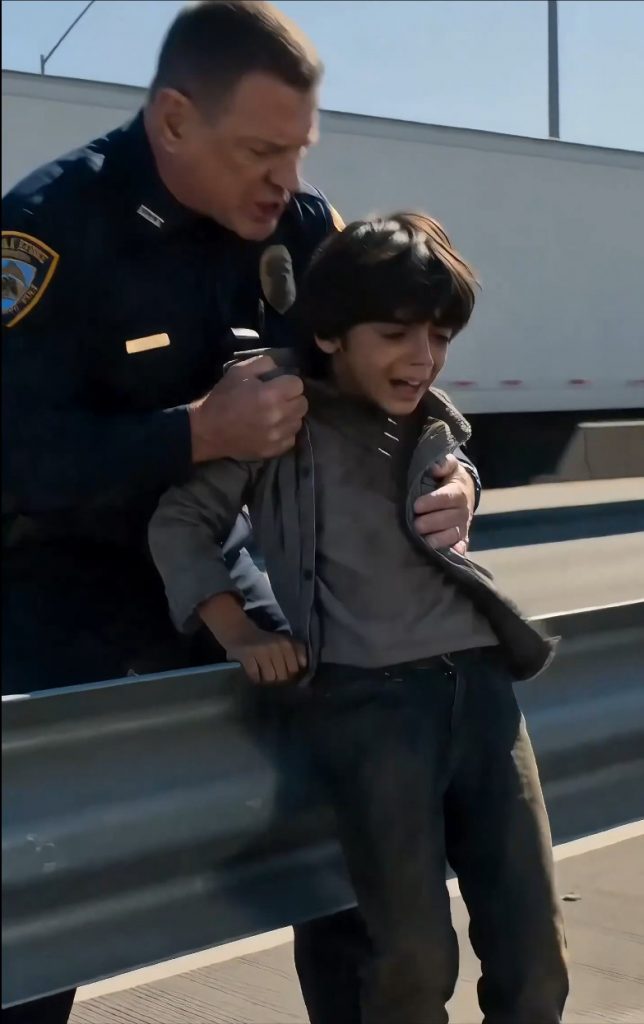
Small hands clinging to the highway railing. Dirty sneakers scraping against concrete. A tattered gray jacket caught on the metal barrier as the child tried to swing one leg over the side.
Daniel ran.
“Hey! Stop!”
The boy did not stop.
He was sobbing so hard his shoulders shook, but he kept trying to climb over, his face turned toward the drop beneath the overpass. Below them was nothing but a steep slope of dry grass, dirt, weeds, and shadow.
One slip, and the child would be gone.
Daniel grabbed him by the back of the jacket and hauled him away from the edge.
“Why would you do something so reckless?” he shouted.
The boy screamed and fought against him.
Not like a child trying to escape punishment.
Like a child being pulled away from the only thing in the world that mattered.
“Let me go!” he cried. “Please, please, I have to get him!”
Daniel locked both hands around the boy’s shoulders and put his body between the child and the railing.
“Get back here.”
Cars rushed by. Tires hissed on asphalt. A horn blared somewhere behind them. The bridge vibrated under another passing truck.
The boy twisted in Daniel’s grip, pointing wildly through the railing.
“Look at him,” he sobbed. “Please.”
Daniel was still angry. Still scared. Still thinking of accident reports, grieving parents, and how close this boy had come to falling.
Then he followed the boy’s finger.
At first, he saw only weeds.
Then dirt.
Then a black shape half-hidden below the overpass.
A suitcase.
Daniel leaned closer to the railing, keeping one hand on the boy.
The black suitcase sat in the grass like trash thrown from a car. Its zipper was not fully closed. Something pale rested near the opening.
Daniel narrowed his eyes.
The boy whispered, “He’s in there.”
The world seemed to drop away beneath the traffic noise.
Because the pale thing near the zipper was not cloth.
It was a baby’s hand.
Daniel’s anger vanished so completely it left him cold.
He looked down at the suitcase.
Then at the trembling boy beside him.
And in that moment, he understood the child had not been trying to fall.
He had been trying to save a life.
Act II
The boy’s name was Caleb Ward.
Daniel learned that later, after the rescue team arrived, after the paramedics climbed down the embankment, after the black suitcase was opened just enough to lift the infant out and wrap him in a silver emergency blanket.
But on the bridge, Caleb was only a crying child with dust on his face and terror in his eyes.
“He’s my brother,” Caleb kept saying. “He’s my baby brother.”
Daniel held him back while firefighters moved below. The slope was steeper than it looked from the road, scattered with loose dirt and broken brush. Caleb would never have made it down safely. But that did not mean he had been wrong to try.
The baby was alive.
Small. Cold. Weak.
But alive.
When the paramedic called up, “We’ve got a pulse,” Caleb collapsed against Daniel like every bone in him had given out.
Daniel caught him.
For years, Daniel had been known as a hard officer.
Not cruel. Not dirty. Just hard.
He had spent twenty-eight years pulling people away from bad decisions, bad nights, bad roads, bad men. He had learned to raise his voice before panic could spread. He had learned to make himself bigger than the danger in front of him.
But holding Caleb on that bridge, Daniel felt something inside him crack.
The boy could not have been more than nine.
Too thin. Too dirty. Too used to apologizing before anyone asked him a question.
His jacket had a torn cuff. One sleeve was stained with mud. His hair was dark and messy, sticking to his forehead from sweat and tears.
“Where are your parents?” Daniel asked gently.
Caleb shook his head.
“My mom was trying to find help.”
“Where is she?”
The boy’s lip trembled. “I don’t know.”
Daniel crouched in front of him, lowering his voice beneath the traffic.
“Caleb, did someone put your brother down there?”
The boy stared at the railing.
Then he nodded once.
The answer came so quietly Daniel almost missed it.
“The lady said he was too much trouble.”
Daniel’s jaw tightened.
“What lady?”
Caleb pulled his torn sleeve over his hand and wiped his face.
“The one from the house.”
That was when Daniel noticed the paper bracelet around Caleb’s wrist.
It was not from a hospital.
It was from a shelter.
Green band. Faded ink. County family intake center.
Daniel knew the place. Everyone on patrol knew it. A temporary stop for families in crisis, foster placements, emergency custody transfers, and children who had nowhere else to sleep that night.
Caleb followed his gaze and quickly covered the bracelet.
As if being seen was dangerous.
Daniel’s radio crackled. The dispatcher confirmed an ambulance was on the way. Another unit was blocking the right lane. Traffic slowed, drivers leaning to see what had happened.
Below the bridge, the paramedic carried the infant toward the service path.
Caleb pressed himself against the railing.
“Is he okay?”
Daniel looked down.
The baby’s face was hidden by the emergency blanket. The paramedic was moving fast but carefully.
“He’s getting help,” Daniel said. “You did the right thing.”
Caleb did not look comforted.
He looked terrified of what would happen next.
That fear stayed with Daniel long after the ambulance doors closed.
Because most children are afraid after danger.
Caleb looked afraid of being found.
And when Daniel asked his last name, the boy hesitated before answering.
Not because he had forgotten.
Because someone had told him never to say it.
Act III
At the hospital, Caleb refused to let go of the baby blanket.
Not the baby. The blanket.
A thin blue one with tiny stars printed across it, pulled from inside the suitcase after the paramedics took his brother. Caleb held it to his chest like it was proof the child existed.
Daniel sat beside him in a quiet consultation room while doctors examined the infant down the hall.
A nurse brought Caleb crackers and juice. He stared at them for a long time before eating, as if waiting for someone to take them away.
“What’s your brother’s name?” Daniel asked.
Caleb whispered, “Micah.”
“Micah Ward?”
The boy nodded.
“And your mom?”
His small fingers tightened around the blanket.
“Lena.”
Daniel wrote the name down.
Lena Ward.
Something about it bothered him.
Not recognition exactly.
A scrape against memory.
He had heard that name recently. Maybe in a report. Maybe from dispatch. Maybe from one of the missing-person bulletins that crossed his desk every morning and turned into background noise because there were too many.
He stepped outside and called it in.
Ten minutes later, the answer came back.
Lena Ward had been reported missing two nights earlier.
Not by family.
By a nurse at a free clinic.
The report said Lena had arrived with two children, one infant and one older boy, exhausted and frightened. She had asked about emergency housing. Before the clinic social worker could meet with her, a woman arrived claiming to be Lena’s aunt. Lena left with her. The nurse felt something was wrong and called it in.
The woman’s name was Diane Mercer.
Daniel stopped walking.
Mercer.
That name he knew.
Diane Mercer ran Bright Haven Family Services, a private foster-placement agency that had contracts with the county. She smiled in newspaper photos beside judges and donors. She gave speeches about protecting vulnerable children. She wore pearls to charity breakfasts and quoted Scripture whenever a camera was nearby.
Daniel had met her once after a runaway case.
He remembered disliking her instantly.
She had looked at frightened children the way some people looked at paperwork.
Necessary. Inconvenient. Manageable.
Daniel returned to Caleb’s room.
The boy looked up quickly, scanning Daniel’s face for bad news.
“Caleb,” Daniel said, “did Diane put Micah under the bridge?”
The child went white.
That was answer enough.
Daniel sat slowly.
“You’re not in trouble.”
Caleb’s eyes filled again. “She said nobody would believe me.”
“I believe you.”
“She said Mom didn’t want us anymore.” Caleb’s voice broke. “But Mom wouldn’t leave Micah. She wouldn’t.”
Daniel believed that too.
He had spent enough years around abandoned children to know the difference between being left and being taken.
“What happened at the house?” he asked.
Caleb looked toward the door, terrified someone might be listening.
Daniel closed it.
The story came out in pieces.
A big house outside town. White fence. A room with two mattresses. Other children Caleb never got to speak to for long. Diane telling Lena she could help if Lena signed temporary guardianship papers. Lena refusing. A man taking Lena away in a car “to calm down.” Caleb hearing Micah cry all night.
Then, that morning, Diane put Caleb and Micah in a van.
“She said we were going somewhere safe,” Caleb whispered. “But then Micah kept crying. She got mad.”
Daniel’s hands curled into fists beneath the table.
Caleb looked down.
“She stopped on the bridge road. She threw the suitcase down there. I screamed. She told me if I told anyone, she’d say I did it.”
Daniel had to look away.
Not from disbelief.
From rage.
But he kept his voice steady.
“How did you get out of the van?”
“I bit her.”
For the first time all day, Caleb sounded almost proud.
“She opened the door to grab me, and I ran. I ran back to the bridge because Micah wasn’t crying anymore.”
Daniel looked at this small boy in the oversized jacket, this child who had bitten through fear, run along a highway, climbed a railing, and tried to reach his baby brother alone.
“You saved him,” Daniel said.
Caleb shook his head hard.
“No. Not yet.”
Daniel leaned closer.
“What do you mean?”
Caleb reached into the pocket of his dirty jacket and pulled out a folded photograph.
It showed a young woman with tired eyes, holding Caleb with one arm and baby Micah with the other. Behind them stood a faded blue motel door.
On the back, written in shaky blue ink, were five words.
If anything happens, find Hayes.
Daniel stared at the name.
Find Hayes.
His own name.
And suddenly he knew why Lena Ward had sounded familiar.
She was not just a missing mother.
She was the daughter of the man Daniel had failed fifteen years ago.
Act IV
Fifteen years earlier, Daniel Hayes had arrested a mechanic named Samuel Ward.
The case had looked simple.
Stolen car parts. Fraudulent invoices. A witness statement. A signed confession.
Samuel had gone to prison insisting he had been framed by a business partner with better lawyers and richer friends. Daniel had not believed him. Young officers often trust clean paperwork too much.
Samuel died two years after his release.
By then, Daniel had learned the truth.
The evidence had been twisted. The partner had paid someone to lie. Samuel Ward lost his garage, his home, and custody of his teenage daughter before the case quietly fell apart.
Daniel had carried that mistake for years.
He had tried to find Samuel’s daughter.
Lena.
But she had disappeared into foster homes and county systems that swallowed names and spit out case numbers.
Now her son sat in front of him with a photograph that said, find Hayes.
Daniel’s throat tightened.
Lena had known his name.
Not as a savior.
As the officer who owed her family a debt.
Daniel stood so quickly the chair scraped the floor.
Within an hour, police were at Bright Haven Family Services.
Diane Mercer greeted them in the foyer with her usual soft smile.
She wore a cream blouse, gold earrings, and the calm expression of someone who believed reputation was stronger than truth.
“Officer Hayes,” she said. “What a surprise.”
“Where is Lena Ward?”
Diane blinked once.
A small mistake.
“I’m not familiar with that name.”
Daniel held up the photograph.
Her smile faded.
Behind him, two detectives moved down the hallway with a warrant. Another officer checked the garage. A child-protection supervisor arrived with a county team, faces grim, clipboards ready.
Diane’s voice sharpened.
“This is harassment. My agency works with the county.”
“Not anymore,” Daniel said.
They found Lena in a locked room behind the old office wing.
Alive.
Weak.
Terrified.
But alive.
When she saw Daniel, she tried to stand and nearly fell.
“My boys,” she whispered.
“They’re alive,” Daniel said. “Both of them.”
Lena covered her mouth and broke.
Daniel turned away just enough to give her privacy while the medic checked her. He had seen people cry from pain before. From fear. From shock.
This was different.
This was a mother’s soul returning to her body.
The investigation widened fast.
Bright Haven’s clean image cracked open within hours. Hidden records were found in a locked filing cabinet. Temporary guardianship forms with forged signatures. Payments from couples desperate to adopt outside normal channels. Children moved without proper review. Parents labeled unstable when they became inconvenient.
Diane Mercer had built an empire on other people’s desperation.
She knew which mothers had no money. Which fathers were absent. Which children had no grandparents waiting in a clean living room with a lawyer. She knew how to make a poor parent look irresponsible on paper.
Lena had been targeted because of Micah.
A healthy infant was valuable to the wrong kind of people.
But Lena had refused to sign.
So Diane had planned to make her disappear from the story.
Caleb had ruined everything by running.
Micah had survived because his brother refused to let the highway be louder than his love.
That evening, Daniel stood outside the pediatric unit as Lena was wheeled in to see her sons.
Caleb saw her first.
For a second, he did not move.
Then he ran.
Lena opened her arms, and Caleb crashed into her so hard the wheelchair shifted. A nurse caught it with one hand, smiling through tears.
Micah slept in a hospital bassinet nearby, tiny and wrapped in clean blankets. Monitors blinked softly around him.
Lena reached for him with shaking hands.
When the nurse placed the baby in her arms, Lena bowed her head over both her children.
Caleb held onto her sleeve like he would never let go again.
Daniel watched from the doorway.
He had spent fifteen years wishing he could undo one mistake.
He could not.
But he could stand there now and make sure no one turned this family into paperwork again.
Then Caleb looked over his mother’s shoulder.
“Officer Hayes?”
Daniel stepped closer.
Caleb’s voice was small.
“Are we safe now?”
Daniel looked at Lena.
At Micah.
At the boy who had climbed toward danger because love had left him no other choice.
“Tonight,” Daniel said, “yes.”
But by morning, he would make sure the whole city knew why they had not been safe before.
Act V
Diane Mercer’s arrest made headlines before noon.
By evening, Bright Haven Family Services had been shut down pending a full investigation. The county suspended its contracts. Judges demanded emergency reviews of placements connected to the agency. Parents who had been ignored for months began calling, showing up, bringing folders, photos, voicemails, and stories no one had wanted to hear until a suitcase under a bridge forced the truth into daylight.
Diane tried to deny everything.
People like her always do.
She claimed the records were misunderstood. She claimed Lena was unstable. She claimed Caleb was confused by trauma.
Then investigators recovered dash-camera footage from a passing truck.
It showed Diane’s van stopped near the overpass.
It showed Caleb running.
It showed enough.
Not everything.
Enough.
The rest came from the records, the locked room, the forged signatures, and the other children whose silence had finally been broken by one little boy’s scream.
Lena stayed in the hospital for three days.
Not because of injuries anyone could photograph for drama, but because exhaustion and fear had worn her down to almost nothing. She slept in a chair between Caleb’s cot and Micah’s bassinet, waking at every sound.
Daniel visited each day.
At first, he stood in the hall.
Then Lena asked him to come in.
“You knew my father,” she said.
Daniel nodded.
“I wronged him.”
Lena looked at him for a long time.
Her face was pale. Her hair had been brushed by a nurse. Micah slept against her chest while Caleb colored quietly at the bedside table.
“My dad said you came looking for us,” she said.
“I did. Too late.”
“He said that mattered anyway.”
Daniel did not know what to say.
Lena looked down at Micah.
“When I wrote your name on that photo, I didn’t know if you were good,” she said. “I just knew my father believed you regretted what happened. And sometimes regret makes people useful.”
Daniel almost smiled.
Samuel Ward had raised a strong daughter.
The weeks that followed were not simple, but they were honest.
Lena and her sons were moved into protected housing. Caleb started counseling with someone patient enough to let him sit in silence when words felt too big. Micah recovered steadily, gaining weight, crying louder, gripping fingers with surprising force.
Caleb visited the overpass once more.
Not because anyone made him.
Because he asked.
Daniel drove him there on a quiet morning after traffic had thinned. The bridge looked smaller in daylight. Less monstrous. The grass below had been cleared where the rescue team had climbed down.
A new temporary barrier stood along the railing.
Caleb stood beside Daniel, holding a stuffed bear the hospital had given Micah.
“I thought he was gone,” Caleb said.
Daniel kept his eyes on the road ahead.
“But you still tried.”
Caleb nodded.
“I was scared.”
“I know.”
“I thought you were mad at me.”
Daniel turned to him.
“I was scared too. Sometimes adults sound angry when they’re terrified.”
Caleb considered that.
Then he said, “You pulled me back.”
“Yes.”
“But you looked.”
Daniel swallowed.
Because that was the part that mattered.
Not the badge. Not the shouting. Not the report.
He had looked.
He had listened before it was too late.
Months later, when the court hearing finally came, Caleb testified from a small side room with a child advocate beside him. He did not have to face Diane. He did not have to be brave in the way adults like to demand from children.
He only had to tell the truth.
And the truth was enough.
Diane Mercer was convicted on multiple charges. Her network collapsed. Several families were reunited. Other cases reopened. The county director resigned after records showed years of ignored warnings.
At the final hearing, Lena held Micah in the back row while Caleb sat beside Daniel.
The judge praised Caleb’s courage.
Caleb looked uncomfortable with that.
Later, in the hallway, he tugged Daniel’s sleeve.
“Was I brave?”
Daniel crouched so they were eye level.
“You were terrified,” he said. “And you still helped your brother. That’s what brave means.”
Caleb nodded slowly, as if placing the definition somewhere safe.
A year after the bridge, Lena moved into a small yellow house on a quiet street with a fenced yard and a maple tree out front.
Nothing fancy.
Everything hers.
Caleb got a bike. Micah learned to crawl, then walk, then chase after his brother with the determined wobble of a child who had no memory of how close the world came to losing him.
Daniel visited on Sundays.
At first, he told himself it was to check in.
Eventually, he stopped lying.
He came because Caleb waited on the porch.
Because Lena trusted him enough to hand him Micah while she cooked.
Because some debts could not be repaid, but they could be honored.
One autumn afternoon, Caleb brought Daniel a drawing.
It showed a bridge, a police car, a boy, and a baby wrapped in silver.
Below the picture, in careful pencil, Caleb had written:
He looked.
Daniel stared at the words until his vision blurred.
Caleb shifted awkwardly. “Do you like it?”
Daniel folded the paper carefully, like it was an official document, like it mattered more than any report he had ever filed.
“I do,” he said. “Very much.”
That night, Daniel placed the drawing in a frame and set it on his desk at the station.
Officers came and went. Radios crackled. Phones rang. Cases stacked up the way they always did.
But whenever Daniel felt himself hardening again, whenever a call sounded routine, whenever a frightened voice came through dispatch sounding too strange to believe, he looked at the drawing.
A bridge.
A boy.
A baby.
He looked.
Because sometimes a child climbing over a railing is not trying to leave the world.
Sometimes he is the only one in the world still trying to save someone.
And sometimes the difference between tragedy and rescue is one adult willing to stop shouting long enough to see where he is pointing.