Act I
The carrot dropped first.
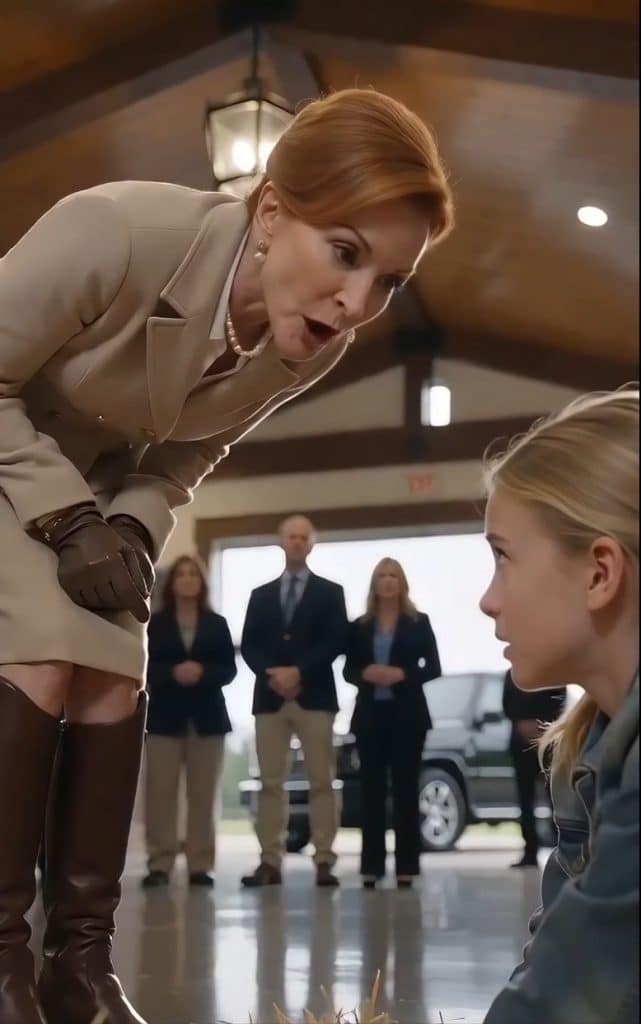
It fell from the little girl’s hand and landed in the straw near the champion’s front hoof, bright orange against the gold bedding. A second later, twelve-year-old Emma Dawson stumbled sideways and hit the wooden divider beside the stall.
The slap echoed through the stable.
The horse lifted his head sharply, nostrils flaring, polished coat catching the warm light. Buyers froze. Grooms stopped mid-step. A trainer near the aisle grabbed the lead rope instinctively, while the wealthy families gathered outside the stall stared in stunned silence.
Emma fell to one knee in the straw.
Her faded denim jacket twisted at the shoulder. Her riding boots slipped against the floor. One hand scraped lightly against the wooden divider, but she bit her lip and stayed quiet, trying with everything in her not to cry.
Above her stood Victoria Ashford.
Auburn hair. Beige riding coat. Leather gloves. Pearl earrings. A cold society smile that had vanished the moment Emma touched the champion horse.
Victoria looked down at the girl as if she had found dirt on a silver tray.
“Champions don’t belong to dirty little girls from nowhere,” she said.
The stable went colder than winter.
Behind Emma, the brass nameplate beside the stall gleamed under the lights.
Dawson Legacy.
But Victoria did not look at it.
She looked only at Emma’s old jacket, her scuffed boots, the small carrot near the horse’s hoof, and decided the girl had no right to stand beside something valuable.
Emma stayed low, one hand pressed to the straw.
The horse lowered his head toward her, soft and worried.
That small gesture made Victoria’s face twist harder.
“Don’t touch him,” she snapped. “That animal is worth more than your entire life.”
A few buyers gasped.
Still, no one moved fast enough.
Then hurried footsteps thundered down the stable aisle.
The stable manager, Jack Mercer, rushed in wearing a green stable jacket, riding boots, and a radio clipped to his belt. His weathered face went pale the moment he saw Emma in the straw.
He moved between Victoria and the girl without hesitation.
“Miss Dawson,” he said, voice shaking with controlled anger, “your father’s champion is ready for the auction.”
The crowd froze.
Victoria’s smile died.
Jack’s hand lifted toward the brass nameplate.
Dawson Legacy.
The horse lowered his head again, this time pressing gently toward Emma’s shoulder.
Victoria stared at the nameplate.
Then at the girl.
“Dawson?”
Act II
Emma Dawson had known Dawson Legacy before he had a name.
Before buyers whispered about him.
Before magazines called him the future of American racing bloodlines.
Before rich people in polished boots stood outside his stall and spoke about him like a painting, a stock, a trophy, anything except a living creature with a heartbeat and memory.
To Emma, he had first been a long-legged foal wobbling in the dawn.
She was seven then.
Her father, Thomas Dawson, had carried her into the foaling barn wrapped in his old jacket because she refused to miss the moment. The mare had been restless all night. The workers whispered. The rain tapped against the roof. Emma held her breath like the whole world might crack if she breathed too loudly.
Then the foal stood.
Awkward. Shaking. Beautiful.
Emma laughed so hard she cried.
“He looks like he forgot how legs work,” she whispered.
Her father smiled.
“Most of us start that way.”
The foal grew into Dawson Legacy because Emma named him that by accident.
One afternoon, after her mother’s funeral, Emma sat outside the stall with a book she was not reading. The foal nudged her sleeve again and again until she finally looked up.
“You’re the only thing around here not acting sad,” she told him.
Her father heard from the aisle.
The words broke him quietly.
After that, the foal became Legacy.
Not because he was bred from champions, though he was.
Because he had carried the Dawson family through grief without understanding he was doing it.
Thomas Dawson owned one of the most respected thoroughbred operations in Kentucky, but he had never acted like the kind of man who owned anything easily. His grandfather had started with two mares and a borrowed barn. His father nearly lost the land during a bad season. Thomas rebuilt it with discipline, risk, and a love for horses that made him impatient with people who only loved winning.
He taught Emma early.
A champion was not a machine.
A stable was not a showroom.
And bloodlines meant nothing without care.
“People will talk about horses like their value lives on paper,” he told her. “Don’t believe them. Value lives in how they are treated when no one is bidding.”
That lesson stayed with Emma.
It was why she still came to the stable in her old denim jacket even though her father could afford anything. It was why she cleaned tack with the grooms, learned every horse’s habits, and carried carrots in her pocket no matter how many times the staff teased her.
On auction day, she begged to see Legacy before the buyers arrived.
Thomas hesitated.
The private sale had become bigger than he wanted. Range Rovers lined the gravel outside. Wealthy buyers flew in from New York, Palm Beach, Dallas, and Dubai. Riding staff polished stalls until the wood shone. The brass nameplate had been buffed until it reflected the warm stable lights.
Emma hated it.
“He doesn’t like strangers staring,” she said.
“He’ll manage,” her father replied.
“Will you sell him?”
Thomas looked toward Legacy’s stall.
“That depends.”
“On the price?”
He looked back at her.
“On the person.”
That was the part the buyers did not know.
The auction was not simply about money. Thomas had written a condition into the sale. Dawson Legacy would only go to an owner who passed a care review and agreed to strict welfare terms. No vanity racing schedule. No harsh handlers. No using the horse as a status symbol until he broke under pressure.
Several buyers found the rules insulting.
Victoria Ashford found them personal.
She came from a famous racing family, or at least she liked to say so. Her money was newer than her accent. Her manners were expensive but thin. She had spent years buying her way into horse country circles that still treated her as an outsider behind her back.
Legacy was her chance to become untouchable.
If she owned him, people would have to say her name with respect.
That was what she believed.
So when she saw a girl in an old denim jacket feeding him a carrot beside the champion stall, she did not ask who Emma was.
She saw old clothes.
She saw a child.
She saw someone standing too close to the thing she wanted.
And she decided to remove her.
Act III
Emma heard the click of Victoria’s boots before the woman spoke.
The stable had been full of soft sounds until then. Horses shifting in straw. Leather creaking. Low voices from trainers. The faint hum of wealthy people trying to seem calm while silently calculating how much they were willing to spend.
Legacy’s ears flicked toward the aisle.
Emma turned with half a carrot still in her hand.
Victoria stopped in front of her, gloved hands clasped, lips curved into a smile that did not reach her eyes.
“What are you doing?”
Emma straightened.
“Giving him a carrot.”
Victoria looked at the carrot as if it were offensive.
“This horse is being shown to serious buyers.”
“I know.”
“Then you should not be crowding his stall.”
Emma glanced at Legacy, who had already taken the carrot gently from her palm.
“He knows me.”
Victoria laughed softly.
That laugh brought attention.
A groom nearby looked over. A couple from Lexington paused beside the aisle. Two assistants lowered their tablets.
“He knows you?” Victoria said. “And who are you supposed to be?”
Emma swallowed.
She could have said her full name.
She almost did.
But her father had told her that morning not to let people treat her differently because she was his daughter. Watch first, he said. Listen first. Horses tell you who people are. So do people.
“I help here,” Emma said.
Victoria’s eyes moved over her faded jacket.
“That explains the clothes.”
Emma’s face warmed.
Legacy shifted behind her, pushing his nose toward the stall door.
Victoria stepped closer.
“Move.”
Emma did not.
Not because she was trying to be difficult.
Because Victoria had moved too close, too fast, and Legacy’s body had gone tense.
“He doesn’t like sudden movements,” Emma said quietly.
Victoria’s eyes narrowed.
“Do not lecture me about horses.”
“I’m not.”
“You are standing between me and a champion I intend to buy.”
Emma looked at her then.
Really looked.
And for the first time, she felt afraid not for herself, but for Legacy.
“You shouldn’t buy him if you think he’s just something to stand beside.”
The slap came fast.
It knocked Emma sideways into the wooden divider and down into the straw. The carrot dropped near Legacy’s hoof. The horse threw his head up, startled, while the crowd gasped and stepped back.
Victoria stood over Emma, breathing sharply.
“Champions don’t belong to dirty little girls from nowhere.”
The insult seemed to hang from the rafters.
Emma’s hand stung. Her cheek burned. But the worst part was Legacy pressing against the stall door, trying to reach her while strangers stared and nobody understood what he was asking.
She lifted her eyes.
Victoria’s gloved hand pointed toward the aisle.
“Get out before you spook him.”
Emma said nothing.
She reached for the carrot.
That was when Jack Mercer came running.
He had heard the horse react before he heard the gasp. Good stable managers notice horses first and people second. By the time he reached the stall, he had already seen enough to know something had gone terribly wrong.
Emma in the straw.
Victoria standing over her.
Legacy agitated.
The Dawson nameplate shining beside them.
Jack’s face hardened in a way the staff recognized immediately.
He was not just angry.
He was about to protect the family.
Act IV
Jack stepped in front of Emma.
“Mrs. Ashford,” he said, voice low, “back away from the stall.”
Victoria’s eyebrows lifted.
“Excuse me?”
“Now.”
Her mouth tightened.
“I was dealing with a trespassing child.”
Emma slowly pushed herself upright.
Jack turned to her first.
“Miss Dawson, are you hurt?”
The title changed the air.
Miss Dawson.
Several buyers looked toward the nameplate.
Dawson Legacy.
Victoria blinked, but arrogance fought panic for one more second.
“Miss Dawson?” she repeated.
Jack helped Emma stand with careful respect.
Then he faced the aisle and spoke clearly enough for every buyer, trainer, groom, and assistant to hear.
“Miss Emma Dawson is Mr. Dawson’s daughter. This is her father’s champion, and she has more right to stand beside him than anyone in this barn.”
The stable went silent.
Not ordinary silence.
Judgment silence.
Victoria’s face drained of color.
Her eyes moved from Emma’s scuffed boots to the horse, then to the brass nameplate, then back to the girl she had just slapped.
“Dawson?” she whispered.
Emma looked at her.
Legacy lowered his head again and stretched toward Emma, touching the sleeve of her denim jacket with his muzzle.
The gesture destroyed Victoria more completely than any accusation.
The horse knew.
The horse had known from the beginning.
Victoria tried to recover.
“I didn’t realize,” she said quickly.
Jack’s eyes sharpened.
“That she was Mr. Dawson’s daughter?”
Victoria swallowed.
“Yes. Obviously. This is a terrible misunderstanding.”
Emma’s voice came softly.
“You understood I was a child.”
Victoria froze.
The stable crowd shifted.
A groom near the far stall lowered his eyes. A trainer who had stayed silent looked ashamed. One wealthy buyer shook his head and stepped back from Victoria as if cruelty were contagious.
Victoria clasped her gloved hands.
“I thought she was interfering with a valuable horse.”
Emma looked at Legacy.
“He’s not valuable because people want to buy him.”
Victoria’s mouth opened, then closed.
Jack picked up the fallen carrot from the straw and set it on the stall ledge.
“Mrs. Ashford,” he said, “your buyer credentials are suspended.”
Her face hardened.
“You do not have authority to do that.”
A voice came from the far end of the aisle.
“Yes, he does.”
Thomas Dawson walked in from the main office, coat still open, jaw tight, eyes fixed on his daughter.
Emma’s composure broke for the first time.
“Dad.”
He reached her in three strides and knelt in the straw, taking her scraped hand carefully in his.
“You okay?”
She nodded, though her eyes filled.
Thomas looked at her cheek.
Then he stood.
When he turned toward Victoria, the warmth was gone from his face.
Victoria tried to smile.
“Mr. Dawson, I am mortified. I had no idea she was your daughter.”
Thomas stared at her.
“That seems to be the only part that embarrasses you.”
Her face tightened.
“I reacted poorly. The horse was being handled by someone I believed was unauthorized.”
Thomas looked at Legacy, who remained calm now that Emma was standing beside him.
“The horse seems to disagree.”
A few people murmured.
Victoria’s voice lowered.
“Let’s not damage a serious sale over one unfortunate moment.”
Thomas’s expression became still.
“There will be no sale to you.”
She stiffened.
“You can’t mean that.”
“I do.”
“I am prepared to make the highest offer in this room.”
Thomas glanced at the brass nameplate.
“My daughter just showed me exactly what your highest offer is worth.”
Victoria’s panic became anger.
“This is sentimental nonsense. Bloodlines like his belong with serious owners.”
Emma stepped closer to her father.
Thomas did not raise his voice.
“Bloodlines like his belong with people who understand that power is not permission.”
Jack nodded to security near the stable entrance.
Victoria looked around, realizing too late that the room had turned on her.
“Dawson?” she whispered again.
Thomas put one hand on Emma’s shoulder.
“Yes,” he said. “And you are done here.”
Act V
Victoria Ashford left the stable without seeing the champion walk.
That was the consequence that hurt her most.
Security escorted her down the polished aisle, past brass nameplates, fresh straw, and grooms who no longer lowered their eyes. Outside, her Range Rover waited among the others, glossy and useless beneath the gray Kentucky sky.
No one followed her.
No one pleaded on her behalf.
Inside the barn, Thomas called off the auction for one hour.
Not for the buyers.
For Emma.
She sat on an overturned tack trunk in the side room while Jack cleaned her hand and her father held a cold cloth wrapped in linen against her cheek. She kept insisting she was fine until Thomas finally said her name in the voice he used when she was little and pretending nightmares had not scared her.
“Emma.”
Her chin trembled.
“She shouldn’t have touched him like that,” she whispered.
Thomas closed his eyes.
Of course that was what she said.
Not, She hurt me.
Not, She embarrassed me.
She was thinking of the horse.
He pulled her close carefully.
“No,” he said. “She shouldn’t have touched either of you.”
Emma leaned into him.
For a while, the barn carried on without them. Hooves shifted. Staff murmured. Buyers waited in the viewing area, quieter than before. The whole stable seemed to understand that what had happened was not a disruption of business.
It was a test of it.
When Emma returned to the aisle, she wore the same faded jacket.
She refused to change.
Thomas did not ask again.
Legacy stood calm in the light, black mane brushed smooth, eyes soft as Emma approached. She lifted the carrot from the stall ledge and held it out. He took it gently, as he always did.
The crowd watched.
This time, no one called her dirty.
No one asked why she belonged.
The auction resumed, but Thomas changed the terms aloud.
“Before bidding continues,” he said, standing beside his daughter, “every buyer will receive the Dawson care agreement. This horse will not be sold to anyone who treats staff, children, grooms, or animals as accessories to their status.”
A few buyers looked uncomfortable.
One left.
Thomas let him.
The final buyer was not the richest person in the stable.
He was a former jockey turned trainer named Samuel Ortiz, backed by a family farm in Kentucky and a small group of investors who believed Legacy should race carefully and retire sound. He spoke to Emma first, not to flatter her, but to ask what Legacy disliked in the morning and whether he preferred peppermints or carrots.
Emma studied him.
“Carrots,” she said.
Samuel nodded seriously.
“Good to know.”
He won the right to buy the horse because Thomas trusted him.
Not because he bid the most.
Months later, Dawson Legacy won his first major race under Samuel’s care.
Emma watched from the rail beside her father, wearing the same repaired denim jacket. When Legacy crossed the line, the crowd roared, but Emma did not hear most of it. She saw only the horse slowing safely, ears flicking, rider gentle in the saddle.
That mattered more than the trophy.
Afterward, reporters asked Thomas about the controversial private sale and the buyer he rejected.
He did not name Victoria.
He said only, “A champion reveals character before he reveals speed.”
The quote traveled through racing circles quickly.
Some mocked it as sentimental.
Those people were never invited back to Dawson stables.
A year later, the Dawson family opened a youth horsemanship program for children who loved horses but could not afford elite barns. Emma helped design the first rule herself.
No child earns kindness through money.
It was painted on a small wooden sign near the entrance, just below a brass plaque with Legacy’s name.
On opening day, a little girl arrived in borrowed boots two sizes too big. She stood outside the stall aisle, nervous, hands tucked into her sleeves.
Emma recognized the look.
It was the look people get when beautiful places have taught them they might be asked to leave.
She walked over with two carrots.
“One for you to give,” Emma said, handing her one. “One for me, in case he decides he’s starving.”
The little girl smiled.
Together, they approached the stall.
Legacy lowered his head.
Gentle as ever.
Emma still remembered the slap sometimes.
The straw beneath her hands.
The carrot near his hoof.
Victoria’s voice saying champions did not belong to girls from nowhere.
But the memory no longer ended with shame.
It ended with the little girl in borrowed boots laughing as Dawson Legacy took a carrot from her palm.
It ended with her father standing beside the stable door, watching his daughter turn pain into welcome.
It ended with a champion horse teaching a room full of wealthy people that belonging was never about polished boots, family names, or the size of a bid.
Victoria Ashford had been wrong.
Champions did not belong to those who could buy them.
They belonged to those who knew how to be gentle when no one was impressed yet.