Act I
The white handkerchief slipped from her fingers before the room understood what had happened.
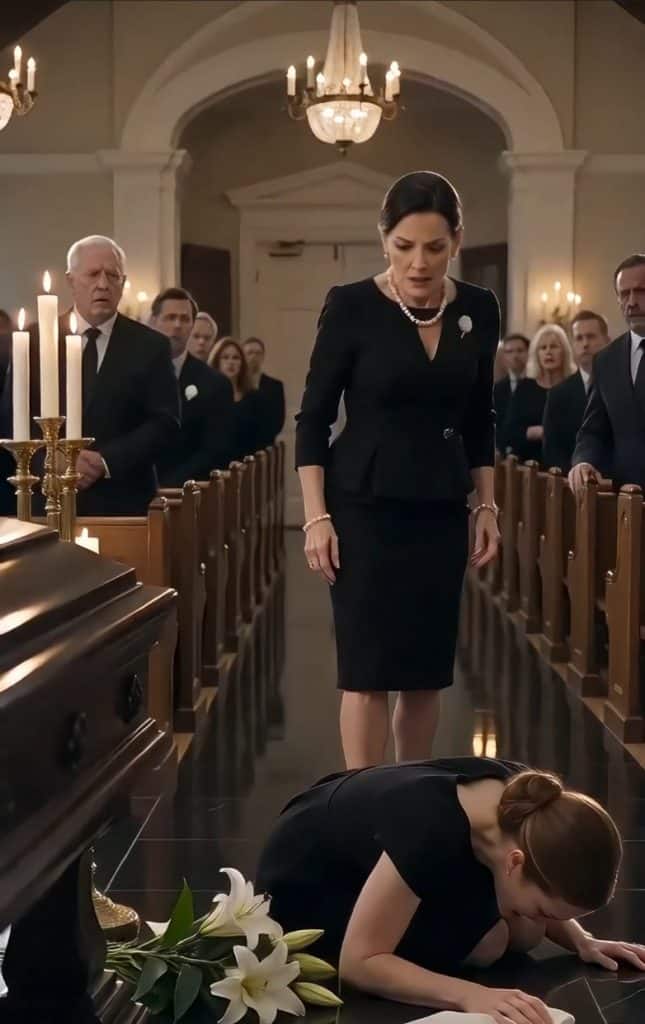
It drifted down beside a fallen spray of lilies, landing on the black marble floor like a small surrender. A second later, Emily Carter stumbled against the front pew, one hand catching the polished wood as pain flashed across her face.
The slap echoed through the chapel.
Quiet organ music faltered. Mourners in black turned from the portrait at the front. Candles trembled near the casket. Somewhere in the back row, a woman gasped and covered her mouth.
Emily stayed low beside the flower stand, her plain black dress creased at the knee, a faint mark appearing near her lip. Her brown hair, pinned neatly at the nape of her neck, had loosened slightly from the impact.
Above her stood Vivian Carter.
The widow.
Sleek black hair. Designer mourning dress. Pearl necklace. A face carved into perfect grief for everyone watching.
But her eyes were cold.
“Family sits in front,” Vivian whispered, loudly enough for the first rows to hear. “Strangers cry from the back.”
The words cut deeper than the slap.
Emily looked up at the large portrait of the deceased man above the lilies.
Henry Carter.
Her father.
The man whose voice she had not heard in person for nine years, but whose letters she had kept tied in a blue ribbon inside a shoebox under her bed.
She opened her mouth.
Nothing came out.
Vivian leaned closer, her funeral smile tightening.
“You don’t get to appear at the end and pretend you mattered.”
The mourners shifted. Relatives looked at one another. Ushers froze in the aisle, unsure whether to interrupt the widow of one of Chicago’s most respected real estate developers during his own funeral.
No one helped Emily up.
That was the humiliation Vivian wanted.
A grieving daughter on the floor.
A chapel full of people pretending they did not know grief when it wore a cheaper dress.
Then the chapel doors opened.
An older man in a dark suit stepped into the aisle, silver tie straight, glasses low on his nose, a sealed legal envelope in one hand.
Arthur Bell, Henry Carter’s attorney, stopped when he saw Emily near the flowers.
His expression changed at once.
He walked forward with controlled urgency.
Vivian turned sharply.
“Arthur, this is a private family matter.”
Arthur ignored her.
He stopped beside Emily and offered his hand.
“Ms. Carter,” he said, voice formal and clear, “your father named you sole executor of his estate.”
The chapel went silent.
Arthur lifted the sealed envelope beneath Henry Carter’s portrait.
Vivian’s face drained of color.
“Carter?” she whispered.
Emily slowly rose.
Act II
Emily Carter had been twelve when her father left the first time.
Not physically.
That came later.
The first leaving happened at dinner, when Henry Carter stopped laughing at her jokes because his phone kept lighting up beside his plate. It happened when he missed her school concert and sent flowers too large for the auditorium. It happened when his company grew so fast that people began calling him a visionary, and Emily realized visionary was what strangers called fathers who were never home.
Her mother, Laura, tried to protect her from the bitterness.
“Your father loves you,” she would say.
Emily believed her because she wanted to.
Then Laura got sick.
Henry paid for everything. The best doctors. The private rooms. The specialists who spoke gently and left quickly. But money did not sit beside a hospital bed at two in the morning. Money did not hold a woman’s hand when she was afraid.
Emily did.
She was seventeen when her mother died.
Henry came to the funeral in a black suit that looked too expensive for the small church. He cried quietly during the final hymn, then disappeared into a crowd of business partners before Emily could decide whether to forgive him.
A year later, he married Vivian.
Vivian was elegant in a way that made rooms behave differently. She knew which charities mattered, which donors to flatter, which newspaper photographers to call. She spoke of family legacy with the confidence of someone who had arrived late and immediately begun rearranging the portraits.
Emily tried.
At first.
She accepted lunch invitations. She answered polite questions. She sat through dinners where Vivian called her “sensitive” whenever Emily mentioned her mother. Slowly, Vivian learned the exact shape of the wound and pressed it whenever Henry looked away.
“You and your father need time,” Vivian would say.
Then she made sure they never had any.
Phone calls were missed. Letters went unanswered. Visits were rescheduled. Vivian controlled Henry’s calendar, his home, his events, and eventually the story of his life.
In that story, Emily became difficult.
Ungrateful.
Distant by choice.
By twenty-six, Emily stopped trying to enter rooms where she had been quietly erased.
But Henry had not stopped trying to reach her.
Not directly enough. Not bravely enough. But in the last year of his life, after a diagnosis he hid from the press and most of the family, he began writing letters by hand.
Emily received the first one in a cream envelope.
Emmy,
I don’t know whether I deserve an answer. I only know silence has become heavier than pride.
She read it on her kitchen floor and cried so hard she could not finish.
There were six letters.
In them, Henry did not defend himself.
He apologized for absence, for cowardice, for letting grief become something he outsourced to money. He wrote about Laura. He wrote about Emily’s childhood. He wrote about the night she fell asleep on his office couch waiting for him to finish a call, and how he had carried her to bed still wearing his shoes.
The last letter arrived three weeks before he died.
It contained only one request.
Come to the chapel if you can. Sit where you belong, even if someone tells you not to.
Emily did not tell Vivian she was coming.
She wore the plain black dress her mother had bought her years earlier for a college interview. She pinned her hair low. She wore her mother’s simple necklace. She carried a white handkerchief because her mother had always said grief deserved dignity, even when it was messy.
When she entered the private funeral chapel, the first thing she saw was her father’s portrait.
The second was Vivian watching her from the front pew.
Vivian’s face did not show surprise.
It showed fear.
And fear, in people like Vivian, often disguised itself as control.
Act III
The chapel had been arranged like a portrait of Vivian’s version of Henry Carter.
White lilies everywhere. Black marble floors polished until they reflected candlelight. Wooden pews filled with business partners, society friends, distant cousins, and mourners who knew Henry best from newspaper profiles.
At the front, Vivian sat like a queen of loss.
Every detail supported her.
The floral arrangements. The printed programs. The order of speakers. Even the large portrait chosen for the front showed Henry in a tuxedo at a charity gala, smiling beside Vivian as if the second half of his life had erased the first.
Emily stood near the back for three minutes.
Then she remembered the letter.
Sit where you belong.
Her feet moved before her courage caught up.
She walked down the aisle quietly, passing relatives who looked at her with uncertain recognition. A cousin whispered her name. An elderly aunt lifted one hand to her chest. Someone near the second pew murmured, “Is that Emily?”
Vivian heard it.
Her shoulders stiffened.
Emily reached the front pew and placed one hand lightly on the wood.
“Vivian,” she said softly.
The widow turned with a controlled smile.
“This row is reserved.”
“I’m his daughter.”
The sentence was not loud.
It did not need to be.
Several heads turned.
Vivian stood slowly, the pearls at her throat catching the candlelight.
“You should have called ahead.”
Emily looked toward her father’s portrait.
“He asked me to come.”
Vivian’s mouth tightened.
“My husband was confused near the end.”
Emily flinched.
That was when the first crack opened.
Not in Emily.
In the room.
People heard the cruelty beneath the polished grief. They looked toward Vivian, then toward Emily, then back at the portrait as if Henry himself might clarify the truth.
Emily reached into her purse and touched the folded letter inside.
“I’m going to sit.”
Vivian stepped into the aisle.
“No, you are not.”
“I don’t want a scene.”
“Then stop making one.”
Emily’s eyes filled, but her voice stayed steady.
“This is my father’s funeral.”
Vivian’s smile vanished.
The slap came fast.
Emily staggered into the pew, hand striking the polished wood. The flower arrangement beside her tipped, lilies spilling against the marble. Her handkerchief fell. Gasps broke through the organ music.
Vivian leaned over her before anyone could move.
“Family sits in front,” she said. “Strangers cry from the back.”
Emily stared at the handkerchief on the floor.
For one terrible second, she was seventeen again, standing at her mother’s funeral while adults spoke over her grief. Then she was twenty-one, waiting for a birthday call that never came. Then twenty-eight, reading her father’s apology at midnight with her hand pressed to her mouth so her neighbors would not hear her sob.
She reached for the handkerchief.
Vivian’s heel stopped beside it.
“Don’t make this uglier,” Vivian whispered.
The chapel doors opened then.
Arthur Bell entered with the sealed envelope.
He had served as Henry Carter’s lawyer for thirty-four years, long enough to know the difference between a widow managing a funeral and a woman guarding a lie.
He saw Emily on the floor.
He saw Vivian standing over her.
And he understood why Henry had insisted the envelope be opened before the service began.
Act IV
Arthur helped Emily stand with both hands.
Not because she needed weakness acknowledged.
Because her place in the room did.
“Ms. Carter,” he said, “are you able to continue?”
Emily nodded once.
Vivian’s face hardened.
“Arthur, whatever this is can wait until after the service.”
“No,” Arthur said. “It cannot.”
A murmur moved through the pews.
Vivian glanced toward the mourners, then back at Arthur.
“This is inappropriate.”
Arthur lifted the sealed envelope.
“Your husband gave me explicit instructions.”
“My husband trusted me.”
“He did,” Arthur said. “Until he no longer could.”
The sentence struck the chapel like a bell.
Vivian’s eyes flashed.
“Be very careful.”
Arthur looked at Emily, then at the portrait above the lilies.
“I intend to be exact.”
He broke the seal.
The sound was small, but every person heard it.
Emily stood beside the fallen flowers, still holding her handkerchief, her cheek marked faintly, her grief suddenly exposed in front of people who had not been brave enough to defend her moments earlier.
Arthur unfolded the document.
“Henry Robert Carter, being of sound mind, appointed his daughter, Emily Laura Carter, as sole executor of his estate.”
The room gasped.
Vivian took one step back.
“No.”
Arthur continued.
“He further directed that Ms. Carter oversee all funeral decisions, estate distributions, charitable transfers, and the review of all personal and corporate records related to the Carter family trust.”
Vivian’s face turned pale beneath her makeup.
Emily looked at Arthur.
She had known about executor status.
She had not known about the records.
Arthur met her eyes with quiet apology.
“There is more.”
Vivian moved forward.
“I object to this being read here.”
Arthur did not lower the paper.
“Henry requested it be read in the chapel before the service, in the presence of family.”
“I am his wife.”
Arthur looked at Emily.
“And she is his child.”
The first row went silent.
Arthur read the next section.
“If my daughter is challenged, excluded, or publicly denied her place at my memorial, Mr. Bell is instructed to present the attached correspondence and suspend all discretionary transfers pending investigation.”
Vivian’s lips parted.
Emily turned toward her.
“What correspondence?”
Arthur reached back into the envelope and removed a thinner stack of papers.
“Letters from your father. Copies of emails. Calendar records. Medical access logs. And statements regarding attempts to interfere with communication between Mr. Carter and his daughter during his illness.”
Vivian’s control cracked.
“That is private.”
Emily’s voice came quietly.
“You told me he didn’t want to see me.”
Vivian said nothing.
The silence answered too much.
A cousin in the second row whispered, “Vivian…”
The widow snapped toward her.
“You don’t understand what I carried.”
Arthur’s expression remained formal.
“What you carried is now subject to review.”
Vivian’s grief mask slipped completely.
“You think she deserves everything because she shows up in a cheap dress with red eyes?”
Emily flinched, but only once.
Arthur stepped slightly in front of her.
“Mrs. Carter, you will step away from Ms. Carter.”
Vivian laughed bitterly.
“This is my husband’s funeral.”
Emily looked at the portrait.
Then at Vivian.
“No,” she said softly. “It’s my father’s.”
The chapel held its breath.
Arthur turned to the funeral director.
“Under Mr. Carter’s instructions, Ms. Carter will take the front pew. Mrs. Carter will be seated according to Ms. Carter’s discretion.”
Vivian’s face twisted with panic.
“Carter?” she whispered again.
Emily picked up the fallen handkerchief.
“Yes,” she said. “I never stopped being one.”
Act V
Emily did not remove Vivian from the chapel.
That disappointed some people.
It confused others.
Vivian herself looked almost relieved when Emily quietly told the usher to seat her on the opposite side of the front pew, far enough away that they would not touch but close enough that everyone would understand mercy had been chosen in public.
Not forgiveness.
Mercy.
There was a difference.
Emily sat in the front row beneath her father’s portrait. Her handkerchief rested in her lap. The lilies were replaced. The organ music began again, softer this time, as if the room had learned humility.
When the service started, the first speaker was not Vivian.
It was Emily.
She stood at the lectern with her father’s final letter folded between her fingers.
For a moment, she could not speak.
The mourners waited.
This time, no one looked away.
“My father was not a simple man,” Emily began.
Her voice trembled, then steadied.
“He built beautiful things and failed at some of the most important ones. He could negotiate entire city blocks, but sometimes he did not know how to cross a quiet room and say he was sorry.”
A few mourners lowered their heads.
Emily looked at the portrait.
“But near the end, he tried. Not perfectly. Not soon enough. But honestly.”
Vivian stared at the floor.
Emily did not look at her.
“My mother used to say grief tells the truth eventually. Today, I think it already has.”
She read only one line from the letter.
Come to the chapel if you can. Sit where you belong.
Then she folded the paper and pressed it to her chest.
“I came, Dad,” she whispered. “I’m here.”
There was no dramatic sobbing.
No collapse.
Just the sound of a daughter finally taking her seat in a story someone had tried to erase her from.
After the funeral, the estate review began.
Arthur Bell handled it with the patience of a man who had spent decades watching rich families hide cruelty behind polished signatures. The records showed what Henry had feared near the end: Vivian had intercepted calls, delayed letters, canceled visits, and repeatedly told staff that Emily’s presence would “agitate” him.
The trust transfers Vivian expected were frozen.
Her access to Carter Holdings was suspended.
A charitable foundation Henry had once planned to name after Vivian was redirected under Emily’s supervision toward hospice care, grief counseling, and legal aid for families dealing with elder isolation and estate manipulation.
Vivian fought it.
Of course she did.
She gave interviews about betrayal. She claimed Emily had returned only for money. She wore black to every meeting as if mourning could still be used as evidence.
But grief without truth had lost its power.
Emily did not respond publicly.
She had spent too many years trying to explain herself to people invested in misunderstanding her.
Instead, she moved quietly through the estate.
She opened Henry’s study and found the things Vivian had not thought mattered: Emily’s childhood drawings in a locked drawer, her mother’s old scarf folded inside a cedar box, a photo of the three of them at the lake before everything broke.
And the letters.
Dozens of drafts her father had never sent.
Some began with My dearest Emmy.
Some ended after one line.
I am sorry I let distance become easier than courage.
Emily read them slowly over several months.
Not because they fixed anything.
Because they were pieces of a bridge built too late, and she had to decide how much weight it could hold.
One year after the funeral, Emily returned to the chapel alone.
No lilies this time.
No cameras.
No formal mourners.
Just morning light on the black marble floor and the faint scent of polished wood.
She walked to the front pew and sat where Vivian had tried to stop her.
In her hand was the same white handkerchief, cleaned and folded neatly.
Arthur Bell had offered to store it with the estate papers.
Emily kept it.
Not as a reminder of the slap.
As proof of the moment she stopped asking permission to grieve.
She looked at the space where her father’s portrait had stood.
“I’m still angry,” she said quietly.
The empty chapel did not argue.
“I miss you too.”
That was the hardest truth.
Not every story ends with clean forgiveness. Some end with a daughter learning that love can be real and still not enough, that regret can be sincere and still late, that family can be both wound and inheritance.
Emily stood after a while.
Before leaving, she placed a small card on the front pew.
It was for the new Carter Foundation grief program, the one she had built from the wreckage Vivian left behind.
At the bottom, beneath the foundation name, Emily had chosen one sentence.
No one should have to prove they belong before they are allowed to mourn.
She touched the words once.
Then she walked out of the chapel into the morning, no longer the stranger Vivian had tried to send to the back.
She was Henry Carter’s daughter.
She was the executor of his final wishes.
And at last, she was the keeper of her own grief.