Act I
The folded invitation slid across the red carpet before the cameras stopped flashing.
It skidded beneath the velvet rope, catching on the edge of a gold stanchion as photographers gasped and lowered their lenses. A second later, Lily Avery fell beside it, one hand pressed against the carpet, her worn brown coat twisted at the shoulder.
A faint red mark appeared near her lip.
For one impossible moment, the Broadway premiere froze around her.
The giant posters still glowed above the theater doors. Gold marquee lights spelled out the title in proud letters. Black-tie guests turned from their poses. Paparazzi held their cameras midair. Fans behind the barricades stared in stunned silence.
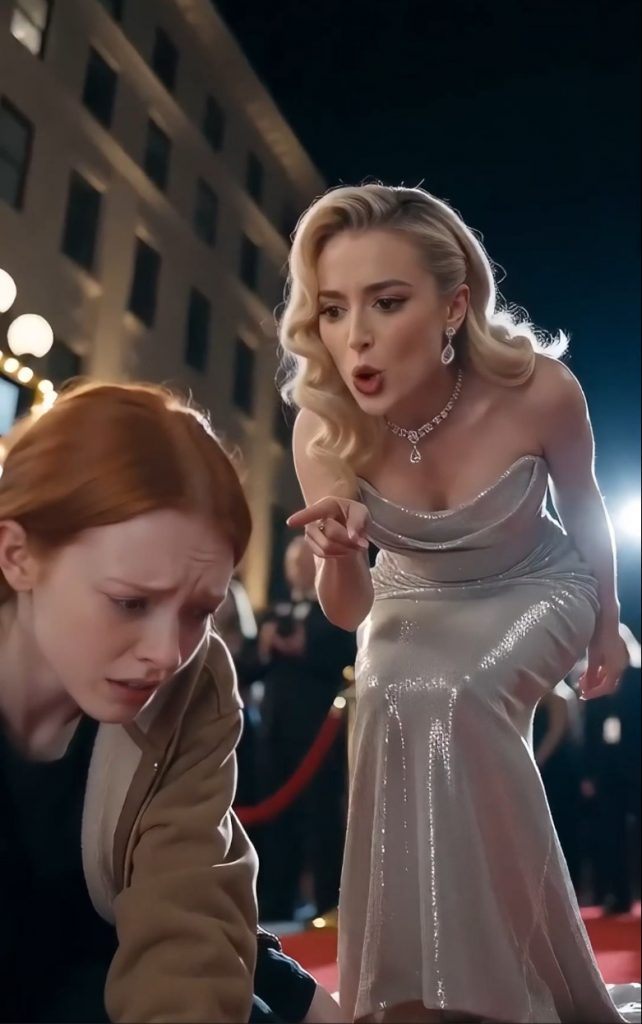
The woman who had slapped Lily stood over her in a silver evening gown.
Celeste Marlowe.
The star of the night.
Blonde waves. Diamond choker. Red-carpet smile sharpened into something cruel. She had spent the last month on talk shows calling this role “the honor of her career,” but now she looked down at the young woman on the carpet as if she had found dirt on her train.
“Premieres are for stars,” Celeste said, fake-sweet and loud enough for every camera to catch. “Not little nobodies begging for attention.”
The insult rippled through the crowd.
Lily stayed low, breathing carefully. Her red hair had fallen across one cheek. Her scuffed shoes pressed against the carpet as she reached for the invitation.
Celeste stepped closer.
“Don’t touch that,” she snapped. “Security can throw it away with you.”
A few reporters exchanged looks.
No one moved.
That was the strange power of celebrity. It could make an entire crowd watch cruelty and wonder if stopping it would be bad for their careers.
Then a gray-haired man in a black tuxedo stepped down from the red-carpet platform with a microphone in his hand.
Theater director Samuel Hart stopped when he saw Lily on the ground.
His face changed.
He crossed through the camera flashes, past Celeste, and lowered himself beside the young woman with unmistakable respect.
“Miss Avery,” he said, voice shaking with shock, “the entire play was adapted from your novel.”
The crowd went silent.
A camera tilted toward the giant poster behind them.
Based on the novel by Avery.
Celeste’s smile collapsed.
“Avery?”
Act II
Lily Avery wrote her first novel in a laundromat.
Not the whole thing, of course.
Only the first sentence.
She was sixteen, sitting beside a humming dryer while her mother’s work shirts tumbled behind glass. Rain ran down the window. The fluorescent lights buzzed overhead. Her notebook rested on her knees, cheap and bent from being carried everywhere.
She wrote:
The girl learned early that silence was not the absence of a voice, but the place where everyone else buried it.
Then she stared at the sentence until the dryer stopped.
That sentence became The Glass Orchard.
A novel about a young woman growing up in a town owned by a wealthy family, where every beautiful thing had a cost and every poor person was expected to be grateful for being allowed near it. It was about grief, class, ambition, mothers, daughters, and the terrifying moment a quiet person decides she will no longer be edited out of her own life.
Lily wrote it between shifts at a bookstore, community college classes, and nights spent caring for her mother, who had worked too hard for too many years and still apologized whenever she needed rest.
For a long time, no one wanted the book.
Agents said it was too quiet.
Then too angry.
Then too literary.
Then too young.
One editor wrote, kindly, that Lily had “a rare voice,” but the market was difficult.
Lily cried over that email in a grocery store parking lot, then went home and kept writing.
The book finally sold to a small publisher when she was nineteen. No one expected much. There was no massive publicity campaign. No celebrity book club. No giant window display.
Then readers found it.
Slowly at first.
A teacher assigned one chapter to her seniors. A theater student quoted it in a graduation speech. A nurse posted a photo of the book on her nightstand after a night shift. Young women underlined entire pages and passed copies to friends with notes in the margins.
By twenty-one, Lily Avery was being called the voice of a generation by people who would not have returned her emails two years earlier.
She hated the phrase.
It made her sound larger than she felt.
What she loved was the letters.
Readers wrote to say they had recognized their mothers. Their towns. Their shame. Their courage. Their first quiet act of refusal.
Then Broadway called.
Samuel Hart, one of the most respected theater directors in New York, read The Glass Orchard on a flight and wept into an airline napkin. He optioned the book personally and promised Lily he would protect its heart.
“We are not turning your story into a costume party for rich people,” he told her.
She almost believed him.
Then Celeste Marlowe was cast as the lead.
Celeste was famous enough to sell out previews before rehearsal began. She was beautiful, charming, ruthless, and terrified of being taken seriously only when the lighting was flattering. Playing the heroine of The Glass Orchard was supposed to prove she was more than a celebrity.
But from the beginning, Lily sensed the problem.
Celeste loved the idea of the role.
She did not love the girl at the center of it.
She called the character “fragile” when Lily had written her as observant. She called the mother “tragic” when Lily had written her as funny. She wanted the ending softened because, as she told a magazine, “audiences need hope.”
Lily said hope was not the same as comfort.
Celeste stopped inviting her to rehearsals.
Samuel noticed the tension, but the production was too large, too expensive, too close to opening. He kept promising Lily the play still belonged to the book.
On premiere night, Lily arrived quietly.
No stylist.
No borrowed diamonds.
No publicist walking ahead of her.
Just a simple black dress, a worn brown coat, scuffed shoes, and the folded invitation Samuel had sent with a handwritten note.
Come through the front. This night belongs to you.
Lily almost turned around twice.
Then she saw the poster.
Based on the novel by Avery.
Her name was there.
Small, but real.
She stepped onto the red carpet holding the invitation in both hands.
Celeste saw her before Samuel did.
And decided the girl did not belong beside her story.
Act III
At first, Celeste smiled for the cameras.
That was what she did best.
She stood beneath the marquee lights with one hand on her hip, chin angled perfectly, diamond choker flashing every time another camera popped. Reporters shouted her name. Fans screamed from behind the barricades. Her publicist hovered nearby, whispering which outlet mattered most.
Then Lily approached the velvet rope.
An usher checked her invitation and nodded.
“Welcome, Miss Avery.”
Celeste heard the usher say Miss.
Not the last name.
Just Miss.
She turned and saw Lily.
The worn coat. The plain dress. The nervous hands. The invitation folded too many times from being held too tightly.
Celeste’s expression changed for only a second.
Then she stepped between Lily and the theater entrance.
“Can I help you?” she asked, still smiling for nearby cameras.
Lily looked up.
“I’m supposed to go inside.”
Celeste’s eyes moved over her shoes.
“For what?”
“The premiere.”
Celeste laughed softly.
A few photographers leaned in, sensing a moment.
“Sweetheart, everyone wants to go inside.”
Lily held up the invitation.
“I was invited.”
Celeste took it before Lily could stop her.
She opened it, glanced at the front, and saw Samuel’s handwriting. For a moment, something sharp crossed her face.
Recognition.
Then jealousy.
Because Samuel had never written her notes like that. He gave her direction. Praise when she earned it. Corrections when she did not. But he protected the author’s words with a reverence Celeste had never managed to inspire.
Lily reached for the invitation.
“Please don’t.”
Celeste lifted it away.
“This is embarrassing.”
“It has my name on it.”
Celeste’s smile tightened.
“What name?”
Lily hesitated.
That hesitation doomed her.
Celeste saw uncertainty and mistook it for weakness. The cameras were close. The crowd was watching. The premiere night was supposed to belong to her, and some unknown girl in a thrift-store coat was threatening to become a question she could not control.
“This is what I hate about theater fans,” Celeste said brightly. “You think holding paper means access.”
“I’m not a fan,” Lily said quietly.
Celeste’s eyes flashed.
The slap came fast.
It turned Lily’s face and sent her stumbling toward the velvet rope. The invitation slipped from her hand and slid across the carpet as gasps burst from the crowd.
For a second, Lily could hear nothing but camera shutters.
Then Celeste leaned down, lips curled into a red-carpet smile made poisonous.
“Premieres are for stars,” she said. “Not little nobodies begging for attention.”
The words landed in front of every lens.
Lily looked toward the poster.
Her name glowed above her.
Avery.
But Celeste still had not seen it.
Or maybe she had only seen what she wanted: a nobody beneath her lights.
Then Samuel Hart stepped down from the stage.
He had been preparing to welcome the press when the flashes stopped in the wrong way. Every director knows the difference between attention and alarm. He followed the silence and found Lily on the red carpet.
His stomach dropped.
He reached her as she was trying to stand.
“Miss Avery,” he said.
The title cut through the crowd.
Celeste turned.
Samuel picked up the invitation, saw the smudge on the corner, and looked at the actress with a face no one had seen in rehearsal.
Not disappointed.
Furious.
“The entire play,” he said into the microphone still in his hand, “was adapted from your novel.”
And the red carpet became a courtroom of cameras.
Act IV
Celeste froze.
For once, her face did not know what to perform.
The photographers turned from glamour to consequence. Fans behind the barricades whispered. Reporters lifted phones. The giant poster behind them seemed suddenly merciless.
Based on the novel by Avery.
Lily stood slowly, one hand near her cheek, the other clutching her coat closed as if dignity could be held together by fabric.
Samuel stepped beside her.
“Are you hurt?”
She shook her head once.
Not because it did not hurt.
Because the question felt too large to answer in front of everyone.
Celeste found her voice.
“I didn’t know.”
Samuel looked at her.
“You didn’t know what?”
Celeste swallowed.
“That she was Avery.”
Lily looked at her then.
The entire red carpet waited.
“You knew I was a person,” Lily said.
The sentence was quiet.
It destroyed every excuse before Celeste could build it.
Celeste glanced toward the cameras.
That glance told the truth.
She was not thinking about Lily.
She was thinking about footage.
“No,” Celeste said quickly, forcing a laugh that fooled no one. “This is being taken out of context. I thought she was trying to crash the event.”
Samuel’s voice turned cold.
“So you struck her?”
Celeste’s publicist moved closer, panic in her eyes.
“Celeste, don’t say anything else.”
But Celeste was too frightened to stop.
“She was acting strange. She wouldn’t explain herself.”
Lily picked up the folded invitation from Samuel’s hand.
“You took my invitation.”
Celeste’s lips parted.
Reporters heard it.
So did the ushers.
One usher, pale and shaking, stepped forward.
“She was cleared,” he said. “I welcomed her by name.”
The crowd murmured.
Celeste looked at him like he had betrayed her.
Samuel turned toward the theater staff.
“Ms. Marlowe will leave the red carpet.”
Celeste blinked.
“What?”
“Now.”
“You can’t be serious. I am the lead.”
Samuel held her gaze.
“And Miss Avery is the reason there is a lead.”
The line moved through the crowd like fire.
Celeste’s face flushed.
“You need me tonight.”
Lily lowered her eyes.
That was the old fear speaking inside her. The fear that famous people were always necessary, and quiet people were always replaceable.
Then Samuel turned to her.
“No,” he said, as if answering the thought. “We needed the book. We needed the truth of it. We needed what you wrote.”
He faced Celeste again.
“The understudy will perform.”
A collective gasp rose from the carpet.
Celeste’s mouth opened.
“On premiere night?”
“Yes.”
“My contract—”
“Has a conduct clause,” Samuel said. “And so does Miss Avery’s adaptation agreement.”
Celeste went still.
Lily looked at him, startled.
Samuel’s expression softened only for her.
“You insisted that no performer be allowed to publicly demean the class of people the story was written to defend.”
Lily remembered then.
The clause everyone had called unusual.
The clause her agent said might make her difficult.
The clause she had asked for because The Glass Orchard was not about turning pain into luxury entertainment for people who despised its source.
Celeste’s panic sharpened.
“You’re ruining my career over one mistake.”
Lily looked back at her.
“No. You’re afraid one moment showed people the part of you the role was supposed to change.”
The red carpet went silent again.
Even the photographers paused.
Celeste’s eyes glittered, not with remorse, but with fury trapped behind fear.
Security approached.
Her publicist whispered urgently, but the words no longer mattered. The velvet ropes that had been arranged to separate stars from fans now became the path of her removal.
As Celeste was guided away, she looked once more at Lily.
“Avery?” she whispered.
Lily did not answer.
She turned toward the theater doors.
Act V
The premiere began twenty-eight minutes late.
By then, Celeste Marlowe was gone, the understudy was in costume, and the red carpet had become the only story anyone outside the theater wanted to discuss.
Inside, Lily sat in the front row with her coat folded on her lap.
Samuel offered her a private box.
She refused.
She wanted to sit where she could see everything. The stage. The actors. The audience. The space between what she had written alone and what hundreds of people had gathered to witness together.
Her cheek still stung.
But beneath the pain was something stranger.
Clarity.
The understudy, Maya Chen, stepped onto the stage in the first scene with visible nerves. Her voice trembled on the opening line, then steadied as if the character herself had taken her hand.
By the end of Act One, the audience had forgotten she was the understudy.
By the final scene, no one wanted Celeste back.
Maya did not play the heroine as fragile.
She played her as observant.
She did not beg for sympathy.
She carried silence like a blade wrapped in cloth.
Lily cried before the final curtain.
Not because the adaptation was perfect. It was not. No adaptation can be. Some lines were different. Some scenes were gone. Some moments had become larger than she imagined.
But the heart remained.
The girl who had been told she was nobody stood at the end of the play and spoke the truth anyway.
When the curtain fell, the applause rose slowly at first, then thundered through the theater.
Samuel stepped onto the stage and waited until the room quieted.
“There is someone here tonight without whom none of this would exist,” he said.
Lily’s hands tightened around her coat.
Samuel looked directly at her.
“Miss Lily Avery.”
A spotlight found her.
The audience stood.
For one terrible second, Lily wanted to disappear.
Then Maya, still in costume, began applauding from the stage with tears on her face.
Lily rose.
Not like a celebrity.
Like a young woman learning her own story could hold her upright.
After that night, everything changed.
Celeste’s apology arrived through a crisis manager before sunrise. It spoke of pressure, confusion, and a misunderstanding on a chaotic red carpet. It did not mention the word nobody.
Lily did not respond.
Samuel did.
He announced that Celeste Marlowe had been permanently removed from the production. Maya Chen would continue in the lead role. A portion of opening week profits would fund emerging playwrights and novelists without industry connections, especially those adapting work rooted in working-class and overlooked communities.
The headlines were brutal.
Some called it a scandal.
Others called it justice.
Lily called it exhausting.
For weeks, people wanted her to become a symbol. They wanted interviews about humiliation, resilience, celebrity cruelty, and class. They wanted her to sound either furious or healed.
She was neither.
She was a writer.
So she returned to the page.
Months later, after the play became a phenomenon, Lily visited the theater on a quiet afternoon. No red carpet. No cameras. No shouting. Just a stagehand repainting a flat and dust moving through the golden light above the empty seats.
Maya found her in the aisle.
“You came back.”
Lily smiled.
“I wanted to see it without everyone looking.”
Maya sat beside her.
For a while, neither of them spoke.
Then Maya said, “That night, when Samuel told me I was going on, I thought I would ruin everything.”
“You didn’t.”
“I know that now.”
Lily looked at the stage.
“She said premieres were for stars.”
Maya laughed softly.
“She was wrong.”
Lily nodded.
But she was thinking of something deeper.
The premiere had not belonged to Celeste. It had not belonged to the cameras, the diamonds, the posters, or the people who mistook visibility for importance.
It belonged to the years no one saw.
The laundromat sentence.
Her mother’s tired hands.
The rejection emails.
The notebooks.
The quiet readers.
The ushers and understudies and stagehands.
The people who build meaning before the world arrives dressed for opening night.
Lily reached into her bag and removed the folded premiere invitation. The corner was still bent from the red carpet.
She had kept it.
Not as a wound.
As evidence.
A reminder that the door had opened, even if someone tried to knock her down in front of it.
On the anniversary of opening night, the theater installed a small plaque near the stage entrance.
Based on the novel by Lily Avery.
Beneath it, Samuel had added a line from her book.
No one becomes a voice by being handed a room. She becomes one by speaking after the room decides not to listen.
Lily touched the plaque once.
Outside, another crowd was gathering for another performance. Fans lined the sidewalk. Cameras waited for actors. The marquee glowed.
Somewhere among them, a young woman in an ordinary coat clutched a notebook to her chest and stared at the theater like it belonged to another world.
Lily saw her through the glass doors.
She walked out and held the door open.
The young woman blinked.
“Are you sure I can go in?”
Lily smiled gently.
“Yes,” she said. “This place is for stories.”
And this time, no one dared tell the storyteller she was nobody.