Act I
The dining room fell silent long before anyone understood why.
It was one of the city’s most exclusive restaurants, where polished wine glasses sparkled beneath warm lights and every table had been reserved weeks in advance. Guests expected flawless service, quiet conversations, and expensive meals—not a public confrontation that would stop every fork in midair.
Daniel, a twenty-six-year-old server, moved calmly between the tables. His uniform was neatly pressed despite the long shift, and his smile never wavered. When he noticed smoke drifting through the no-smoking section, he approached the man responsible with practiced professionalism.
“Sir, I’m sorry, but smoking isn’t permitted in this area.”
The guest barely looked at him.
Tailored Italian suit. Gold cufflinks. A watch worth more than most employees earned in a year. He exhaled another cloud of smoke as though the rules belonged to everyone else.
Daniel repeated the request politely.
That was all it took.
The man slammed his hand onto the table so hard that glasses rattled across the white linen.
Every conversation stopped.
Nobody realized they were witnessing the beginning of a moment that would become the restaurant’s most talked-about story.
And the man who believed money bought immunity had no idea whose restaurant he was standing in.
Act II
The VIP guest rose from his chair with unmistakable contempt.
His voice carried across the dining room.
“People like you don’t tell people like me what to do.”
Several diners lowered their eyes.
Others glanced toward the manager, expecting someone to intervene. Instead, the room remained frozen, trapped between fear of causing a scene and fear of confronting a wealthy customer.
Daniel didn’t argue.
He simply apologized for the inconvenience and quietly explained that the policy existed for every guest, regardless of status.
That calm response only fueled the man’s arrogance.
He mocked Daniel’s uniform.
He questioned whether someone “born to serve tables” should ever dare correct someone who could afford to dine there.
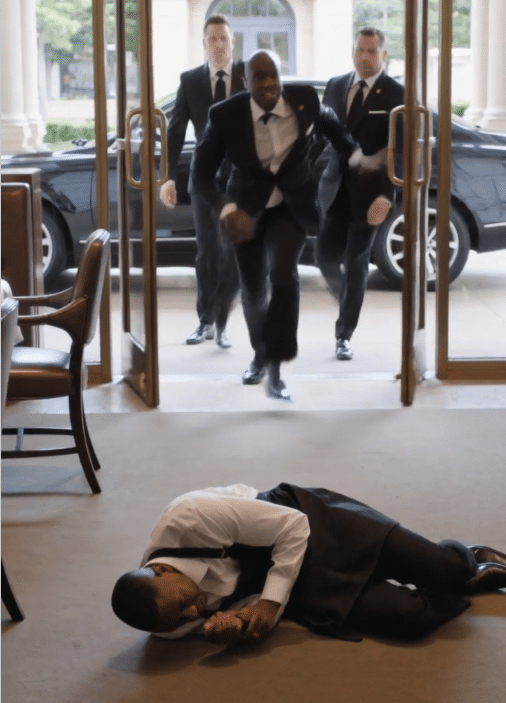
A decorative vase toppled during the confrontation, scattering white stones across the polished floor. Daniel stumbled while trying to steady it, ending up on one knee as his serving tray slid away.
The VIP laughed.
“Serve from the floor.”
A few nervous chuckles escaped from nearby tables before guilt quickly replaced amusement.
Daniel slowly stood again.
His expression wasn’t angry.
It was disappointed.
He had seen entitlement before.
Just never quite like this.
Then the restaurant’s front entrance opened.
Act III
A black luxury sedan stopped outside the glass entrance.
The maître d’ looked toward the door—and instantly turned pale.
Every employee straightened without being asked.
Two security personnel entered first.
Behind them walked a distinguished older gentleman whose quiet presence commanded more respect than any raised voice ever could.
The entire management team immediately moved aside.
He wasn’t another VIP guest.
He owned the restaurant.
In fact, he owned every restaurant in the group.
Without acknowledging anyone else, he walked directly across the dining room.
Past the expensive tables.
Past the silent customers.
Past the man still holding his cigarette.
He stopped beside Daniel.
For a brief moment, the room couldn’t understand why the owner looked so concerned about an ordinary waiter.
Then Daniel quietly said one word.
“Dad.”
A collective gasp spread through the restaurant.
The owner’s eyes softened immediately as he placed a reassuring hand on his son’s shoulder.
Only after making sure Daniel was unharmed did he slowly turn toward the guest.
The confidence that had filled the room only moments earlier began disappearing from the man’s face.
Act IV
The owner calmly asked a staff member to escort other guests away from the area.
No shouting.
No dramatic threats.
Just complete control.
He listened while witnesses described exactly what had happened. Several diners confirmed that Daniel had remained respectful throughout the encounter.
Security informed him that the entire incident had been captured from multiple camera angles.
The owner nodded once.
Then he looked directly at the guest.
His voice remained quiet.
“Who thought humiliating my son was acceptable?”
The words landed harder than anyone expected.
The guest attempted a nervous smile.
“I didn’t know…”
“No,” the owner interrupted. “You didn’t think it mattered.”
Silence returned.
This time, it wasn’t fear that filled the room.
It was realization.
Status had just changed completely.
Act V
Within minutes, the atmosphere transformed.
Managers apologized publicly to Daniel for failing to intervene sooner.
Several customers approached him personally, admitting they wished they had spoken up when the confrontation began.
The owner thanked those who had come forward and made it clear that respect inside his restaurants would never depend on wealth, clothing, or social standing.
As father and son prepared to leave the dining room together, the owner quietly adjusted Daniel’s uniform and smiled with unmistakable pride.
“You handled yourself exactly the way I taught you.”
Daniel smiled back.
He had never needed revenge.
Only the truth.
Behind them, the once-arrogant guest remained standing alone in the middle of the elegant dining room, surrounded by untouched wine glasses and silent tables.
For the first time all evening, he had nothing left to say.
Except four words that came out almost as a whisper.