Act I
The child barely stumbled before his mother turned the entire playground upside down.
One moment, a preschool boy was running across the soft rubber mat near the little slide.
His foot caught slightly.
He stumbled and went down.
It wasn’t a dangerous fall. There was no serious injury. The teacher was already moving toward him, checking that he was all right while another staff member guided the other children away from the area.
Then the boy’s mother stormed through the pickup gate.
She was forty years old, dressed in an expensive white coat, black pants, heels, and carrying a designer handbag. She looked at her son, then at the teacher, and immediately decided who was to blame.
The teacher tried to explain.
“He only tripped on the mat…”
She never got the chance to say more.
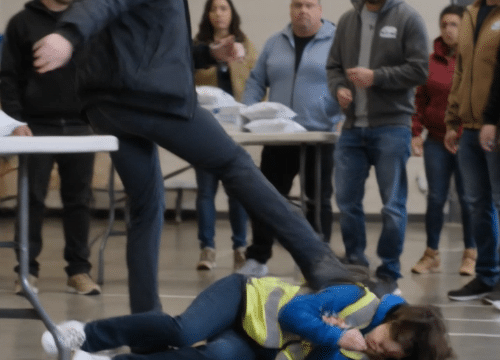
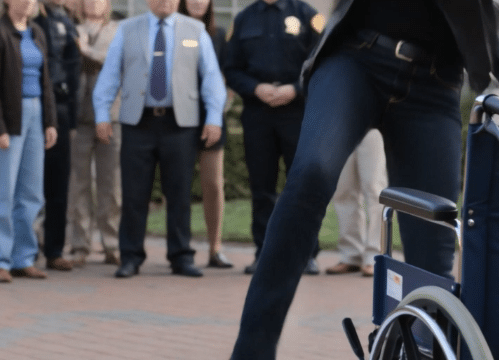
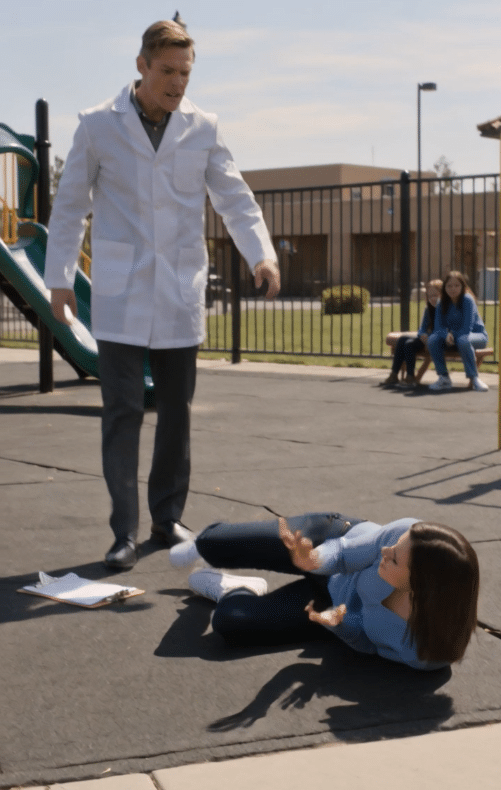
The mother charged across the playground and drove a forceful kick into the teacher’s chest.
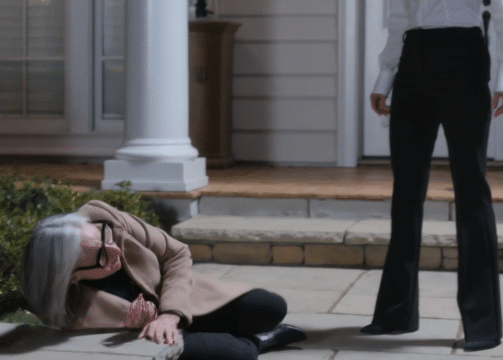
The teacher flew backward onto the rubber surface beside the slide.
Her clipboard struck the ground and fell open.
A pen rolled beneath the equipment.
Her forearm caught the edge of the plastic step, leaving only a thin trace of blood, but the shock on her face was unmistakable.
The children gasped.
Parents covered their mouths.
Teachers pulled several little ones farther away.
The teacher curled instinctively from the pain, but even on the ground, her face turned toward the children first.
She was checking whether they were safe.
The woman stood over her.
“Trash. You failed my child.”
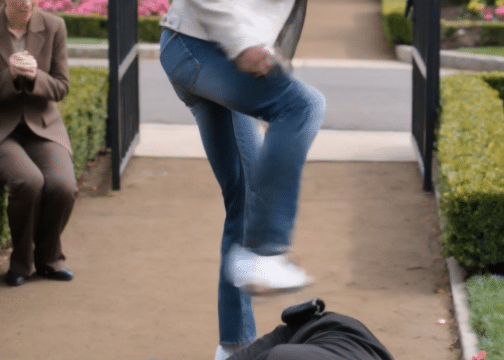
Then came two more hard kicks into the teacher’s back and side.
The playground went silent except for frightened children and the quick movement of adults trying to create distance.
The teacher breathed sharply, fighting through the pain.
She had been attacked for doing exactly what she was supposed to do.
And the mother wasn’t finished humiliating her.
“You shouldn’t be near children.”
Then, from beyond the pickup gate, came the unmistakable sound of screeching tires.
A black SUV had just arrived.
And the people stepping out were not there to ask what happened.
They were there because someone had been watching.
Act II
The preschool had a simple philosophy: children could fall.
They could trip.
They could get grass on their clothes, scrape a knee, cry over a toy, or lose their balance while learning to run.
Adults were supposed to help them recover without turning every ordinary childhood moment into a crisis.
The thirty-two-year-old teacher understood that better than most.
She had spent her days watching small children discover the world one awkward step at a time.
That afternoon had been no different.
The boy had been running too quickly.
His foot had caught the rubber mat.
He had stumbled.
The teacher immediately moved toward him.
Nothing about the moment suggested negligence.
In fact, her first instinct had been exactly what every parent hoped a teacher would have: check the child, protect the other children, and keep the situation calm.
But his mother didn’t see any of that.
She saw her child on the ground.
And in her mind, someone had to pay.
Her anger seemed to grow with every second she remained in front of an audience.
Parents were waiting near the pickup fence.
Other teachers were supervising the playground.
Small children were watching from behind adults.
The mother had an audience, and she seemed determined to establish who was in control.
The teacher’s light blue sweater was already dusted from the rubber mat. Her neat hair had come loose slightly. Her name tag remained clipped to her shirt.
She wasn’t acting like someone who had failed.
She looked like someone who had been blindsided.
Yet even after being attacked, she didn’t focus on the woman.
She focused on the children.
That detail would later become impossible for everyone to ignore.
Because while the wealthy parent was accusing her of being unfit to work around children, the teacher was still trying to make sure those same children weren’t frightened or placed in danger.
The parents nearby had witnessed everything.
Some looked toward the playground cameras.
Others looked at the teacher.
No one stepped forward before the school leadership arrived.
Fear had frozen the playground.
But the cameras hadn’t been frozen.
They had been running the entire time.
And the person who was about to walk through that gate knew exactly where they were.
Act III
The black SUV stopped hard at the preschool entrance.
The principal stepped out first.
Behind him came the preschool system owner and two security guards.
They moved quickly through the gate.
The atmosphere changed immediately.
Parents stopped whispering.
Teachers gathered the children farther from the scene.
The mother turned toward the entrance, still visibly furious.
She seemed prepared to continue arguing.
Then she saw who had arrived.
The principal didn’t walk toward her.
The owner didn’t ask the mother for an explanation first.
Security moved directly between the woman and the injured teacher.
That was the first message.
Protection came before confrontation.
The teacher remained on the ground, breathing carefully and trying to steady herself.
The principal looked toward her.
Then toward the children.
Then toward the playground cameras.
The owner followed his gaze.
There were cameras positioned around the playground.
They had recorded the child’s stumble.
They had recorded the teacher moving to help.
They had recorded the mother’s arrival.
And they had recorded the attack.
No accusation could change what those cameras had captured.
The mother had arrived convinced she was defending her child.
But the footage could show whether the teacher had failed him—or whether the teacher had simply become the target of a parent who couldn’t accept that accidents happen.
The owner didn’t reveal the footage.
Not yet.
He didn’t announce the consequences.
Not yet.
Instead, he took control of the scene.
Children needed to be moved away from the confrontation.
Parents needed to be brought inside.
The teacher needed protection.
And the incident needed to be formally examined.
The principal turned toward the staff.
“Get every parent inside. This is now under review.”
The words were calm.
Almost clinical.
But they carried a weight the mother hadn’t expected.
She had believed she was the person demanding answers.
Suddenly, she was the person whose actions were being examined.
Security remained between her and the teacher.
The owner looked again toward the cameras.
The mother followed his gaze.
For the first time, uncertainty appeared beneath her anger.
What exactly had those cameras captured?
How much had everyone seen?
And what did “under review” really mean?
The answers were still being withheld.
But the balance had already shifted.
And the woman who had entered the playground believing she could destroy a teacher’s reputation with one accusation was beginning to realize that evidence did not care how expensive her coat was.
Act IV
The children were moved farther away from the playground.
Parents followed the staff toward the building.
The laughter that had filled the afternoon was gone.
In its place was the sound of security footsteps, hurried movement, and the quiet tension of people realizing they had just witnessed something they would never forget.
The teacher remained protected.
She had been kicked down in front of the very children she had been responsible for protecting.
Yet her attention remained on them.
That was perhaps the most painful contradiction of the entire scene.
The woman who had accused her of being unfit around children had been the one who turned a harmless playground stumble into a terrifying spectacle.
The teacher had not abandoned her responsibility.
Even while hurting, she kept looking toward the children.
The school owner noticed.
So did the parents.
The mother had wanted everyone to believe the teacher had failed.
But the scene itself told another story.
The teacher’s clipboard lay open on the ground.
Her pen had rolled away.
Her name tag was still visible.
The rubber mat where the child had stumbled was completely ordinary.
Nothing about it explained the mother’s fury.
The real danger had come afterward.
And now the school leadership was standing directly between the person who had caused it and the person who had suffered it.
The owner did not need to raise his voice.
He did not need to humiliate the mother in return.
He simply looked toward the cameras.
That glance was enough to make the mother understand that this was no longer her version of the story against the teacher’s.
There was another witness.
One that couldn’t be intimidated.
One that couldn’t be pressured.
One that had captured the entire sequence from beginning to end.
The playground cameras had seen the child stumble.
They had seen the teacher respond.
They had seen the attack.
And now they were about to become part of an official review.
The mother stood behind the security line.
Her earlier certainty began to fracture.
She had wanted everyone to believe that her child had been failed.
Now she had to face a much harder possibility:
What if the evidence showed that she was the one who had crossed every line?
The owner remained silent.
The principal continued directing staff.
The children were safe.
The teacher was protected.
And the mother was left staring at a process she had never expected to become part of.
Then the final realization began to settle over her face.
She hadn’t come to the playground expecting an investigation.
She had come expecting everyone to agree with her.
Now everyone was waiting for the cameras.
Act V
The playground looked completely different after the confrontation.
The small slide stood empty.
The swings moved slightly in the afternoon air.
The soft rubber mat still covered the ground where the child had stumbled and where the teacher had been attacked moments later.
It was an ordinary preschool scene.
That was what made everything so disturbing.
A child had fallen.
A teacher had tried to help.
And a parent had responded with violence.
The school owner understood that the incident was bigger than one argument.
Teachers could not do their jobs if parents were allowed to attack them whenever something went wrong.
Children could not feel safe if adults turned ordinary accidents into scenes of intimidation.
And a school could not protect its students by abandoning the people responsible for caring for them.
So the owner had done the most important thing first.
He protected the teacher.
Then he protected the children.
Then he ordered the incident reviewed.
The mother had wanted an immediate judgment.
Instead, she was going to face evidence.
That difference mattered.
The teacher had not needed to fight back.
She had not needed to scream.
She had not needed to prove her innocence in the middle of chaos.
The cameras had been running.
The staff had been present.
The parents had witnessed the aftermath.
And the school leadership had arrived before the situation could become even worse.
The teacher slowly steadied herself.
She was still shaken.
Still hurt.
Still embarrassed.
But she was no longer alone.
The woman who had called her trash was now standing on the opposite side of a security barrier, watching the school owner and principal take control of the playground.
Her anger had nowhere left to go.
Her accusation had become an investigation.
Her certainty had become confusion.
And the words she had thrown at the teacher only minutes earlier now sounded hollow.
The school owner glanced toward the playground cameras once more.
There was still much to determine.
The footage would have to be reviewed.
The incident would have to be documented.
And the adults responsible for the preschool would have to decide what happened next.
But one thing had already changed.
The teacher’s job was no longer being judged by the loudest person in the playground.
The truth would be examined by the people responsible for the school.
The mother stared at the principal.
Then at the security guards.
Then toward the cameras.
Her face tightened.
For the first time, she seemed to understand that the word “review” could mean something very different when the evidence was already waiting overhead.
Her confidence froze.
And in the silence that followed, she finally asked the question that revealed just how quickly the entire situation had turned against her.
“Under review?”