Act I
The community gym was supposed to be a place where nobody had to beg.
Long tables stretched across the floor, covered with food bags, winter coats, and boxes of baby milk. Families stood shoulder to shoulder in a patient line, some clutching paperwork, others holding children against the cold that had followed them inside.
At the end of one table, a 28-year-old volunteer in a blue hoodie and yellow reflective vest looked down at a mother holding a shivering little child.
The mother had already received her assigned package.
But the child was staring at the milk boxes.
The volunteer glanced around, hesitated for half a second, and quietly reached for one more relief package.
That tiny act of kindness changed everything.
The supervisor saw it.
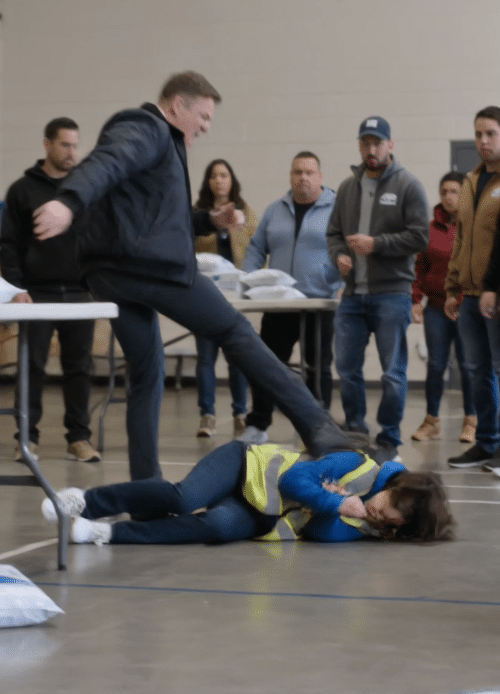
He came charging down the length of the table, his black jacket swinging behind him, his supervisor badge catching the fluorescent light.
Before the volunteer could turn fully toward him, he drove a forceful kick into her chest.
She flew backward into the edge of the metal table.
Food bags crashed to the floor.
A baby milk box rolled across the gym.
The volunteer dropped beside the scattered supplies, one forearm striking the table leg hard enough to leave a thin trace of blood.
For a moment, nobody moved.
She curled inward, struggling to catch her breath. Then, instead of protecting herself, she reached weakly toward the rolling milk box.
“She has a child. They needed one more…”
The supervisor stood over her.
“Trash. You don’t decide who deserves help.”
Then he kicked her again.
And again.
Families recoiled from the table. Volunteers covered their mouths. Someone pulled a child backward into the line.
The supervisor looked around as though the entire gym belonged to him.
“Compassion doesn’t run this place.”
But outside the front doors, something had just arrived that compassion didn’t need permission from.
And the man stepping out of that black SUV was about to change who ran everything.
Act II
For months, the relief center had operated on a simple promise: nobody who came through the doors would leave without being treated with dignity.
The promise had been printed on banners.
It appeared on volunteer handbooks.
It was repeated at staff meetings.
But promises on paper meant very little when the person holding authority believed the rules existed mainly to protect his authority.
The volunteer had learned that quickly.
Her name was Emily Carter, and she had started helping at the gym after losing her own job during a difficult winter. She wasn’t famous. She wasn’t wealthy. She didn’t have a powerful family behind her.
What she had was a habit of noticing people.
She noticed when elderly visitors struggled with heavy bags.
She noticed when parents tried to hide that their children were hungry.
She noticed when someone stood at the back of the line because they were too embarrassed to ask for help.
That morning, she had noticed the little boy’s shaking hands.
The extra package wasn’t meant to create a scandal.
It was meant to get a hungry child through another night.
But the supervisor, Daniel Mercer, had built his authority around strict control.
Every family received an assigned number of packages. Every box had to be accounted for. Every exception had to be approved.
At least, that was what he told everyone.
Behind closed doors, however, employees had noticed something else.
Daniel treated the relief center less like a charity and more like a kingdom.
He shouted when volunteers questioned him. He humiliated people who challenged his decisions. He had even begun warning new workers that kindness could become a disciplinary problem if it interfered with “distribution efficiency.”
Emily had never liked the way he spoke about struggling families.
Still, she had tried to keep her head down.
Until she saw that child.
The mother had whispered that she had two children at home.
Emily knew there was another milk box available.
She also knew Daniel would probably say no.
So she made the decision herself.
One package.
One mother.
One frightened child.
And somehow, that was enough for him to decide she deserved to be punished in front of everyone.
What Emily didn’t know was that the event was not just another community giveaway.
It was the largest relief program the gym had hosted that year.
And almost everything inside it had been paid for by one man.
A man who had not yet walked through the door.
Act III
The black SUV stopped so abruptly outside that several people near the entrance turned toward the sound.
The rear door opened.
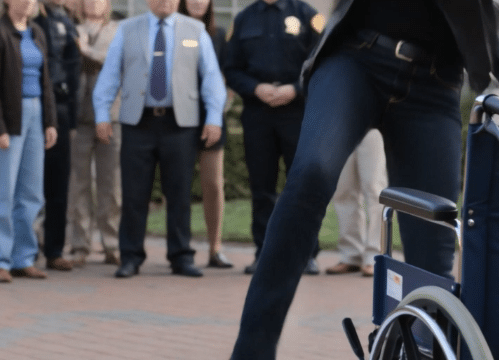
A 60-year-old man in a black suit and long coat stepped onto the pavement.
Two security guards followed.
Then came media staff carrying cameras.
The room began to change before anyone understood why.
The sponsor had arrived.
His name was Thomas Reed, a businessman who had spent years quietly funding food programs, emergency shelters, winter drives, and family assistance projects across the region.
He rarely appeared at distribution events.
He preferred the work to speak for itself.
That morning, however, a local media team had asked to film him visiting the gym.
He had expected to see families receiving supplies.
He had expected to see volunteers doing what they had been trained to do.
He had not expected to walk through the front doors and find a woman on the floor beside a spilled box of baby milk.
Thomas stopped.
His eyes went first to Emily.
Then to the milk box.
Then to Daniel.
The cameras stopped moving.
The families stopped whispering.
Even the children seemed to sense that something had changed.
One of the security guards stepped between Daniel and Emily.
The other moved toward the scattered supplies.
Thomas didn’t begin by asking about the rules.
He didn’t ask how many packages had been distributed.
He didn’t demand to see paperwork.
He stood beside Emily first.
That detail mattered.
Because the person on the floor was no longer invisible.
Thomas looked down at the milk box that Emily had tried to protect even after being knocked down.
Then he looked at the supervisor’s badge.
His expression remained calm.
But something in his eyes had gone cold.
“Then I’m pulling my funding.”
The words landed harder than the kicks had.
A ripple moved through the line.
Some families looked at each other.
Several volunteers lowered their hands from their faces.
Daniel stared at Thomas as if he had heard the sentence incorrectly.
The cameras were suddenly pointed directly at him.
For the first time that morning, he was no longer the person controlling the room.
He was the person being watched.
And Thomas had not yet explained what his funding actually controlled.
Act IV
Daniel’s confidence began disappearing one piece at a time.
He looked toward the tables.
Then toward the entrance.
Then at the security guards.
The same people who had spent the morning obeying his instructions were now standing between him and the woman he had attacked.
Thomas remained beside Emily.
A staff member finally brought a first-aid kit.
Another volunteer gathered the fallen food bags.
The mother who had received the extra package stood frozen near the line, holding her child tightly.
Emily slowly pushed herself upright.
Her breathing was still uneven.
But her eyes went immediately to the little boy.
The milk box had stopped near the wall.
Someone picked it up and carried it back to his mother.
No one applauded.
No one celebrated.
The moment was too serious for that.
But the room understood what had happened.
The supervisor had believed the relief packages belonged to him because he controlled the table.
He had believed the rules mattered more than the people.
And he had believed the volunteer had no power because she had no title.
Thomas knew better.
The entire relief event existed because of a network of funding commitments he controlled.
Food suppliers had been paid through his foundation.
Transportation had been contracted through his organization.
The emergency warehouse that replenished the gym’s supplies was supported by his grants.
The winter-coat program depended on his annual contribution.
And the next phase of the relief operation was scheduled to begin the following week.
Pulling his funding didn’t mean removing a few boxes from one table.
It meant the entire operation would have to be reconsidered.
Daniel finally understood that he had not merely assaulted a volunteer.
He had exposed the culture he had created inside a program whose purpose was supposed to be helping people.
Thomas didn’t need to shout.
He didn’t need to threaten him.
He simply looked at the supervisor’s badge.
The authority Daniel had used to humiliate Emily suddenly looked very small.
The families remained silent.
They had come expecting food.
They had witnessed something else instead.
They had watched a man who thought compassion was weakness discover that the person he dismissed as powerless was standing inside a program supported by someone who could make every decision he had relied upon disappear.
Daniel’s face went pale.
Yet the biggest consequence still had not been spoken.
And then the cameras moved closer.
Act V
The gym felt strangely different now.
The tables were still covered with food.
The winter coats were still stacked near the wall.
The line of families was still there.
But the illusion of control had vanished.
Emily sat near the first-aid station while a staff member checked her arm. She kept asking whether the mother and child had received everything they needed.
That question said more about her than any speech could have.
She had been attacked because she gave away one extra package.
And even after everything that happened, she was still thinking about the person who needed it.
Thomas heard her.
He turned toward the mother and quietly made sure the family received the additional supplies.
Then he looked across the gym.
His decision was no longer about punishing Daniel.
It was about changing what the program stood for.
The supervisor had treated compassion as a weakness because he believed rules gave him power.
But rules were never supposed to be the destination.
They were supposed to protect the people the program existed to serve.
By the time the media cameras began recording again, the story had already changed.
It was no longer about a volunteer who had broken a distribution rule.
It was about what happened when authority became more important than humanity.
The mother held her child close.
The little boy clutched the milk box against his coat.
Emily watched them leave the table with the supplies she had tried to protect.
And Thomas stood between the frightened families and the man who had forgotten why the doors were open in the first place.
Daniel had spent the morning believing that everyone in the gym answered to him.
Now he finally realized that his badge had never made him untouchable.
He stared toward Thomas, his face drained of color, trying to understand what exactly had just been taken away from him.
His confidence.
His authority.
His position.
Or something even bigger.
The cameras kept rolling.
The gym remained silent.
And for the first time all day, the supervisor looked like a man who had no idea what would happen next.
“Pulling what?”