Act I
The apples scattered before anyone understood what had happened.
A paper bag slipped from the edge of a fruit stall, burst open on the wooden walkway, and dozens of bright red apples rolled between shoppers’ feet beneath the warm Saturday sun.
Standing only a few feet away was sixty-seven-year-old Samuel Brooks.
The old military jacket hanging from his shoulders was faded from years of wear, and the empty sleeves pinned neatly at his sides told a story no introduction ever could. Samuel had lost both arms decades earlier while serving his country, yet he still carried himself with remarkable dignity.
He hadn’t reached for the apples.
He couldn’t have.
He had simply stopped at the stall, hoping to ask whether someone might help him purchase a small bag to take home.
Before anyone spoke, the stall owner rushed forward.
His face twisted with fury.
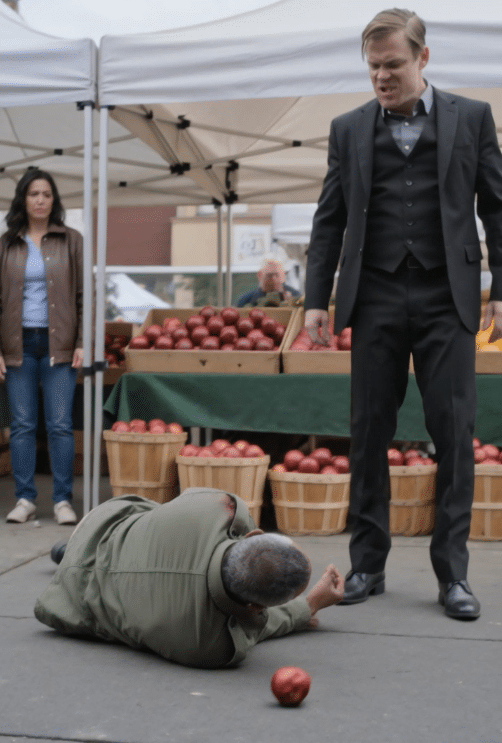
Without asking a single question, he drove a hard kick straight into Samuel’s chest.
The elderly veteran crashed backward beside the baskets of fruit. One shoulder scraped lightly against the wooden walkway as more apples rolled around him.
The market gasped.
Parents pulled children closer.
Shoppers froze in disbelief.
The stall owner stood over the fallen veteran and pointed angrily at the scattered fruit.
“Trash. Don’t touch what you can’t pay for.”
Samuel closed his eyes for a moment.
Not because the kick hurt the most.
Because after surviving war, hospitals, and years of rebuilding his life, he still found himself judged before anyone cared to learn his name.
What no one noticed was the black sedan slowly turning into the market aisle.
Act II
Samuel had never allowed tragedy to define him.
Learning to live without both arms required years of determination that few people could imagine. He mastered everyday tasks with extraordinary patience, refusing to surrender the independence he had fought so hard to reclaim.
Neighbors knew him as the veteran who volunteered at local schools, encouraging young people to value perseverance over excuses.
Every Saturday, he visited the farmers market.
Not because it was convenient.
Because the vendors treated him like family.
At least…
Most of them did.
The owner of the apple stand had opened his business only months earlier.
Ethan Parker admired profit far more than people.
He believed every customer represented either income or inconvenience.
Samuel, standing quietly near his display, looked like the second.
As the veteran struggled to sit upright, Ethan’s anger only intensified.
His first follow-up kick landed squarely against Samuel’s back.
The crowd cried out.
Before anyone could intervene, Ethan delivered another brutal kick into the veteran’s ribs.
A nearby patrol officer instinctively stepped forward but paused, calling urgently into his radio while waiting for additional support.
Ethan sneered, kicking one loose apple farther across the walkway.
“Get out of my market.”
The words echoed through the now-silent crowd.
Samuel said nothing.
Years of military discipline had taught him that true strength isn’t measured by the ability to strike back.
Sometimes it is measured by the decision not to.
Ethan mistook that silence for surrender.
He never noticed the market managers suddenly looking toward the entrance.
Act III
The black sedan rolled slowly to a stop near the center walkway.
Its arrival was quiet.
Almost understated.
A man in his late fifties stepped out wearing a tailored vest suit instead of the extravagant clothing people often associated with wealth.
He closed the car door himself.
No dramatic entrance.
No raised voice.
Yet the atmosphere changed immediately.
Market managers hurried toward him before stopping respectfully several steps away.
The patrol officer lowered his radio.
Additional officers arriving from the opposite entrance instinctively gave him space.
Shoppers whispered among themselves.
Some recognized him instantly.
Others simply recognized the respect everyone else showed.
The man walked directly toward the scattered apples.
He didn’t look at Ethan first.
Instead, he bent down carefully.
One by one, he picked up several apples from the ground and placed them gently back into the basket.
Only after restoring what little order he could did he rise.
His eyes settled calmly on the stall owner.
One word broke the silence.
“Enough.”
Nothing about his voice sounded angry.
Yet every conversation in the market stopped.
Ethan forced an uneasy laugh.
“This doesn’t concern you.”
The suited man offered no immediate reply.
Behind him, the patrol officers remained still.
The market managers waited silently.
For the first time that morning, Ethan realized nobody was looking to him anymore.
Act IV
The man was Jonathan Mercer.
Years earlier, he had founded one of the largest agricultural cooperatives in the region, helping hundreds of independent family farms survive when corporate distributors threatened to drive them out of business.
Many weekend farmers markets—including this one—operated on land and funding provided by his foundation.
But very few visitors knew another part of his story.
As a young man, Jonathan had nearly lost his own future after a devastating farming accident.
While recovering at a military rehabilitation hospital during a volunteer program, he met Samuel Brooks.
The veteran spent weeks encouraging injured patients who believed life was over.
Samuel never spoke about heroism.
He simply lived it.
His resilience changed Jonathan’s understanding of leadership forever.
When Jonathan later achieved extraordinary success, he quietly dedicated scholarships, grants, and veteran assistance programs in Samuel’s honor—without ever telling him.
Seeing that same man lying helpless beside scattered apples struck him harder than words could describe.
Jonathan looked toward the patrol officer.
“What happened?”
Witnesses answered immediately.
Several shoppers had recorded the assault.
Security cameras from nearby vendors captured every second.
The market managers confirmed Samuel had touched nothing before the bag accidentally fell.
There was no confusion.
Only evidence.
Ethan tried desperately to defend himself.
“He scared away paying customers.”
Jonathan looked at the elderly veteran.
“No.”
His voice remained calm.
“You attacked the very kind of person this market exists to serve.”
He turned toward the managers.
“Preserve every recording.”
Then toward the patrol officers.
“Please handle this properly.”
No one questioned the request.
No one hesitated.
Because everyone present understood exactly who Jonathan Mercer was.
Everyone…
Except Ethan.
Act V
Several shoppers gently helped Samuel back to his feet.
A young girl quietly picked up one remaining apple and smiled as she nudged it toward the basket with her shoe.
The small gesture made Samuel smile for the first time that morning.
Jonathan stepped beside him.
“I’ve owed you more thanks than I ever managed to say.”
Samuel looked puzzled.
Jonathan laughed softly.
“You probably don’t remember every patient you encouraged all those years ago.”
“I remember every person who decided not to give up,” Samuel answered.
The crowd fell silent again.
Not because of fear.
Because those simple words carried more weight than any speech.
Market managers announced that Samuel would always be a welcome guest, and several nearby vendors immediately insisted on giving him fresh produce for the week.
He accepted only a few apples.
“No more than I need,” he said with quiet humility.
Across the walkway, Ethan stood completely alone.
The patrol officers now waited beside him.
The managers looked to Jonathan for guidance.
Every vendor understood who truly held influence in the market.
Ethan’s confidence vanished.
His face drained of color.
His lips trembled as he whispered the only question left.
“Who are you…?”
Jonathan never answered.
Instead, he picked up the final apple from the ground and placed it gently into Samuel’s basket before walking beside the veteran toward the market exit.
Sometimes the strongest answer is not a title.
Not a fortune.
Not even a reputation.
Sometimes it is the quiet respect earned over a lifetime of protecting people who can never repay the kindness.
And on that bright Saturday morning, everyone at the market discovered that real authority isn’t proven by forcing someone to the ground.
It is revealed by the person willing to help them stand again.