Act I
The chapel had been built for silence.
Rows of dark wooden pews stretched toward a simple altar, where white flowers surrounded a framed photograph and a folded American flag. Families sat shoulder to shoulder with officers, veterans, and old friends who had come to remember someone who would never walk through those doors again.
Nobody spoke above a whisper.
Until the Brigadier General in the third pew leaned toward the man beside him and laughed under his breath.
It was small.
Almost nothing.
But in a room where grief had settled over every person like a weight, it sounded cruel.
The woman sitting nearby turned her head.
She was forty-three, a veteran herself, dressed in a simple black dress beneath a black coat. Her brown hair was pulled into a low bun. Her eyes were tired from mourning, but steady.
She leaned slightly toward the General.
“This is a memorial. Lower your voice.”
Three seconds.
That was all it took.
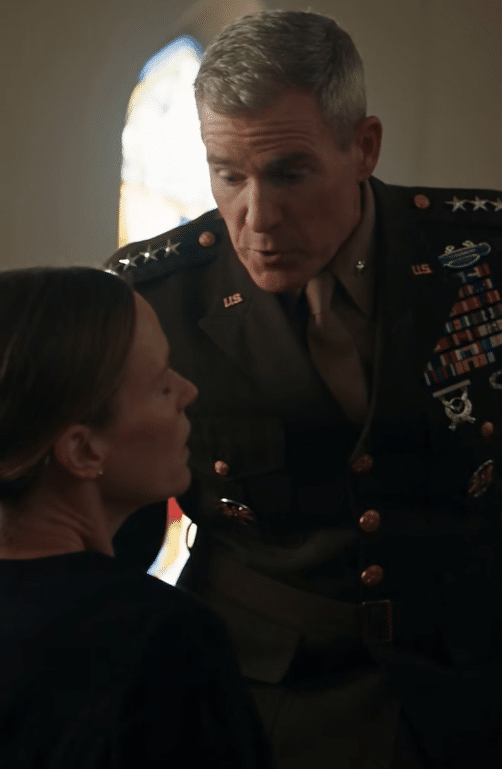
The General turned slowly.
His gray eyebrows tightened.
He had spent decades wearing uniforms that made rooms fall silent when he entered them. Rows of medals covered his chest, and he carried himself with the confidence of a man who had learned that people usually obeyed before he finished speaking.
“You don’t tell a general how to mourn.”
The woman didn’t answer.
The General stood.
Several people lowered their eyes.
He reached for her arm.
His fingers closed around it hard.
He pulled her from the pew.
She caught herself, but before she could regain her balance, his hand struck her across the face.
The sound echoed through the chapel.
Someone gasped.
The woman stumbled against the wooden pew behind her.
Her cheek reddened almost immediately.
But she didn’t fall.
She didn’t beg.
She simply stood there, breathing slowly.
The General stared at her as though daring anyone to object.
Nobody did.
Then her coat shifted.
Something small slipped from the inside pocket.
It hit the wooden floor.
Clink.
The object rolled between the pews.
Past a pair of polished shoes.
And stopped directly beside the feet of a sixty-seven-year-old senior officer seated in the front row.
He looked down.
At first, he seemed merely confused.
Then his face changed.
The grief disappeared.
Fear replaced it.
He leaned forward.
His eyes fixed on the old scratched medal.
He knew that symbol.
And he knew exactly how dangerous it was to pretend he didn’t.
He looked at the General.
“General… don’t touch that medal.”
The General glanced down.
Then laughed quietly.
“It’s just metal on the floor.”
The woman slowly bent down.
She picked up the medal with both hands.
Her fingers closed around it.
Then she looked directly at him.
“It carried names you were not allowed to say.”
The General’s expression froze.
The chapel became completely still.
His eyes moved from her face to the medal.
Then back again.
“Names…?”
And for the first time in his career, the General looked like a man who had just realized his rank could not protect him from what he had done.
Act II
Before that moment, the chapel had been filled with memories.
The photograph at the front showed a smiling service member standing beneath a clear sky.
Around it were flowers, handwritten cards, and small personal objects brought by people who had known him.
His family sat in the front pew.
The officers sat behind them.
The veterans farther back.
Nobody had come for ceremony alone.
They had come because someone was gone.
The woman had arrived early.
She hadn’t worn a uniform.
She didn’t need to.
She had chosen a simple black coat and dress because she wanted the attention to remain where it belonged: on the person being remembered.
For nearly an hour, she had sat quietly.
She listened to the stories.
She watched the family cry.
She lowered her head during the prayers.
She never looked toward the General until he began whispering.
At first, she ignored him.
Then he made another remark.
Still quiet.
Still disrespectful.
But audible enough for the people nearby.
The woman finally turned.
“This is a memorial. Lower your voice.”
There was no insult in it.
No challenge.
No attempt to embarrass him.
It was simply the kind of correction a person made when a sacred moment was being disturbed.
The General couldn’t tolerate it.
He was used to being obeyed.
More importantly, he was used to being admired.
His medals caught the chapel light whenever he moved.
His uniform was immaculate.
His posture was rigid.
Everything about him announced authority.
But authority was not the same thing as character.
The woman knew that.
She had seen enough in her own years of service to understand the difference.
So when he stood and grabbed her arm, she was surprised by the violence.
Not frightened.
Surprised.
Then came the slap.
The chapel seemed to stop breathing.
A child near the back buried her face against her mother’s shoulder.
One veteran stared at the floor.
Another clenched his hands against his knees.
The senior officer in the front row didn’t move.
He was watching the woman.
Not the General.
The woman had straightened herself.
Her cheek was red.
Her breathing was controlled.
And her eyes had become strangely distant.
Not broken.
Remembering.
Then her coat opened.
The medal fell.
The senior officer saw it.
And suddenly, he was no longer looking at an old piece of metal.
He was looking at a door into a part of military history most people had never been allowed to enter.
He had seen that symbol decades earlier.
It had appeared on paperwork that wasn’t meant to be copied.
On photographs that were never displayed.
On names that had been spoken only in rooms where every door was locked.
He remembered being young.
He remembered being warned.
Some people served under flags.
Some people served without anyone being allowed to know their names.
The medal had belonged to the second kind.
And somehow, it was now in the pocket of a grieving woman sitting quietly in a chapel.
The senior officer’s stomach tightened.
He understood immediately why she had said nothing.
She didn’t need to explain.
The General, however, had no idea.
And he was about to make that ignorance very expensive.
Act III
The General looked at the medal again.
“What is that?”
The woman didn’t answer.
She wiped a speck of dust from its scratched surface with her thumb.
The senior officer watched her carefully.
He didn’t speak.
He couldn’t.
Whatever the medal represented, it wasn’t his story to tell.
The General took one step closer.
“I asked you a question.”
The woman raised her eyes.
“You should be listening to the memorial.”
His face hardened.
“You’ve already caused enough disruption.”
The irony was almost unbearable.
The person who had disrupted the memorial was accusing the grieving woman of doing exactly that.
She looked toward the folded flag.
Then at the photograph.
“I haven’t caused anything.”
The General’s jaw tightened.
“You embarrassed me in front of my officers.”
“No.”
She looked at him calmly.
“You embarrassed yourself.”
A murmur almost escaped someone in the back.
The General heard it.
His face reddened.
He pointed toward the medal.
“What is that?”
The woman closed her fingers around it.
The senior officer spoke again.
“General.”
His voice was low.
“Don’t touch that medal.”
The General turned sharply.
“You seem very concerned about a piece of scrap metal.”
The senior officer didn’t respond.
His eyes remained fixed on the medal.
The General sneered.
“It’s just metal on the floor.”
The woman looked down at it.
Then back at him.
“It carried names you were not allowed to say.”
The General’s smile disappeared.
The senior officer lowered his gaze.
He remembered one name.
Then another.
Not because they had been famous.
Because they had never been supposed to become famous.
People whose work had been buried beneath ordinary records.
People whose sacrifices had been acknowledged only through symbols like the one now resting in the woman’s palm.
The General’s breathing changed.
He looked at the old medal again.
There was a strange mark near its edge.
Scratched.
Worn.
Almost erased by time.
But not completely.
The woman noticed him staring.
“You recognize it.”
He didn’t answer.
“Don’t you?”
The General swallowed.
The room seemed colder.
He had spent years believing medals represented rank, achievement, status.
This one was different.
It represented people.
People whose names had been deliberately removed from the stories told in public.
People whose families had sometimes received no explanation.
People who had been remembered by a tiny circle of those who knew the truth.
The General looked at the woman.
“How do you have that?”
She said nothing.
That silence was worse than an answer.
Because now the question had changed.
It wasn’t what the medal was.
It was why she had it.
And why someone like her had been sitting quietly in a chapel while a powerful man treated her like she was nobody.
The senior officer already knew the answer might be far more painful than anyone expected.
Act IV
The woman walked slowly toward the altar.
Nobody stopped her.
She held the old medal in her palm.
The General watched her.
For the first time, he seemed unsure whether he should follow.
She stopped beside the memorial photograph.
Her eyes rested on the face of the fallen service member.
Then she whispered something too quietly for most people to hear.
The senior officer heard it.
His eyes widened.
It was a name.
A name he had not heard spoken aloud in decades.
His face went pale.
The General noticed.
“What did she say?”
The senior officer didn’t answer.
“Sir.”
Nothing.
“Who is she?”
The older officer finally looked at him.
There was no anger in his expression.
Only something closer to disbelief.
“You really don’t know?”
The General’s face tightened.
“Know what?”
The older officer glanced toward the woman.
She stood beneath the chapel light, holding the scratched medal.
“She was there.”
The General stared.
“Where?”
The older officer didn’t answer.
He didn’t need to.
The General’s eyes moved back to the medal.
Something clicked.
Not completely.
But enough.
He remembered old reports.
Old stories.
An operation that had officially become a footnote.
A group of people whose names had never appeared on the memorial walls.
A medal that had supposedly disappeared years ago.
He remembered being told that some records were sealed for reasons beyond ordinary classification.
He remembered the symbol.
He remembered being warned never to ask who carried it.
And now the woman was standing in front of him.
The same woman he had just slapped.
The same woman he had dragged from a pew.
The same woman he had publicly humiliated because she had told him to lower his voice.
His arrogance began collapsing.
Not because she threatened him.
Because she didn’t.
That was what frightened him.
She didn’t need to.
The old medal had already spoken.
The woman turned toward him.
“You thought this was about your rank.”
He said nothing.
“It wasn’t.”
She looked toward the family seated in the front pew.
“It was about respect.”
Her voice trembled slightly now.
Not with fear.
With grief.
“These people came here to remember someone they loved.”
She looked at the General.
“And you couldn’t stay quiet for ten minutes.”
The General lowered his eyes.
The senior officer remained seated.
He looked toward the memorial photograph.
Then toward the woman.
He understood something the General had not.
The woman hadn’t brought the medal to make a scene.
She had carried it because she had spent years carrying the people behind it.
The medal wasn’t a weapon.
It was a memory.
And the General had nearly stepped on it.
Act V
Nobody spoke for several seconds.
Then the woman walked back toward the pew.
She stopped beside the General.
Not above him.
Not below him.
Simply beside him.
She held out the medal.
He stared at it.
His hand did not move.
For the first time, the man who had spent his life commanding others looked incapable of giving an order.
The woman lowered her hand.
“You don’t have to know all the names.”
He looked at her.
“But you should know enough to understand why we came here.”
Her words settled over the chapel.
The General finally looked toward the photograph.
His face changed.
Whatever anger had remained was gone.
He looked older.
Smaller.
Not because anyone had stripped him of his rank.
Because he had finally understood the difference between wearing a uniform and honoring what it represented.
The woman returned to her seat.
She sat beside the family.
Her cheek was still red.
She didn’t touch it.
She didn’t look toward the General again.
The service resumed.
A chaplain stepped forward.
The room rose.
The folded flag remained exactly where it had been.
The flowers remained untouched.
The photograph still showed the same smile.
But something had changed.
The General stood at the back of the chapel alone.
His medals no longer seemed impressive.
They looked heavy.
The senior officer eventually approached him.
He stopped beside him.
For several seconds, neither man spoke.
Then the General whispered:
“Who was she?”
The older officer looked toward the woman.
Then toward the old medal.
And quietly answered:
“Someone who remembers what you forgot.”
The General stared at him.
The older officer walked away.
The woman never turned around.
She didn’t need to.
Her dignity had already answered everything.
Years later, people might forget the argument.
They might forget the slap.
They might even forget the General’s name.
But the old medal would remain.
Scratched.
Worn.
Carrying names that had once been forbidden to speak.
Names that belonged to people who had disappeared from public history but had never disappeared from the memories of those who survived them.
And that was the lesson the General finally understood.
A uniform could command silence.
A rank could command obedience.
But neither could command respect.
Respect had to be earned.
And inside that chapel, in front of a folded flag and a grieving family, a woman who had every reason to break had chosen something stronger.
She chose to remember.
And the man who had tried to humiliate her was forced to remember too.