Act I
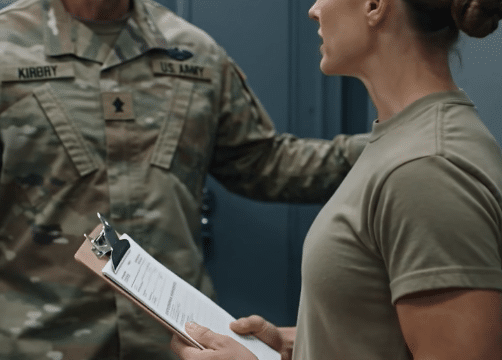
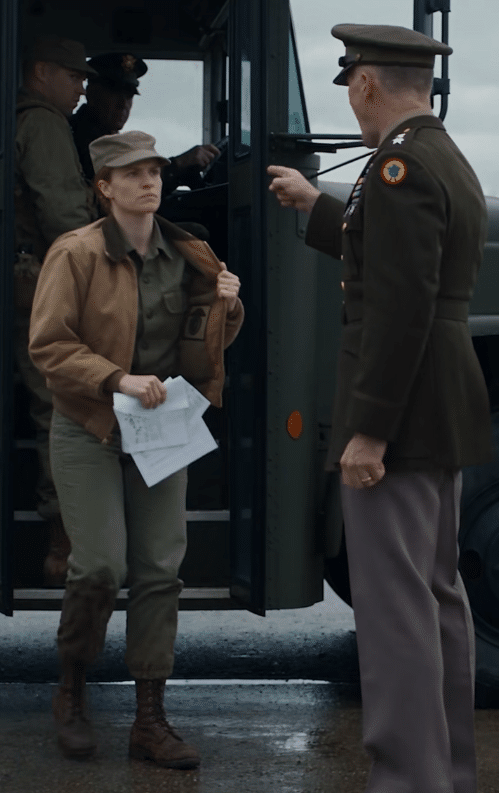
The rain had stopped, but the concrete was still slick when the woman stepped onto the bus stairs and looked down at the roster in her hand.
Thirty-seven names.
Thirty-six soldiers standing beside the olive-green buses.
She counted again.
Then she looked toward the loading zone.
“We’re missing one soldier.”
Her voice wasn’t loud.
It didn’t need to be.
The words cut through the noise of boots, rucksacks, diesel fumes, and shouted instructions.
For a moment, nobody moved.
Then Major Daniel Voss turned around.
At forty-six, Voss had perfected the kind of command presence that depended less on respect than on making everyone uncomfortable enough to obey. His uniform was immaculate despite the wet morning. His boots were polished. His schedule was printed, highlighted, and clipped to a folder beneath one arm.
The convoy was supposed to leave in four minutes.
Four minutes was apparently more important than one missing soldier.
Voss walked toward the bus.
“Check again.”
The woman looked at the roster.
“I already did.”
“Then check faster.”
She didn’t react to the insult.
Her name was Sergeant Mara Ellis. Thirty-two years old. Eight years in uniform. She had a reputation for being difficult in exactly one way: she took procedures seriously when other people treated them as suggestions.
She looked back at the names.
“Private Aaron Cole isn’t here.”
Voss stopped in front of her.
Behind him, soldiers suddenly became very interested in their rucksacks.
“We’re not holding an entire convoy for one private.”
Mara’s eyes remained on the roster.
“He’s assigned to this bus.”
“He can catch up.”
“That isn’t the procedure.”
Voss’s jaw tightened.
The sentence wasn’t disrespectful.
That was what made it worse.
She wasn’t challenging him.
She was simply refusing to pretend he was right.
Voss reached forward and ripped the roster from her hand.
Mara grabbed for it.
“Major—”
He shoved her.
Hard.
Her shoulder struck first. Then the edge of her chest caught the bus frame, and her boots slipped from the wet step.
She fell backward onto the concrete.
The roster flew from her hand and scattered several feet away.
A gasp passed through the loading zone.
Mara’s knee scraped against the ground.
For half a second, she closed her eyes.
Then she opened them.
No tears.
No pleading.
No panic.
She pushed herself upright and reached for the roster.
Voss stood above her.
“One nobody doesn’t delay my convoy.”
The words landed harder than the shove.
Mara slowly picked up the papers.
Around them, soldiers stared at the ground.
Nobody moved.
Nobody wanted to become the next person who suddenly mattered to the Major.
Mara brushed the wet grit from her knee.
Then something shifted beneath her field jacket.
The fall had pulled the fabric open.
For just a second, the inside lining became visible.
And sewn into it was a dark patch.
The old bus driver saw it first.
His hand froze on the steering wheel.
He had spent more than thirty years around military buses, convoys, training grounds, and people who wore authority differently.
He knew that patch.
He hadn’t seen one in decades.
And he knew exactly what it meant when it appeared somewhere it shouldn’t.
He turned off the engine.
“Major…”
Voss glanced toward him.
The driver’s face had gone pale.
“You should look at her jacket.”
But Voss didn’t look.
He looked at his watch instead.
“I said load the bus.”
And that was the moment he made his second mistake.
Because the first one had been putting his hands on Mara Ellis.
The second was refusing to find out why she had stopped his convoy.
And somewhere beneath the wet jacket, a secret had just become visible.
Act II
Five minutes earlier, Mara had been just another soldier in the loading zone.
At least, that’s what everyone thought.
She hadn’t arrived with the senior officers.
She hadn’t demanded attention.
She hadn’t even spoken to Major Voss until she found the missing name.
That was how Mara preferred it.
Invisible until necessary.
She had learned a long time ago that the safest person in a military environment was sometimes the one nobody bothered to notice.
But there was another reason she kept her head down.
The dark patch sewn inside her jacket wasn’t decorative.
It wasn’t a unit emblem.
It wasn’t something meant to be displayed.
It was a marker from a chapter of military history most ordinary soldiers had never heard about.
A small symbol used years earlier to identify personnel who were assigned to sensitive accountability work after serious failures had occurred during deployments and training exercises.
People who wore the patch weren’t necessarily higher ranking.
Sometimes they weren’t even officers.
Their authority came from something else.
They were there to document what happened when people in charge believed nobody was watching.
Mara had never told the younger soldiers.
She didn’t need to.
Her orders were simple.
Observe.
Verify.
Report.
And that morning, her assignment had been even simpler.
Make sure every person on the roster arrived before the convoy departed.
That was all.
No confrontation.
No scandal.
No punishment.
Just accountability.
Then Aaron Cole’s name appeared on the roster without a corresponding soldier at the bus.
Mara had checked the sleeping quarters.
She had checked the medical station.
She had checked the secondary staging area.
Nothing.
That should have been enough to delay departure.
But Major Voss had been under pressure for weeks.
His convoy schedule had already been criticized after a previous delay, and he had become obsessed with proving that nothing—not weather, paperwork, or personnel—could interfere with his timetable.
To him, the roster wasn’t a safety document.
It was an obstacle.
And Mara had just become the person holding it.
After she stood, she noticed the older driver’s eyes.
He wasn’t looking at her face.
He was looking at the inside of her jacket.
Recognition had changed him.
The driver was named Frank Mercer.
Sixty-one.
He had driven military buses long enough to know that some things were better left unexplained in public.
He looked at Mara.
She gave him the smallest possible nod.
Not permission.
Not reassurance.
Just acknowledgment.
He understood.
Then he looked at Major Voss.
“Major… you should look at her jacket.”
Voss laughed once.
Not because anything was funny.
Because he couldn’t believe someone had interrupted him.
“I said load the bus.”
Frank’s hands remained on the wheel.
The engine stayed off.
That was unusual.
Very unusual.
Voss noticed.
“You heard me.”
Frank didn’t answer.
Mara slowly pulled the roster against her chest.
Voss stared at her.
“You’ve already caused enough trouble.”
Mara looked toward the empty space where Aaron Cole should have been standing.
“I’m not causing trouble.”
Her voice was quiet.
“I’m preventing it.”
Voss stepped closer.
“You think this is some kind of game?”
“No.”
“Then get on the bus.”
Mara didn’t move.
The soldiers watching them began to understand that something was wrong.
Not with Mara.
With the Major.
Because Frank Mercer wasn’t afraid of the missing soldier.
He was afraid of what Mara’s jacket meant.
And the more Voss tried to force the morning back onto schedule, the more obvious it became that the schedule was no longer the most important thing on that concrete.
There was still one name missing.
And Mara knew exactly why.
But she wasn’t ready to say it.
Not yet.
Act III
The first person to notice the patch clearly was a young soldier standing near the rear of the bus.
He didn’t recognize it.
Neither did the others.
To them, it looked like a dark piece of fabric stitched into the lining of Mara’s jacket.
Nothing more.
But Frank Mercer knew better.
He had seen the symbol when he was twenty-nine.
Back then, it had appeared after an accountability failure that had nearly destroyed several careers.
A convoy had once departed with a discrepancy on its manifest.
One person had been marked present who wasn’t.
The mistake had been discovered too late.
Afterward, a small internal team had been created to examine how such failures happened—not just on paper, but in the human decisions behind them.
The people assigned to that work carried a dark patch hidden inside their jackets.
It wasn’t meant to intimidate anyone.
It existed for one reason.
So that when they entered a room, nobody knew who they were until it mattered.
Frank hadn’t seen the patch in thirty-two years.
Until that morning.
And now it was sewn into Mara Ellis’s jacket.
He understood immediately.
She wasn’t merely checking the roster.
She was checking whether someone had been deliberately overlooked.
The thought made his stomach tighten.
Because there was one other thing Frank remembered.
People wearing that patch didn’t usually investigate the people who made mistakes.
They investigated the people who thought mistakes were acceptable.
Mara picked up the last page of the roster.
Voss stepped toward her.
“Give me that.”
She didn’t.
He reached for it.
Mara pulled it back.
“You’re going to tell me where Cole is.”
Voss’s expression hardened.
“That’s not your concern.”
“It is if his name is on my list.”
“Your list?”
“Yes.”
Voss glanced at the patch again.
He had finally noticed it.
His eyes narrowed.
“What is that?”
Mara said nothing.
Frank looked away.
That silence told Voss more than an explanation would have.
His confidence flickered.
Then his pride returned.
“I said load the bus.”
No one moved.
The soldiers remained frozen.
Voss looked around.
“You heard the order.”
Still nothing.
The convoy was supposed to be moving by now.
Instead, thirty-six soldiers stood in the rain beside an idling vehicle whose engine had been deliberately shut off.
And one missing name sat between them.
Mara looked down at the roster.
Then she looked directly at Voss.
“That missing name is why I’m here.”
The Major blinked.
“What?”
Mara’s voice remained steady.
“That missing name is why I’m here.”
Something changed in the loading zone.
It wasn’t dramatic.
Nobody shouted.
Nobody saluted.
Nobody announced a secret identity.
The change happened in people’s faces.
Frank lowered his eyes.
One of the younger soldiers quietly stepped away from Voss.
Another stopped pretending to load his bag.
Even the driver seemed to be waiting for something.
Voss looked at the dark patch again.
Then at the roster.
Then at the empty space where Aaron Cole should have been.
The pieces were beginning to connect.
And Voss suddenly remembered something he’d said five minutes earlier.
One nobody doesn’t delay my convoy.
His face tightened.
Because if Mara was who Frank believed she was, then the missing soldier wasn’t a minor inconvenience.
The missing soldier was the entire point.
Act IV
Voss had spent years believing rank gave him control over every room he entered.
He could silence junior soldiers.
He could accelerate schedules.
He could turn a correction into insubordination simply by raising his voice.
But there was one thing rank couldn’t do.
It couldn’t make a missing person appear.
And now everyone was looking at the same empty space.
Mara’s jacket had fallen open just enough for the patch to remain visible.
Voss stared at it.
“You’re with accountability.”
Mara didn’t answer.
That was answer enough.
Frank finally spoke.
“I’d stop asking questions, Major.”
Voss turned toward him.
“You knew?”
Frank swallowed.
“I recognized the patch.”
“What does it mean?”
Frank looked at Mara.
She gave him nothing.
He looked back at Voss.
“You should ask yourself why someone carrying that patch would care about one missing name.”
The Major’s face changed.
The convoy schedule.
The pressure from headquarters.
The previous delays.
The constant demands to keep departure times clean.
Suddenly all of it seemed irrelevant.
Because there was something else.
Three days earlier, Voss had signed the preliminary accountability sheet.
He had personally marked Aaron Cole as present.
He had done it because the young private had been assigned to a different temporary detail and Voss didn’t want another discrepancy appearing on the morning report.
He had assumed Cole would return before departure.
He hadn’t.
And now the name was still there.
Present on paper.
Absent in reality.
Mara hadn’t discovered a random missing soldier.
She had discovered a false accountability entry.
Voss’s stomach dropped.
“You knew he wasn’t here?”
Mara held his gaze.
“I knew his name was marked present.”
“That isn’t the same thing.”
“It is when someone signs the document.”
Voss looked at the roster.
His signature was there.
So was the time.
So was the accountability check.
He suddenly understood why Mara had been so calm.
She hadn’t come to argue with him.
She had come to watch what he would do when confronted with the discrepancy.
And he had shown her everything.
He had tried to force the bus forward.
He had ignored the missing soldier.
He had ripped away the roster.
He had assaulted the person holding it.
And when an older witness warned him to look at her jacket, he had refused.
Every decision had become evidence.
Voss’s breathing grew shallow.
“Where is Cole?”
Mara finally looked away from him.
“That’s what we’re going to find out.”
The words weren’t triumphant.
They were almost sad.
Because Mara hadn’t wanted this.
She hadn’t wanted the Major to fail.
She hadn’t wanted witnesses to watch him humiliate himself.
She had wanted one simple thing.
A soldier to be accounted for before a vehicle left the gate.
Frank turned toward the radio.
The younger soldiers stepped back from the bus.
The convoy was no longer moving.
And Voss finally understood the cruel irony.
He had been terrified of losing four minutes.
Now he had no idea how much of his career he had just lost.
Mara folded the roster carefully.
Then she looked at the missing name.
Aaron Cole.
One name.
One empty space.
One signature.
And one hidden patch that had transformed an ordinary loading delay into an investigation.
Voss stared at her.
For the first time that morning, he didn’t look angry.
He looked afraid.
And then the question escaped him.
Act V
“Why you’re here?”
The words came out quieter than Voss intended.
Mara didn’t answer immediately.
She looked at him for several seconds.
Not with anger.
Not with satisfaction.
With the tired expression of someone who had watched a preventable mistake become something much larger.
Then she glanced toward Frank.
The old driver understood.
He reached for the radio.
“Hold all movement.”
The message went out across the loading zone.
No bus left.
No soldier was dismissed.
No paperwork disappeared into a folder.
For the first time that morning, everyone waited for the truth instead of waiting for the clock.
Aaron Cole was found twenty-two minutes later.
He wasn’t missing at all.
He had been sent to a maintenance building before dawn after reporting a mechanical issue with another vehicle. His temporary reassignment had never been entered properly into the morning movement sheet.
But that wasn’t the end of the problem.
The investigation discovered that Voss had known Cole was elsewhere.
He had deliberately marked him present because he believed the paperwork could be corrected later.
That decision had seemed small.
Almost harmless.
Until the convoy nearly departed without knowing exactly where one of its soldiers was.
And then there was the assault.
Mara’s statement was simple.
She didn’t exaggerate.
She didn’t ask for revenge.
She simply described what happened.
He took the roster.
She tried to retrieve it.
He shoved her.
She fell.
The truth didn’t need embellishment.
The security footage confirmed everything.
Voss was removed from convoy command pending formal review.
The dark patch inside Mara’s jacket was never publicly explained.
Frank never told the younger soldiers what he had recognized.
And Mara never volunteered the story.
Months later, when someone asked her why she had refused to let the bus leave that morning, she gave the same answer she had given from the beginning.
“Because one soldier was missing.”
That was all.
But the people who had been there knew there had been another lesson hidden underneath those words.
Accountability wasn’t something reserved for dramatic emergencies.
It existed in small decisions.
In rosters.
In signatures.
In names.
In the moment someone had to decide whether one missing person mattered enough to stop everything.
Major Voss had believed the convoy belonged to him.
He had believed four minutes were worth more than one soldier.
He had believed rank could turn a safety question into disrespect.
And most dangerously, he had believed nobody was watching.
He was wrong.
Mara had been watching.
Frank had been watching.
The roster had been watching.
And the missing name had been there the entire time, quietly exposing the truth.
Long after the buses finally left, the wet concrete had dried.
The tire marks faded.
The soldiers moved on.
But one image remained in Frank Mercer’s memory.
A woman lying on the pavement after being shoved by a man twice as concerned with his schedule as his people.
Then standing up.
Picking up the roster.
And refusing to leave one name behind.
Because the most powerful thing about Mara Ellis had never been the patch hidden inside her jacket.
It was the reason she had been wearing it.
She didn’t need anyone to know who she was.
She only needed to know who was missing.
And on that cold, wet morning, that was enough to stop an entire convoy—and expose the man who thought his rank made him untouchable.