Act I
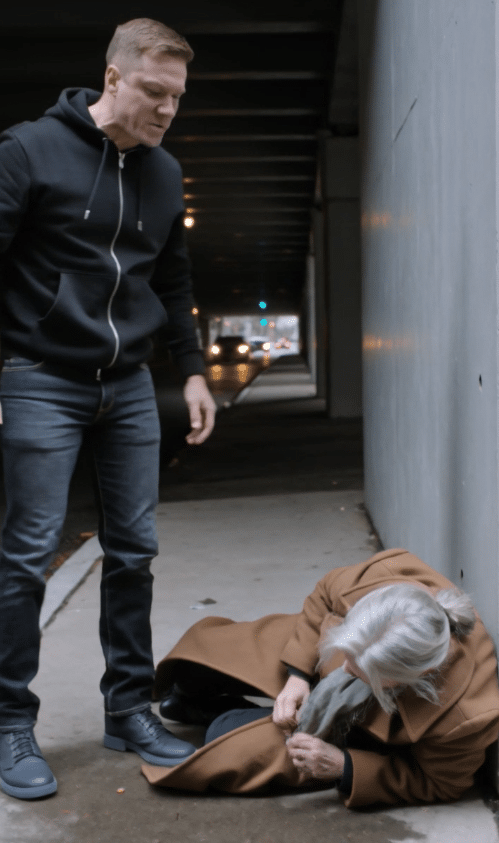
The man in the black hoodie crouched beside the elderly woman, slipped several bills out of her dented metal bowl, and smirked as if stealing from someone who couldn’t see him was the easiest thing in the world.
The coins rattled softly against the metal.
The woman turned her cloudy white eyes toward the sound.
“Please put it back.”
The man froze.
For a moment, the damp underpass seemed to hold its breath. Traffic rushed overhead, headlights streaking across the concrete ceiling, while cold air drifted between the shadowed pillars. A few people sat farther beneath the bridge, keeping to themselves, unwilling to attract attention.
The man slowly straightened.
“What did you say?”
“I heard you take it,” the woman replied. Her voice was weak, but there was nothing uncertain about it. “Please. That’s all I have.”
She was seventy-nine, with messy silver hair escaping from beneath a frayed scarf and an old brown wool coat that had seen too many winters. Her hands shook from the cold, but she had learned to recognize the smallest sounds around her: footsteps slowing, coins shifting, a stranger moving too close.
Her blindness had taken away her ability to see the world, not her ability to understand it.
The man glanced at the money in his hand.
Then he looked at her unfocused eyes and laughed.
“Trash. You don’t need money under a bridge.”
The woman swallowed.
“It’s mine.”
“Then you should have kept a better eye on it.”
He knew exactly how cruel the joke was. That was what made it worse.
She drew her coat closer around herself.
“I’m asking you to give it back.”
The man’s expression twisted. Her calm refusal to accept the theft seemed to offend him more than the accusation itself. He had expected fear, perhaps silence, maybe the helpless resignation of someone who believed she had no right to challenge him.
Instead, she had spoken.
He snatched the dented metal bowl from beside her and slapped her hard across the face.
The woman fell sideways onto the cold concrete.
A sharp gasp escaped her. Her forearm scraped against the ground, leaving a thin trace of blood, and the bowl rolled away with a hollow metallic clatter. Several coins scattered across the damp pavement.
She tried to lift herself, but pain forced her back down.
Her cloudy eyes stared into nothing. One trembling hand moved across the concrete, searching for the bowl by sound.
The man stepped closer.
Then he kicked her twice more, striking her back and side as she curled instinctively to protect herself.
A man standing near a bridge pillar recoiled. Another person covered their mouth. Someone whispered, “Stop,” so quietly that the word barely rose above the traffic.
Nobody intervened.
The attacker looked down at the elderly woman as though she had caused him an inconvenience.
“No one cares what you heard.”
She breathed in short, painful gasps.
Still, her hand continued searching for the bowl.
Not for the man. Not for revenge. Not even for help.
For the few coins she had managed to collect.
The sight seemed to make the people nearby even more uncomfortable. They could look away from the assault, but they could not easily ignore the desperate movement of that trembling hand.
Then headlights swept across the underpass entrance.
A black SUV braked hard at the curb.
The driver’s door opened, and a tall man in a dark coat rushed into the shadows. He saw the woman on the ground, the scattered coins, and the man standing over her.
He did not hesitate.
He crossed the distance and landed one hard punch to the attacker’s face, sending him stumbling backward. The man in the hoodie caught himself against a concrete pillar, stunned, a thin trace of blood appearing at the corner of his mouth.
The newcomer immediately positioned himself between the attacker and the fallen woman.
His face was controlled, but his eyes burned with anger.
“You stole from a blind woman under a bridge,” he said.
The attacker wiped his mouth and glared at him.
“Who the hell are you?”
The newcomer did not answer that question.
Instead, he looked down at the woman and made sure the attacker could no longer reach her.
Then he spoke with the cold authority of someone who had come to a place he knew all too well.
“I fund every shelter under this bridge.”
The man in the hoodie stared at him.
“Every shelter?”
For the first time that night, the bully seemed to understand that he might have chosen the wrong person to terrorize.
But the wealthy stranger’s connection to the shelters was only the beginning of what he was about to uncover.
Because the woman on the ground had been trying to survive a winter that the man in the black hoodie had never bothered to understand.
And the philanthropist was about to discover why the system he had built had failed her.
Act II
The man who had rushed from the SUV was Daniel Whitmore, a fifty-two-year-old philanthropist whose foundation operated emergency shelters, meal programs, and outreach services across the city.
His wealth had come from a logistics company he built with two partners before selling his share. He could have spent the rest of his life in private comfort, far from the places where winter could become dangerous within hours.
Instead, he had devoted much of his fortune to housing programs.
His foundation funded beds, meals, outreach workers, and partnerships designed to help people move from emergency accommodation into more stable living arrangements. The underpass was one of the areas his teams visited regularly, connecting people with available services and offering transportation to shelters when space permitted.
Daniel had learned that writing a check was the easiest part of helping someone.
The difficult work came afterward.
A shelter might have beds available but lack accessible facilities. A person might be eligible for housing assistance yet struggle to complete the paperwork. Someone who had experienced years of instability might distrust a stranger offering help, even when that stranger carried official identification and a sincere promise.
The foundation had been working to close those gaps.
Daniel visited outreach sites himself because he did not want reports and financial summaries to become substitutes for understanding what people actually experienced.
That night, he had been returning from a late meeting when his driver noticed movement under the bridge. Daniel looked through the window and saw a man bending over an elderly woman.
At first, he thought the man was helping her.
Then he saw money being taken from the bowl.
He saw the woman turn toward the sound and speak.
He saw the man strike her.
By the time the SUV stopped, Daniel was already out of the door.
Now, standing in the cold underpass, he looked toward the woman.
“Ma’am, can you hear me?”
She turned toward his voice.
“Yes.”
“My name is Daniel. I’m going to stay right here while we get you help.”
Her fingers continued moving across the concrete.
“My bowl,” she whispered.
Daniel followed the sound of the coins and spotted the dented metal bowl near a pillar. He retrieved it and placed it close enough for her to locate without stretching painfully.
“It’s here.”
Her fingertips touched the rim.
She pulled it toward herself and held it with both hands.
“Thank you.”
Daniel crouched nearby, careful not to crowd her.
“I’m calling for medical assistance. Can you tell me your name?”
“Evelyn.”
“Evelyn, do you know where you’re hurt?”
“My side. My arm. My face.”
Her voice shook as she tried to take a deeper breath.
Daniel asked the nearest bystander to call emergency services while he stayed beside her. He also directed someone to alert the shelter outreach team, making it clear that no one should move Evelyn or handle her belongings unnecessarily while the responders assessed the situation.
Then he rose and faced the attacker.
The man was still rubbing his mouth.
“You hit me,” he said angrily.
Daniel’s jaw tightened.
“You assaulted her.”
“She was accusing me of stealing.”
“You took money from her bowl.”
“She couldn’t even see what I was doing.”
The words came out with such casual contempt that Daniel felt his anger sharpen.
The attacker seemed to think blindness made Evelyn less capable of recognizing a crime—and less likely to be believed if she reported one.
He had mistaken her disability for permission.
“You knew she couldn’t see you,” Daniel said.
“So what?”
Daniel stared at him.
“So you thought that meant you could do whatever you wanted.”
The man scoffed.
“You don’t know anything about me.”
“No,” Daniel replied. “I know what you did tonight.”
The attacker glanced toward the others beneath the bridge. Their faces were mostly hidden in shadow, but their attention had shifted toward the confrontation.
He seemed to realize that his audience was no longer simply watching an elderly woman suffer.
They were watching him.
“People like her shouldn’t be hanging around here,” he muttered.
Daniel’s expression hardened.
“People like her?”
“People who live under bridges. They make everything worse.”
Daniel looked toward the damp concrete, the dark spaces between the pillars, and the people who had retreated into those spaces to avoid trouble.
“This place is cold,” he said. “It’s dark. People come here because they have nowhere else to go.”
“That’s not my problem.”
“No. But hurting someone is your decision.”
The man shifted his weight as if considering whether to leave.
Daniel moved just enough to keep himself between him and Evelyn, without attempting to restrain him.
“You’re staying here until the authorities arrive.”
“Make me.”
Daniel did not take the bait.
Instead, he turned to the witnesses.
“If you saw what happened, please tell the responders exactly what you witnessed. You don’t need to add anything or leave anything out.”
A few people nodded.
One older man stepped slightly out of the shadows. His expression was troubled.
“I saw him take the money,” he said. “Then she asked him to put it back.”
A woman standing near the far pillar spoke next.
“I saw him hit her.”
The attacker turned toward them.
“Stay out of this.”
Daniel’s voice cut through the underpass.
“Don’t threaten them.”
For a moment, nobody moved.
Then the first siren sounded in the distance.
The attacker looked toward the entrance, and his confidence began to fracture.
Daniel turned back to Evelyn, who was holding the bowl tightly against her coat.
She had not asked who Daniel was. She had not asked about his money or his foundation. She did not yet know that the man standing beside her could fund every shelter beneath the bridge.
She only knew that someone had finally stopped the person hurting her.
But when the responders arrived and began asking questions, Evelyn revealed something that made Daniel’s anger give way to a different, more troubling feeling.
She had tried to enter one of his shelters earlier that evening.
And she had been turned away.
Act III
Evelyn’s hands shook as the responders examined her injuries.
She answered their questions carefully, pausing when pain made it difficult to speak. Her forearm had been scraped, her face hurt from the slap, and her back and side were painful after the kicks. The responders explained their assessment and recommended further medical evaluation.
Daniel remained nearby but gave them room to work.
When one of the responders asked where Evelyn had been staying, she hesitated.
“Under here,” she said. “For now.”
“Have you been offered shelter?”
Evelyn lowered her head.
“I went to one tonight.”
Daniel looked at her.
“Which one?”
“Riverside House. The one with the blue sign.”
He knew it.
Riverside House was a partner facility funded in part by his foundation. It had emergency beds, a meal service, and a small team trained to assist older adults and people with disabilities.
It was not supposed to turn away a vulnerable person without explaining the available alternatives.
“Why did they turn you away?” Daniel asked gently.
Evelyn’s fingers tightened around the bowl.
“They said there wasn’t a place for me.”
Daniel waited.
“They said the dormitory was full. I asked if there was somewhere else I could go, but the man at the desk said I should try again tomorrow.”
“Did he give you information about another shelter?”
She shook her head.
“No.”
“Did he know you were blind?”
“Yes.”
The answer struck Daniel harder than he expected.
He had personally approved funding for accessible outreach services. The foundation had paid for staff training, referral agreements, and procedures intended to ensure that people who could not be accommodated at one facility were directed toward alternatives.
If Evelyn’s account was accurate, something had failed.
Perhaps the shelter had genuinely reached capacity. Emergency facilities could not always provide a bed to everyone who arrived. But a full dormitory should not have meant that a blind seventy-nine-year-old woman was left without guidance, without a safe alternative, and without any clear plan for the night.
Daniel looked at the responders, then back at Evelyn.
“I’m sorry.”
She turned toward his voice.
“You didn’t send me away.”
“No,” he said. “But my foundation supports that shelter, and I need to understand what happened.”
Evelyn was silent for a moment.
“I didn’t expect a private room,” she said. “I know places get full. I only wanted someone to tell me where else I could go.”
Daniel felt a weight settle in his chest.
She had not expected him to guarantee a bed. She had not demanded special treatment. She had asked for information that could have helped her reach another safe place.
Instead, she had been left to find her own way through a city she could not see.
And beneath the bridge, she had become the target of someone who believed that no one would care what happened to her.
Daniel turned toward the foundation’s outreach coordinator, who had arrived after being contacted by the security team.
“Please arrange an appropriate placement for Evelyn tonight, subject to what she wants and what the available services can safely provide. Make sure the location can accommodate her needs. And I want a review of what happened at Riverside House.”
The coordinator nodded.
Daniel continued.
“Preserve the relevant intake records. Find out whether staff followed the referral procedure, and document any capacity issue or other reason she was turned away. I want the facts, not assumptions.”
He knew better than to declare the shelter guilty before the review began. There might have been an operational problem, a communication failure, or a genuine shortage of beds.
But none of those possibilities would make the failure unimportant.
The attacker, meanwhile, had become increasingly agitated.
“You’re making all this about a shelter now?” he demanded. “She was already living under a bridge. What difference does it make?”
Daniel turned slowly.
“It makes the difference between someone having a safe place to sleep and someone being left out here in the cold.”
“She chose this life.”
Evelyn flinched at the words.
Daniel noticed.
“No,” he said. “You don’t know what she chose. You don’t know what happened to her. And you certainly don’t get to decide that she deserves to be hurt.”
The attacker scoffed.
“I’m supposed to feel sorry for every person who can’t get their life together?”
“No one is asking you to solve her life.”
Daniel glanced at the bowl in Evelyn’s hands.
“You were asked to leave her money alone.”
The man had no answer.
The police arrived and began separating the witnesses so each could give an independent account. Daniel described what he had seen, including the punch he had delivered after arriving. He did not attempt to hide his own actions or suggest that his wealth entitled him to decide the outcome.
The officers documented Evelyn’s account, the witnesses’ statements, and the available evidence. The attacker was questioned, and the incident proceeded through the appropriate legal process.
Daniel then turned his attention to the shelter.
He called the foundation’s director and asked for an immediate review of the partner facility’s intake procedures. He wanted to know how staff handled full capacity, what alternatives they offered people who were blind or otherwise disabled, and whether outreach workers had a clear way to locate a safe placement after hours.
The initial information was troubling.
Riverside House had been close to capacity that night. The employee at the desk had followed the rule requiring staff to check available beds before accepting a new resident.
But the review also found that the referral process had not been completed. The employee had not contacted the on-call coordinator or checked the list of partner facilities with possible openings. The interaction had ended after Evelyn was told to return the next day.
A procedure intended to prevent unsafe overcrowding had been treated as the end of the conversation rather than the beginning of the search for an alternative.
The failure did not explain the attack beneath the bridge, and it did not make the attacker responsible for the shelter’s mistake.
But it showed Daniel that the night’s cruelty had been preceded by another kind of neglect.
Evelyn had asked for help twice.
The first time, she was dismissed.
The second time, she was assaulted.
And now Daniel had to confront a question he could not answer with another donation.
What good was funding shelters if the people who needed them most could still fall through the gaps?
Act IV
By sunrise, the underpass had begun to empty.
Cars continued across the bridge overhead, carrying people toward offices, schools, and appointments. The city was waking up around the place where Evelyn had spent the night fighting for a handful of coins.
She had received medical attention, and the outreach team had arranged a temporary placement that could accommodate her needs. Before leaving, she made sure the dented metal bowl was with her.
Daniel watched her hold it as the outreach worker explained where they were going and what assistance would be available.
“Will I have to leave tomorrow?” Evelyn asked.
The worker explained the placement’s terms, the next steps, and who would help her review longer-term options. Nothing was promised that the service could not guarantee, but Evelyn was given clear information and a way to ask questions.
She nodded slowly.
Daniel was relieved that she had somewhere safer to go, but he knew one night of assistance was not a solution to every problem she faced.
He also knew that the foundation’s review could not stop with one employee at Riverside House.
Over the following days, the team examined intake records, staff accounts, referral logs, and the rules governing emergency placements. They found no evidence that the shelter had intentionally targeted Evelyn, but they did identify a pattern of inconsistent follow-through when beds were full.
Some staff contacted partner facilities immediately. Others relied on outdated lists or told applicants to return later. The process depended too heavily on individual judgment and too little on a reliable system.
Daniel ordered corrective action.
Riverside House introduced a clearer escalation procedure for full-capacity situations. Staff were required to contact an on-call coordinator before ending an intake when no bed was available, and the referral directory was updated to include accessibility information and current contact routes.
The foundation also reviewed its oversight of partner shelters, strengthening the process for reporting service failures and tracking whether referrals resulted in actual placements.
Daniel insisted on measuring outcomes, not just money spent.
The number of beds funded mattered, but so did whether people could reach them. The number of outreach workers mattered, but so did whether a person leaving an intake desk knew where to go next.
He wanted the foundation to ask harder questions about the difference between a service existing on paper and a person successfully receiving it.
The review also examined whether Evelyn had been given an accessible explanation of her options. Staff received additional guidance on communicating with blind residents respectfully, offering information in usable formats, and asking what assistance a person wanted rather than assuming it.
These were not dramatic changes.
They were practical ones, designed to make it less likely that another person would be sent away without a next step.
Meanwhile, the investigation into the assault continued independently.
Witnesses confirmed that the attacker had taken money from Evelyn’s bowl, struck her, and kicked her twice while she was down. The available evidence supported her account. The man’s claim that she had provoked him did not explain or excuse his actions.
The authorities handled the case under the applicable law. Daniel did not attempt to direct the outcome, and the foundation did not offer to make the matter disappear in exchange for silence.
The man was ultimately held accountable through the legal process. His circumstances and the specific legal consequences were determined by the relevant authorities, not by Daniel’s personal judgment.
For Daniel, that distinction mattered.
He had reacted physically when he saw Evelyn being attacked. His anger had been immediate, and he did not regret intervening to stop the assault, but he also understood that his own use of force was a separate matter that could not be erased by his good intentions.
Protecting a vulnerable person did not mean that every action taken in anger became automatically justified.
He had to answer for his choices just as everyone else did.
The foundation’s board also asked him to explain what the incident revealed about its outreach work. Daniel presented the findings without blaming individual employees for every systemic failure, but he did not soften the conclusions to protect the organization’s reputation.
“We funded services that were supposed to help people find safety,” he told the board. “But our process allowed someone to leave without a safe alternative or a clear referral. The funding is not the finish line. It’s our responsibility to make sure the service actually works.”
The board approved the corrective measures and scheduled follow-up reviews to check whether they were being implemented.
Some people suggested a public campaign built around the attack. Daniel refused to turn Evelyn’s pain into a promotional story.
“She doesn’t owe us her suffering,” he said. “If we want to show the work matters, we should demonstrate that the system has changed.”
He also made sure that Evelyn’s privacy was respected. The foundation would not publish her name or image without her informed consent, and staff were instructed not to treat her as a symbol for fundraising.
When Daniel later visited the temporary placement, he went without a photographer or a group of executives.
Evelyn was seated in a quiet common room, her silver hair neatly arranged, her coat folded beside her. The dented metal bowl rested close to her.
She recognized Daniel’s voice.
“You came back.”
“I wanted to check how things were going.”
She listened while he explained that the foundation had reviewed the shelter’s procedures and made changes to the referral process. He described what had been changed without claiming that every problem was solved.
Evelyn was quiet.
“Will it help the next person?” she asked.
“That’s what we’re trying to make sure of.”
She nodded.
“Good. That’s more important than making me feel special.”
Daniel sat with that answer.
He had entered the underpass thinking he needed to stop one violent man. He had left it understanding that the work did not end when the attacker was gone.
The person harmed needed care. The evidence needed to be preserved. The failures that had left her vulnerable needed to be examined. And the people responsible for providing help needed a system that made doing the right thing more reliable than leaving someone to fend for herself.
But Evelyn had one more request.
It was small, direct, and more difficult than Daniel expected.
Act V
Several weeks later, Evelyn returned to the underpass during the day.
She was not alone; an outreach worker had accompanied her to help her attend an appointment nearby. The weather remained cold, but the morning sunlight reached farther between the concrete pillars, illuminating the damp patches on the ground.
Evelyn paused where she had been sitting on the night of the assault.
For a moment, she said nothing.
She could still remember the sound of the coins scattering. She could remember the sudden blow, the cold pavement against her arm, and the terror of trying to locate the bowl while someone stood over her.
She could also remember the silence.
Not everyone beneath the bridge had been cruel. Some had been frightened. Some had been unsure what to do. But their retreat had left her alone with a man who believed that no one would care what happened to her.
Daniel met her there after she agreed to the visit.
“I wanted to see this place again,” Evelyn explained.
He nodded.
“You don’t have to stay if you’d rather leave.”
“I know.”
She turned her face toward the passing traffic.
“I used to think that if I kept quiet and didn’t bother anyone, people would leave me alone.”
Daniel waited.
“But sometimes they take your silence as permission.”
The words stayed between them.
Evelyn was not suddenly free of hardship. Her eyesight had not returned. The difficulties that had led her to homelessness had not disappeared because a wealthy man had stepped out of an SUV.
She was still working with local services to find a stable housing arrangement, and there would be forms, appointments, waiting lists, and decisions she could not control.
But she now had a clearer path toward those services. She knew whom to contact when she needed help, and the outreach team had explained her options without making promises they could not keep.
Daniel asked whether she needed anything else.
Evelyn considered the question.
“I’m doing better. I don’t need you to fix everything.”
“I understand.”
“But I have something I’d like you to do.”
“Tell me.”
“Make sure the people working at those shelters know what it’s like to be turned away without knowing where to go.”
Daniel nodded slowly.
“We’ve started reviewing that.”
“Keep going,” she said. “People get tired. They get busy. Maybe they don’t mean to hurt anyone. But when you’re the person standing there with nowhere to go, it doesn’t matter much whether they meant to hurt you.”
Daniel looked toward the concrete pillars.
He thought about the foundation’s budgets, the occupancy reports, and the summaries he had read over the years. The numbers had told him how many beds existed and how much money had been spent.
They had not told him what it felt like to be told to return tomorrow when tomorrow offered no guarantee of safety.
He had funded shelters because he believed that nobody should have to face the cold without somewhere to turn.
Evelyn had shown him that the promise of a shelter was not fulfilled merely because a building existed.
Someone had to answer the door.
Someone had to listen.
And when the first option failed, someone had to help find the next one.
Daniel thanked her for telling him.
Evelyn gave a small nod, then asked the outreach worker to guide her toward the waiting vehicle for her appointment. Daniel did not insist on walking beside her or turning the moment into a public gesture.
He let her decide how to leave.
In the months that followed, the foundation continued its reviews. Partner shelters were assessed not only on capacity but also on referral practices, accessibility, and the consistency of their responses when applicants could not be accommodated immediately.
The organization tracked whether referrals led to placements and whether people received clear information about the next steps. When problems were found, staff were expected to address them and document the changes.
It was not a perfect system, and Daniel knew it would never become one. There would still be nights when demand exceeded capacity, when a person needed more support than a single facility could offer, and when the available options were painfully limited.
But the foundation could no longer treat a full bed count as a complete answer.
It had to ask what happened to the person who stood outside the door.
As for Evelyn, she continued taking small steps toward a more stable life. She accepted assistance where it helped, questioned explanations she did not understand, and kept the dented metal bowl.
When someone asked why she still carried it, she answered simply.
“It’s mine.”
There was no anger in her voice when she said it. Just a quiet insistence that even the smallest part of a person’s life deserved to remain their own.
Daniel remembered that answer.
He had arrived beneath the bridge with wealth, influence, and the ability to move resources quickly. Those things had helped him intervene and improve the services his foundation supported.
But they were not what made Evelyn worthy of help.
She had been worthy of help before he arrived. She had been worthy of respect when she was sitting alone in the cold, when her bowl held only a few coins, and when nobody nearby knew her name.
The man in the black hoodie had looked at her blindness and poverty and decided she was someone he could hurt without consequence.
The people who watched had seen the danger but hesitated to act.
And the shelter system, despite the money invested in it, had failed to give her a clear path to safety when she needed one.
Each failure had been different. Each required a different response.
But they shared one dangerous assumption: that a person with little power could be left to carry the burden alone.
Daniel could not change the entire city with one act of generosity. He could not guarantee that no one would ever be cruel again.
What he could do was refuse to confuse charity with dignity.
Charity was something people might offer.
Dignity was not something Evelyn had to earn.
She had not needed to be grateful enough, polite enough, or important enough to deserve protection from violence. She had not needed a wealthy stranger to arrive before her voice became worth hearing.
She had needed someone to leave her money alone, to listen when she asked for help, and to recognize that her life mattered.
Under the bridge, the traffic continued to thunder overhead. People still hurried past the dark spaces between the pillars, carrying their own worries and rushing toward the places they believed they needed to be.
But the foundation’s work continued, too: less visible than a billionaire stepping from an SUV, and far more enduring than one dramatic confrontation.
Because the true measure of Daniel Whitmore’s wealth was not the size of his fortune or the number of shelters bearing his foundation’s name.
It was whether that wealth helped make the next vulnerable person’s night safer.
And the true measure of a city was not how quickly its powerful people could rescue someone after a terrible act.
It was whether ordinary people could ask for help without being humiliated, whether systems could respond when the first door was closed, and whether anyone watching cruelty unfold would find the courage to say, Enough.
Evelyn had been nearly invisible beneath that bridge.
But she had never been worthless.
And the greatest failure that night was not that a blind, elderly woman had so little money. It was that someone believed her life mattered so little that he could take what she had, hurt her for speaking up, and expect the world to keep walking.