Act I
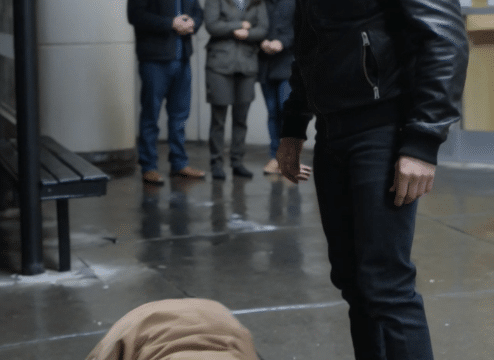
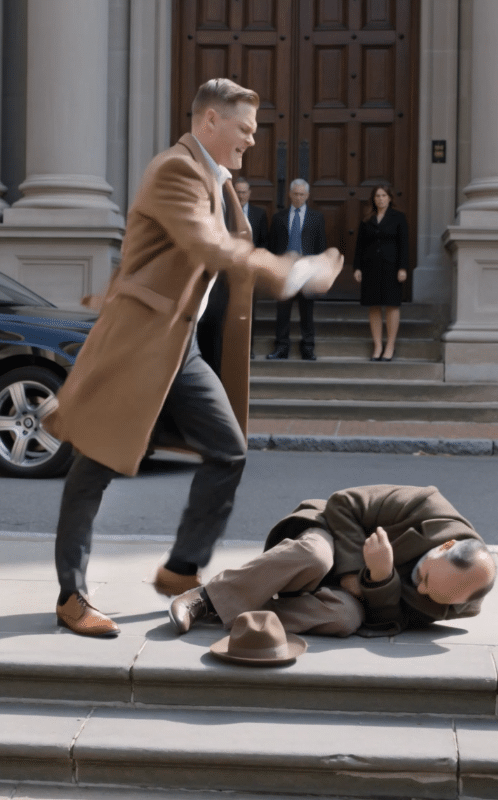
The man bent down as if he were about to make a donation. Instead, he stole from the blind old man sitting on the church steps.
His expensive camel coat barely brushed the stone as he reached toward the worn felt hat resting upside down beside the elderly man. A few coins and small bills lay inside, the remains of whatever strangers had given him that morning. The younger man slipped a bill and several coins into his pocket, then straightened with a smug smile.
He thought he had gotten away with it.
The elderly man turned his cloudy gray eyes toward the sound.
“I heard the coins leave.”
The words were quiet, but they stopped the younger man cold.
Sunday morning sunlight fell across the columns of the old American church. Wooden doors stood open behind a stream of arriving worshippers, and the sound of distant conversation drifted down the steps. People in pressed jackets and elegant dresses passed the entrance, greeting friends and preparing for service.
The old man had been sitting there long before most of them arrived.
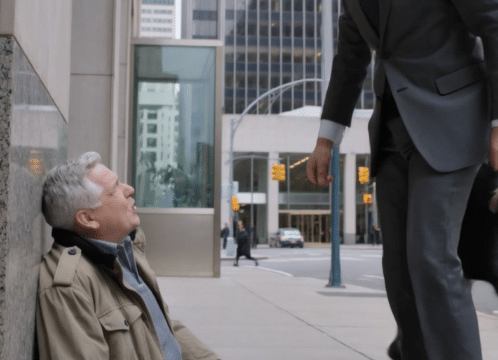
At seventy-seven, he wore a thick, worn coat and old brown pants that had grown loose around his frame. His silver beard framed a face marked by years of hardship, and his eyes, cloudy and unable to focus, revealed nothing of the people moving around him. He could not see the man’s expensive clothes or the contempt twisting his expression.
But he could hear.
He had heard the coins shift. He had heard the faint scrape of fingers against the felt hat. And he had heard the sudden silence that followed when the thief realized he had been caught.
The younger man was thirty-seven-year-old Brandon Cole, a regular churchgoer who took particular pride in appearing successful. He liked being seen in expensive clothes. He liked having people admire his polished appearance and laugh at his jokes. Around his friends, he carried himself as though wealth were proof of character.
Now those friends stood nearby, watching his face.
Brandon’s smile vanished.
“What did you say?”
“I heard you take the money,” the old man replied.
Brandon leaned closer, his voice dropping into a vicious whisper.
“Trash. No one will believe a blind old beggar.”
The elderly man’s fingers tightened against his knee.
“Please give it back.”
That should have been the end of it. Brandon could have returned the money, muttered an excuse, and walked through the church doors. The amount was small enough that he would barely have noticed it missing from his own pocket.
But being exposed in front of his friends felt, to Brandon, like an unforgivable insult.
He looked around. Several churchgoers had slowed. One woman pressed her lips together, clearly uncomfortable. A man standing beside a column glanced at Brandon and then quickly looked away.
No one challenged him.
That silence gave Brandon the confidence he wanted.
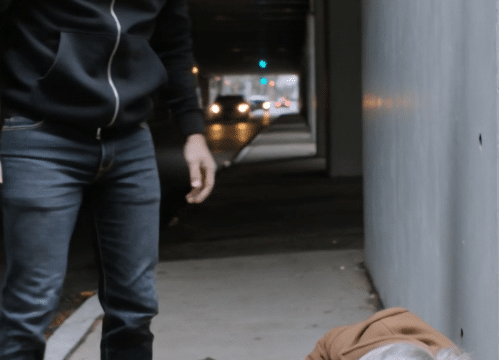
He stepped forward and drove a hard kick into the elderly man’s chest.
The old man fell backward against the stone step, his body striking the edge before collapsing onto the pavement. His felt hat tumbled down one step, spilling a few coins and bills across the stone. He gasped, struggling to draw breath, and a thin trace of blood appeared on his elbow.
For a moment, he lay stunned.
Then his hand began searching.
His cloudy eyes stared uselessly into the morning light. He could not see where the hat had fallen, so he moved his fingers over the stone, feeling for the familiar worn brim.
Brandon watched him.
Then he stepped closer and delivered two more hard kicks, one to the old man’s back and another to his side.
The elderly man curled inward, his breath breaking into painful gasps. Still, his hand reached toward the hat.
Around them, the church steps fell silent.
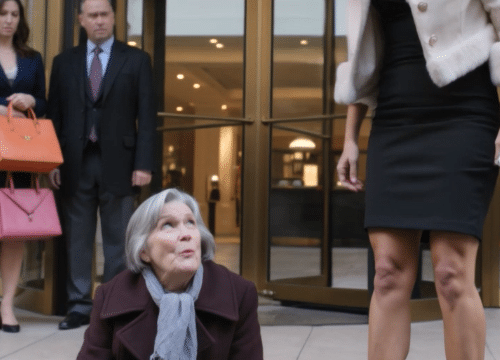
Brandon’s friends covered their mouths. One woman recoiled toward the doors. A man who had been standing only a few feet away stepped backward, his expression caught between horror and fear.
Nobody intervened.
Brandon stood over the old man, breathing hard, his carefully styled hair still in place.
“Stay quiet where you belong.”
Then the sound of a powerful engine cut through the murmurs.
A black Bentley stopped sharply at the curb.
The rear door opened, and a man in a dark overcoat stepped out. He looked toward the church steps, saw the elderly man on the ground, and began moving toward them with frightening purpose.
Brandon had no idea who was coming.
But within seconds, the man in the dark suit would make him question everything he thought he knew about power, credibility, and whose voice the world was willing to hear.
Act II
The man from the Bentley was Judge Thomas Whitaker, a fifty-five-year-old federal judge known for his measured manner and uncompromising attention to evidence.
He had spent decades watching people construct elaborate stories to protect themselves. He had heard defendants insist that witnesses were mistaken, that victims were unreliable, and that the truth depended on who could speak with the greatest confidence.
He knew that a convincing performance and an honest account were not always the same thing.
That morning, he had been arriving for Sunday service when he noticed a disturbance on the church steps. At first, he saw only a cluster of people standing strangely still. Then he saw Brandon towering over the elderly man.
He saw the hat lying one step below.
He saw the old man’s hand searching across the stone.
And he saw Brandon’s expression.
Thomas moved before the driver had fully closed the car door.
Brandon turned just as the judge reached him. He began to speak, perhaps to explain, perhaps to defend himself, but Thomas saw the old man’s pain and the scattered money.
He struck Brandon once across the face.
The punch landed hard enough to send Brandon staggering sideways. He caught himself against a church column, one hand flying to his mouth. A thin trace of blood marked his lower lip.
The crowd went utterly silent.
Thomas stepped between Brandon and the elderly man. His dark overcoat shifted in the breeze, and his face was rigid with anger.
“I believe him.”
Brandon stared at him.
The judge’s words were simple. They carried no elaborate threat, no boast about connections, and no announcement of his position. Yet they struck Brandon harder than the punch had.
For the first time that morning, someone had refused to accept his version of events before even hearing it.
Brandon touched his lip, then looked at the man standing in front of him.
“Who the hell are you?”
Thomas did not answer immediately. He turned toward the elderly man and lowered himself carefully onto one knee.
“Sir, can you hear me?”
The old man nodded faintly.
“My name is Thomas. I’m here to help.”
“Did he leave?” the elderly man asked.
“Not yet. But he won’t come near you again.”
The old man swallowed. His hand was still stretched toward the step below.
“My hat.”
Thomas looked down, found the worn felt hat, and asked whether he could bring it closer. When the old man nodded, he placed it within reach without moving the coins or bills scattered around it.
The elderly man’s fingers closed around the brim.
“Thank you.”
Thomas felt a sharp ache in his chest at the way the man said it. He sounded less relieved than apologetic, as though needing help were another burden he had to impose on strangers.
Thomas had seen that expression before—not only in courtrooms, but in hospital corridors, public offices, and crowded places where people in distress learned to make themselves as small as possible.
He looked back at Brandon.
“What happened here?”
Brandon straightened his coat, attempting to rebuild the dignity he had lost.
“He was begging. I tried to move past him, and he started accusing me of stealing.”
Thomas glanced at the hat.
“Did you take money from it?”
“No.”
“Did you strike him?”
Brandon hesitated.
“He got in my way.”
“That wasn’t my question.”
Brandon’s jaw tightened.
The judge’s voice remained controlled, but his eyes were hard.
“Did you strike him?”
Brandon glanced at his friends, searching for support. They had watched him steal the money. They had watched him kick an elderly man on the church steps. Now, with a federal judge standing between them, none seemed eager to confirm Brandon’s story.
Thomas did not need to announce his title to command their attention. His authority was visible in his composure, his precision, and the fact that he did not appear interested in being impressed by anyone.
Still, he was not acting in a courtroom. He was a witness to a violent incident, and he understood that his own actions would need to be accounted for. He had punched Brandon in anger, and whatever his reasons, his position did not place him above the law.
He would not use his office to decide what happened next.
Instead, he instructed the church staff to contact emergency services and asked that the incident be documented. He told the witnesses that they should give their own accounts, without coordinating their stories or allowing anyone to pressure them.
Only then did he turn fully toward Brandon.
“You don’t get to decide that he isn’t believable because he’s blind, poor, or sitting on these steps.”
Brandon’s face flushed.
“You think you’re better than me because you wear a robe?”
“No,” Thomas replied. “I think you are responsible for what you did.”
The old man sat quietly behind him, holding the felt hat against his knees.
Thomas asked for his name.
The man hesitated, as if he had not expected anyone to care.
“Arthur,” he finally said. “Arthur Miller.”
Thomas repeated it, making sure he had heard correctly.
“Arthur Miller.”
For the first time that morning, the elderly man seemed to understand that someone was speaking to him as though his name mattered.
But when Thomas asked whether he needed medical attention, Arthur’s answer revealed that the theft was only the beginning of a much longer story.
Act III
“I don’t want to cause trouble,” Arthur said.
Thomas looked at the thin trace of blood on his elbow and the way Arthur guarded his chest when he breathed.
“You’re not causing trouble.”
Arthur gave a small, weary shake of his head.
“People always say that before they tell you to move.”
The words hung between them.
Thomas had spent much of his career listening to people explain why they had done what they had done. He had learned to recognize evasions, contradictions, and rehearsed performances. But Arthur’s answer carried no performance at all.
It sounded like a lesson learned through repetition.
Arthur explained that he had been homeless for several months. He had not always lived that way. Years earlier, he had worked in maintenance for a small manufacturing company outside the city. He had raised a family, paid his bills, and taken pride in fixing things that other people had given up on.
Then the company closed.
After that came a series of setbacks: temporary work that disappeared, rent that rose faster than his income, and a period of illness that left him unable to keep up with everything at once. By the time he realized how far he had fallen, he had already lost the stability that might have helped him recover.
He had become blind gradually, after an eye condition worsened over several years. He had sought treatment, but the appointments were difficult to manage, and the costs had become impossible to predict.
Eventually, he stopped expecting life to become easy.
He began focusing on surviving one day at a time.
The church had become a familiar place. Some people offered him food or a few dollars. Others passed without looking at him. A few made it clear that his presence offended them, even though he never blocked the doors or demanded anything from anyone.
Arthur had learned which footsteps were hurried, which people carried coins, and which voices belonged to those who might stop long enough to ask whether he was all right.
That morning, he had heard Brandon approach and bend beside him. For a brief moment, Arthur had thought the man was making a donation.
Then the coins moved.
“I knew what I heard,” Arthur told Thomas. “I just didn’t know whether anyone would believe me.”
Thomas glanced toward the church doors.
“That doesn’t make what happened your fault.”
Arthur’s face tightened.
“People see a man like me, and they think they already know everything about him.”
Thomas had no argument against that.
He knew that a courtroom was supposed to be a place where claims were tested against evidence, not judged by someone’s appearance or social position. Yet outside a courtroom, people made judgments in seconds, often with no intention of revisiting them.
Arthur had been convicted in the eyes of the crowd before anyone had asked him a single question.
He had been treated as unreliable because he was blind and homeless. Brandon, meanwhile, had relied on the assumption that a polished coat and confident voice would make his denial sound more credible.
That assumption had nearly worked.
A church staff member brought emergency responders to the steps. They approached Arthur carefully, explaining who they were and asking permission before examining him. Arthur admitted that his chest hurt and that he felt pain along his back and side.
The responders decided he needed medical evaluation. The assault had been forceful, and the visible mark on his elbow could not tell them whether he had suffered deeper injuries.
While they assessed him, Thomas spoke with the witnesses.
At first, several were reluctant to say anything. Brandon’s friends looked uncomfortable, and one muttered that the situation had escalated too quickly for anyone to know exactly what happened.
Thomas did not argue with them.
“Tell the responders what you personally saw,” he said. “If you didn’t see something, don’t claim that you did.”
That simple instruction seemed to break the spell of the morning.
One woman admitted that she had watched Brandon reach into the hat. Another had heard Arthur accuse him of taking the money. A third had seen Brandon kick Arthur after he fell.
The witnesses’ accounts began to align with one another.
Brandon’s excuses grew less convincing with every statement.
He insisted that Arthur had insulted him first. He claimed he had only been trying to defend himself. Then he argued that Thomas had attacked him without warning.
Thomas did not deny the punch.
“I struck you,” he said. “I will answer for that. It doesn’t erase what you did to him.”
Brandon stared at him, seemingly unable to understand why a powerful man would admit to something that could damage his own position.
Thomas had no desire to pretend he had acted perfectly. His anger had been immediate and genuine, but anger was not a substitute for due process. The incident needed to be documented honestly, including his own conduct.
He could accept scrutiny without allowing Brandon’s actions to disappear behind it.
When emergency responders prepared to take Arthur for evaluation, the elderly man reached down for the hat once more. His fingers brushed the worn felt, and he carefully drew it closer.
Thomas waited until Arthur had secured it before asking if he needed anything else.
Arthur hesitated.
“I was hoping to come to church today,” he said. “I thought maybe if I sat here quietly, people would let me be.”
Thomas looked toward the open wooden doors.
“Is that what you want? To attend the service?”
Arthur nodded.
“Then we’ll find out how to make that possible.”
But before Thomas could follow through, a church administrator approached with a worried expression and quietly told him that Brandon was not the only person whose behavior needed to be examined.
The church had received complaints about the way Arthur was treated long before that morning.
And the person who had been responsible for handling those complaints had never told the congregation how many there were.
Act IV
The administrator’s name was Peter Lawson, and he had served the church for nearly a decade.
He was not the pastor, nor was he a law enforcement officer. He managed the building, coordinated volunteers, and handled practical issues around the church entrance. When complaints arose about people gathering on the steps, Peter had often been the person asked to respond.
He told Thomas that several congregants had expressed discomfort about Arthur’s presence.
Some worried that visitors would mistake the church for a place that encouraged begging. Others complained that seeing someone homeless outside the entrance made them feel guilty or uneasy. A few had argued that the church should focus on its members rather than people who came asking for help.
Peter had tried to keep the peace.
Sometimes he asked Arthur to move farther from the doors. Sometimes he told him to remain quiet. He had not considered those actions cruel. He believed he was managing a difficult situation with limited resources and trying to avoid conflict among the congregation.
But now, standing beside the church steps, he could see where that reasoning had led.
Arthur had been pushed to the margins so that other people could enter the building without having to confront his existence.
No one had ordered Brandon to steal from him. No one had forced Brandon to attack him. Those choices belonged to Brandon alone.
Yet the atmosphere around Arthur had helped create a dangerous assumption: that the old man was a nuisance whose complaints could be dismissed.
Thomas listened carefully.
He did not claim that every congregant was responsible for Brandon’s actions. Nor did he suggest that the church could solve homelessness with a single decision. But he told Peter that the congregation needed to confront the difference between welcoming people in principle and treating them with dignity in practice.
“If your doors are open,” Thomas said, “you have to think about what people experience when they stand outside them.”
Peter lowered his eyes.
He admitted that no formal record had been kept of the complaints involving Arthur. Staff members had handled them informally, often by asking him to move along. There had been no consistent process for distinguishing a safety concern from simple discomfort, and no clear plan for connecting someone in need with assistance.
The church had been trying to avoid difficult conversations.
Instead, it had allowed the difficulty to settle on Arthur.
Thomas suggested that the church review its procedures with local outreach workers and establish a more compassionate response to people who sought help near the entrance. He urged them to make sure that anyone raising a concern about mistreatment could be heard, and that staff understood how to respond when a vulnerable person was threatened.
He did not demand public apologies or threaten to use his position to punish anyone. He made clear that he was speaking as a witness and a churchgoer, not issuing a judicial order.
His job as a federal judge did not give him authority over the church’s internal affairs.
But he could ask people to look honestly at what had happened.
Meanwhile, the assault investigation proceeded. The witnesses’ statements and available evidence would be handled by the appropriate authorities. Brandon could not simply declare himself innocent because Arthur lacked sight, and Thomas could not decide the legal outcome because he had witnessed the incident.
The facts would have to stand on their own.
Thomas also provided an account of his punch, acknowledging that he had struck Brandon before speaking to him. He understood why he had reacted so quickly, but he did not treat his title as a shield against accountability.
That decision surprised some of the people who had watched the confrontation.
They had expected a powerful man to use his influence to protect himself. Instead, Thomas insisted that his own actions be documented alongside everything else.
He wanted the truth recorded accurately, not edited to make him look heroic.
Arthur, meanwhile, received medical attention and began discussing practical support with local services. The people helping him asked what he wanted rather than assuming they knew. They explained his options and allowed him to make decisions at his own pace.
When Thomas visited him later, Arthur was sitting quietly, the felt hat resting within reach.
“Did they catch him?” Arthur asked.
“The authorities are handling the investigation,” Thomas replied. “The witnesses have spoken, and the evidence is being preserved.”
Arthur nodded.
“Good.”
Thomas waited, expecting him to ask for punishment or revenge.
Instead, Arthur asked whether the church would let him sit on the steps again.
The question struck Thomas with unexpected force.
After everything that had happened, Arthur was not asking whether Brandon would lose his friends or whether his reputation would collapse. He was asking whether he would still be allowed to occupy a small piece of public space without being treated as a problem.
Thomas leaned forward.
“You shouldn’t have to be afraid of sitting there.”
Arthur turned his cloudy eyes toward the sound of his voice.
“That isn’t the same as saying I can.”
Thomas had no easy answer.
He could ask the church to reconsider its practices. He could encourage the congregation to make better choices. He could testify honestly about what he had witnessed.
But he could not promise that every person would suddenly become kind.
What he could do was refuse to let the incident be forgotten once the crowd had gone home.
And the following Sunday, when Thomas returned to the church, he found Arthur on the steps again—and discovered that the most important change had not come from the man who owned a Bentley or the man who wore a judge’s suit.
It had come from someone who had finally decided to stop looking away.
Act V
The following Sunday, Arthur returned to the church.
He wore the same thick coat and old brown pants. His silver beard caught the morning light, and his cloudy eyes remained fixed in their unfocused stare. Beside him lay the worn felt hat, turned upside down with a few coins and small bills inside.
For a moment, nothing seemed different.
People arrived in their Sunday clothes. The wooden doors opened. Conversations drifted down the stone steps, and the familiar columns cast long shadows across the entrance.
Then a church volunteer approached Arthur and greeted him by name.
“Good morning, Mr. Miller. We’re glad you’re here.”
Arthur lifted his head, surprised.
The volunteer explained that someone would be available if he needed assistance entering the building. No one would force him to move simply because his presence made another person uncomfortable. If a genuine safety issue arose, staff would address it without treating him as less deserving of respect.
Arthur listened quietly.
“Can I sit here?” he asked.
“Yes, sir.”
He touched the edge of the hat.
“Then I’ll sit here for a while.”
The volunteer nodded and went back inside.
It was a small exchange. There were no cameras, no dramatic speeches, and no crowd waiting to applaud. Yet for Arthur, it meant more than a dozen promises made by people who never returned.
He had been acknowledged.
Not as a problem to be managed, but as a person who belonged in the world around him.
Thomas arrived a little later. His black Bentley stopped at the curb, and he stepped out in his dark suit and overcoat. Several congregants greeted him, but he barely noticed. His attention went straight to Arthur, who turned his head when he heard the familiar footsteps.
“Judge?” Arthur asked.
“Thomas is fine.”
Arthur smiled faintly.
“Did you come to check on me?”
“I did.”
Thomas sat a few steps away, leaving Arthur enough room to feel comfortable.
He told him that the investigation was continuing through the proper channels. The witnesses had provided statements, and the church was reviewing how it handled complaints involving vulnerable people near the entrance. Thomas had also made sure his own actions were documented.
Arthur listened, then nodded.
“You didn’t have to admit you hit him.”
“Yes, I did.”
“Most people wouldn’t.”
Thomas considered the answer.
“Being angry doesn’t mean I get to pretend I did nothing.”
Arthur turned his face toward him.
“That’s a good thing to remember.”
The words carried no accusation. They sounded like advice from a man who had spent years watching people with more power make excuses for themselves.
Thomas accepted them in silence.
He had arrived that morning believing the most important thing he could do was stand up for someone who had been treated as though his word meant nothing. He still believed that. But Arthur had forced him to see something more difficult.
It was not enough to believe a vulnerable person after harm had occurred.
People had to be willing to listen before the harm began.
The congregation could not undo what Brandon had done. It could not erase the fear Arthur had felt as he searched for his hat on the stone steps, or the shame of hearing people gasp without hearing anyone come to his aid.
But it could choose what happened next.
Over the following weeks, the church began working with local outreach organizations to understand how it could respond more constructively to people in need. Volunteers received guidance on offering assistance without humiliation, and staff established a clearer way to raise concerns without automatically treating the person in distress as the problem.
Some congregants welcomed the changes. Others struggled with them. A few had to confront the uncomfortable realization that they had been more concerned about how the entrance looked than about the people standing outside it.
That process was neither quick nor perfect.
But the conversations had begun.
Brandon, meanwhile, could no longer rely on the silence that had protected him during the first moments of the assault. Witnesses had spoken. The theft and violence had been documented, and the authorities would determine the consequences based on the evidence. His friends could no longer pretend they had seen nothing.
Thomas did not announce the outcome of the case from the pulpit or use his position to influence it. He knew the difference between believing someone and abandoning the standards that made evidence matter.
Arthur deserved to be heard.
He did not need a special verdict based on sympathy. He needed the same seriousness that should have been afforded to anyone who reported being robbed and assaulted.
One morning, several weeks after the incident, Arthur sat on the church steps as the bells rang above him. The worn felt hat rested beside his knee, its few coins shifting softly when a breeze moved across the stone.
A child passing with his parents paused and asked why the old man sat there.
The father looked uncomfortable, searching for a quick answer. Before he could speak, the child asked whether the man was waiting for someone.
Arthur heard the question and smiled.
“Just enjoying the morning,” he said.
The child smiled back before following his parents through the church doors.
Thomas, standing nearby, watched the exchange.
It was nothing extraordinary. No powerful stranger had arrived. No one had been exposed or punished. A child had simply spoken to an old man, and the old man had answered.
Yet Thomas thought of that first Sunday, when people had stood only a few feet away while Arthur was kicked on the steps. They had seen a man in an expensive coat and assumed his confidence meant he would be believed. They had seen an elderly beggar and assumed his vulnerability meant he could be ignored.
Brandon had built his cruelty on that difference.
He had believed that Arthur’s blindness made him an easy target, that poverty made him an unworthy victim, and that the crowd would protect him from consequences.
For a few terrible minutes, he had been right about the crowd.
Then Thomas had stepped out of a Bentley and said the words no one else had been willing to say.
“I believe him.”
The sentence had changed the atmosphere on the church steps. It had given witnesses the courage to speak and forced Brandon to confront the fact that his version of events was not the only one that mattered.
But Thomas knew the words would mean very little if they were remembered only because they came from a federal judge.
Arthur should not have needed a judge to make his suffering believable.
He should not have needed a wealthy stranger to establish that stealing from him was wrong. He should not have needed a violent confrontation to earn the right to sit quietly outside a church.
His dignity had existed before Brandon approached him.
It had existed before the coins left the hat.
It had existed even when every person on those steps was too afraid or too uncomfortable to defend him.
Thomas turned toward the church doors as the morning service began. Arthur remained where he was, listening to the bells, his hand resting near the worn felt brim.
The world would continue to judge people by their clothes, their income, their confidence, and the power they appeared to possess. Some would still mistake silence for weakness and poverty for a lack of worth.
But the church steps had become a reminder of something the congregation could no longer pretend not to know.
The man in the camel coat had thought no one would believe a blind old beggar.
He had been wrong.
And the deepest justice was not that a federal judge had arrived to prove him wrong.
It was that, after the judge had gone, Arthur was still there—heard, welcomed, and finally treated as a man whose voice mattered, even when no powerful person stood beside him.