Act I
“Colonels don’t wait behind trainees.”
The words echoed through the crowded Army dining hall as dozens of soldiers turned toward the serving line.
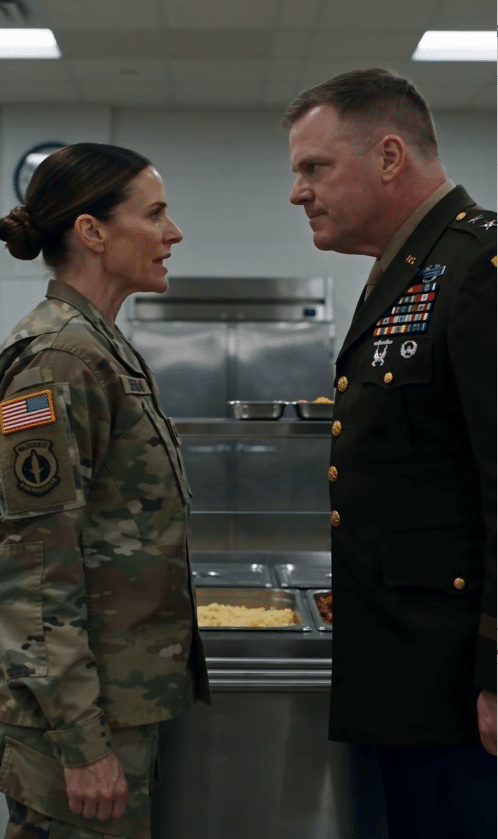
A large, broad-shouldered colonel stood near the counter, his polished black shoes planted firmly on the floor. His silver eagle insignia was clearly visible on his uniform, alongside a row of ribbons and a nameplate that announced his authority.
Standing directly in front of him was a woman in her early forties, wearing an ordinary-looking Army OCP combat uniform and tan boots. Her dark-brown hair was pulled into a neat military bun, and a field jacket partially concealed the insignia on her chest.
She had been standing patiently in line with several young trainees.
The colonel clearly didn’t like that.
“They’ve been waiting longer,” the woman replied, glancing toward the exhausted soldiers behind her.
Colonel Marcus Whitmore gave a contemptuous laugh.
“Colonels don’t wait behind trainees.”
The woman turned toward him.
“Today you do.”
For a moment, the dining hall seemed to hold its breath.
Whitmore wasn’t accustomed to being challenged, especially by someone he considered an ordinary officer. He had spent years cultivating an intimidating reputation, and his subordinates had learned that questioning him usually came with consequences.
He stepped closer.
“Learn where you stand.”
Before the woman could move, Whitmore grabbed a nearby food tray and violently hurled its contents into her face and chest.
Food splattered across her uniform.
Then he struck her hard across the cheek.
Her head snapped sideways, and a red mark immediately spread across her face. A faint trace of blood appeared at the corner of her mouth.
Before she could recover, he drove a forceful kick into her abdomen.
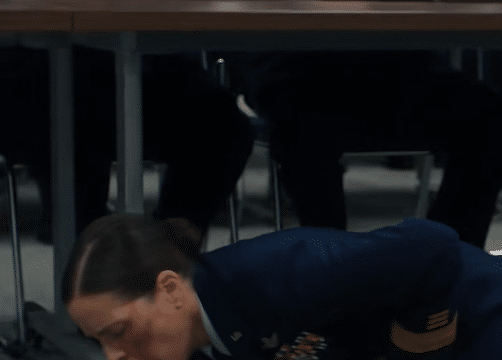
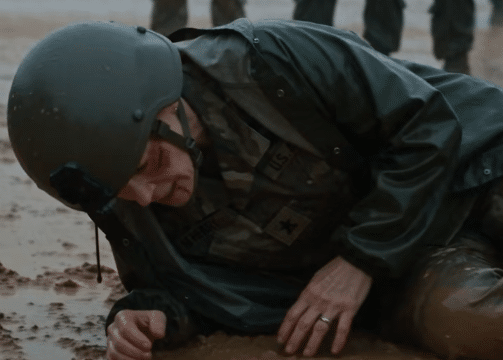
She crashed against the edge of a folding table and dropped to one knee, struggling to catch her breath.
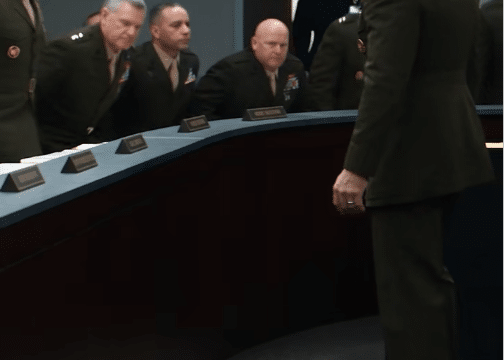
Twenty soldiers watched in disbelief.
Nobody moved.
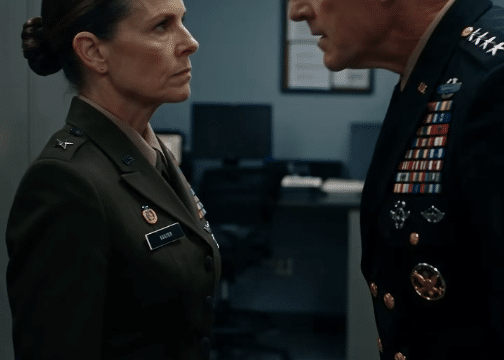
Whitmore stood over her, looking down with unmistakable satisfaction.
“Learn where you stand.”
But he had just made a mistake that would change everything.
Because the woman on the floor was not the officer he thought she was.
Act II
Her name was Elizabeth Carter.
At least, that was what most of the soldiers at Fort Redstone knew.
She had arrived at the installation several days earlier, wearing an ordinary field jacket and carrying herself with the quiet confidence of someone who didn’t need to announce her importance.
She ate in the same dining hall as the trainees.
She waited in the same lines.
She listened more than she spoke.
And she had a habit that confused some of the younger soldiers: whenever she saw a struggling trainee, she made time for them.
Elizabeth had spent the morning inspecting training facilities, reviewing operational readiness, and speaking privately with junior personnel.
She had heard complaints about the dining facility, including reports that some officers routinely pushed enlisted soldiers aside during meal periods.
She wanted to see the situation herself.
That was why she had entered the dining hall without a formal entourage.
She wanted to understand the culture of the installation from the perspective of the people who lived and worked there every day.
Unfortunately, she had encountered Whitmore.
At forty-seven, the colonel was known for his obsession with rank and appearances. His office displayed awards, framed photographs, and certificates documenting years of military service.
But beneath that impressive record was a different kind of reputation.
Junior officers described him as difficult.
Enlisted soldiers described him as intimidating.
And trainees had learned to avoid drawing his attention whenever possible.
He believed military discipline meant unquestioned obedience.
He believed authority was something to be displayed.
Most importantly, he believed that a person’s importance could be determined by the insignia on their uniform.
Elizabeth had challenged that belief with one simple sentence.
And Whitmore had responded with violence.
Now, as she remained on one knee, the soldiers around her struggled to process what they had witnessed.
A young trainee at the nearest table clenched his fists.
Another looked toward the two colonel’s aides standing near the serving line. Both men appeared uncomfortable, but neither had intervened.
Whitmore adjusted his uniform.
He seemed convinced that the incident was over.
Elizabeth slowly raised her head.
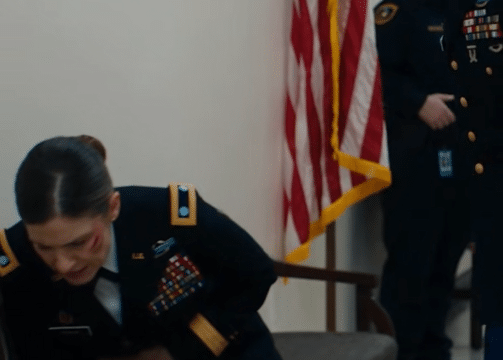
Her cheek was swollen. Food covered her jacket, and one hand remained pressed against her abdomen.
Yet there was something in her expression that unsettled the colonel.
She wasn’t looking at him with fear.
She was studying him.
As though she were memorizing every detail of what he had just done.
Then the dining hall doors opened.
And the person who entered recognized her immediately.
Act III
The first person through the double doors was the installation’s Command Sergeant Major.
He had entered expecting an ordinary walk through the dining facility.
But the moment his eyes landed on the woman kneeling beside the table, his expression changed.
He stopped.
His posture snapped upright.
For a fraction of a second, he seemed unable to believe what he was seeing.
Then he did something that made every soldier in the room turn.
He raised his right hand.
And saluted Elizabeth.
It wasn’t a casual greeting.
It was a formal, unmistakable salute delivered with absolute military precision.
The nearest trainees stared.
Whitmore turned toward the entrance, initially looking irritated by the interruption.
Then he noticed the Command Sergeant Major’s expression.
The senior enlisted leader wasn’t looking at him.
His attention remained fixed on the injured woman.
And he was standing at attention.
The first table of soldiers rose.
One after another, chairs scraped backward across the floor.
A group near the windows stood.
Then another group beside the serving line.
Within seconds, the movement spread through the entire dining hall.
Soldiers who had been eating stopped mid-meal.
Trays were abandoned.
Conversations disappeared.
Nearly every person in the room rose to their feet.
And then, as though following a single silent command, they saluted her.
Hundreds of soldiers.
Standing.
Saluting.
In complete silence.
Elizabeth remained on one knee, her injured face turned toward the entrance.
The Command Sergeant Major held his salute.
Nobody explained anything.
Nobody needed to.
Whitmore looked from one soldier to another.
He had spent the last several minutes believing he was the most important person in the room.
Now, the entire dining hall was showing respect to the woman he had just assaulted.
His eyes moved toward her uniform.
The field jacket.
The concealed rank area.
The calm expression.
Suddenly, the details he had ignored began to matter.
Why had the Command Sergeant Major saluted her?
Why were the trainees standing?
Why had the entire dining hall recognized someone he had dismissed as an insignificant officer?
The answer was written in the reaction of every soldier around him.
And Whitmore was beginning to understand that he had just attacked someone far above his own authority.
Act IV
Elizabeth slowly pushed herself upright.
A nearby soldier moved as if to help, but she steadied herself against the table and regained her balance.
Her breathing was still uncomfortable.
Her cheek was visibly swollen.
Yet she stood with the composure of someone who had spent a lifetime learning how to remain steady under pressure.
The Command Sergeant Major lowered his hand only when the moment was appropriate.
But the rest of the dining hall remained standing.
Whitmore looked around again.
His two aides had gone completely silent.
The young trainees who had previously avoided eye contact with him were now looking directly toward Elizabeth.
The colonel’s confidence began to disappear.
He had recognized the salute.
Every experienced officer knew what it meant when an entire command structure showed that kind of immediate respect.
It wasn’t a spontaneous display of sympathy.
It was recognition of authority.
Elizabeth Carter was not an ordinary visiting officer.
She was a Lieutenant General.
Three stars.
One of the Army’s highest-ranking officers.
And she had been conducting a field inspection without the usual public display of rank or accompanying ceremony.
Whitmore’s face drained of color.
He glanced at her shoulder area, then at the Command Sergeant Major.
The woman he had humiliated was now standing before an entire dining hall that had risen to honor her.
The same woman he had struck.
The same woman whose food he had thrown across her uniform.
The same woman he had kicked onto the floor.
His mouth opened slightly.
But nothing came out.
Elizabeth looked at him.
There was no satisfaction in her expression.
No smile.
No dramatic gesture.
Only a cold, controlled disappointment.
For her, the incident was no longer about a personal insult.
It was about what Whitmore had revealed in front of hundreds of soldiers.
He had treated junior personnel as though they were beneath him.
He had used his rank to intimidate someone he believed could not challenge him.
And when he had encountered resistance, he had chosen violence instead of leadership.
The dining hall had witnessed all of it.
Elizabeth turned toward the Command Sergeant Major.
He remained at attention.
She acknowledged him with a brief nod.
Then she looked back at Whitmore.
The colonel finally understood that the worst part of the afternoon wasn’t the humiliation he was experiencing.
It was that every soldier in the room now knew exactly what kind of leader he was.
Act V
The silence continued.
Elizabeth stood in the middle of the dining hall, her stained OCP uniform contrasting sharply with the spotless service uniform of the Command Sergeant Major.
The soldiers remained at attention.
Some still held their salutes.
Others watched Whitmore with expressions of disbelief.
He looked toward Elizabeth, then toward the hundreds of soldiers standing behind her.
His shoulders slowly dropped.
The man who had demanded that everyone learn their place could no longer find his own.
He had believed rank gave him permission to humiliate people.
He had believed a junior-looking officer would be too insignificant to challenge him.
And he had believed that the dining hall would remain silent because everyone was afraid of him.
Instead, the entire command had just demonstrated where its respect truly belonged.
Not to the loudest voice.
Not to the most intimidating personality.
Not even to the officer with the most impressive-looking uniform.
But to the person whose authority had earned the respect of everyone around her.
Elizabeth looked across the room.
She noticed the young trainees who had been waiting in line before the confrontation began.
They were still standing.
Still watching.
She understood that they had just witnessed something they would remember for the rest of their military careers.
The lesson wasn’t that a three-star general deserved respect because she outranked a colonel.
It was that no soldier should ever have to surrender their dignity just because someone else possessed more authority.
Whitmore swallowed.
His eyes widened as he looked once more at the saluting soldiers.
The realization was now complete.
He had assaulted a Lieutenant General in front of an entire room full of witnesses.
And the people who had watched him do it were no longer looking at him as their commanding colonel.
They were looking at him as the man who had forgotten what the uniform was supposed to represent.
His lips parted.
His voice came out barely above a whisper.
“Why are they saluting her…?”
Nobody answered.
The soldiers remained standing.
Elizabeth Carter stood calmly in the center of the room, injured but unbroken.
And for the first time that afternoon, Colonel Whitmore had absolutely no idea what to do next.
Tighten the repetitive middle sections