Act I
“Delete that record.”
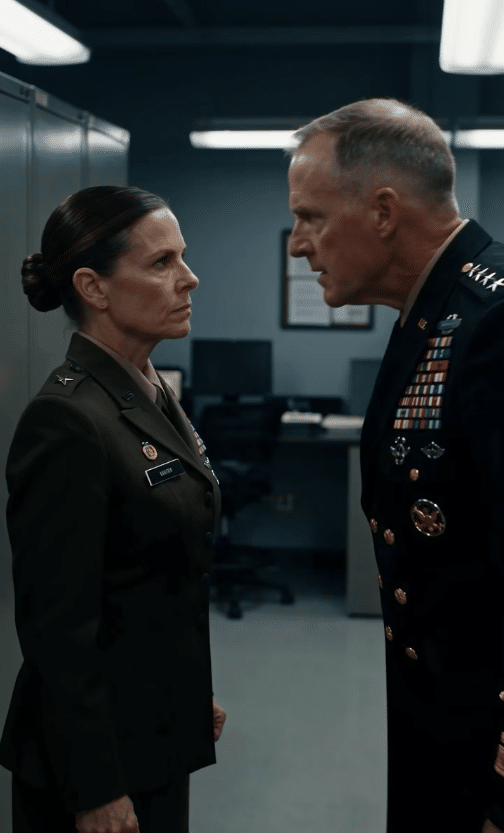
Major General stood over the evidence terminal, his two-star insignia catching the cold fluorescent light. At fifty-one, he was accustomed to rooms falling silent when he entered them. In the secure JAG evidence room, he expected the same unquestioning obedience.
But the woman standing across from him did not move.
“That record stays.”
She was forty-three, dressed in an Army service uniform with formal trousers and polished shoes. Her dark hair was pulled into a precise bun, and her expression was severe without being theatrical. Three stars were partly obscured by the angle of her jacket, easy to overlook if someone wasn’t paying attention.
The Major General wasn’t paying attention.
He leaned closer to the terminal. Behind him, evidence cabinets lined the walls, each one secured with electronic locks. Three JAG officers were working at a nearby table, reviewing sealed folders and documenting chain-of-custody information.
“You don’t tell me what stays.”
The woman held his gaze.
She had not raised her voice. She had not insulted him. She had simply refused to erase a record that, according to military regulations, was required to remain intact.
That refusal was enough to expose how much he feared what the record contained.
The Major General’s expression hardened. He looked at the terminal, then at her, as though trying to decide which obstacle he wanted to destroy first.
He chose the person standing in his way.
And in the next few seconds, the entire evidence room would witness something that could not be deleted.
Act II
The record concerned an operation that had officially ended months earlier.
At the time, the Major General had been responsible for a series of command decisions involving intelligence assessments, operational approvals, and the movement of personnel. The operation had been described in official briefings as successful, but the paperwork told a different story.
One report had been altered after its original submission.
Another had disappeared from the archive.
A third contained an authorization timestamp that did not match the operational logs. Individually, each discrepancy could have been dismissed as an administrative error. Together, they suggested that someone had changed the official account after the consequences became impossible to ignore.
The woman in the evidence room knew the difference.
She had spent much of her career reviewing decisions that other officers preferred to leave buried. Her reputation had been built on precision, not popularity. She did not confuse rank with immunity, and she understood that a signature on a military document could carry consequences long after the person who signed it had left the room.
That was why she had insisted the original record remain preserved.
The Major General had come to the evidence room under the pretext of reviewing the file. His actual purpose was more urgent. A formal review was approaching, and the original record could connect his office to a decision he had repeatedly denied making.
He had expected a junior legal officer to handle the request.
Instead, he found a woman who understood exactly what he was asking her to destroy.
He also made a dangerous assumption about her. Her quiet manner, her lack of visible entourage, and the partially obscured insignia on her uniform convinced him that she was someone he could intimidate without consequences.
The three JAG officers nearby understood that the situation was becoming abnormal. They exchanged brief looks, then returned their attention to the documents. They were trained to preserve evidence, maintain professional discipline, and avoid interfering with a confrontation unless circumstances required it.
But they were no longer simply observing a disagreement over paperwork.
They were watching a senior general attempt to pressure an officer into violating the integrity of an official investigation.
And the woman was not going to surrender the record.
Act III
The Major General stepped closer.
The woman remained beside the terminal, one hand resting near the secured evidence file. She knew that if the record disappeared, the investigation would lose its most important connection between the original operational decision and the later changes to the archive.
It wasn’t just a document.
It was the difference between an honest review and a carefully manufactured version of history.
The Major General’s voice grew sharper. He had spent years commanding officers who learned to recognize the moment when an argument was no longer worth having. He expected her to recognize it too.
Instead, she stood her ground.
Then he struck her.
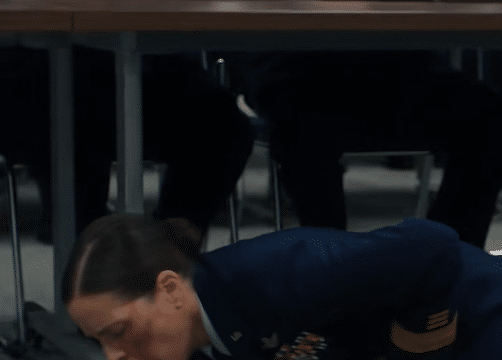
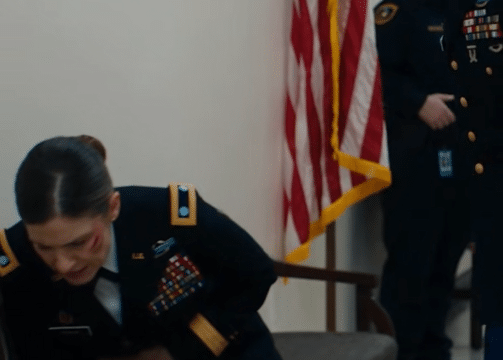
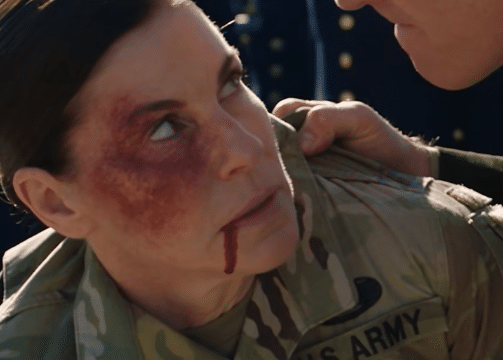
The slap landed hard across her cheek. Her head turned with the impact, and she staggered against the edge of the evidence station. A red mark began spreading across her face, and a small trace of blood appeared at the corner of her mouth.
The JAG officers froze.
Before she could fully regain her balance, the Major General seized her upper arm and drove a forceful kick into her torso. She lost her footing and fell beside an archive shelf, struggling to draw a steady breath.
An evidence box toppled from the shelf and struck the floor.
He kicked it away.
The box slid across the polished surface, scattering the impression of an orderly evidence room into a scene of unmistakable intimidation.
The woman remained conscious. One arm guarded her ribs, and her breathing was controlled but strained. Her cheek was swollen, yet she refused to lower her eyes.
The Major General looked down at her with the satisfaction of a man who believed the argument had finally ended.
“You don’t tell me what stays.”
The words hung in the room.
The three JAG officers had seen the assault. They had seen the evidence box kicked aside. They had also seen the woman refuse to abandon the record even when doing so might have spared her the confrontation.
But the Major General still believed he had won.
He had no idea that the people who were about to enter the room would recognize her before they even asked what had happened.
Act IV
The secure door opened.
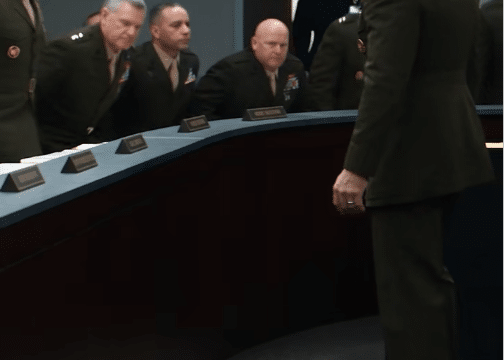
Three JAG officers entered in Army legal and service uniforms. Their arrival was orderly, but the moment the lead officer saw the woman on the floor, his expression changed.
He took in the swollen cheek, the trace of blood near her mouth, the displaced evidence box, and the Major General standing over her.
Then he looked directly at the man responsible.
“General, step away from the reviewing authority.”
Silence swallowed the room.
The Major General turned toward him, initially appearing more irritated than concerned. He seemed ready to demand an explanation for the interruption.
Then he looked back at the woman.
The reviewing authority.
The phrase changed the meaning of everything he had just done.
The woman was not a subordinate assigned to process his paperwork. She was a Lieutenant General, a three-star officer serving as the reviewing authority for the military justice matter connected to the evidence in that room.
Her authority was not based on proximity to the investigation or a temporary administrative assignment. She had been entrusted with reviewing the record precisely because the integrity of the process mattered more than the rank of anyone whose decisions might be examined.
The three stars that had been partly hidden by her jacket were suddenly impossible to ignore.
The lead JAG officer did not need to explain further. His warning had already established the chain of authority.
The other two officers moved into position with disciplined urgency. One focused on the injured Lieutenant General, while the other secured the evidence area. Their attention was no longer directed toward the Major General’s demands.
It was directed toward the reviewing authority.
The woman slowly lifted her head.
Pain remained visible in her face, and she still held one arm close to her torso. But the fear the Major General had expected to see was absent. Her expression had become cold and controlled, the same expression she had worn when he first ordered her to delete the record.
Nothing about her authority had changed.
Only his understanding of it had.
The Major General glanced toward the terminal, then toward the evidence box he had kicked across the floor. For the first time, he seemed to understand that the room contained more than witnesses to an assault.
It contained the original record he had wanted erased.
It contained officers who had seen him attempt to destroy the independence of a military review.
And it contained the very authority empowered to examine the evidence.
The truth had not been hidden.
He had simply mistaken restraint for weakness.
Act V
Nobody rushed to fill the silence.
The Lieutenant General remained on the floor for another moment, breathing carefully as the JAG officers approached. One offered assistance, while the lead officer kept his attention on the Major General.
The two-star general’s posture began to collapse.
Only minutes earlier, he had entered the evidence room expecting the authority of his rank to settle the matter. Now the same rank looked painfully small beside the three stars on the woman he had attacked.
He tried to find an explanation in the faces around him.
There was none.
The officers who had witnessed the confrontation did not look confused about whom they recognized. They did not look uncertain about whose authority governed the review. Their rigid attention made the answer unmistakable.
The Lieutenant General finally accepted assistance and began to rise. Her movements were careful, restrained by the pain in her ribs. The swelling on her cheek had become more pronounced, but she made no attempt to hide it.
She looked toward the terminal.
The record was still there.
That mattered more than the humiliation, more than the bruises, and more than the Major General’s sudden loss of confidence. The document had survived his demand, his violence, and his attempt to turn a secured evidence room into a place where orders replaced law.
The lead JAG officer understood what needed to happen next. The evidence had to remain secured, the original record had to be preserved, and the assault itself could not be separated from the attempted interference with the review.
The Major General had wanted one record deleted.
Instead, his actions had created another record—one witnessed by multiple officers, in a secure room, at the exact moment he believed nobody could challenge him.
The Lieutenant General looked at him once.
She did not need to shout. She did not need to threaten him. Her authority was no longer something he could dismiss, and the evidence he had tried to erase remained beyond his reach.
The Major General stared at her three-star insignia. His face had gone pale, sweat gathering along his forehead as the consequences began to register.
The same woman he had ordered, struck, and kicked was the officer whose authority he had just openly defied.
His voice finally broke.
“Reviewing authority…?”
Name both officers before the confrontation