By the time the shadows stretched across the stone driveway, Daniel Mercer had already learned the kind of fear that changes a person forever.
One minute, the late afternoon felt almost ordinary. The golden sunlight spilled across the front yard, lighting up the trimmed hedges, the polished black mailbox, and the iron gate that framed the entrance to his family’s property. Their house stood tall behind them, all glass and stone and clean lines, the kind of place neighbors admired from a distance and real estate agents described with words like luxury, security, and lifestyle. It was the sort of home Daniel had spent years building for his family through discipline, long office hours, careful banking decisions, and a relentless belief that if he worked hard enough, he could protect the people he loved from anything.
But no amount of planning could prepare him for what his daughter said next.
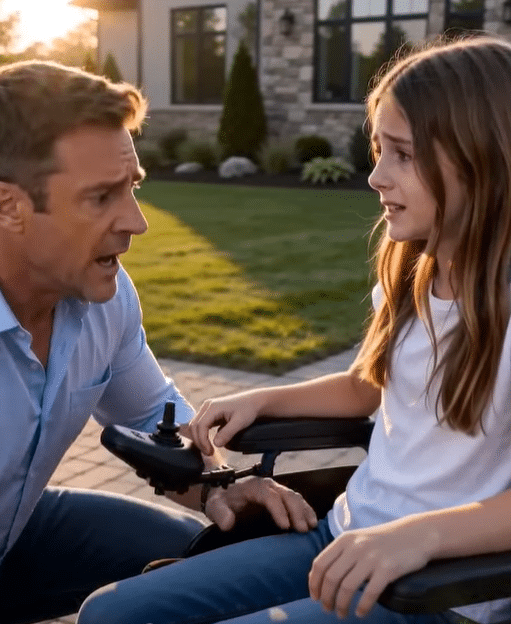
“Dad,” Emily whispered, her voice trembling. “I can’t feel my legs.”
Daniel dropped to one knee so fast that his phone slipped from his hand and landed on the driveway with a crack he barely noticed. Emily sat in her wheelchair, her small fingers clenched around the armrests, her face pale and wet with tears she was trying hard not to let fall. She was only nine, but in that moment her eyes looked older, filled with a fear no child should ever have to carry.
“I know,” Daniel said softly, even though he didn’t know anything at all. Not really. He rested both hands gently on her knees, as if sheer fatherly warmth could restore what had been lost. “I know. I’m here.”
Three days earlier, Emily had been laughing in this same driveway, racing chalk lines and pretending the wheelchair in the garage was part of an obstacle course. It had belonged to Daniel’s mother after surgery, and Emily had found it fascinating in the innocent way children sometimes do. Then came the accident everyone kept calling “unfortunate.” A sudden incident at a private wellness retreat outside town. A slippery staircase. A rushed ambulance. A blur of specialists, scans, insurance calls, and hospital corridors bright enough to make everyone look exhausted.
The doctors had said her condition might be temporary. They used phrases like neurological trauma, uncertain prognosis, intensive rehabilitation, and cautious optimism. Daniel had heard every word and trusted none of them. He had already spent two sleepless nights reading medical journals, reviewing health coverage paperwork, and calling one specialist after another through a network of private referrals. Money wasn’t the issue. He would have sold the house, emptied every investment account, and drained every college savings fund if it meant Emily could stand again.
But then the boy appeared.
Daniel sensed him before he fully saw him. Emily’s eyes shifted first, pulling his attention toward the open gate at the end of the driveway.
A young boy stood there, still as a figure carved from stone.
He looked about eight, maybe nine. He wore a crisp white button-down shirt tucked into black slacks, as if he had walked out of a formal family portrait and into the wrong story. The neighborhood street behind him was silent. The tall trees barely moved. Even the air seemed to pause.
The boy’s expression never changed.
“I can help her,” he said.
Daniel’s entire body tightened.
He rose halfway, one hand still gripping the wheelchair handle. “Stay back.”
The boy didn’t move.
“She’s not supposed to be like this,” he added, his tone calm in a way that felt completely wrong for a child.
Daniel stared at him. “What do you mean?”
The boy looked directly at Emily, then back at Daniel. “This wasn’t an accident,” he said. “Because I was there.”
Emily turned in her chair, confused through her tears. “How do you know?”
Daniel stood so quickly the muscles in his back pulled tight. His heart began to hammer, not with panic anymore, but with something colder. “Where?”
That was the moment everything changed.
The boy stepped forward at last, slow and measured, stopping just inside the gate as if he understood invisible boundaries better than most adults did. Up close, he seemed even stranger—not frightening exactly, but composed in a way children usually aren’t. His eyes held the weight of someone carrying a message too large for his age.
“My name is Oliver,” he said. “And your daughter fell because someone wanted her father to be afraid.”
Daniel felt a rush of anger so sharp it almost steadied him. “That makes no sense.”
“It will,” Oliver replied.
Daniel should have called security. He should have ushered Emily inside and locked every door. Instead, he stayed exactly where he was, because something about the boy’s voice did not sound like imagination. It sounded like certainty.
Emily reached for her father’s wrist. “Dad…”
He covered her hand with his own. “I’ve got you.”
Oliver looked toward the house, then back to Daniel. “The woman at the retreat told everyone the floor was wet. It wasn’t. The handrail had been loosened before Emily went upstairs.”
Daniel froze.
The detail hit him harder than the accusation itself.
No one outside the family, the retreat staff, and hospital representatives knew about the handrail. That fact had been omitted from the first public incident report pending legal review. Daniel knew because he had spoken personally with the facility’s insurance investigator that morning. They were still debating liability, facility negligence, and whether a maintenance failure would trigger a broader commercial claim. The retreat, eager to avoid scandal, had urged patience. Daniel had given them until sunrise the next day before threatening litigation.
“How do you know that?” Daniel asked, his voice low.
“I saw the man who did it.”
The words landed in the warm evening air like ice.
Daniel knelt beside Emily again, but his eyes remained fixed on Oliver. “Who?”
Oliver hesitated, and for the first time he seemed like an actual child—small, unsure, and burdened.
“My father,” he said.
Silence filled the driveway.
Daniel looked at the boy’s neat clothes, his pale face, his rigid posture. Suddenly none of it seemed eerie anymore. It seemed sad.
Oliver swallowed. “He works for someone who hates you.”
Daniel’s mind raced backward through the last year of his life. He had built his reputation as a financial risk consultant, the person companies hired when they wanted hidden weaknesses exposed before they became public disasters. It was high-pressure work at the intersection of finance, insurance, corporate governance, and reputation management. Six months ago, Daniel had led an internal review that uncovered fraud at Halcyon Ridge Retreat—the same exclusive wellness property where Emily had been injured.
The fraud hadn’t been small. Inflated invoices. Shadow vendors. Misused health reimbursement funds. Quiet kickbacks routed through shell accounts. Daniel’s report had triggered board-level panic and a criminal investigation that never became public because the company moved quickly to settle internally and remove the executives involved.
Or so he had thought.
“There was a man named Victor Soren,” Daniel said slowly, more to himself than anyone else.
Oliver nodded once.
Daniel had never met Victor directly, but he knew the name. Halcyon Ridge’s former operations director. Forced out after Daniel’s report. Financially ruined, according to industry rumor. Daniel had dismissed the whispers that Victor blamed him personally. Angry executives were common. Dangerous ones were rare.
Apparently, not rare enough.
“My dad used to drive for him,” Oliver said. “He said Mr. Soren promised enough money to fix everything. Our rent, the debt, my mom’s treatments. He said nobody would get seriously hurt. Just scared. Just a warning.”
Daniel closed his eyes for one terrible second.
There it was: the ugly machinery behind so many disasters. Not just cruelty, but desperation mixed with greed. Debt. Medical bills. Empty accounts. Promises made by people with power to people with none. The kind of thing Daniel understood professionally but hated seeing up close. A family cornered by financial pressure. A man making one unforgivable choice because he convinced himself it wasn’t as bad as it really was.
Emily’s voice came small and shaky. “Did he push me?”
Oliver’s face crumpled. “No. He loosened the rail before you got there. He thought maybe your dad would see it in time. He thought maybe nobody would fall.”
“That doesn’t make it better,” Daniel said, sharper than he intended.
Oliver flinched.
The anger in Daniel’s chest shifted almost immediately into shame. This was just a boy, standing in the open and confessing to something that could destroy his own family. Whatever his father had done, Oliver had chosen to come here alone.
“Why tell us now?” Daniel asked.
Oliver looked at Emily. “Because last night I heard my dad crying. And I realized grown-ups can know something is wrong and still do nothing. I didn’t want to become like that.”
Daniel had spent years believing character was revealed in boardrooms, contracts, negotiations, and moments of visible pressure. But standing there in the fading sunlight, he saw courage in its purest form: a frightened child telling the truth when every incentive pointed the other way.
He pulled out his phone and called his attorney first, then the detective whose number had been quietly passed to him earlier that day. He kept his voice controlled, professional, exact. There would be witness protection considerations, he said. A minor involved. Immediate urgency. He wanted it all documented. Every word. Every name.
What happened next unfolded fast.
Detectives arrived before dark. Oliver repeated his account with remarkable steadiness. His father, reached later that evening, confessed within hours. Victor Soren was arrested two days later while trying to move funds out of state through a network of personal and business accounts. Authorities later alleged he had used multiple intermediaries, hoping to pressure Daniel into withdrawing a confidential supplemental report tied to a pending civil recovery action. The deeper investigators looked, the more they found: hidden assets, falsified maintenance records, and attempts to manipulate insurance exposure through forged compliance logs.
The news stunned the community.
To neighbors, Daniel had always seemed like the man who had everything under control. The house. The career. The polished routine. But privately, the scandal stripped his life down to what mattered. He stopped caring about appearances. He ignored the gossip blogs. He turned down interviews. He spent his days at rehabilitation appointments, learning the rhythms of physical therapy, adaptive health care, and the endless patience recovery demands from both children and parents.
And Emily?
For a while, progress came in inches.
A twitch in one foot. A flicker of sensation. Then, weeks later, pressure. Warmth. Pain.
The doctors called it promising.
Daniel called it hope.
The road back was neither quick nor perfect. There were setbacks, tears, exhausted evenings, and moments when Emily wanted to quit. On those days, Daniel reminded her that strength didn’t always look like standing up. Sometimes it looked like showing up again after a bad day. Sometimes it looked like trying once more when the world had already taken too much.
Oliver and his mother entered a protection program for a period while the case moved forward. Daniel helped quietly, never publicly, through legal referrals and a private family support fund established through his firm’s charitable arm. Some people told him he owed that family nothing. Maybe technically, they were right. But Daniel had seen enough of life to know that justice without mercy often leaves the next tragedy waiting in the wings.
Months later, on a cool morning washed in silver light, Emily stood for six full seconds between parallel bars in the rehab center.
Six seconds.
To anyone else, it was a small thing. To Daniel, it felt larger than every deal he had ever closed, every promotion he had ever earned, every number that had ever appeared in a brokerage account or quarterly statement. He cried openly, and Emily laughed at him for it.
By winter, she took her first assisted steps.
By spring, she crossed part of the Mercer driveway on her own, slowly and carefully, while Daniel walked beside her without touching her arm unless she asked.
When they reached the gate, she stopped.
The same gate.
The same place where fear had once entered their lives disguised as a child in a white shirt.
Emily looked up at her father. “Do you think Oliver is okay?”
Daniel smiled, though his eyes stung a little. “I think telling the truth gave him a better future than silence ever could.”
She nodded, then looked down the quiet street lined with trees. “Good.”
That evening, after Emily went inside, Daniel remained in the driveway alone as the sun dipped low again, painting the stone in gold and amber. For the first time in months, the house behind him didn’t feel like a fortress or a symbol or a fragile promise he might fail to keep. It felt like a home.
He had spent years believing protection came from money, contracts, security systems, and influence. Those things mattered, sure. They could open doors, buy time, and ease burdens. But they were not the same as safety. Real safety, he finally understood, was built from truth told at the right moment, courage chosen when fear would be easier, and love strong enough to endure what power could not prevent.
Victor Soren had tried to teach Daniel a lesson through intimidation.
In the end, karma chose a different teacher.
A frightened little boy at an open gate.
And a daughter who refused to stop fighting for the life that was still waiting for her on the other side of fear.