Act I
The rain made the city look expensive.
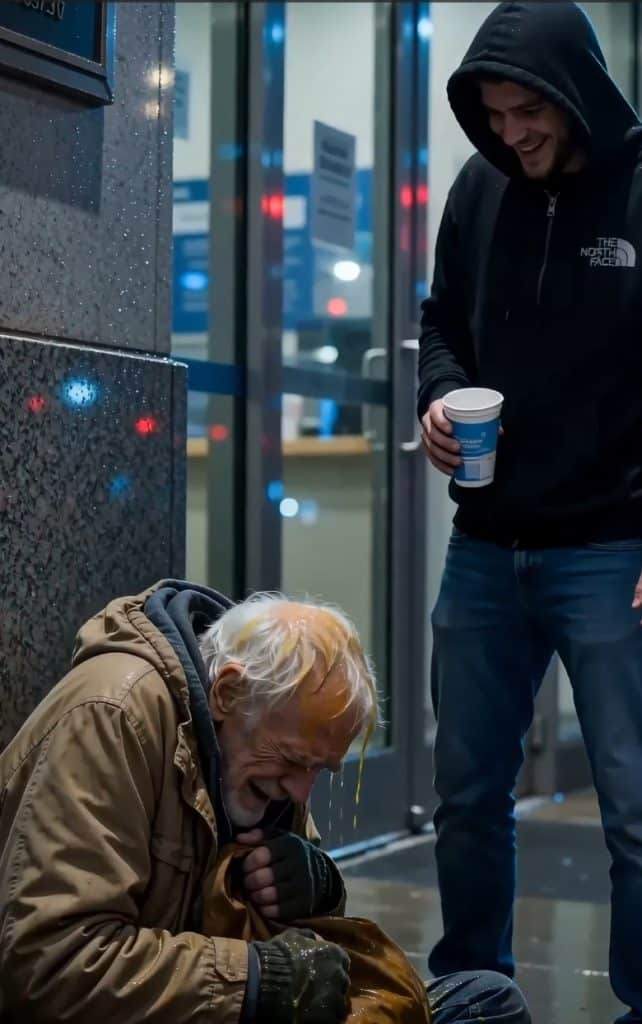
It polished the black pavement outside the bank until the streetlights melted across it in gold and blue. It ran down the marble wall beside the entrance, slid over the chrome door handles, and turned every passing taxi into a smear of light.
But under the bank’s awning, an old man sat soaked to the bone.
He had white hair, a weathered face, and a tan work jacket worn thin at the elbows. His black fingerless gloves clutched a dirty brown bag against his chest as if everything he had left in the world was inside it.
The young men laughed before they reached him.
There were three of them. Clean sneakers. Hoodies. Phones already out. The one in front wore a black sweatshirt with a circular graphic on the chest and the casual cruelty of someone who had never been afraid of consequences.
“Look at this guy,” he said, grinning at the phone camera behind him. “Sleeping outside a bank like he’s waiting for a loan.”
The old man did not look up.
That seemed to irritate them.
The lead bully stepped closer, holding a paper cup.
“Hey,” he said. “You thirsty?”
The old man’s shoulders tightened.
Then the boy tipped the cup.
Yellow liquid splashed over the old man’s head and ran down his hair, his collar, his jacket. It mixed with rainwater and dripped from his chin onto the bag in his lap.
The two others burst into laughter.
One of them zoomed in with his phone.
The old man closed his eyes.
He did not beg. Did not curse. Did not raise a hand.
He only curled inward, as if humiliation were weather and he had survived worse storms than this.
That was when the barking came.
Deep.
Violent.
Close.
A German Shepherd exploded out of the rain from the left side of the sidewalk, wet fur glistening under the streetlights, ears forward, eyes locked on the boy standing over the old man.
The bully barely had time to turn.
The dog hit the pavement in front of him with a snarl so fierce the young man stumbled backward, slipped on the wet sidewalk, and crashed onto the ground.
His phone clattered away.
The other two stopped laughing.
The German Shepherd planted himself between the bullies and the old man, teeth bared, chest heaving, rain dripping from his black-and-tan coat.
“Get it off!” the lead bully shouted, scrambling backward.
The dog barked once more.
The two boys with phones ran.
The lead bully crawled away after them, all swagger gone, hoodie soaked, face twisted with panic.
Then the dog stopped barking.
He turned.
The old man slowly opened his eyes and lifted one trembling hand.
The German Shepherd stepped closer.
The old man’s breath broke.
“Sheriff…”
The dog’s ears softened.
And in the middle of the rain, he lowered his head and licked the old man’s glove like he had been searching for him for years.
Act II
Before the city knew him as a homeless man outside Meridian Bank, his name was Thomas Bell.
Captain Thomas Bell.
Twenty-eight years in law enforcement. Twelve commendations. Three bulletins framed in the precinct hallway. One old scar along his left hand from a night nobody liked to talk about.
And one dog who had saved his life more times than any medal ever could.
Sheriff was not supposed to be Thomas’s dog.
He had been assigned to a younger handler first, a decorated officer with sharp reflexes and no patience. Sheriff was too stubborn for him. Too sensitive. Too quick to disobey when he sensed the command was wrong.
“He’s not suitable,” the handler said after six weeks.
Thomas, already gray at the temples and two years from retirement, watched the German Shepherd sitting alone at the edge of the training yard.
“He’s not unsuitable,” Thomas said. “He’s thinking.”
They became partners by accident and family by choice.
Sheriff learned Thomas’s limp before anyone else noticed it. He learned the sound of Thomas’s truck. He learned to sit beside him during long nights when a bad call followed him home and sleep would not come.
When Thomas’s wife, Ellen, died of a sudden stroke, Sheriff was the only living creature in the house who did not try to comfort him with words.
The dog simply climbed onto the floor beside Thomas’s chair, pressed his body against his leg, and stayed there until morning.
After retirement, Thomas thought he would have peace.
He was wrong.
Peace required money to last.
At first, the pension came like it was supposed to. Then the letters started. Questions about account verification. A missing signature. A banking transition after Meridian absorbed the small credit union where Thomas and Ellen had kept their savings for thirty years.
He went to the bank in person.
He brought documents.
He brought his badge ID.
He brought Ellen’s death certificate folded in a plastic sleeve because touching it still made his hands shake.
A young assistant manager told him the issue would be resolved.
It was not.
Then came the lockout.
Then the eviction.
Then the notice that his savings had been transferred under power-of-attorney authorization to an investment account Thomas had never opened.
When he reported it, the first officer taking the complaint looked embarrassed.
“Captain Bell,” he said quietly, “the bank says you signed.”
Thomas had not signed.
Someone had used his name, his age, his grief, and the assumption that old men forget things.
He fought for six months.
Then he got sick.
Not dramatic sick. Not the kind that earns sympathy quickly. Just a slow collapse of strength. Missed appointments. Lost paperwork. Nights in shelters where Sheriff was not allowed inside.
That was the final wound.
A charity worker offered to take Sheriff temporarily while Thomas “got back on his feet.”
Thomas refused for weeks.
Then winter came hard.
Sheriff began shivering under the bridge beside him.
So Thomas made the decision that broke him.
He gave Sheriff to a retired K9 foster network outside the city and told himself it was temporary.
The dog fought the leash.
Thomas could still hear it.
The desperate barking as the volunteer led Sheriff away.
The scrape of claws on pavement.
The sound of loyalty being dragged from one life to another because love, sometimes, means admitting you are no longer enough.
Three months later, the foster network told Thomas that Sheriff had been placed with a stable home.
Thomas stopped calling after that.
Not because he stopped loving the dog.
Because every call reminded him that the world had taken even the one soul who still knew his worth.
So on the rainy night outside Meridian Bank, Thomas had not come to sleep beneath the awning.
He had come because the next morning, the bank was holding a private donor event. The CEO would be there. Cameras would be there. People in suits would shake hands under warm lights and talk about community trust.
Thomas had one thing left.
The dirty brown bag in his arms.
Inside were documents no one at the bank wanted seen.
And someone had already noticed him waiting.
Act III
Sheriff had not found Thomas by chance.
Across the street, half hidden beneath the glow of a bus shelter, a woman stood with a leash still looped around her wrist.
Her name was Grace Alvarez. She ran the foster network that had taken Sheriff in.
For three months, Sheriff had slept by the front door of her home.
He ate. He obeyed. He tolerated kindness.
But he never settled.
Every siren made him stand. Every older man in a tan jacket made him pull. Every night, he returned to the door and waited as if the world had made a mistake and Thomas Bell would come correct it.
Grace started looking.
At first, the shelters would not tell her much. Privacy rules. No current address. No guaranteed placement. Then she found a volunteer who remembered Thomas. Then a soup kitchen worker. Then a clerk at the courthouse who said the old captain came every Thursday asking about a fraud complaint that never seemed to move.
Grace put the pieces together slowly.
A retired officer.
A missing pension.
A bank dispute.
A man who gave up his dog so the dog would not freeze beside him.
That night, Grace had driven Sheriff into the city because a shelter worker called and said, “The old man is outside Meridian again. He looks bad.”
She arrived just as the boys started recording.
She had not unclipped the leash.
Sheriff had torn it from her hand.
Now she crossed the wet street, heart pounding, as the German Shepherd stood over Thomas with his head pressed into the old man’s palm.
“Captain Bell?” she asked softly.
Thomas did not look at her at first.
His eyes were fixed on the dog.
“I told them to keep you warm,” he whispered to Sheriff.
The dog whined and pushed closer.
Grace crouched a few feet away, careful not to break the reunion too quickly.
“He wouldn’t stop looking for you,” she said.
Thomas blinked through rainwater.
“I gave him up.”
“No,” Grace said. “You protected him.”
That was when the bank doors opened.
A security guard stepped out first, frowning at the scene. Behind him came a man in a charcoal overcoat, silver hair neatly combed, expensive watch flashing beneath the awning lights.
Richard Vale.
Regional director of Meridian Bank.
The man who had signed three letters telling Thomas Bell that his claim lacked sufficient evidence.
Vale looked at the wet pavement. The old man. The dog. The scattered cup. The broken phone near the curb.
Then he looked at the brown bag in Thomas’s arms.
His expression tightened.
“Mr. Bell,” he said, voice smooth. “You can’t be here.”
Grace stood.
Sheriff’s head lifted.
Thomas clutched the bag.
“I have a meeting tomorrow,” Thomas said.
“No,” Vale replied. “You have been informed repeatedly that there is no meeting. You’re trespassing.”
Grace’s eyes narrowed.
“He was just assaulted in front of your building.”
Vale barely glanced at her.
“We’ll call police.”
Thomas gave a tired, humorless laugh.
“I was police.”
Vale’s face hardened.
“That doesn’t give you the right to harass a private institution.”
Sheriff stepped forward and growled.
Not loud.
Enough.
Vale took one step back.
And from the sidewalk behind them, a voice said, “Actually, Mr. Vale, I’d love for you to call the police.”
Everyone turned.
A woman in a navy pantsuit stood beneath a black umbrella, holding a leather briefcase in one hand.
Thomas stared at her like a ghost had stepped out of the rain.
It was his daughter.
Act IV
Mara Bell had not spoken to her father in almost two years.
Not because she hated him.
Because grief had made them cruel in different ways.
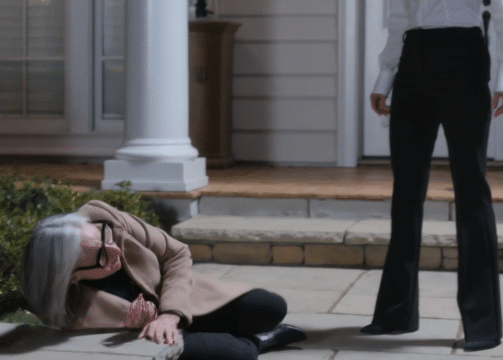
After Ellen died, Thomas disappeared into paperwork, anger, and pride. Mara begged him to move in with her. He refused. She offered to handle the bank calls. He accused her of thinking he was helpless. She called him stubborn. He called her busy.
Their last conversation ended with Thomas saying, “I’m still your father.”
Mara had answered, “Then let me be your daughter.”
Neither called back.
When Thomas lost the house, shame finished what grief had started. He changed shelters. Stopped checking voicemail. Convinced himself Mara’s life would be easier without an old man falling apart in the middle of it.
But Mara had not stopped looking.
She was an attorney now. Not rich, not powerful, but stubborn in the exact way she inherited from him. When Grace Alvarez contacted her through an old emergency form from Sheriff’s foster file, Mara did not hesitate.
She dug.
What she found was not confusion.
It was theft.
Thomas Bell’s pension deposits had been rerouted through forged authorization forms. His savings had been transferred into a high-yield product connected to a shell advisory firm. The signature pages were scanned, stamped, and approved in a branch office supervised by Richard Vale.
Thomas had been dismissed as confused because that was cheaper than admitting the bank had preyed on him.
Now Mara stood in the rain outside Meridian with every document copied, timestamped, and ready.
Vale’s smile returned, but it had lost warmth.
“Ms. Bell,” he said. “This is not the proper venue.”
“No,” Mara said. “The proper venue is court.”
He glanced at the security guard. “This is a private matter.”
Mara lifted her phone.
“The assault was public. The fraud is documented. And those boys who attacked my father were recording. One of their phones is still live.”
Vale’s eyes flicked toward the cracked phone on the ground.
The screen glowed.
Comments were already rising across it. Viewers had watched the humiliation. Then the dog. Then Vale stepping outside and telling the old man he could not be there.
For the first time, Richard Vale looked truly afraid.
Not of Sheriff.
Of witnesses.
The lead bully, still crouched near the curb, tried to crawl toward his phone.
Sheriff turned his head.
The boy stopped.
Police lights appeared at the corner, red and blue scattering across the wet street.
Grace moved closer to Thomas.
Mara knelt in front of him, no longer caring about the rain soaking her suit.
“Dad,” she whispered.
Thomas looked away.
“I didn’t want you to see me like this.”
Mara’s face crumpled.
“I wanted to see you any way I could.”
His gloved hand trembled around the bag.
“I lost everything.”
“No,” she said. “They took it.”
Thomas’s eyes filled.
Sheriff pressed his body against his side.
The police arrived expecting a disturbance outside a bank. What they found was a soaked retired captain, three frightened bullies, a protective K9, a bank director with too many polished answers, and an attorney holding enough evidence to turn a sidewalk into the beginning of a federal case.
The young bullies gave up quickly.
Cowards often do when cameras point the other way.
The lead boy admitted they had been paid to “move the old guy along” and make him look unstable on video. He claimed he did not know by whom.
But when officers checked his phone, they found the message.
Make him leave before morning. Embarrass him if you have to.
The sender was saved under one name.
R.V.
Vale said nothing after that.
Act V
Thomas did not sleep outside the bank that night.
He slept in Mara’s guest room with Sheriff stretched across the doorway.
At first, Thomas protested.
He said he smelled like rain and street dirt. He said the dog would be more comfortable on a proper bed. He said Mara did not need trouble.
Mara stood in the hallway with clean towels in her arms and looked at him with the same fierce eyes her mother used to have.
“Dad,” she said, “stop trying to make your disappearance sound polite.”
That silenced him.
Sheriff followed Thomas into the room and refused to leave.
When Thomas sat on the bed, the dog climbed halfway onto his lap like he was still young enough to fit there. Thomas buried one shaking hand in Sheriff’s wet fur and bowed his head.
“I’m sorry,” he whispered.
Sheriff only sighed.
Dogs are merciful that way.
They do not demand explanations for absence when the person they love has returned.
The investigation moved fast because the video moved faster.
By morning, the clip of Sheriff defending Thomas had spread across the city. By afternoon, reporters were outside Meridian. By evening, three other elderly customers had come forward with similar stories: missing funds, forged authorizations, complaints dismissed as memory problems.
Richard Vale resigned before the bank could fire him.
It did not save him.
The messages on his phone linked him to the shell advisory firm and to the young men hired to frighten Thomas away before the donor event. Federal investigators took over within the week.
Meridian Bank issued an apology written by lawyers.
Mara called it “professionally regretful and morally useless.”
Then she sued them anyway.
Thomas’s funds were restored months later, with damages. But money did not give him back the house where Ellen had planted roses. It did not erase the nights under overpasses or the moment he handed Sheriff’s leash to a stranger because he could not keep his best friend warm.
Some losses are not refunded.
They are carried differently.
Thomas moved into a small apartment three blocks from Mara’s place. It had a narrow balcony, a view of a brick wall, and enough sunlight in the morning for Sheriff to nap in a bright rectangle on the floor.
At first, Thomas hated needing help.
Mara hated how carefully he tried not to need it.
They fought.
Then they learned.
She learned not to treat every silence like a crisis. He learned not to treat every kindness like an insult. Sheriff, wiser than both of them, simply moved between their apartments as if he owned both.
Grace visited often.
She insisted Sheriff was still technically registered through the foster network until the paperwork was corrected. Thomas offered to sign whatever she needed.
Grace smiled.
“Captain, he corrected the paperwork himself when he ran across that street.”
After the court hearing, the judge ordered restitution and opened a broader review of Meridian’s elder fraud practices. The three bullies received community service, probation, and the permanent humiliation of having their own video shown in court.
The lead bully could not look at Thomas when he apologized.
Thomas listened.
Then said only, “Learn sooner than I did that cruelty is usually cowardice wearing a louder jacket.”
The boy cried.
Thomas did not comfort him.
Forgiveness was not a performance he owed anyone.
One rainy evening almost a year later, Thomas and Mara walked past the old bank building. The sign had changed. So had the security staff. The marble wall still reflected the rain, cold and polished as ever.
Thomas stopped beneath the awning.
Mara tensed.
“You okay?”
He looked down.
Sheriff stood beside him, older now, muzzle touched with gray, but still alert. Still watching the street. Still placing himself between Thomas and the world without needing to be asked.
“I used to think this was where I lost the last of myself,” Thomas said.
Mara’s voice softened.
“And now?”
He reached down and touched Sheriff’s head.
“Now it’s where he found me.”
Across the street, the traffic light changed. Rain whispered over the pavement. A taxi passed, sending ripples through the puddles.
Mara slipped her arm through her father’s.
He let her.
That was new.
Sheriff leaned against Thomas’s leg, warm and solid in the cold city rain.
For a long time, they stood there without speaking.
The bank wall no longer looked as tall.
The doorway no longer looked like judgment.
And the old man who had once sat under it with nothing but a dirty brown bag and a broken name now walked away with his daughter on one side and his loyal dog on the other.
Not restored to who he had been.
Not untouched by what had happened.
But seen.
Loved.
And finally, no longer alone in the rain.