Act I
“Your daughter can see.”
The words came from behind them.
Daniel Hart stopped so suddenly his daughter’s hand tightened around his fingers.
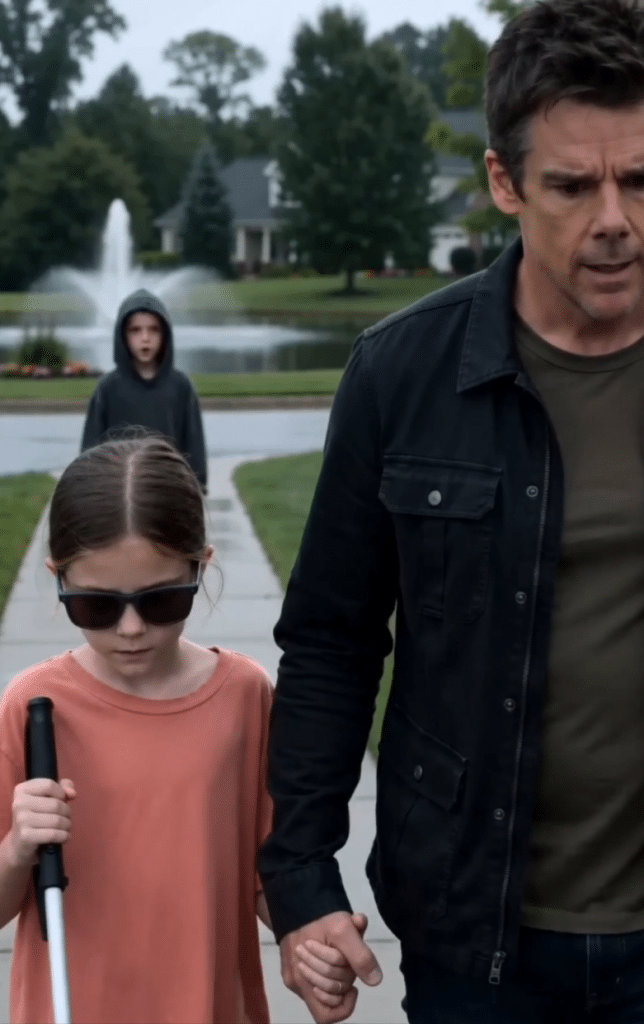
They had been walking beside the pond, past the fountain and the perfect lawns of a neighborhood where everything looked clean enough to be staged. His eight-year-old daughter, Lily, moved carefully beside him, dark sunglasses covering her eyes, a white cane tapping softly against the damp sidewalk.
Daniel turned.
A boy stood several yards away.
He could not have been older than twelve. His hood was pulled low over his forehead, and there was a cut above one eyebrow. A dark smear marked his lower lip.
Daniel instinctively pulled Lily closer.
“What?”
The boy did not blink.
“Your daughter can see,” he repeated.
Daniel’s chest tightened.
“Who are you?”
The boy looked past him, directly at Lily.
“Ask your wife,” he said. “She trained her.”
Daniel felt the words hit somewhere beneath his ribs.
Lily stood perfectly still.
Her sunglasses hid everything.
Daniel looked down at her, then back at the boy.
“Why?”
For the first time, the boy’s face changed.
Not with fear.
With grief.
“Because blindness is safer than memory.”
Then he turned and ran.
And Daniel realized his daughter had not moved her cane once since the boy spoke.
Act II
Lily had been declared legally blind two years earlier.
At least, that was what Daniel had been told.
He had been away when it happened—not by choice, but because his work as an emergency infrastructure engineer sent him across the country after a bridge collapse. His wife, Marissa, called him crying from a hospital hallway.
“There was an accident,” she said.
He remembered the sound of her breathing more than the words.
Lily had fallen down the basement stairs during a storm. A power outage. Broken glass. Panic. Head trauma. Vision loss.
That was the story.
By the time Daniel got home, Lily was quiet in a hospital bed with bandages near her temple and Marissa sitting beside her like a statue.
Doctors spoke in careful phrases.
Possible trauma response.
Functional vision loss.
Neurological uncertainty.
Daniel did not understand all of it. He only understood that his daughter reached for him without looking at his face.
So he learned.
He covered sharp corners. He labeled drawers. He walked beside Lily for hours while she practiced with the cane. He let her memorize rooms by touch. He praised her bravery every time she crossed a sidewalk.
And Marissa became her coach.
Patient. Exact. Tireless.
“Don’t rush her,” she would tell Daniel.
“Let her trust the cane.”
“Don’t ask what she remembers.”
That last part bothered him sometimes.
But grief changes the rules inside a family. It makes silence look like mercy.
For two years, Daniel obeyed.
Until a wounded boy on a quiet sidewalk told him his home was built around a lie.
Act III
That night, Daniel did not confront Marissa immediately.
He watched.
At dinner, Lily reached for her water before her fingers touched the glass.
When Marissa dropped a fork, Lily’s eyes flicked toward it before her head turned.
When Daniel silently held up three fingers across the table, Lily’s mouth tightened.
Marissa saw it too.
Her face went pale.
After Lily went upstairs, Daniel stood in the kitchen and placed the white cane on the table between them.
“Tell me the truth.”
Marissa gripped the counter.
“Daniel—”
“Can she see?”
Her silence answered first.
Then she whispered, “Yes.”
The room seemed to lose air.
Daniel stepped back.
“For how long?”
Marissa closed her eyes.
“Since the beginning.”
He stared at her as if she had become someone else.
“You let me believe our daughter was blind for two years?”
“I didn’t do it to hurt you.”
“No,” he said, voice breaking. “You just let me grieve a child who was standing right in front of me.”
Marissa covered her mouth.
Then Daniel asked the question he feared most.
“What happened in the basement?”
Marissa looked toward the stairs.
And for the first time in two years, she looked afraid of Lily remembering.
Act IV
Lily had not fallen.
She had hidden.
The night of the storm, Marissa’s older brother, Evan, came to the house drunk and furious. He had lost money, blamed Marissa for refusing to help him, and forced his way inside while Daniel was away.
Lily heard shouting.
Then she saw Evan take something from Daniel’s locked office.
A small hard drive.
Daniel’s work drive.
It held inspection records tied to a construction company Evan had secretly invested in—records proving dangerous shortcuts had been approved before the bridge collapse.
Lily saw him.
Evan saw her.
He chased her toward the basement stairs. She slipped, hit the wall, and blacked out.
When she woke, she remembered enough to be terrified.
Marissa made a choice.
A terrible one.
She told Lily to pretend she could not see. She told the doctors Lily was confused. She told Daniel the injury had changed everything.
“Evan believed she had seen him,” Marissa said, crying now. “If he thought she remembered, he would come back.”
Daniel’s hands curled at his sides.
“So you hid her in blindness.”
“I hid her in survival.”
“And the boy?”
Marissa wiped her face.
“Evan’s son. Noah. He was in the car that night. He must have heard more than we knew.”
Daniel thought of the boy’s cut lip.
“He came to warn us.”
Marissa nodded.
“Or to escape him.”
That was when Lily appeared on the stairs.
No sunglasses.
No cane.
Her small voice trembled.
“I remember the red flashlight.”
Daniel turned slowly.
Lily gripped the railing.
“Uncle Evan had it in his mouth when he opened your desk.”
Act V
The next morning, Daniel called the police.
Not the local officer who played golf with Evan.
Not the family friend Marissa had been afraid to trust.
He called a state investigator connected to the bridge case and gave him everything: the hidden vision, the missing hard drive, Lily’s memory, and Noah’s warning.
Noah was found that afternoon at a gas station three miles away, hungry, bruised, and carrying a flash drive taped inside his hoodie.
He had stolen it from his father.
On it were copies of emails, payments, and inspection files Evan had tried to bury.
The truth did not explode all at once.
It unfolded in courtrooms, interviews, sealed statements, and nights when Lily woke crying because pretending to be blind had not erased what she saw.
But Daniel stayed.
Through every question.
Every appointment.
Every hard conversation with Marissa.
Forgiveness did not come quickly.
It came in fragments.
Marissa had lied. She had also been terrified. She had protected Lily badly, desperately, and at great cost.
Months later, Lily walked beside the same pond again.
No sunglasses.
No cane.
Daniel held one hand.
Marissa held the other.
Ahead of them, Noah sat on the bench with a new backpack and a healing face, waiting for the foster caseworker who had helped place him with a safe aunt.
Lily stopped in front of him.
“You told my dad,” she said.
Noah looked down.
“I should’ve told sooner.”
Lily shook her head.
“You told when you could.”
The fountain whispered behind them.
Daniel looked at his daughter in the gray afternoon light and thought of all the things adults call protection when they are really just fear wearing a softer name.
Lily squeezed his hand.
“Dad?”
“Yeah, sweetheart?”
“I don’t want to pretend anymore.”
Daniel knelt in front of her.
“You never have to.”
And for the first time in two years, Lily looked straight into her father’s eyes without hiding what she could see.