Act I
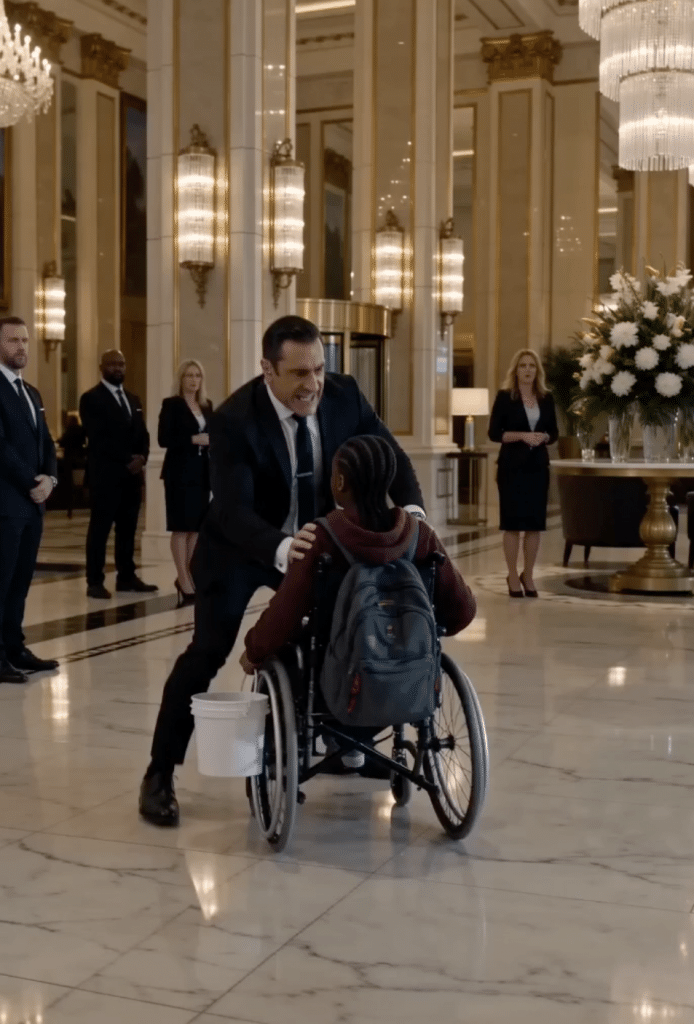
“Get this filthy gutter trash out of my hotel!”
The words cracked across the marble lobby.
Every chandelier seemed to freeze above them. Guests stopped mid-conversation. A bellhop lowered a suitcase. At the reception desk, two clerks stared in horror as the hotel manager shoved the wheelchair toward the glass doors.
The girl in the chair gripped the armrests.
She was maybe sixteen, wearing a burgundy hoodie, faded jeans, and a backpack strapped across her lap. A white bucket rested near her feet. Her hair was damp from the rain outside, her face pale with humiliation.
“People like you belong on the sidewalk,” the manager shouted, “not in here!”
Then he pushed.
Too hard.
The wheelchair rolled through the entrance and out onto the wet pavement, stopping crookedly near the curb.
The girl sat there, stunned.
Behind the glass, the manager straightened his suit as if he had just corrected a stain in the carpet.
Then a black SUV pulled up.
Its doors opened with quiet precision.
A tall man in a dark suit and sunglasses stepped out, walked to the girl, and knelt beside her wheelchair.
“Ma’am,” he said, voice low and respectful, “the owner’s daughter should not have been kept waiting.”
The girl looked up.
For a second, the hurt stayed on her face.
Then it changed.
“Oh,” she whispered.
Inside the lobby, the manager went white.
“What?”
And suddenly, everyone understood the real filth in the hotel had never been on the sidewalk.
Act II
Her name was Lily Harrow.
To the manager, she had looked like an inconvenience.
To the guests, maybe a lost teenager.
To the staff, a problem they were too afraid to touch.
But Lily knew every inch of the hotel better than most of them ever would.
Her father, Daniel Harrow, had bought the Valemont Grand ten years earlier, when it was bankrupt, faded, and nearly empty. He restored the marble. Reopened the ballroom. Rehired old staff. Built its reputation back until celebrities, diplomats, and billionaires booked suites months in advance.
But Daniel taught Lily one rule early.
“A beautiful hotel means nothing if ugly people run it.”
That was why she had come that day without warning.
No designer clothes.
No assistant.
No famous last name announced at the front desk.
Just a hoodie, backpack, wheelchair, and a white bucket.
Inside the bucket were cleaning supplies.
Lily had been testing the hotel.
Not for luxury.
For humanity.
Her father was preparing to transfer part of the business to her trust when she turned eighteen. Before that happened, Lily wanted to know what happened in the lobby when no one important was supposed to be watching.
Now she knew.
The manager’s name was Richard Bell.
He was polished, ambitious, and adored wealthy guests because they made him feel close to power. He remembered diamond members by name. He sent champagne to influencers. He bowed to politicians and bullied housekeepers.
For months, staff complaints had reached Daniel Harrow’s office.
Rude behavior.
Threats.
Discrimination.
A wheelchair user denied access to the lounge.
A cleaner fired after reporting a guest’s missing jewelry, then later proven innocent.
Richard always had an explanation.
So Lily asked to see for herself.
Her father refused at first.
Then Lily said, “You taught me to look people in the eye before judging them.”
Daniel had agreed on one condition.
Security would stay nearby.
But Lily insisted they wait outside.
She wanted the truth unedited.
And Richard Bell had given it to her in less than twelve minutes.
Act III
The lobby doors opened again.
This time, Richard did not move.
The man in sunglasses pushed Lily’s wheelchair back inside slowly, one hand steady on the handle. Guests stepped aside as if a queen were entering, but Lily did not look triumphant.
She looked tired.
That made the silence worse.
Richard forced a laugh.
“There has been a misunderstanding.”
Lily looked at him.
“No. There was a decision.”
His mouth twitched.
“Miss Harrow, I had no idea—”
“That I mattered?” she asked.
The words cut cleanly through the room.
Richard swallowed.
“I thought you were disturbing guests.”
“I asked for the accessible restroom.”
A receptionist looked down.
Lily turned toward her.
“And you told me it was locked.”
The young clerk’s eyes filled.
“Mr. Bell told us not to let non-guests use it.”
Lily nodded slowly.
“I also asked whether I could wait inside because it was raining.”
No one spoke.
Richard lifted his hands.
“This is a five-star property. We have standards.”
The security man removed his sunglasses.
“And now we’re going to discuss yours.”
His name was Marcus Vale, head of Harrow private security and former hotel operations investigator. He had been recording from the SUV after Lily activated the emergency signal hidden under her chair armrest.
The shove.
The insult.
The staff watching in fear.
All of it.
Marcus placed a phone on the front desk and played the audio.
Richard’s own voice filled the lobby.
Filthy gutter trash.
People like you.
Sidewalk outside.
A woman near the floral arrangement gasped.
A bellhop whispered, “He’s done.”
Richard turned on the staff.
“Who said that?”
Lily’s voice stayed calm.
“No one had to.”
Act IV
Daniel Harrow arrived twenty minutes later.
No announcement.
No entourage.
Just a tall man in a charcoal coat walking through his own lobby with the kind of quiet fury that made people lower their eyes.
Richard hurried toward him.
“Mr. Harrow, sir, I can explain.”
Daniel walked past him.
He went straight to Lily, knelt, and placed a hand over hers.
“Are you hurt?”
Lily shook her head.
“Not badly.”
Daniel closed his eyes for one second.
Then he stood.
Richard began again.
“Sir, with respect, she arrived looking like—”
“Careful,” Daniel said.
One word.
Richard stopped.
Daniel turned to the staff.
“Has this happened before?”
No one answered.
Fear still held them.
Then the housekeeper near the elevator raised her hand.
“Yes, sir.”
Richard glared at her.
Another hand rose.
Then another.
The receptionist began crying.
“He made us turn people away,” she said. “People in wheelchairs. People he thought looked poor. People who didn’t match the image.”
Daniel’s face hardened with every word.
Richard’s confidence collapsed in layers.
“Sir, I was protecting the brand.”
Daniel looked around the marble lobby, the chandeliers, the flowers, the polished surfaces.
“The brand,” he said, “is not marble.”
He pointed toward Lily.
“It is how we treat someone when we think they cannot hurt us.”
Then he faced Richard fully.
“You are terminated effective immediately.”
Richard staggered.
“You can’t do that in front of everyone.”
Daniel’s expression did not change.
“You pushed my daughter onto a sidewalk in front of everyone.”
Act V
By evening, Richard Bell was gone.
Not escorted dramatically through a crowd.
Just removed with a cardboard box and the stunned silence of a man who had mistaken cruelty for authority.
The next morning, the Valemont Grand held an emergency staff meeting.
Lily attended.
Not hidden in her father’s office.
Not protected from the discomfort.
Right there in the ballroom, facing the people who had watched and the people who had suffered.
She did not give a speech about revenge.
She talked about doors.
Doors too heavy to open.
Restrooms locked for convenience.
Employees too scared to report abuse.
Guests judged before they reached the desk.
Then Daniel announced changes.
Accessibility audits.
Anonymous staff protections.
Mandatory dignity training.
A new guest assistance policy.
And the promotion of the housekeeper who had spoken first.
Her name was Maria.
She became Director of Guest Care.
Weeks later, Lily returned to the hotel again.
This time, no one shoved her.
No one looked away.
The entrance doors opened automatically before her chair reached them. The receptionist greeted her by name, then greeted the elderly man behind her with the same warmth.
Lily paused in the lobby.
The marble still shone.
The chandeliers still glittered.
The flowers were still perfect.
But the hotel felt different.
Not because it had become more luxurious.
Because it had become less afraid.
Her father stood beside her.
“Are you ready?” he asked.
Lily looked toward the front desk, where Maria was helping a tired young mother check in early without making her beg.
Then Lily smiled.
“Now it looks like ours.”
And somewhere beyond the glass doors, the sidewalk still held the memory of the moment Richard Bell threw away his career.
Not because he failed to recognize the owner’s daughter.
Because he failed to recognize a person.