Act I
The black sedan did not belong on that road.
It rolled through the dust like something from another life, all polished chrome and tinted glass, its tires crunching over gravel that had only ever known pickup trucks, tractors, and muddy boots. The engine stayed low and smooth, almost insulting in the quiet of the farmstead.
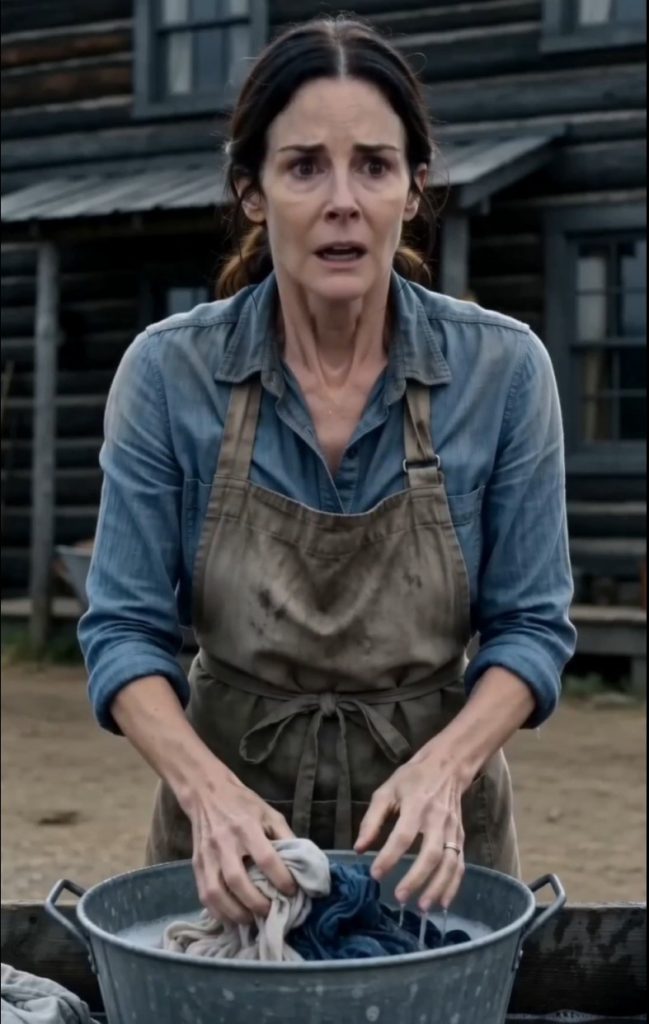
At the wash trough, Nora Bennett stopped with both hands buried in gray water.
A shirt slipped from her fingers and sank beneath the soap.
She did not turn right away.
For six years, every strange sound had taught her to measure danger before facing it. A truck slowing outside the cabin. A man’s voice near the fence. A name spoken too loudly at the market.
But this was different.
The car door opened.
The villagers near the feed shed went still. Old Mr. Haskell lowered the sack of grain on his shoulder. Two women by the chicken coop stopped whispering mid-sentence.
A man stepped out in a navy three-piece suit.
He was tall, broad-shouldered, perfectly groomed, the kind of man whose shoes had never been meant for dirt. He stood beside the open door with his suit jacket folded over one arm, staring across the yard as if the whole world had narrowed to the woman at the basin.
Nora finally looked up.
The color drained from her face.
Her lips parted, but nothing came out at first. Her wet hands hung uselessly at her sides, dripping onto the dry earth.
Then she whispered, “It’s you.”
Caleb Whitmore took one step toward her.
For a second, the expensive car, the shabby cabins, the gathered locals, the gray sky above them all seemed to disappear. There was only him, and her, and the six years of silence standing between them like a locked door.
His voice was deep, but it shook.
“I finally found you.”
Nora did not move.
She looked older than he remembered, but not in years. In weight. In weather. Her dark hair was tied back with a strip of cloth. Her blue chambray shirt was faded thin at the elbows, and the heavy apron over it was marked with soap, ash, and old work.
She looked like someone who had survived by making herself useful.
Caleb took another step.
That was when a child’s voice broke the spell.
“Mom! Mom!”
A little boy came running from behind one of the cabins, bare knees dusty, sandy-brown hair flying in every direction. He was laughing, breathless, carrying a crooked stick like it was a sword.
Nora’s whole body changed.
She bent fast and pulled him into her side, pressing him against her apron with a protective arm. Her fingers tightened on his shoulder.
The boy looked up at the stranger in the suit.
His smile faded.
Caleb stopped dead.
The boy had Nora’s mouth.
But the eyes belonged to him.
For one terrible, beautiful moment, Caleb could not breathe. His face changed slowly, shock breaking through discipline, hope cutting through anger, grief rising before he had permission to feel it.
He looked from the child to Nora.
His voice came out cracked and barely above a whisper.
“Is he… is he my son?”
Nora closed her eyes.
And the silence told him everything before she ever nodded.
Act II
The boy felt his mother’s arm tighten and leaned closer to her, confused by the way all the adults had gone quiet.
His name was Eli.
He was five years old, almost six, and until that morning the richest man he had ever seen was the county doctor who wore clean boots in winter. He had never seen anyone like Caleb Whitmore, with his silver watch, dark tie, and the kind of stillness that made people step aside before he asked.
Eli tugged at Nora’s apron.
“Mom?” he whispered.
Nora opened her eyes, but she did not look down. She kept staring at Caleb as if the wrong movement might shatter them both.
Caleb swallowed hard.
“What did you name him?”
The question was simple.
It broke her.
“Eli,” she said.
Caleb’s expression flickered.
His father’s name had been Elias.
Nora saw the recognition hit him and looked away, ashamed of a tenderness she had never meant to reveal.
“I didn’t think you’d ever know,” she said.
A muscle worked in Caleb’s jaw. “You thought I didn’t want to?”
Nora’s head snapped back toward him.
The villagers shifted uneasily. They had seen Nora quiet, exhausted, kind, stubborn. They had seen her drag feed sacks twice her size, mend roofs in cold rain, sit up all night with sick children who were not hers.
They had never seen her look at someone like she was staring at the ghost of the life she should have had.
“You sent me away,” she said.
Caleb went completely still.
“No.”
Nora laughed once, but there was no humor in it.
“You sent a lawyer to my apartment with an envelope and a check. He said you were engaged to Vivienne Cross by morning. He said your family would bury me if I made noise.”
Caleb stared at her as though she had spoken in another language.
“I never sent anyone.”
Nora’s grip tightened around Eli.
“I was there, Caleb. I saw the papers. I saw your signature.”
“I never signed them.”
The words landed hard.
For six years, Nora had built a wall out of that signature. Every time Eli asked why he did not have a father, every time winter came too early and the firewood ran low, every time she saw Caleb’s face in some newspaper wrapped around meat at the butcher’s counter, she had told herself the same thing.
He chose his world.
She chose her child.
That was the only way to survive it.
But now he was standing in front of her with pain so raw it did not look rehearsed. He did not look like a man defending an old betrayal.
He looked like a man discovering he had been robbed.
Caleb took a slow breath.
“I went to your apartment that night,” he said. “The night before the courthouse. It was empty. Your neighbor said you left with two suitcases and a man from my office.”
Nora shook her head. “No.”
“I called you for weeks. Your number was disconnected. Your bank account was closed. Your landlord said you broke the lease.”
“That lawyer made me sign papers.”
“What lawyer?”
She hesitated.
Then she said the name she had not spoken aloud in years.
“Martin Vale.”
Caleb’s face hardened so quickly even Eli noticed. The softness vanished, replaced by something cold and dangerous.
Martin Vale had been the Whitmore family attorney for thirty years.
He had handled Caleb’s trusts, his father’s estate, board negotiations, campaign donations, charity funds, and every secret rich families preferred to call a legal matter.
Nora saw Caleb’s expression and felt the ground tilt beneath her.
“You know him,” she whispered.
Caleb’s eyes lifted to hers.
“Yes.”
The wind moved through the dry grass beside the cabins.
Somewhere behind them, the sedan engine finally shut off.
And in the sudden silence, Nora realized the lie she had lived under had a name.
Act III
Caleb had searched for her.
Not politely. Not briefly. Not in the way rich men searched when they wanted to say they had tried. He had spent six years pushing through locked records, paid-off witnesses, dead phone numbers, and addresses that led nowhere.
He told her this standing in the dirt, in front of people who had no idea they were hearing the collapse of an empire.
“At first they told me you left for money,” he said. “Then they told me you never loved me. Then they told me you were in Europe, then California, then married somewhere under another name.”
Nora’s face twisted. “And you believed them?”
Caleb looked at Eli.
“No.”
The answer was quiet.
That made it worse.
Nora turned her face away, but the tears came anyway.
She remembered the Caleb from before the suits and the headlines. The man who had taken off his jacket in a rainstorm and wrapped it around her shoulders outside a diner. The man who had sat on the kitchen floor of her tiny apartment, eating burnt toast and laughing because he said burnt toast tasted honest.
She had loved him before she knew what his last name could do to a room.
And that had been the problem.
Caleb Whitmore was not just wealthy. He was the only surviving son of a family whose name sat on hospitals, banks, and half the factories in three states. His mother had come from old money. His father had made new money look obedient.
Nora had been a seamstress in the alterations department of Whitmore House, hired to repair gowns for charity galas and private events.
She was not supposed to be noticed.
Caleb noticed anyway.
For eleven months, they had hidden nothing except how serious it had become. Then he asked her to marry him in the back garden of the old Whitmore estate, under a maple tree older than his family fortune.
Nora had said yes before he finished asking.
Two weeks later, everything vanished.
The lawyer. The check. The threat. The forged signature. The warning that if she was pregnant, the family would prove she was unstable and take the child.
So she ran.
Not because she was weak.
Because she was alone and twenty-nine and terrified of losing a baby no one else knew existed.
She ended up in Briar Glen, a half-forgotten farm settlement where people asked few questions if you worked hard enough to earn silence. A widow named Ruth Haskell let her sleep in the back room of a cabin for three nights.
Three nights became six years.
Eli was born during a thunderstorm while the bridge into town was flooded. Ruth boiled water. Old Haskell drove for the doctor and got stuck halfway. Nora screamed into a towel and thought of Caleb the entire time.
She hated him for not being there.
She loved him for the same reason.
Caleb listened without interrupting, but every sentence carved something into him.
When she finished, he reached into the inside pocket of his vest and pulled out a folded photograph.
The paper was worn at the edges.
Nora recognized it before he opened it.
It was the picture of her sitting on the steps of her old apartment, laughing at something outside the frame, one hand lifted to block the sun.
“You kept that?” she asked.
“I carried it every day.”
Nora could not speak.
Caleb looked at her with a grief that had aged in private.
“Three months ago, Martin Vale died.”
The name made Eli press closer to his mother.
Caleb continued, “His daughter found a storage unit under a company alias. Inside were files. Letters. Payments. Reports on you.”
Nora’s breath stopped.
“Reports?”
He nodded.
“Someone knew where you were.”
The farmstead seemed to darken around her.
Caleb’s voice lowered.
“Someone kept me from finding you.”
Nora’s eyes went to the villagers, then the cabins, then Eli’s small hand gripping her apron.
“Who?”
Caleb looked toward the black sedan.
For the first time, Nora noticed there was someone in the back seat.
An older woman sat behind the tinted glass, perfectly still.
Caleb’s expression turned to stone.
“My mother.”
Act IV
The rear door of the sedan opened.
Eleanor Whitmore stepped out like she was entering a boardroom instead of a farmyard. She was elegant, silver-haired, wrapped in a cream coat that probably cost more than every cabin in sight.
No one spoke.
Even the chickens near the fence seemed to quiet.
Nora felt Eli’s small body stiffen against her. He did not know who the woman was, but children understand danger long before adults explain it.
Eleanor looked at Nora first.
There was no warmth in her eyes.
Then she looked at Eli.
For one brief moment, something like recognition crossed her face. Caleb saw it, and whatever doubt remained inside him burned away.
“You knew,” he said.
Eleanor did not answer.
Caleb took one step toward her. “You knew he existed.”
His mother removed her gloves finger by finger.
“I knew there was a possibility.”
Nora let out a sound that was almost a laugh, almost a sob.
“A possibility?”
Eleanor’s gaze stayed fixed on Caleb. “You were twenty-four when you met her.”
“I was thirty-two.”
“You were vulnerable after your father died.”
“I was in love.”
“You were being used.”
The words snapped through the yard.
Old Mr. Haskell muttered something under his breath. Ruth Haskell crossed her arms and stepped closer to Nora, a silent shield built from years of hard living.
Caleb’s face was pale with fury.
“You paid Vale to threaten her.”
“I paid him to protect this family.”
“You stole my son.”
Eleanor finally looked at Eli again.
The boy stared back with wide, uncertain eyes.
For a second, the old woman’s composure shifted. Not enough to make her human. Just enough to reveal that she knew exactly what she had done.
“He would have been torn apart in our world,” she said.
Nora’s voice came out sharper than anyone expected.
“No. You mean he would have inherited it.”
Eleanor turned.
Nora was shaking, but she did not lower her eyes.
“That’s what this was about, wasn’t it? Not my background. Not Caleb’s future. Him.”
She pulled Eli closer.
“If Caleb married me, if he had a child with me, your bloodline would have a name you couldn’t polish. A mother who washed clothes for a living. A son born outside your approval.”
Eleanor’s silence was answer enough.
Caleb reached into his vest again and took out a second paper. This one was crisp, sealed in plastic.
“Vale kept copies,” he said. “Of everything.”
His mother’s eyes dropped to the document.
For the first time, fear touched her face.
Caleb held it up.
“A payment authorization from the Whitmore Foundation account. Your signature. Dated two days before Nora disappeared.”
Eleanor’s jaw tightened.
Caleb pulled out another page.
“A private investigator’s report from four years ago. Nora Bennett located in Briar Glen. Child observed. Male, approximately eighteen months.”
Nora covered her mouth.
Eli looked from one adult to the next, sensing that his world was changing but not knowing where to stand inside it.
Caleb’s voice trembled, not with weakness, but with restraint.
“You let me grieve a living woman. You let my son grow up without me.”
Eleanor lifted her chin.
“And now what? You destroy your family in front of farmers and strangers?”
Caleb glanced around the yard.
At the worn boots. The tired faces. The cabins patched with tin and stubbornness. The people who had watched over Nora when his own blood had hunted her into silence.
“They are not strangers,” he said. “They knew my family better than I did.”
Then Eli spoke.
His voice was small.
“Are you my dad?”
Everything stopped.
Caleb turned slowly.
The fury in him broke apart so completely that Nora saw the young man she had loved underneath it all.
He crouched in the dirt, not caring about the suit.
“I think I am,” he said gently. “But only if your mom says it’s okay for me to be here.”
Eli looked up at Nora.
That was the cruelest part.
Not the documents. Not Eleanor’s lies. Not the years.
It was the trust in her son’s eyes, asking her to decide whether hope was safe.
Nora looked at Caleb kneeling in the dirt, his expensive clothes ruined at the knees, his face open and afraid.
Then she looked at Eleanor Whitmore, standing beside a luxury car, still trying to look like power.
Nora inhaled slowly.
“No one takes him from me,” she said.
Caleb nodded at once.
“No one.”
“Not your mother. Not your lawyers. Not your name.”
“Never.”
Eleanor scoffed, but the sound was thin now.
Caleb stood and turned back to her.
“The board already has the files. So does the state attorney general.”
Eleanor’s face went white.
“I came here before the press did,” he said. “Because Nora deserved to hear the truth from me first.”
A distant rumble rolled across the gray sky.
Or maybe it was only the sound of Eleanor Whitmore’s world beginning to collapse.
Act V
The next morning, every major paper carried the story.
Not all of it. Not the parts that mattered most. Newspapers were good at numbers, names, resignations, investigations. They wrote about the Whitmore Foundation, misused funds, forged documents, a deceased attorney’s hidden records, and a matriarch stepping down amid scandal.
They did not write about Nora standing in the doorway of her cabin that night, unable to sleep because the truth had not freed her as gently as people imagined.
Freedom hurt when it arrived late.
Caleb stayed at the old Haskell house down the road instead of the hotel his driver had suggested. He did not ask to stay with Nora. He did not ask to see Eli again that night.
For the first time in six years, he did not push against a locked door.
He waited.
At dawn, Nora found him by the fence, still in yesterday’s shirt, sleeves rolled up, looking out over the fields as if trying to learn the shape of the life that had raised his son without him.
“You’ll ruin your shoes,” she said.
He looked down at the mud on them.
“They were never that important.”
She almost smiled.
Almost.
For a while, they stood without speaking. A rooster called somewhere behind the barn. Smoke rose from Ruth’s chimney. Eli was still asleep inside, one arm thrown over the stuffed dog Nora had sewn from scraps when he was two.
Caleb’s voice was quiet.
“I don’t expect you to forgive me.”
Nora stared at the field.
“I blamed you for six years.”
“You had reason to.”
“I taught myself not to miss you.”
He nodded, but the words landed hard.
Nora looked at him then.
“But I did anyway.”
The admission sat between them, fragile and frightening.
Caleb did not reach for her. That was how she knew he had changed, or maybe how she remembered he had always been before money and grief and family poison had turned everything sharp.
He let her choose the distance.
“I want to know him,” he said. “Not take him. Not move him into some mansion and pretend the last six years didn’t happen. I want to know what makes him laugh. What scares him. What he eats when he’s sick. What stories he asks for at night.”
Nora’s eyes filled.
“He likes pancakes shaped like bears. He pretends he doesn’t need the lantern on, but he does. He thinks thunder is a giant moving furniture.”
Caleb smiled, and it broke her heart because it was the smile she remembered.
“I used to think that too.”
Nora looked away quickly.
Inside the cabin, Eli woke and called for her.
“Mom?”
Nora wiped her face with the heel of her hand.
Caleb stepped back at once, giving her room.
But Eli appeared in the doorway before she could answer, hair wild from sleep, rubbing one eye with his fist. He saw Caleb by the fence and went still.
Then, slowly, he came down the steps.
He carried the little stuffed dog by one ear.
Caleb crouched again, just as he had the day before.
“Morning, Eli.”
Eli studied him with the serious suspicion of a child deciding whether an adult deserved a place in his world.
“You got mud on your pants.”
Caleb looked down.
“I did.”
“Mom gets mad when I do that.”
Nora let out a small, helpless laugh.
Caleb looked up at her. “I’ll accept the consequences.”
Eli considered this.
Then he held out the stuffed dog.
“This is Marshal. He watches the house.”
Caleb received it like it was a sacred object.
“Nice to meet you, Marshal.”
Eli stepped closer.
“My mom said you might be my dad.”
Caleb’s throat moved.
“She said that?”
“She said we have to go slow because grown-ups made a big mess.”
Nora closed her eyes for half a second.
Caleb nodded solemnly.
“She’s right.”
Eli looked relieved by the honesty.
“Can dads fix fences?”
Caleb glanced at the crooked rail behind him.
“I can learn.”
That afternoon, the richest man in three states stood in a borrowed pair of work gloves while Eli showed him which fence posts leaned and which hens were “mean for no reason.” He listened as if every word were a contract more important than anything he had ever signed.
Nora watched from the wash trough.
The basin was full again. The laundry still had to be done. The world had not magically become easy because a black sedan had arrived with the truth inside it.
But something had shifted.
For years, she had lived as if love were a place she had been forced to leave. Now it stood in her yard, awkward and muddy, holding a stuffed dog while a little boy explained chicken politics with absolute seriousness.
Weeks passed.
Eleanor Whitmore disappeared from public life, surrounded not by loyalty but by lawyers. The board stripped her name from the foundation. Martin Vale’s records opened investigations that reached farther than anyone expected.
Caleb came back every weekend.
Then twice a week.
Then he stopped arriving in a suit.
He learned to stack firewood badly, then better. He burned pancakes twice before Eli declared the third batch “not terrible.” He sat with Nora on the porch after Eli fell asleep, and they spoke carefully around the years, touching the past only when they could bear it.
Trust did not return like lightning.
It grew like something planted.
Slow. Stubborn. Needing weather.
One evening, near the end of summer, Caleb brought no driver, no papers, no polished speech. Just an old photograph in a new frame.
It was the picture of Nora on her apartment steps.
Beside it, he had placed another photo.
Eli standing in the farmyard, grinning with both front teeth showing, one arm around Nora’s waist and one hand gripping Caleb’s sleeve.
Nora stared at it for a long time.
“We look like a family,” she whispered.
Caleb’s voice was gentle.
“We are one. Even if it takes time to believe it.”
From the yard, Eli shouted for them to come see the sunset.
Nora stepped off the porch first. Caleb followed, but not too close, still letting her choose.
Halfway across the dirt path, Eli ran back, grabbed Caleb’s hand, then grabbed Nora’s.
He pulled them both forward like it was the most natural thing in the world.
And under the fading gold light, between the weathered cabins and the fields that had kept her alive, Nora finally understood something she had not allowed herself to hope.
The man in the black sedan had not come to take her son away.
He had come to bring back the part of their lives that had been stolen.
This time, no one was going to make them disappear.