Act I
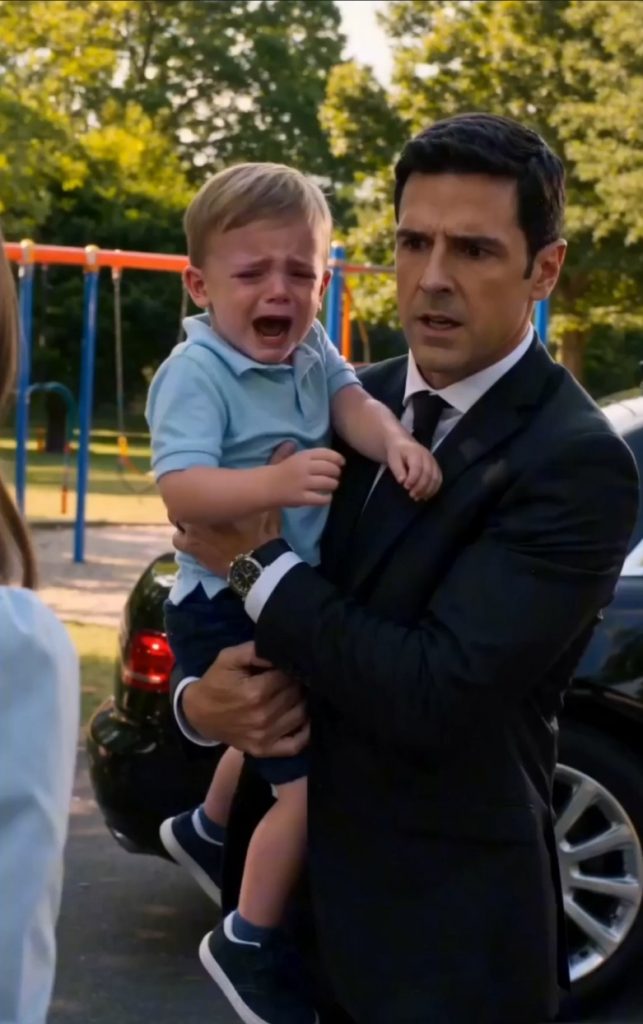
The little boy screamed Emma’s name like it was the only word keeping him alive.
“I want Emma!” he cried, twisting in his father’s arms. “I want Emma to be my mommy!”
Elias held him tightly against his chest, one arm locked across the boy’s small stomach, the other hooked beneath his thighs. He was a strong man, broad-shouldered in a sharp black suit, the kind of man who walked into boardrooms and made people stand straighter without saying a word.
But in the middle of that sunny playground, he looked helpless.
“Noah, stop,” he said, though his voice had no command left in it. “Please.”
The child did not stop.
He reached both hands toward Emma as if the space between them was unbearable. Tears ran down his red cheeks. His little body lunged forward again and again, fighting not away from his father, but toward the young woman standing a few feet from them in a pale blue maid’s uniform.
Emma stood trembling near the curb.
Behind her, green trees swayed gently around a bright playground. A black luxury car waited with its door open. The whole neighborhood looked peaceful, almost cruelly peaceful, while the boy shattered in front of everyone.
Emma’s face was wet with tears.
She lifted one hand, then dropped it, as if touching Noah would break whatever fragile control remained.
Elias stared at her, confused and afraid.
“Emma,” he said, his voice low and urgent, “what happened?”
She took a breath that nearly broke her.
“Your mother fired me.”
Elias went still.
Noah sobbed harder.
Emma looked at the child, then at Elias, and something in her expression changed. The grief was still there, but underneath it was something stronger. Something she had been carrying for longer than this morning.
She reached into the pocket of her apron and pulled out an oval silver locket.
The metal was worn at the edges, polished by years of nervous fingers. When she opened it, Elias saw a small black-and-white photograph of a young woman with soft eyes and dark hair.
His breath caught before he understood why.
Emma looked down at the picture.
“Her name was Celeste,” she whispered. “And your mother knew exactly who I was the moment she saw this.”
Then she closed the locket in her palm.
“And now you need to know why she was so desperate to make me disappear.”
Act II
Emma had entered the Veyron mansion through the service door six months earlier.
That was how Vivian Veyron preferred it.
Staff came through the back. Guests came through the front. Family entered wherever they wished, because family owned the walls, the floors, the staircase, the air.
Emma had stood beneath the rear awning in a clean blue uniform, her hair pinned back, her references folded in a folder she had bought with the last of her cash. She looked younger than twenty-six that day, though grief had aged her in private ways no one could see.
The housekeeper interviewed her first.
Then the household manager.
Then Vivian.
Elias’s mother had walked into the sitting room wearing pearls and a beige blouse, her dark hair pinned smooth, her face calm in the practiced way of women who had never needed to raise their voices to ruin someone.
“You have experience with children?” Vivian asked.
“Yes, ma’am.”
“With difficult children?”
Emma hesitated.
Noah was not difficult.
That was the first thing she learned about him.
He was lonely.
He was three years old, almost four, with light brown hair and solemn eyes that seemed to expect adults to leave before they even sat down. He did not throw tantrums for attention. He withdrew from it. He lined his toy cars by color. He refused new food. He cried at night but never called for his father.
Elias loved him, Emma saw that immediately.
But Elias loved like a man standing outside a locked room.
He bought Noah the best doctors, best tutors, best clothes, best toys. He took calls from specialists. He came home from work with exhaustion hidden beneath expensive tailoring and knelt in front of his son as if asking permission to enter his world.
Noah usually turned away.
Then Emma arrived.
On her third night, she heard him crying from the nursery. Not screaming. Not calling. Just the small, exhausted sound of a child who had learned tears did not always bring someone.
Emma sat beside the bed and hummed an old lullaby.
Noah stopped crying.
He turned his head slowly.
Emma almost stopped breathing.
It was the lullaby her sister Celeste used to sing while brushing her hair, while baking bread in their tiny apartment, while dreaming aloud about a life that would be gentler than the one they had inherited.
Noah whispered, “Again.”
So Emma sang again.
By the end of the week, Noah let her hold his hand.
By the end of the month, he ran to her when he scraped his knee.
By the third month, he called her “Emmy” and tucked his face into her shoulder whenever strangers entered the room.
Elias noticed.
At first, he was grateful.
Then he grew curious.
“You’re very good with him,” he told her one evening in the mansion foyer.
Emma stood at the base of the grand wooden staircase, Noah asleep in her arms, one cheek pressed against her collar.
“He just needed consistency,” she replied.
Elias looked at his son with aching tenderness.
“He never attached to anyone like this.”
Emma nearly said, He attached before.
But she swallowed the words.
She had not come to the Veyron house to steal anyone’s child. She had come because of a promise made beside a hospital bed four years earlier, a promise to find the truth when she was strong enough.
Celeste had been her older sister.
Celeste had once loved Elias Veyron.
And according to every story Elias had been told, Celeste had abandoned him, vanished, and left their newborn son behind.
Emma knew that was a lie.
The locket was the first thing Vivian noticed.
It slipped from Emma’s collar one afternoon while she lifted Noah out of his high chair. Vivian saw the silver oval, saw the old photograph inside, and for one rare second, her mask cracked.
“You,” Vivian said.
Emma froze.
Vivian did not shout. She did not ask questions.
She only stepped close enough that no one else could hear.
“Pack your things before Elias returns.”
Emma’s heart sank.
But Vivian had moved too late.
Noah had already heard the word goodbye.
And he did not survive it quietly.
Act III
The mansion foyer felt colder than the street.
Emma stood beneath the high ceiling with her hands clenched at her sides, the silver locket resting against her chest. The wooden staircase rose behind Vivian like a throne. Elias stood several feet away, still holding Noah, whose crying had softened into exhausted hiccups.
Vivian’s fingers rested against her pearl necklace.
That was how Emma knew she was afraid.
“Elias,” Vivian said, “this girl is unstable. She upset your son deliberately. I was protecting the household.”
Emma let out a broken laugh.
“Protecting the household,” she repeated.
Elias looked between them, his confusion hardening into suspicion.
“Mother,” he said slowly, “why did you fire her?”
Vivian lifted her chin.
“She lied about who she was.”
Emma stepped forward.
“No. I hid who I was because your mother made sure my sister’s name became poison in this house.”
Elias went pale.
“Your sister?”
Emma opened the locket again and held it up.
“Celeste.”
Noah’s small hand reached toward the photo.
Elias stared at it.
Memory moved across his face in fragments. A woman laughing in sunlight. A hospital corridor. A letter he had read through anger and disbelief. A mother’s voice telling him he had been used, telling him Celeste had never wanted his life, his name, or his child.
“She left,” Elias said, but the words sounded weak even to him.
Emma shook her head.
“She was taken from you.”
Vivian’s hand tightened around her pearls.
“That is a disgusting accusation.”
“No,” Emma said. “It is an old one.”
The foyer went silent.
Emma’s voice trembled, but she did not lower it.
“Celeste was scared because she found out your mother had changed her medical records.”
Elias stopped breathing.
Vivian looked as if the floor had shifted beneath her.
Emma continued before fear could steal the words.
“My sister had complications after Noah was born. She was weak, confused, and separated from everyone she trusted. Your mother arranged private care, private doctors, private paperwork. Then suddenly Celeste’s records said things that were not true. They said she was unstable. They said she refused treatment. They said she was a risk to her baby.”
“No,” Elias whispered.
“Yes,” Emma said. “And while Celeste was trapped in that clinic, your mother told you she had run away.”
Vivian’s voice snapped like glass.
“Enough.”
Emma turned on her.
“You told him she didn’t want the child.”
Vivian’s face hardened.
“She was not suitable for this family.”
The words came out before she could stop them.
Elias stared at his mother.
That one sentence did what Emma’s grief could not.
It revealed the shape of the truth.
Vivian realized it too late. Her mouth opened, but no correction arrived fast enough to save her.
Emma reached into the pocket of her apron and removed a folded, weathered piece of paper. The creases were soft from years of being opened and closed, read and reread, carried through grief like a relic.
“My sister left this for you,” she said.
She held it toward Elias.
“Read it.”
His hand shook as he took it.
Noah went quiet against his chest, as if even the child understood that something sacred had entered the room.
Elias unfolded the letter.
And the first line broke him.
My dearest Elias, if this reaches you, it means your mother failed to destroy everything.
Act IV
Elias read the letter standing in the foyer where his mother had hosted senators, investors, and charity boards.
Every word stripped the house of its grandeur.
Celeste had written in a trembling hand, but her voice was unmistakable. She told him she had not left. She told him she had begged to see him. She told him Vivian had stood beside her hospital bed and said Elias did not want a fragile woman raising his heir.
She wrote that someone had altered her records after she questioned the medication she was being given and the restrictions placed on her visitors.
She wrote that she had overheard Vivian speaking to a doctor about “protecting the Veyron name.”
She wrote that Noah’s birth documents had been handled by Vivian’s attorney before Celeste ever saw them.
Elias’s eyes blurred, but he forced himself to keep reading.
I know what she will tell you. She will say I chose to leave. She will say I was unfit. She will say love is not enough. Please do not believe her forever.
Forever.
That word destroyed something in him.
Because he had believed it for four years.
He had believed Celeste abandoned him. He had believed the cruel letter Vivian showed him, the one with Celeste’s forged signature saying she wanted money and distance. He had believed his mother because grief needed someone to hold the map, and Vivian had held it with steady hands.
Elias lowered the paper.
“What did you do?” he asked.
Vivian’s face had gone rigid.
“I protected you.”
“No,” he said. “What did you do?”
Noah flinched at the tone, and Emma instinctively stepped closer. Elias saw it. Even now, after being fired, accused, and humiliated, Emma’s first instinct was to comfort his son.
His son.
Celeste’s son.
The child Vivian had allowed to grow up motherless while his real mother died believing she had been erased.
Vivian descended one step.
“She would have ruined you,” she said. “You were twenty-nine, Elias. You were about to inherit the company. She was a waitress with no family name, no education worth mentioning, no idea what our world required.”
“She was Noah’s mother.”
“She was a mistake.”
The air left the room.
Emma moved before she realized it, one hand covering her mouth as if she could physically hold in the pain. Noah began to cry again, but this time he turned his face into Elias’s suit jacket.
Elias stared at Vivian like he had never seen her before.
Perhaps he had not.
Not truly.
His mother’s love had always come dressed as protection. Her control had always called itself sacrifice. Her cruelty had always arrived with reasons polished enough to pass for wisdom.
But now the polish was gone.
Only the rot remained.
“She died,” Emma said softly.
Vivian looked away.
Emma’s voice sharpened.
“She died asking whether Elias knew the truth.”
Elias closed his eyes.
The letter trembled in his hand.
Emma stepped closer, tears sliding silently down her face.
“I was nineteen. I didn’t have money, lawyers, power, anything. Celeste made me promise not to come here until I could prove it. So I waited. I studied. I worked. I followed every record I could find. And then I saw the advertisement for a nanny in this house.”
She looked at Noah.
“I only meant to see him. To know he was safe.”
Noah reached for her.
This time, Elias did not hold him back.
He lowered his son carefully to the floor.
Noah ran straight into Emma’s arms.
She dropped to her knees and caught him, holding him with a sob that seemed to come from years beneath the surface. The boy buried his face in her neck, small fingers gripping the white collar of her uniform.
Elias watched them, and the truth became unbearable in its simplicity.
Noah had not chosen Emma over his father.
He had recognized love that came from the same place his mother’s had.
Vivian’s eyes flashed.
“You are making a scene.”
Elias turned to her.
“No,” he said. “You made a life out of one.”
Act V
The first thing Elias did was call his attorney.
The second was call the family doctor.
The third was ask Emma to sit down.
She refused at first, still holding Noah on the foyer floor as if someone might try to take him. Elias did not blame her. He would spend the rest of his life earning the right not to be grouped with the people who had failed Celeste.
Vivian stood near the staircase, silent now, one hand still at her pearls.
But no amount of pearl, silk, or old money could return authority to her voice.
By sunset, the mansion had changed.
Not visibly. The staircase was still grand. The ceilings were still high. The chandelier still threw golden light across polished floors.
But power had moved.
Vivian’s personal attorney stopped answering questions once Elias requested independent counsel. The household manager quietly admitted that Emma’s dismissal had been ordered without cause. The old family physician, when confronted with Celeste’s letter and the copied records Emma had gathered, said the words no one in that house had expected to hear.
“These files need to be reviewed by authorities.”
Vivian sat down then.
For the first time all day, she looked her age.
Elias did not feel sorry for her.
That surprised him. Some part of him had expected guilt to rise automatically. She was his mother. She had raised him. She had built walls around his life and called them safety.
But then Noah reached in his sleep for Emma’s hand, and whatever pity Elias might have felt turned into something harder.
Justice did not always arrive with shouting.
Sometimes it entered a room with copied records, a dead woman’s letter, and a child finally allowed to reach for the person who made him feel safe.
The investigation began quietly, then widened.
Medical records were subpoenaed. Old signatures were compared. The clinic that had treated Celeste was forced to produce files Vivian’s lawyer had once claimed no longer existed. Nurses who had been young and afraid four years earlier were older now, and some were tired of carrying what they had seen.
The truth came out in pieces.
Vivian had not acted alone.
A doctor had accepted money. An attorney had prepared documents that stripped Celeste of credibility while she was too ill and isolated to fight. A forged letter had been placed in Elias’s hands at the exact moment grief made him easiest to manipulate.
Celeste had lived three months after Noah’s birth.
Three months in which she wrote letters no one delivered.
Three months asking for her son.
Three months believing Elias had chosen silence.
When Elias learned that, he locked himself in his study and broke for the woman he had failed without meaning to.
Emma did not comfort him.
Not then.
Some grief had to kneel before it could be forgiven.
Weeks passed before Noah stopped waking up screaming whenever Emma left the room. Elias changed his schedule, then his priorities, then the entire rhythm of his house. He learned how to make Noah’s breakfast badly, then better. He learned which pajamas scratched, which bedtime story worked, which stuffed rabbit had to be found before sleep could even be discussed.
Emma stayed.
Not as a maid.
Not as a secret.
As Noah’s aunt.
Elias offered her a formal guardianship role in Noah’s life, with legal protection Vivian could never touch. Emma cried when she signed the papers, not because they gave her a place in the family, but because they finally acknowledged she had belonged there by blood, by promise, and by love.
Vivian left the mansion before the first hearing.
She did not leave dramatically. No shouting. No final curse from the staircase. She simply walked out with two suitcases and a face emptied by consequences. Elias watched from the foyer with Noah in his arms.
She paused at the door.
“I did it for you,” she said.
Elias looked at his son.
“No,” he replied. “You did it because you thought love was something you could manage like property.”
Vivian had no answer.
After she was gone, the house felt enormous for a while.
Then slowly, it began to feel like a home.
Emma moved Celeste’s photograph into Noah’s room. Not hidden inside the locket anymore, but framed on the dresser where the boy could see her. At first, he asked simple questions.
“Is that my mommy?”
“Yes,” Emma said.
“Did she love me?”
Elias answered that one.
“More than anything.”
Noah touched the frame with one careful finger.
“Emma loves me too.”
Emma’s eyes filled.
“Yes,” she whispered. “I do.”
Months later, Elias took Noah and Emma back to the same playground where everything had broken open.
The trees were green again. Children ran across the rubber mats beneath the swings. The black luxury car waited by the curb, but this time its door stayed closed. No one was leaving. No one was being sent away.
Noah climbed the slide, laughing when Elias pretended not to know how to catch him at the bottom. Emma sat on a bench with the silver locket in her hands, watching them through tears she no longer needed to hide.
Elias sat beside her after a while.
“I hated Celeste for leaving,” he said quietly. “That was easier than wondering why it hurt so much.”
Emma looked at him.
“She never left you. Not in the way that mattered.”
He nodded.
“I know that now.”
A long silence passed between them.
Not empty.
Healing.
Elias looked at the locket.
“May I?”
Emma placed it in his hand.
He opened it and stared at the black-and-white photograph. Celeste smiled up at him from another life, young and brave and stolen from a future she should have had.
“I’m sorry,” he said.
The apology was too late for Celeste.
But not useless.
Emma closed her hand over his.
“She wanted him loved,” she said. “Start there.”
Across the playground, Noah turned toward them.
“Emma!” he shouted. “Daddy! Watch me!”
Both of them looked up.
Noah slid down, laughing into the sunlight.
And for the first time, when he ran toward them, he did not look like a child afraid someone would disappear.
He looked like a little boy who finally understood he had more than one pair of arms waiting to catch him.
Emma held the locket against her heart.
Elias watched his son.
And somewhere between the playground and the mansion, between the lie that broke them and the truth that brought them back, Celeste’s name stopped being a secret.
It became what it should have been all along.
A mother’s name.
A sister’s promise.
A love no one had managed to erase.