Act I
The dog knew before the people did.
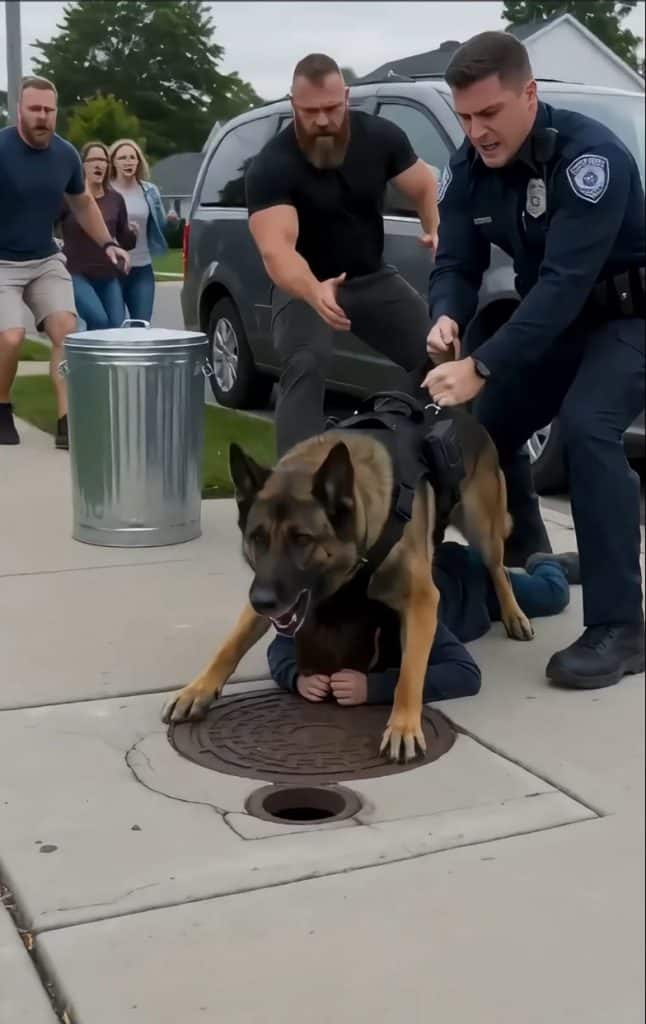
A silver trash can clattered across the sidewalk, spinning wildly over the concrete before slamming against the curb. A woman screamed. Someone shouted for everybody to move. A gray minivan sat parked too close to the chaos, its windows reflecting the pale overcast sky.
But the German Shepherd did not run.
He stood over the boy.
Four paws planted wide. Black tactical harness stretched tight across his chest. Ears forward. Teeth bared toward the round metal drainage cover in the sidewalk.
Beneath him, a young boy lay face down on the concrete with both hands locked over the back of his head.
“Ajax!” Officer Nolan Reed shouted, pulling the leash with both hands. “Back!”
The dog refused.
His bark cracked through the street again, rapid and furious, aimed not at the crowd but at the circular hole in the pavement. Thin white smoke curled from its edges, low at first, then thicker, crawling around the dog’s legs.
A bearded man in a black T-shirt grabbed the leash behind the officer.
“Pull him!” he yelled. “Get him off the kid!”
Together, they leaned backward, boots and sneakers scraping hard against the concrete. The harness stretched. The leash tightened.
Ajax did not move more than an inch.
The boy beneath him trembled but stayed flat, his fingers digging into his hair. He was small enough that the dog’s body almost covered him entirely.
Then the drainage hole hissed.
Sharp. Metallic. Alive.
Orange sparks spat from the ring.
The crowd stumbled back.
Officer Reed looked down and saw what Ajax had seen all along.
The danger was not the dog.
The danger was underneath the sidewalk.
“Get back!” Reed roared. “Move away!”
Smoke surged upward in pulses.
The dog lowered his body closer over the boy.
The officer pulled harder, but his face changed as he understood the impossible truth.
Ajax was not disobeying.
He was shielding him.
Then the drainage hole erupted with a muffled boom.
Gray-white smoke swallowed the sidewalk, the dog, the boy, the officer, and every scream in the street.
And for one terrible moment, nobody could see who was still there.
Act II
The boy’s name was Ethan Hale.
He was nine years old, and until that morning, the most dangerous thing he had ever done was ride his scooter down Ridgeview Avenue without wearing the helmet his mother left hanging on the garage hook.
He lived three houses away from the drainage cover.
Everyone on the block knew him as the quiet kid with dark clothes, serious eyes, and a habit of noticing things adults stepped over.
Cracks in sidewalks.
Bird nests in gutter pipes.
Which neighbors left porch lights on.
Which dogs barked because they were angry and which dogs barked because they were lonely.
His mother, Claire, called him “my little detective.”
His father, Marcus, called him “too smart to be this stubborn.”
Marcus was the bearded man now choking on smoke beside the curb, the one who had grabbed the leash in panic because he thought the police dog was trapping his son.
He had not seen what happened first.
He had only heard the barking.
Ethan had been walking home from the corner store with a bottle of lemonade and a pack of gum in his hoodie pocket when he noticed the metal cover shaking.
Not a lot.
Just enough.
He stopped.
A strange white thread of smoke slipped from the edge.
Then the trash can near the curb tipped over by itself, rattling as a blast of pressure pushed from below the sidewalk.
Ethan froze.
He should have run.
Instead, he stepped closer.
That was Ethan’s problem. He always wanted to know why.
Officer Nolan Reed had been driving past with Ajax in the back of the patrol SUV, returning from a school safety demonstration. Ajax had been calm all morning, patient with children, gentle with sticky hands and nervous teachers.
Then, without warning, he went wild.
He slammed his body against the inside of the vehicle.
Barked once.
Twice.
Then again and again, with a tone Reed had heard only during searches for live victims trapped under rubble.
Reed pulled over.
The second he opened the rear door, Ajax bolted toward Ethan.
The boy had just bent near the drainage cover when the dog reached him.
Ajax hit him hard enough to knock him flat.
Not to hurt him.
To get him down.
By the time Marcus ran from his driveway, all he saw was his son face down under a snarling police dog.
Fear erased everything else.
He did not know Ajax had saved Ethan from standing directly over the first burst of sparks.
He did not know the dog had dragged him six inches away with his shoulder and then planted himself above him.
He only knew his child was on the ground and danger was everywhere.
So he pulled.
Reed pulled too at first, driven by training, by instinct, by the terror of losing control in front of a crowd.
Then Ajax looked back at him through the smoke.
Just once.
A look so focused, so fierce, so full of command that Reed stopped thinking like a handler and started listening like a partner.
The dog was telling him the truth.
The boy had to stay low.
Act III
When the smoke cleared enough to see shapes again, the sidewalk looked like another world.
Dust covered the concrete in a pale film. The gray minivan’s side windows were fogged with residue. People stood back near the lawns, coughing, crying, recording and praying in the same breath.
Officer Reed was on one knee, one arm across his face.
Marcus was beside him, coughing hard, eyes wild.
“Ethan!” he shouted.
A bark answered first.
Rough. Hoarse. Alive.
The smoke thinned.
Ajax was still standing.
His body shook from the blast wave, but he remained above Ethan, legs braced, head low, ears still locked toward the drainage hole.
Under him, Ethan moved.
Marcus surged forward, but Reed grabbed his arm.
“Slow,” the officer warned. “There may be another burst.”
“My son is under there!”
“I know,” Reed said, and his voice cracked. “I know.”
Ajax finally shifted when Reed gave the soft command, not the loud one.
“Easy, boy.”
The dog stepped aside just enough for Marcus to drop to the pavement and pull Ethan into his arms.
The boy coughed, eyes squeezed shut, but he was conscious.
“Dad,” he whispered.
Marcus made a sound that was almost a sob.
“I’ve got you. I’ve got you.”
Ethan’s hands were still locked behind his head. He did not seem to know he could let go.
Reed reached slowly toward Ajax, checking him with shaking fingers. The dog leaned into the touch for half a second, then turned back toward the smoking cover and growled low.
Not finished.
Reed’s radio crackled.
“Unit Twelve, report.”
Reed grabbed it.
“Possible underground electrical or gas event. Ridgeview and Maple. We need fire, utility, medical, and evacuation on this block now.”
The crowd murmured.
Utility event sounded too small for what they had just witnessed.
Then a woman from the far sidewalk spoke up.
“It’s been smoking for weeks.”
Everyone turned.
She was elderly, wrapped in a blue cardigan, standing barefoot on her own lawn as if she had run out without thinking.
“I called,” she said, voice trembling. “I called the city twice.”
Another neighbor stepped forward.
“So did I.”
Then another.
“My porch lights flickered last night.”
“Our basement smelled weird.”
“The kids said the sidewalk was warm.”
Reed looked at the drainage cover.
The round metal ring was blackened now, but smoke still seeped from one side.
Ethan turned his head weakly in his father’s arms.
“I told the man,” he whispered.
Marcus looked down.
“What man?”
“The one by the van,” Ethan said. “He said it was nothing.”
Reed followed the boy’s gaze to the gray minivan.
On its side, barely visible beneath the dust, was a magnetic decal.
Harrow Municipal Utilities.
The passenger door was open.
The driver was gone.
Act IV
Fire crews arrived first.
Then utility trucks.
Then an ambulance.
Ridgeview Avenue became a ribbon of flashing lights under the gray sky. Neighbors were moved back behind tape. Houses on both sides were evacuated. Firefighters crouched near the drainage cover with meters and thermal cameras while utility workers stared at readings that made their faces tighten.
Marcus sat on the curb with Ethan wrapped in an emergency blanket, refusing to let go of him.
Ajax lay at Officer Reed’s feet, panting heavily, his harness dusty and his eyes still tracking every movement near the damaged cover.
A paramedic tried to examine the dog.
Ajax growled softly until Reed knelt beside him.
“It’s okay,” Reed whispered. “You did your job.”
Only then did Ajax allow the paramedic to check him.
Across the street, two officers found the missing utility worker behind a hedge, coughing and shaking, his hard hat on the ground beside him.
His name was Paul Danner.
He kept saying the same thing.
“I was going to report it.”
Reed stood over him.
“When?”
Danner looked toward the smoke.
“I didn’t know it would blow.”
That was not an answer.
The investigation began right there on the sidewalk.
Danner had been sent to inspect the drainage cover that morning after multiple complaints. He found heat, pressure, and signs of a fault in a buried line. Instead of closing the sidewalk immediately, he called his supervisor.
The supervisor told him to mark it for review.
Not emergency repair.
Review.
The block was scheduled for redevelopment soon. Repairs would be expensive. A full shutdown would trigger reports, media questions, and liability problems because complaints had already been logged and ignored.
So Danner stayed by the van, waiting for instructions.
Then Ethan approached the smoking cover.
The boy told him it looked dangerous.
Danner told him to go home.
A child listened less than the city did.
That nearly killed him.
When Reed heard it, his face went still.
Marcus did not explode. Not at first. He stood slowly, still holding Ethan’s blanket around his shoulders, and looked at the utility supervisor who had just arrived in a clean jacket and expensive work boots.
“My son told your man,” Marcus said.
The supervisor opened his mouth.
Marcus’s voice rose.
“My son saw what adults were paid to see.”
The supervisor tried to speak again.
Ajax barked once.
Everyone went silent.
It was ridiculous, maybe, that a dog’s bark carried more moral force than a city official’s explanation.
But in that moment, it did.
By evening, the truth had grown larger than one drainage cover.
The utility vault beneath the sidewalk had been failing for months. Complaints had been categorized as low priority. Work orders had been delayed, reassigned, and buried beneath budget notes. The hazard had become a paper problem until it became smoke under a child’s feet.
News vans arrived after sunset.
They wanted footage of the blast.
They wanted the dog.
They wanted the boy.
Marcus said no to cameras near Ethan.
Officer Reed said no to cameras near Ajax until the vet cleared him.
But one neighbor’s video had already spread.
A German Shepherd bracing over a child while men tried to pull him away.
Smoke rising.
Sparks flashing.
A final white-out.
The internet called Ajax a hero.
Reed sat on the back step of the ambulance with his hand resting on the dog’s head and knew the word was too small.
Heroes choose.
Ajax had understood.
And he had refused to leave.
Act V
Ethan was released from the hospital that night with sore ribs, irritated lungs, and a story he would be asked to tell for the rest of his childhood.
Ajax stayed overnight at the emergency veterinary clinic.
Officer Reed slept in a plastic chair beside him.
Or tried to.
Every time the dog shifted, Reed woke.
“You scared ten years off my life,” he muttered at 3:12 a.m.
Ajax blinked at him, unimpressed.
By morning, the vet said he was bruised, exhausted, and lucky.
Reed laughed once.
“Lucky?”
The vet looked at the dog.
“Stubborn, then.”
That fit better.
The city held a press conference two days later. The mayor promised a full investigation. The utilities department promised accountability. People in clean suits said words like unfortunate, unforeseeable, and isolated.
Then Ethan asked to speak.
Marcus hesitated, but Ethan tugged his sleeve.
So the boy stood at the microphone wearing a dark hoodie and a bandage on one elbow. He looked tiny beside the adults.
“I told the utility man it was smoking,” he said.
The cameras clicked.
“He told me to go away.”
The mayor’s expression froze.
Ethan swallowed.
“Ajax didn’t.”
That was the line everyone remembered.
Not the mayor’s promise.
Not the supervisor’s resignation.
Not the emergency infrastructure audit that followed.
Just a boy, standing under a gray sky, explaining the difference between being dismissed and being protected.
The fallout came slowly, then all at once.
Records showed twenty-seven complaints across six months. Three inspection delays. Two closed reports that should never have been closed. A budget memo advising departments to “avoid unnecessary emergency classification” in residential zones scheduled for future upgrades.
Danner, the utility worker, admitted the cover should have been barricaded immediately.
His supervisor was fired.
Two officials resigned.
The city paid for medical care, repairs, and a full replacement of the underground line.
Marcus did not celebrate.
He attended every public meeting with Ethan’s empty lemonade bottle in his coat pocket. He did not know why he kept it. Maybe because it was ordinary. Maybe because it reminded him how close ordinary had come to becoming unbearable.
Officer Reed and Ajax returned to Ridgeview Avenue three weeks later.
The drainage cover was gone, replaced by a fresh square of concrete and a temporary metal plate. The sidewalk looked patched, pale, and strangely innocent.
Ethan stood at the curb with his hands in his hoodie pockets.
Ajax saw him and pulled gently on the leash.
Reed smiled.
“Go ahead.”
The dog walked to Ethan and sat in front of him.
For a moment, the boy did not move.
Then he knelt and wrapped both arms around Ajax’s neck.
“Thank you,” Ethan whispered.
Ajax leaned into him, heavy and warm and alive.
Neighbors watched from porches, quieter than usual.
The elderly woman in the blue cardigan brought out a bowl of water for the dog. Someone else tied a yellow ribbon around the black mailbox near the blast site. Another neighbor placed a small sign in the grass.
Trust the ones who warn you.
At first, Marcus thought it was about Ajax.
Then he realized it was about everyone.
The old woman who called twice.
The neighbors who smelled something wrong.
The child who noticed smoke.
The dog who barked until humans finally listened.
Months later, Ridgeview Avenue changed.
Not dramatically. No memorial statue. No grand plaque. Just small changes that mattered.
Utility reports were posted publicly. Emergency calls were tracked. Sidewalk hazards were barricaded first and explained later. The neighborhood formed a safety group that met once a month in the church basement, where Ethan became unofficial inspector of anything that hissed, sparked, leaned, cracked, or smelled weird.
He took the role seriously.
Ajax visited the school that fall for another demonstration.
This time, Ethan was in the front row.
When Officer Reed told the students that K9s were trained to detect danger, a boy raised his hand and asked, “Did Ajax know the sidewalk was going to explode?”
Reed glanced at Ethan.
Then at Ajax.
“I think Ajax knew someone needed protecting,” he said. “Sometimes that’s enough.”
Ethan smiled.
Only a little.
But Marcus saw it and felt something inside him loosen.
After the assembly, Ethan walked up to Ajax and placed his hand on the dog’s head.
“You still owe me a lemonade,” he told Officer Reed.
Reed blinked.
Marcus laughed for the first time since the blast.
“I do?”
Ethan nodded seriously. “Mine got exploded.”
Reed looked at Ajax.
Ajax wagged his tail.
“Fair,” Reed said.
They bought him two.
One for the boy.
One poured into a bowl beside the patrol SUV while Ajax watched suspiciously, then decided water was better.
Life did not return to normal.
That was not how near-disasters worked.
For a while, Ethan dropped flat whenever he heard a loud bang. Marcus woke at night imagining smoke under his son’s hands. Officer Reed replayed the leash in his mind, haunted by the seconds he had spent trying to pull Ajax away before understanding why he would not move.
But healing came in pieces.
A new sidewalk.
A dog’s steady breathing.
A father watching his son sleep.
A community learning that warnings are not inconveniences just because they come from the old, the young, the frightened, or the ones who cannot speak in words.
One evening, months after the explosion, Ethan and Marcus walked past the repaired patch of concrete.
Ajax and Reed were across the street, talking to neighbors during a patrol stop.
The dog saw Ethan.
His ears rose.
Ethan raised one hand.
Ajax barked once.
Not urgent this time.
Not afraid.
Just one bright sound across a quiet suburban street.
Marcus looked down at his son.
“You okay?”
Ethan studied the patch in the sidewalk.
Then he looked at the dog.
“Yeah,” he said. “He’s watching.”
Marcus followed his gaze.
Ajax stood beside Officer Reed, calm and proud under the cloudy sky, his black harness catching the last light.
And for once, the street was quiet because it was safe.
Not because people had ignored the danger.
But because a dog had refused to.