Act I
Leah’s voice barely made it to the microphone.
The courtroom was silent enough to hear every broken breath.
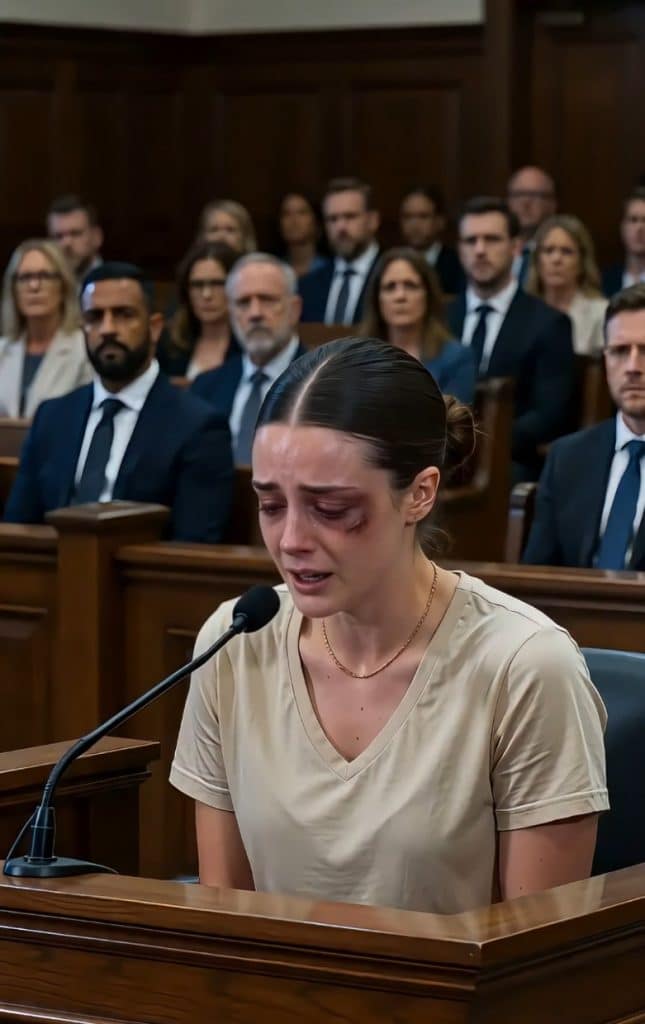
She sat at the witness stand in a plain beige T-shirt, her dark hair pulled into a careful bun that made the bruise around her left eye impossible to miss. The mark was deep purple at the edges, black near the center, ugly under the clean government lights.
Across the room, Marcus Cole watched her from the defense table.
He wore a double-breasted gray suit that probably cost more than Leah’s rent. His tattooed hands rested calmly on the polished wood. His groomed goatee framed a mouth that had learned how to smile without warmth.
Leah looked down once.
Then she forced herself to look up.
“He hit me,” she said, her voice shaking. “I fell. And then he dragged me across the house by my hair.”
A woman in the gallery covered her mouth.
Someone else looked away.
Leah’s shoulders trembled as she tried not to collapse into sobs. She had rehearsed this sentence with the victim advocate in a small room behind the courthouse, whispering it over and over until the words stopped feeling like knives.
But saying it here was different.
Here, Marcus could hear her.
Here, his lawyer could watch her cry.
Here, strangers studied her face like her pain was evidence on a table.
Judge Amara Whitfield leaned forward from the bench, her black robe still, her expression controlled.
“Take your time, Ms. Bell,” she said.
Leah nodded, but she could not take time.
Time was where Marcus lived.
He knew how to stretch it. Twist it. Fill it with doubts. He knew how to make a room wait until the truth felt inconvenient.
So she opened her mouth to continue.
Before she could, Marcus laughed.
Not softly.
Not nervously.
A full, mocking laugh that cracked through the courtroom and made Leah flinch as if the sound had touched her.
He leaned back in his chair, then forward, his cruel half-smile aimed directly at the witness stand.
“You have no proof, Leah,” he said. “You did this to yourself. You’re mentally unstable.”
The words landed exactly where he meant them to.
Leah’s face folded.
Her hands tightened around the edge of the witness desk. For one second, she looked less like a woman testifying in court and more like someone back in that house, back in that room, being told her memory could not be trusted.
Then the gavel struck.
The crack split the air.
“That’s enough!”
Judge Whitfield’s voice filled the courtroom.
Marcus’s smirk vanished.
The judge’s eyes locked onto him with a coldness that made even his attorney go still.
“Mr. Cole,” she said, each word sharp enough to cut through every lie he had brought with him. “Stand.”
Marcus pushed his palms against the table and rose.
For the first time since Leah entered the courtroom, he looked uncertain.
And he should have.
Because the judge had not ordered him to stand just to silence him.
She had ordered him to stand because the truth had finally reached the bench.
Act II
Leah Bell had spent four years learning how to disappear inside her own life.
At first, Marcus had made disappearing feel like being chosen.
He was charming in the loud, expensive way that made other people lean closer. He owned three boxing gyms, sponsored youth sports teams, donated to police fundraisers, and knew every restaurant owner in the city by first name.
When Leah met him, she was working reception at a physical therapy clinic and taking night classes in accounting.
Marcus made her feel seen.
He sent flowers to the clinic. Left notes on her windshield. Remembered tiny details she mentioned only once. He said she was different from the women who wanted him for money or status.
“You’re peaceful,” he told her.
Leah believed that was love.
It took almost a year to realize peaceful meant quiet.
Quiet when he checked her phone.
Quiet when he mocked her clothes.
Quiet when he told her friends were jealous, her sister was toxic, her mother was dramatic, and everyone outside their home wanted to destroy what they had.
By the second year, Leah’s world had narrowed to the size Marcus allowed.
By the third, she no longer argued.
By the fourth, she had memorized every sound in the house: the garage door opening, his keys hitting the bowl, the change in his breathing when he had been drinking, the silence that meant she should not speak first.
Then came the night she called 911 and hung up before saying her name.
She did not think anyone would come.
Someone did.
Officer Daniel Price arrived at 1:42 a.m. and found Leah sitting on the porch steps in the rain, one hand pressed to her face, staring at nothing.
Marcus stood behind her in a robe, calm and irritated.
“She slipped,” he said.
Leah did not contradict him.
Not then.
Fear had trained her too well.
But Officer Price noticed the overturned table inside. The broken lamp. The smear of rainwater and mud where Leah had stumbled out the front door without shoes.
He also noticed the security camera above the porch.
Marcus noticed him noticing.
The next morning, the camera was gone.
So was Leah’s phone.
Marcus drove her to urgent care himself and answered every question before she could. He told the nurse she was embarrassed. He told the doctor she had been under stress. He told Leah in the parking lot that if she tried to ruin him, he would make sure the whole city knew she was unstable.
“You think anyone will believe you over me?” he asked.
Leah did not answer.
Because that was the question that kept victims silent.
Not what happened.
Who will believe it?
Three days later, Leah left while Marcus was at the gym.
She took one backpack, seventeen dollars, and a folder of documents she had hidden behind the air vent in the laundry room.
The folder had photos.
Medical discharge papers.
A copy of a bank statement showing Marcus had drained her savings after she tried to open a separate account.
But it did not have the one thing she needed most.
A recording.
A witness.
Something that could speak when her voice shook.
By the time the hearing arrived, Marcus’s lawyer had already shaped the story.
Leah was unstable.
Leah was jealous.
Leah wanted money.
Leah had caused her own injuries during a breakdown and blamed Marcus out of revenge.
And Marcus, sitting at the defense table in that beautiful gray suit, looked confident because he knew how often confidence passed for innocence.
Leah knew it too.
That was why she cried before she even said the first sentence.
She was not only afraid of Marcus.
She was afraid the truth would not be enough.
But someone else had been listening that night.
Someone Marcus had never thought to threaten.
Act III
Judge Whitfield let Marcus stand in silence for several seconds.
It was not an accident.
Courtrooms have their own weather. Every pause matters. Every movement tells the gallery where power has gone.
For most of the morning, Marcus had acted as if the courtroom belonged to him.
Now he stood because the judge told him to.
His shoulders were squared, but the arrogance had thinned. His attorney, Richard Vale, half-rose beside him.
“Your Honor,” Vale said carefully, “my client’s outburst was inappropriate, but—”
“But?” Judge Whitfield repeated.
Vale stopped.
The judge looked back at Marcus.
“Mr. Cole, this court will not permit intimidation of a witness.”
Marcus swallowed. “I apologize, Your Honor.”
Leah stared at her hands.
She had heard that voice before.
Soft.
Controlled.
The voice Marcus used after breaking something, after shouting, after making her think the worst was over if she would only accept the apology properly.
Judge Whitfield did not soften.
“Do you understand the seriousness of these proceedings?”
“Yes, Your Honor.”
“Do you understand that mocking testimony from a protected petitioner may affect how this court views your compliance and credibility?”
His jaw moved.
“Yes.”
The judge nodded once.
Then she turned to the clerk.
“Bring in the exhibit marked State’s Supplemental One.”
Marcus’s attorney stiffened.
Leah looked up.
She had not heard of a supplemental exhibit.
Neither had Marcus.
The side door opened, and Officer Price entered holding a sealed evidence bag. Beside him walked a woman in a navy coat, small and nervous, with silver hair pinned at the back of her head.
Leah recognized her immediately.
Mrs. Alvarez.
The neighbor from across the street.
The woman who watered her porch plants at sunrise and always waved but never pried.
Leah’s breath caught.
Marcus turned his head slowly.
For the first time, true fear crossed his face.
Not guilt.
Fear of exposure.
Judge Whitfield saw it.
“Mrs. Alvarez,” the clerk said, “please come forward.”
Marcus leaned toward his lawyer, whispering fast.
Vale’s polished expression cracked.
Leah’s heart began pounding so hard she could barely hear.
Mrs. Alvarez took the witness stand with both hands trembling. She did not look at Marcus. She looked at Leah.
“I’m sorry,” she said softly.
Leah’s tears returned, but this time they felt different.
The prosecutor stood.
“Mrs. Alvarez, did you provide law enforcement with video footage from the night of March 14?”
“Yes.”
“Where was the camera located?”
“My front porch. It faces part of the Cole driveway and front steps.”
Marcus’s mouth tightened.
His attorney objected.
Judge Whitfield overruled him.
The courtroom monitor flickered on.
The image was grainy, gray, and timestamped.
Marcus’s house appeared through rain.
For a moment, nothing happened.
Then the front door opened.
Leah stumbled out barefoot, one hand lifted toward her face. She reached for the porch rail and nearly fell. A second later, Marcus stepped into frame behind her.
The footage did not show everything.
It did not need to.
It showed enough.
Marcus grabbing Leah’s arm.
Marcus pulling her back toward the doorway.
Leah twisting away.
Marcus looking up, suddenly aware of the porch camera across the street.
Then the screen went black.
The courtroom sat frozen.
Mrs. Alvarez spoke into the silence.
“My camera lost signal right after that,” she said. “But the audio kept recording to the cloud for another four minutes.”
Marcus closed his eyes.
Leah stopped breathing.
The prosecutor pressed play.
At first, there was only rain.
Then Marcus’s voice, distorted but clear enough to recognize.
Get inside before someone sees you.
Leah’s voice, faint and terrified.
Please don’t.
Then a crash.
Then Marcus again.
No one is going to believe you.
Leah covered her mouth.
The recording ended.
No one moved.
Not the spectators.
Not the attorneys.
Not Marcus.
Judge Whitfield looked down at him from the bench.
“You said she had no proof,” she said.
Marcus stared at the floor.
And Leah realized, with a shock that nearly broke her open, that the room had finally heard what he sounded like when he thought no one was listening.
Act IV
The judge did not shout after the recording played.
That made it worse for Marcus.
Her voice was quiet now, controlled with the kind of anger that did not need volume.
“Mr. Cole, remain standing.”
His attorney whispered something urgently, but Marcus did not answer. His eyes were fixed somewhere between the defense table and the floor, as if he could still find a way to rearrange what everyone had heard.
Judge Whitfield turned to Leah.
“Ms. Bell,” she said, “you may step down for a moment if you need to.”
Leah shook her head.
The movement surprised even her.
Her hands were still shaking. Her face was wet. Her body felt hollowed out by exhaustion.
But she did not want to leave.
Not yet.
For the first time, she wanted to stay in the room where Marcus could not control the story.
The prosecutor approached the bench with a second document.
“Your Honor, in light of the supplemental evidence and the respondent’s conduct in court, the state requests immediate modification of the temporary protective order, GPS monitoring, surrender of firearms through counsel, and revocation of unsupervised contact privileges pending criminal review.”
Marcus’s head snapped up.
“This is ridiculous,” he said.
The judge’s eyes cut to him.
His mouth shut.
Leah almost cried again at the simple sight of it.
Silence.
Not hers.
His.
Vale stood, trying to recover.
“Your Honor, my client has strong community ties, no prior convictions, and there is no allegation of continued contact since the temporary order—”
The prosecutor lifted another page.
“There is, Your Honor.”
Vale went still.
Leah looked confused.
The prosecutor continued.
“Ms. Bell received three anonymous messages this week from a prepaid number. Digital forensics traced the device purchase to a convenience store two blocks from Mr. Cole’s gym.”
Marcus laughed once, but it came out wrong.
Weak.
“Anyone could buy a phone.”
Officer Price stepped forward.
“The store camera shows Mr. Cole purchasing it.”
A murmur moved through the gallery.
Judge Whitfield struck the gavel once.
The room quieted.
Leah’s body went cold.
She had received those messages at the shelter.
You look tired.
Court won’t save you.
Smile for the judge.
She had told herself maybe it was someone else. Maybe Marcus would not risk it. Maybe she was being paranoid the way his lawyer said she was.
But now the paranoia had a receipt.
Marcus’s attorney put a hand to his forehead.
The judge looked at Marcus for a long moment.
Then she said, “Mr. Cole, you will be remanded pending review for violation of the temporary order and witness intimidation.”
Marcus’s face changed completely.
The handsome, controlled mask fell away.
“You can’t do that,” he said.
“I just did.”
His voice rose. “This is insane. She’s lying. She’s been lying since the beginning.”
Leah flinched, but less than before.
The bailiff stepped behind Marcus.
Judge Whitfield leaned forward.
“Mr. Cole, I strongly suggest you stop speaking.”
He looked at Leah then.
Really looked.
Not with charm. Not with apology.
With hatred.
The look lasted only a second before the bailiff moved between them, but Leah felt it.
So did the judge.
“Let the record reflect,” Judge Whitfield said, “that the respondent directed a hostile stare toward the petitioner after being ordered to remain silent.”
Marcus’s face flushed.
For years, he had ruled rooms by making other people doubt what they saw.
Now a judge was naming it in real time.
The bailiff took his arm.
Marcus resisted just enough to make the gallery draw in a collective breath, then thought better of it. His hands curled into fists at his sides, tattooed knuckles stark against the gray of his suit.
Leah watched him being led away from the defense table.
The chair where he had laughed sat empty.
For the first time in four years, he was the one leaving a room before he was ready.
But the victory did not feel clean.
It felt like breathing after nearly drowning.
And when the courtroom doors closed behind him, Leah finally let herself fall apart.
Act V
The court did not erupt.
Real justice rarely looks like applause.
It looks like paperwork. Orders signed in black ink. A clerk stamping pages. A bailiff standing near the door. A woman at the witness stand trying to remember how to breathe now that nobody is laughing at her pain.
Leah stepped down slowly.
Her knees nearly failed before she reached the prosecutor’s table. The victim advocate, Dana, wrapped an arm around her without saying the empty things people say when they want suffering to become smaller.
You’re okay.
It’s over.
Be strong.
Dana said none of that.
She only said, “I’m right here.”
Leah nodded into her shoulder and cried.
Across the courtroom, Mrs. Alvarez remained seated in the witness chair, twisting a tissue in her hands.
Leah pulled away from Dana and walked to her.
The older woman stood immediately.
“I should have come sooner,” Mrs. Alvarez said.
Leah shook her head.
“You came.”
That was all.
Sometimes survival depends on someone doing the right thing late rather than never.
Mrs. Alvarez’s eyes filled.
“I heard him that night,” she whispered. “I was afraid. He knows my son. He knows where my grandchildren go to school. I kept telling myself the police would handle it.”
Leah reached for her hand.
Marcus would have wanted Leah to hate her.
That was how men like him survived: by making victims turn on every imperfect person around them instead of the person who caused the fear.
But Leah was too tired for borrowed hatred.
“You saved me today,” she said.
Mrs. Alvarez covered her mouth and sobbed.
Judge Whitfield had already left the bench, but before she disappeared into chambers, she paused and looked back at Leah.
Not with pity.
With recognition.
There is a difference.
Pity looks down.
Recognition stands beside.
The next weeks did not become easy just because the courtroom believed her.
Marcus’s friends posted careful statements about “false accusations” and “due process.” His gyms released a message about temporary leave. Strangers online studied Leah’s face and decided what kind of woman they thought she was.
But the legal ground beneath her had changed.
The protective order became permanent.
The intimidation charge moved forward.
The recording from Mrs. Alvarez’s porch led investigators to recover more evidence from Marcus’s house, including the damaged security system he thought he had destroyed. His prepaid phone connected him to the threats. His own voice did what Leah had feared hers could not.
It proved him.
Not all at once.
But enough.
Leah moved into a small apartment on the third floor of a building with yellow hallway lights and a landlord who fixed the locks the same day she asked. She bought a secondhand couch, three plates, and a blue kettle that screamed when the water boiled.
The first night there, she slept on the floor because the bed had not arrived.
She woke at 2:00 a.m. in a panic, certain she had heard Marcus’s keys.
There were no keys.
Only the radiator clicking.
Only traffic outside.
Only her own heart trying to learn that quiet did not always mean danger.
Healing came slowly.
It came in court dates she survived.
It came in therapy sessions where she said things aloud without apologizing.
It came the first time she looked in the mirror and saw the bruise fading from purple to yellow to nothing.
The skin healed before the fear did.
But both changed.
Months later, Leah returned to the courthouse for a final hearing.
She wore a navy dress Dana helped her choose. Her hair was down this time. No bruise. No trembling hands around the witness desk.
Marcus entered in a cheaper suit than before.
His goatee was still groomed. His tattoos still covered his hands. But the shine had gone out of him. He no longer looked like a man who owned every room.
He looked like a man who had been recorded.
When Leah gave her statement, her voice shook only once.
“I used to think proof meant I had to make people see every moment exactly as it happened,” she said. “But proof also means patterns. Messages. Medical records. Witnesses. The sound of someone telling you no one will believe you.”
She looked toward the judge.
“And proof means I’m still here.”
Judge Whitfield listened without interrupting.
This time, Marcus did not laugh.
He did not smirk.
He did not call her unstable.
He sat silent because the courtroom had finally become a place where his performance no longer worked.
When the hearing ended, Leah walked out through the front doors into bright afternoon light.
Mrs. Alvarez waited on the steps with a small paper bag.
Inside was a muffin from the bakery across the street.
“I didn’t know what people bring after court,” she said nervously.
Leah laughed.
It startled them both.
Then they sat together on the courthouse steps while traffic moved below and strangers walked past without knowing that a life had just shifted.
Leah tore the muffin in half and handed part to Mrs. Alvarez.
For a while, they ate in silence.
Not tense silence.
Not frightened silence.
The other kind.
The kind that leaves room for tomorrow.
Leah would still have hard days. She knew that. There would be moments when a slammed door made her body remember. There would be nights when freedom felt too quiet. There would be people who asked why she stayed and people who asked why she left and people who believed cruelty always announces itself honestly.
But she would also remember the gavel.
The crack of wood against wood.
The judge’s voice cutting through Marcus’s laughter.
Mr. Cole, stand.
She would remember him rising because, for once, someone with power had ordered him to stop hiding behind it.
And she would remember the moment the recording played.
The moment his own words entered the courtroom and refused to leave.
Marcus had told her no one would believe her.
But the truth had been listening.
And when it finally spoke, the whole room stood still.