Act I
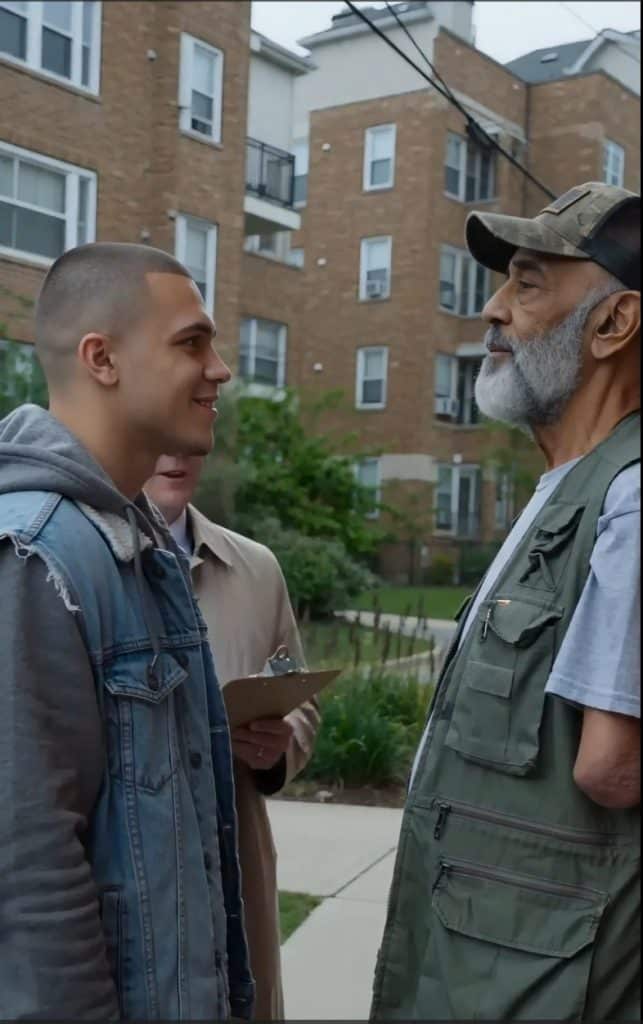
The young man slammed Sam against the brick wall hard enough to shake dust from the mortar.
For a second, the whole sidewalk seemed to hold its breath.
Sam’s back hit first. Then his shoulder. His camouflage cap tilted low over his weathered face, but he did not cry out. He did not swing back. He did not even lift his one remaining arm to defend himself.
He only looked at the boy in front of him.
Calm.
Unblinking.
That made the boy angrier.
“You deaf, old man?” the bully snapped, grabbing Sam’s green utility vest and bunching the fabric in both fists. “He asked you a question.”
A few feet away, a middle-aged man in a tan trench coat stood with a clipboard pressed to his chest. His glasses caught the gray daylight. He wore the kind of smile that never reached the eyes.
His name was Martin Voss, and he had been speaking to Sam like Sam was a problem to be removed from a file.
Not a man.
Not a veteran.
Not someone who had given pieces of himself to a country that now sent a bureaucrat to his doorstep.
Sam’s missing left arm was visible beneath the worn sleeve of his gray T-shirt. His beard hung long and silver against his chest. His jeans were faded at the knees. His boots had been polished years ago, then repaired too many times to pretend at pride.
But his eyes were steady.
The bully hated that too.
Voss glanced at his clipboard. “As I was saying, Mr. Whitaker, the pension appeal has been denied. Your housing assistance has also been frozen pending review.”
Sam said nothing.
The bully leaned closer. His buzz cut made his face look sharper, meaner. His denim vest hung open over a gray hoodie, and his black work boots were planted wide like he owned the pavement.
Voss sighed theatrically.
“Your pension is gone, old man,” he said. “Someone like you doesn’t need to be fussing over paperwork.”
That was when Sam’s hand moved.
Not toward the bully.
Not toward Voss.
Toward the small gold challenge coin hanging from a worn leather cord around his neck.
The bully saw it.
“What’s that?” he said.
Sam’s fingers closed around the coin.
For the first time, something in his face changed.
Not fear.
Protection.
The bully snatched it before Sam could stop him.
The cord broke.
The coin flashed once in the cloudy daylight before hitting the sidewalk with a sharp metallic clink. It bounced twice, spun near the curb, and settled face-up on the concrete.
Sam looked down.
The bully looked down too.
Then he smiled.
He lifted his boot and stomped on it.
The scrape of metal against pavement was small, but it sounded louder than every insult that came before it.
Sam’s jaw tightened.
Voss did not stop the boy.
He did not even pretend to.
The bully ground the coin under his sole. “Looks like trash to me.”
Sam slowly raised his head.
For the first time, his eyes left the coin and moved past the bully, past Voss, toward the gray street.
A low engine rumble was building in the distance.
Sam took one slow breath.
Then he said, “Son, you better look at the road.”
The bully smirked.
But the sound was getting closer.
And Sam already knew who was coming.
Act II
People in the apartment complex thought they knew Sam Whitaker.
They knew the old man in 2B who took his trash out every Thursday morning at exactly seven. They knew the one-armed veteran who fed stray cats behind the building and carried groceries for Mrs. Alvarez even though she begged him not to.
They knew he sat alone on the bench near the sidewalk in the afternoons, a thermos beside him, his old cap pulled low, watching traffic like he was waiting for someone who never came.
They knew he was quiet.
They mistook that for weakness.
Sam had been many things before he became the old man in 2B.
He had been Staff Sergeant Samuel Whitaker of the United States Army. He had been a mechanic, a field instructor, a convoy lead, and the kind of soldier younger men trusted because he never shouted unless shouting could save a life.
Thirty-one years earlier, in a desert no one in the apartment complex could find on a map, Sam had pulled three men from a burning transport after an ambush cut the road in half.
One of those men was Captain Elias Dorne.
Captain Dorne had been young then. Bleeding, stunned, too proud to understand he was dying. Sam had dragged him through smoke, heat, and chaos with one arm already badly injured, refusing to let go even when the vehicle shifted behind them.
By morning, Sam’s left arm was gone.
By afternoon, Captain Dorne was alive.
Sam never told that story.
Other people did.
Commanders. Medics. Men who wrote letters home and said Whitaker was the reason they still had hands to hold their children. But Sam kept only one object from that day.
A gold challenge coin.
Dorne had pressed it into Sam’s palm in a field hospital, still pale and barely able to sit upright.
“You ever need anything,” Dorne had said, voice raw, “you show this.”
Sam had laughed softly because men in pain often said dramatic things.
But Dorne had not been joking.
The coin bore a unit crest on one side and a serial engraving on the other. Not valuable to a pawn shop. Not impressive to a thief. But to men who understood what it meant, it was heavier than gold.
It meant debt.
It meant memory.
It meant a promise made before rank, age, politics, and paperwork had time to bury it.
For decades, Sam never used it.
He came home, married a nurse named Clara, learned to button shirts one-handed, and rebuilt his life with quiet stubbornness. He worked at a machine shop until his back gave out. He coached Little League badly but with enthusiasm. He danced with Clara in their kitchen every anniversary, even after his knees started warning him about weather.
Then Clara died.
After that, Sam’s world narrowed.
Bills stacked up. Appointments multiplied. The pension checks that had arrived steadily for years began arriving late, then short, then not at all. Every call led to a menu. Every menu led to a department. Every department led to a different form.
Sam filled them out.
Then filled them out again.
Then Martin Voss appeared.
Voss introduced himself as a benefits liaison contracted through a veterans housing review program. He was smooth, polite, and always sorry for the inconvenience. He told Sam the missing pension payments were likely administrative. He told Sam he would “clean it all up.”
Instead, the letters got worse.
Sam’s medical supplement was flagged. His housing assistance was questioned. A notice arrived claiming inconsistencies in his records. Another claimed Sam had failed to provide documents he had mailed three times.
Then came the threat of eviction.
That was when Sam began to suspect the truth.
Not error.
Theft.
Voss had access to old veterans, outdated systems, and men too proud to ask for help until it was almost too late. He knew which forms confused them. Which deadlines could be manipulated. Which benefits could be redirected and blamed on missing paperwork.
But Sam was not as alone as Voss thought.
He had found the old coin in Clara’s jewelry box two nights earlier, wrapped in tissue beside her wedding ring.
A note lay with it in Clara’s handwriting.
Sam, pride is not the same as strength. Call the man who owes you his life.
So Sam had made the call.
He did not ask for money.
He did not ask for revenge.
He only left one message with a young officer who sounded too polite to believe him.
“Tell General Dorne,” Sam said, “Whitaker still has the coin.”
Then he hung up.
The next morning, Voss came to the apartment complex with a clipboard and a bully.
And by the time the engines reached the street, Sam understood that the promise from thirty-one years ago had not been forgotten.
Act III
The first black Suburban took the corner too fast.
Its tires screeched against the asphalt, and the bully’s smile died before he even understood why.
The second vehicle pulled in behind it.
Then a third.
All three stopped along the curb with the precision of something practiced, official, and deeply unwelcome to men like Martin Voss. The quiet residential street suddenly filled with engine noise, closing doors, and the hard stillness of authority arriving without asking permission.
Voss clutched his clipboard.
The bully stepped off the coin.
Sam did not move.
He stayed beside the brick wall, his broken leather cord hanging loose from his neck, his face composed in a way that made the moment feel less like rescue and more like judgment finally catching up.
The lead Suburban’s door opened.
A polished black shoe stepped onto the pavement.
Then another.
The man who emerged was tall, older, and dressed in a full Army Service Uniform decorated with medals and ribbons that caught what little light the gray day offered. A white peaked officer’s cap sat squarely on his head. His face was lined, but his posture was straight enough to make every person on that sidewalk correct their own without thinking.
General Elias Dorne took one look at Sam.
Only one.
The years between them seemed to collapse.
For a fraction of a second, his command face cracked.
“Sam,” he said quietly.
The bully swallowed.
Voss looked between them, trying to rebuild his confidence out of nothing.
“General,” Voss began, “I’m sure there has been some misunderstanding—”
Dorne did not look at him.
His eyes dropped to the sidewalk.
To the gold coin.
Scuffed.
Dirty.
Still face-up.
The General’s expression went cold.
He turned to the bully.
“Pick that up,” he said. “Now.”
The command was not loud in the way angry men are loud.
It was worse.
It had the weight of every rank behind it, every battlefield, every funeral, every oath the bully had never understood and Voss had tried to exploit.
The young man looked at Voss.
Voss said nothing.
“Now,” Dorne repeated.
The bully bent so fast he nearly stumbled.
His fingers shook as he picked up the coin. Dirt clung to its edge. He tried to wipe it on his hoodie, but Dorne’s voice stopped him.
“Don’t.”
The bully froze.
“Hand it to him properly.”
The bully turned toward Sam.
For the first time, he looked at the old man like a man.
Not an inconvenience.
Not a target.
A man.
He held out the coin.
Sam took it with his right hand.
His fingers closed slowly around the metal.
Dorne stepped closer, his polished shoes stopping just short of the spot where the bully had stood.
“Do you know what you stepped on?” he asked.
The bully opened his mouth.
No sound came out.
Dorne’s jaw tightened. “That coin was given to the man who pulled me out of a transport while he was losing his arm.”
The sidewalk went silent.
A curtain shifted in an apartment window above them. Someone had been watching. Maybe more than one someone. People always watched when cruelty was public. They just often waited for someone else to decide whether it mattered.
Dorne turned to Voss.
“And you,” he said, “were told to make sure his pension appeal was processed correctly.”
Voss paled.
The clipboard dropped slightly in his hands.
“I followed all appropriate procedures.”
Dorne looked at the man beside him, a younger officer holding a sealed folder.
“Colonel.”
The officer opened the folder and removed a stack of printed records.
“Preliminary review indicates Mr. Whitaker’s benefits were not denied,” the colonel said. “They were diverted through a third-party administrative account tied to Mr. Voss’s office.”
Voss’s mouth tightened.
“That is a serious accusation.”
Dorne finally faced him fully.
“No,” he said. “That is the polite version.”
The bully looked like he wanted to run.
Sam looked down at the coin in his hand.
Thirty-one years ago, it had been a promise.
Today, it had become evidence.
Act IV
Voss tried to recover by becoming louder.
Men like him often did.
“This is completely inappropriate,” he said, his voice rising. “I am a contracted official conducting a lawful review. Mr. Whitaker’s records contain irregularities, and I will not be intimidated by a theatrical entrance.”
Dorne let him finish.
That made it worse.
When Voss ran out of breath, the General spoke with frightening calm.
“Your review was suspended at 0800 this morning.”
Voss blinked.
“What?”
“Your access was frozen. Your accounts were flagged. Your office is being searched.”
The clipboard trembled once.
Only once.
But everyone saw it.
The colonel handed another document to Dorne. The General did not need to read it. He already knew.
“You targeted veterans with limited family support,” Dorne said. “You delayed claims, redirected payments, created false deficiency notices, and pressured them into signing away assistance they had earned.”
Voss looked toward the Suburbans.
Two federal agents had stepped out of the second vehicle.
Plain clothes.
Badges visible.
No drama.
No shouting.
Just inevitability.
The bully took another step back.
Sam saw it and spoke for the first time since the coin had been returned.
“Don’t run, son.”
The young man stopped.
The word son had no affection in it, but no hatred either. That somehow made it more devastating.
Dorne looked at him. “Name.”
The bully swallowed. “Ryan. Ryan Voss.”
Sam’s eyes moved from the boy to the official.
Of course.
The cruelty had come as a family business.
Ryan had not been a random thug. He was Voss’s nephew, hired under the table to “assist with removals,” intimidate tenants, and make old men feel unsafe enough to leave without forcing a court order.
Voss snapped, “Ryan, don’t say anything.”
Dorne’s stare cut toward him.
“You’ve done enough speaking for people today.”
One of the agents approached Voss. The other began asking Ryan questions in a quiet voice that frightened him more than shouting ever could.
Across the sidewalk, apartment doors opened.
Mrs. Alvarez came out first, one hand over her mouth. Then Mr. Bennett from 1C. Then the young mother from the upstairs unit who had once asked Sam to fix her stroller wheel and cried when he refused money.
They gathered slowly, ashamed of how much they had seen and how little they had done.
Sam noticed.
He did not judge them.
That was almost worse.
Dorne stepped beside him.
For a moment, the General was not a General. Sam was not an old man against a wall. They were two soldiers again, standing in the aftermath of a thing that should never have happened.
“You should have called sooner,” Dorne said quietly.
Sam gave a tired half-smile. “Clara used to tell me the same thing.”
Dorne’s face softened at her name.
“She was right.”
“She usually was.”
The General looked down at Sam’s missing arm, then back at his face.
“I’m sorry,” he said.
Sam knew what apology he meant.
Not just for today.
For the years of forms. For the offices that lost him. For every system that thanked him in speeches and failed him in practice. For the country remembering its heroes best when cameras were near.
Sam closed his fingers around the coin.
“You came,” he said.
Dorne nodded once.
“Yes.”
Behind them, Ryan’s voice cracked as he answered the agent. Voss tried to interrupt again and was told, firmly, that he should remain silent. His clipboard was taken from his hands. Without it, he looked smaller. Just a man in a trench coat with no moral weight left to hide behind.
Dorne turned back to Ryan.
“You put your boot on that coin,” he said.
Ryan’s face went red. “I’m sorry.”
Sam watched him.
The apology came too quickly. It was fear, not understanding.
Dorne heard it too.
“No,” the General said. “You’re scared. That is not the same thing.”
Ryan’s eyes dropped.
Dorne pointed at the sidewalk where Sam’s papers from the morning were scattered beside the wall.
“You will pick up every page you knocked from his folder. You will hand them to him. Then you will sit down and wait for the agents to finish.”
Ryan hesitated.
Dorne’s voice hardened. “Move.”
This time, Ryan obeyed.
One page.
Then another.
Benefit forms. Medical records. Appeals. Copies of letters Sam had mailed and remailed until the creases wore soft. Each one had a date. A signature. A life interrupted by someone else’s greed.
Ryan gathered them in silence.
When he handed them to Sam, his hands were shaking.
Sam took the papers.
Then he looked at the boy and said, “Remember this feeling.”
Ryan looked up.
Sam’s voice was low.
“The moment you realize the man you tried to make small was never beneath you.”
Ryan had no answer.
Neither did Voss.
Act V
By sunset, the sidewalk was quiet again.
The Suburbans were gone. Voss was gone. Ryan was gone. The scuffed coin was back in Sam’s hand, though the leather cord was broken beyond repair.
Sam sat on the bench outside the apartment complex while General Dorne stood beside him with his cap tucked beneath one arm.
Neither man spoke for a while.
The brick building behind them looked ordinary again. Parked cars lined the street. Bare trees shivered in the wind. Somewhere upstairs, a television murmured through a half-open window.
Ordinary life had returned with astonishing speed.
That was what always unsettled Sam after violence.
How quickly the world pretended it had not happened.
Dorne finally sat beside him.
“You’re being moved to priority restoration,” he said. “Back pay, medical supplement, housing protection, all of it. The fraud unit will contact you directly. Not through contractors.”
Sam looked at him. “Sounds like paperwork.”
“It is.”
“Always hated paperwork.”
Dorne almost smiled. “I remember.”
Sam rolled the coin across his knuckles with practiced care. The motion was slower than it used to be, but still smooth.
“You kept it,” Dorne said.
“Clara kept it,” Sam corrected. “I just wore it when she told me to stop being a stubborn fool.”
“She saved us both trouble, then.”
“She had a talent for that.”
Dorne looked at the building.
“Do you want to stay here?”
Sam followed his gaze.
The apartment was small. The pipes knocked in winter. The upstairs neighbor played music too loud on Fridays. The elevator had been broken so many times that Sam had memorized the stairs by feel.
But it was his.
Clara’s photo was on the dresser. Her blue mug was still in the cabinet. The window caught morning light the way she had loved. The stray cats knew which porch belonged to him.
“Yes,” Sam said.
Dorne nodded. “Then you stay.”
Simple words.
Late words.
But they settled something in Sam’s chest.
The next week, the story spread farther than Sam wanted.
A local reporter came by. Then a veterans’ advocacy group. Then a district attorney with careful questions and a face that tightened more with every document Sam handed over.
Other veterans began calling.
Men and women Sam had seen in waiting rooms. People who thought they were alone with missing checks, frozen claims, denied supplements, and letters that made them feel foolish for asking what they had earned.
They were not alone anymore.
Voss had counted on silence.
He had forgotten that silence can break.
Ryan accepted a plea later, agreeing to testify. Sam did not follow every legal turn. He let the lawyers and agents do what they did. He had no appetite for watching a young man’s fear become headlines.
But one afternoon, a letter arrived.
No return address.
Inside was a single sentence.
I did not know what that coin meant, but I knew enough to know I was wrong.
Sam read it twice.
Then he placed it in a drawer.
Not forgiven.
Not discarded.
Just held somewhere between justice and time.
General Dorne visited again in the spring.
No motorcade.
No uniform.
Just an old friend in a navy jacket, carrying a small box.
Sam opened it at the kitchen table.
Inside was a new leather cord for the challenge coin, dark brown and braided by hand. Beside it lay a small polished stand with a brass plate.
Staff Sergeant Samuel Whitaker
He carried men home.
Sam stared at it for a long time.
Dorne cleared his throat. “Too much?”
Sam’s eyes shone, though his voice stayed dry.
“You always were dramatic.”
“Says the man who called me using a thirty-one-year-old coin.”
“Clara made me.”
“Then I stand corrected.”
Sam laughed.
It surprised them both.
That evening, after Dorne left, Sam sat by the window with the coin resting on the table beside him. The scuff from Ryan’s boot had not fully come out. A faint mark remained across the edge of the crest.
Sam had refused to polish it away.
Some marks deserved to stay.
Not because they ruined a thing.
Because they proved what it survived.
Outside, the sidewalk lay damp under the gray sky. A young mother pushed a stroller past the brick wall. Mrs. Alvarez waved from the curb. Mr. Bennett nodded as he carried groceries inside.
People looked at Sam differently now.
He wished they had not needed a General to do it.
But he accepted their kindness when it came, because Clara had been right about pride. It was not the same as strength.
Strength was asking for help before the fall.
Strength was standing still when someone tried to humiliate you.
Strength was letting the truth arrive in its own time and not becoming cruel while waiting for it.
Sam picked up the coin and turned it toward the window.
For years, he had thought it was a memory of the man he used to be.
Now he understood it differently.
It was not proof that he had once mattered.
It was proof that he still did.
And when the evening light caught the worn gold, the old soldier smiled softly, closed his fingers around it, and let the quiet room feel like home again.