Act I
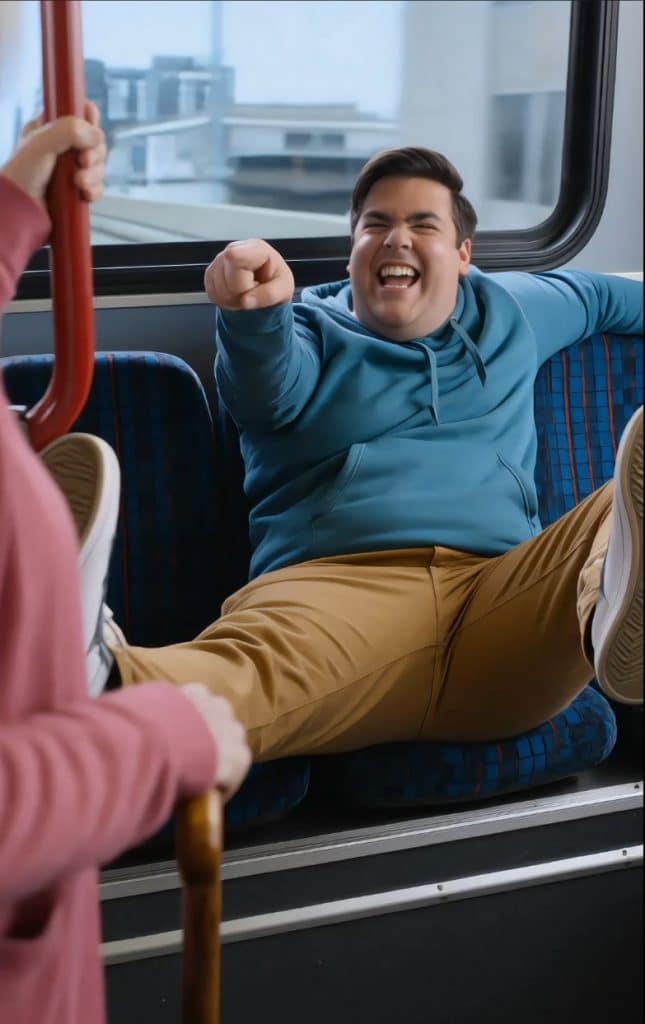
The young man had his sneaker planted on the empty seat like it belonged there.
His bright yellow trousers were impossible to miss, stretched across the aisle as he lounged in his dark teal hoodie, grinning as if the entire bus had been built for his amusement. The morning route rolled through downtown traffic, windows flashing with blurred storefronts and gray office towers, while the engine hummed beneath the tired silence of commuters.
Then he laughed.
Loudly.
“My leg is sitting here!” he said, pointing at the seat beside him.
A few passengers looked up.
Most looked away.
Standing beside the blocked seat was an elderly woman in a pale pink coat, her white hair neatly styled, one hand gripping a red support pole and the other curled around the handle of a wooden cane. She had asked quietly, almost apologetically, if she could sit.
The bus had lurched when it turned.
Her cane had slipped half an inch.
That was when he made the joke.
Now she stood frozen, staring at the sneaker on the seat as if she could not quite understand why someone would choose cruelty over something so simple.
“Come on,” he said, still laughing. “You don’t see my leg? It got here first.”
A canned laugh from someone’s phone burst through the bus.
It was sharp, fake, and ugly.
The elderly woman’s fingers tightened around the pole. Her mouth opened slightly, then closed. She did not argue. She did not scold. She did not demand respect.
She simply lowered her eyes.
That made it worse.
The young man leaned back, searching the bus for approval. He found none, but he mistook silence for permission.
So he kept smiling.
Then a woman standing near the middle aisle turned toward him.
She was young, maybe twenty-five, with long dark hair, a dark green top, and the kind of stillness that came right before a storm. She had been holding the overhead rail, watching the whole thing unfold with disbelief hardening into anger.
The fake laughter stopped.
The bus seemed to shrink around her voice.
“Why is he treating this poor old woman like that?”
No one answered.
The old woman looked toward her, startled, as if help was a language she had not expected to hear that morning.
The young man’s grin twitched.
“What’s your problem?” he muttered.
The woman did not move.
“My problem,” she said, “is that everyone on this bus saw her almost fall, and you decided the funniest thing in the world was making sure she had nowhere to sit.”
The bus went quiet.
One by one, passengers turned toward him.
He looked around, expecting at least one person to laugh with him.
No one did.
And for the first time since the elderly woman had stepped onto the bus, the young man realized he was the one being watched.
But the real reversal had not even begun.
Act II
Her name was Margaret Wells.
Most people on the bus did not know that.
To them, she was just another old woman boarding at the courthouse stop with a cane, a coat buttoned carefully to the neck, and a small handbag pressed against her side. The city was full of older women like her, moving slowly through a world that had become too loud, too fast, too impatient to make space for them.
But twenty-eight years earlier, Margaret had owned that route.
Not legally.
Not officially.
But every driver knew her.
Every regular knew her.
Route 14 had been her line for thirty-two years.
She had driven it through snowstorms, construction detours, transit strikes, summer heat, and school mornings when children packed the aisle with backpacks bigger than their shoulders. She knew who worked early shifts at the hospital. She knew which old men pretended they were not lonely but rode two extra stops just to talk. She knew which teenagers needed watching and which ones just needed someone to say, “You alright today?”
Margaret had never thought of herself as heroic.
She drove a bus.
That was all.
But a bus, she used to say, was not just a machine. It was a room moving through people’s lives. On any given morning, grief sat beside joy. A man going to his first job sat behind a woman going to her last appointment. A child with untied shoes sat across from someone who had not spoken to anyone in days.
“You drive carefully,” she once told a trainee, “because everyone on board is carrying something.”
She had carried plenty herself.
A husband lost too young. A daughter who moved three states away. A body that began to ache before her spirit was ready. Bills. Bad knees. A city that slowly forgot the workers who had kept it moving.
Still, every year on the anniversary of the Route 14 bridge accident, Margaret rode the bus.
She never told strangers why.
Twenty years ago, a delivery truck had run a red light during a rainstorm and clipped the front of her bus near the old river bridge. The bus skidded, slammed sideways, and stopped with its front wheels hanging over the barrier.
There had been twenty-three passengers inside.
Two were children.
One was a pregnant woman.
One was a young mother holding a baby wrapped in a blue blanket.
Margaret’s leg was injured in the crash. Her shoulder never healed correctly. But she kept the doors closed until the bus stopped rocking, kept her voice calm, and got every passenger out through the rear emergency exit before the front end slipped any farther over the edge.
The papers called her brave.
The city gave her a plaque.
The transit union sent flowers.
Then life moved on, as it always does after applauding someone for surviving something that still hurts.
Margaret kept driving for another decade before her injuries forced her into retirement. The cane came later. So did the careful way she climbed steps. So did the humiliation of asking for a seat and feeling like she had asked for too much.
That morning, she was not riding for nostalgia.
She was going to the hospital.
Her old friend from the bus depot, Lionel Harris, was dying.
Lionel had been the dispatcher on duty the day of the bridge accident. He was the first voice on the radio after the crash, the one who kept saying, “Maggie, stay with me. Help is coming.”
Now she had received a call from his daughter before sunrise.
If you want to see Dad, come today.
Margaret had dressed in her pink coat because Lionel always teased her for wearing dark colors.
She had taken the cane because pride did not keep a person standing when the bus turned too sharply.
She had boarded Route 14 with a heart already heavy.
Then a young man decided her need for a seat was entertainment.
Act III
The defender’s name was Lena Ortiz.
She had not planned to get involved.
That was what shamed her most afterward.
When the elderly woman first stepped onto the bus, Lena had noticed her cane. She had noticed the careful way the woman looked for a seat. She had noticed the young man’s sneaker stretched across the blue patterned fabric.
And for two seconds too long, Lena had waited for someone else to speak.
Maybe the driver would notice.
Maybe the man would move.
Maybe the woman would ask louder.
That was how public cruelty survived, Lena realized. Not because everyone approved of it. Because everyone waited for someone else to interrupt it first.
Then the old woman’s face changed.
Not dramatically.
Just a small fading behind the eyes.
That was what pushed Lena forward.
“Move your leg,” she said.
The young man stared at her.
“Excuse me?”
“You heard me.”
Passengers shifted in their seats. A man near the back lowered his phone. A nurse in scrubs leaned into the aisle. An office worker removed one earbud.
The young man scoffed, but his confidence had already begun to loosen.
“Why don’t you give her your spot?” he said. “You’re standing.”
Lena looked at the seat beneath his sneaker.
“Because that spot is empty.”
“It’s not empty. I told you. My leg is sitting there.”
This time, nobody laughed.
The old woman whispered, “Please, it’s alright.”
Lena turned to her, softening for the first time.
“No, ma’am,” she said. “It isn’t.”
The bus braked gently at a light.
Margaret swayed.
Three people reached out at once.
The young man saw it, saw the whole bus notice what his joke had done, and his face flushed.
“Everybody’s so sensitive,” he muttered.
A voice from the front said, “No. Everybody’s just tired of people acting ugly.”
The driver looked into the mirror.
His name was Samir Khan, and he had been driving Route 14 for fifteen years. He had seen fights, tears, sleeping students, spilled coffee, broken strollers, panic attacks, proposals, and once a man carrying six birthday balloons that blocked half the aisle.
He had also seen cowardice.
Not the dramatic kind.
The everyday kind.
The kind that looked like pretending not to hear.
Samir guided the bus to the curb and pulled the brake.
The sudden stop made everyone look up.
The young man blinked. “Why are we stopping?”
Samir stood, turned, and looked down the aisle.
“Because this bus doesn’t move until she sits down.”
The entire vehicle went silent.
The young man stared at him, his sneaker still on the seat.
Samir’s voice stayed calm.
“Move your foot.”
For a moment, the young man looked like he might refuse.
Then the passengers turned fully toward him.
Not just Lena now.
All of them.
The nurse. The office worker. The father with a toddler. The college student in headphones. The construction worker with paint on his boots. The woman holding grocery bags. A dozen ordinary people, all suddenly unwilling to look away.
The young man pulled his foot down.
The seat fabric sprang back, wrinkled and dirty where his sneaker had been.
Margaret did not sit immediately.
She looked at the seat.
Then at the young man.
Then at Lena.
Her face was pale, but her voice was steady.
“Thank you,” she said.
Lena stepped forward and wiped the seat with a tissue from her bag.
Only then did Margaret lower herself carefully, one hand on the pole, one hand on Lena’s arm.
The bus exhaled.
But as Margaret sat, the sleeve of her pink coat shifted.
A small medal pinned inside the lapel caught the light.
Samir saw it first.
His expression changed.
“Mrs. Wells?” he asked.
Margaret looked up.
The driver’s voice dropped.
“Margaret Wells?”
And just like that, the rude young man discovered he had mocked the most respected passenger Route 14 had ever carried.
Act IV
Samir walked down the aisle slowly.
His eyes stayed on the medal.
It was old, no bigger than a coin, with the city seal worn smooth around the edges. Most passengers would not have recognized it. Samir did because a framed copy of the same medal hung in the driver break room downtown.
For distinguished courage in public service.
Margaret Wells. Route 14.
Samir stopped beside her seat.
“I trained under a man named Lionel Harris,” he said quietly. “He told me about you.”
Margaret’s eyes filled at the name.
“I’m on my way to see him.”
Samir’s face softened.
The bus seemed to listen.
“He said you saved twenty-three people on the bridge,” Samir continued. “He said you kept your voice calm while the front of the bus was hanging over the river.”
The young man in yellow trousers went very still.
Margaret lowered her gaze.
“I did my job.”
“No,” Samir said. “You did more than that.”
The nurse near the back stood.
“I remember that accident,” she said. “My mother talked about it for years.”
A man by the window lifted his head slowly.
“Wait,” he said. “That was you?”
Margaret’s fingers tightened around her cane, but this time not from humiliation.
From the pressure of being seen.
Lena sat down in the seat across from her.
“You never said anything,” she said gently.
Margaret gave a tired little smile.
“People don’t always ask old women who they were before the cane.”
That sentence landed harder than any shout could have.
The young man swallowed.
His eyes darted around the bus again, but now the judgment had changed shape. It was no longer simply about bad manners. It was about the carelessness of assuming a person’s frailty erased their life.
Samir turned toward him.
“What’s your name?”
The young man hesitated.
“Tyler.”
“Tyler,” Samir said, “look at her.”
Tyler did not.
Samir waited.
Finally, Tyler lifted his eyes.
Margaret met his gaze.
Not cruelly.
That made it worse.
“You thought I was funny,” she said.
Tyler’s mouth opened, but nothing came.
“You thought needing help made me small,” she continued. “One day, if you are lucky, you will live long enough to need help too.”
The bus remained silent.
Margaret’s voice did not shake now.
“And when that day comes, I hope someone treats you better than you treated me.”
Tyler looked down.
For the first time, the bright yellow trousers no longer looked bold.
They looked childish.
“I’m sorry,” he muttered.
Lena’s eyes narrowed.
Margaret raised one hand slightly, stopping her.
She looked at Tyler.
“Say it like you mean it.”
His face flushed deeper.
He looked up again.
“I’m sorry,” he said, louder. “I was being stupid. And cruel.”
Margaret nodded once.
She did not smile.
Forgiveness was not a performance she owed the bus.
Samir returned to the driver’s seat, but before releasing the brake, he spoke over his shoulder.
“Mrs. Wells needs to reach St. Anne’s Hospital. We’re already behind, but I think we can all agree this bus can afford two minutes of decency.”
A few passengers murmured yes.
Then the toddler near the front began to clap.
Softly at first.
His father tried to stop him, embarrassed, but then the nurse joined. Then the construction worker. Then Lena. Within seconds, the bus filled with applause—not loud and theatrical, but warm, human, and deeply overdue.
Margaret closed her eyes.
One tear slipped down her cheek.
Tyler did not clap.
He stood.
For a second, Lena thought he was leaving.
Instead, he reached for the overhead rail and stepped into the aisle.
“Ma’am,” he said quietly, “do you want me to stand near you until your stop? In case the bus turns?”
Margaret studied him.
The whole bus waited.
Then she nodded toward the red pole beside her.
“Hold that,” she said. “And keep your shoes off the seats.”
A faint ripple of laughter moved through the passengers.
This time, it was not cruel.
Tyler grabbed the pole.
The bus pulled away from the curb.
And Route 14 carried its passengers forward, all of them sitting a little differently than before.
Act V
By the time the bus reached St. Anne’s Hospital, the city outside had brightened.
Sunlight flashed across the windows. Traffic thickened near the medical district. People began gathering their bags, checking their phones, preparing to return to the private emergencies of their own lives.
But no one forgot Margaret.
When the bus sighed to a stop, Tyler stepped back to give her space.
Lena rose first.
“May I help you down?”
Margaret looked at her for a moment.
There was pride in her face.
And exhaustion.
“Yes,” she said. “Thank you.”
Tyler stood awkwardly beside them, one hand still on the pole.
“I can carry your bag,” he offered.
Margaret almost refused.
Then she handed it to him.
It was small, brown, and lighter than he expected.
That embarrassed him too.
Outside the bus, Samir lowered the front step and waited until Margaret’s cane found the pavement. Lena walked beside her. Tyler followed with the bag, looking strangely younger in the open daylight.
Before Margaret turned toward the hospital entrance, Samir leaned from the driver’s window.
“Mrs. Wells.”
She looked back.
He touched two fingers to his brow in a driver’s salute.
“Tell Lionel that Samir from Route 14 says thank you.”
Margaret’s face trembled.
“I will.”
At the hospital doors, Tyler handed her the bag.
He looked as if he wanted to say something else but did not know how to make words strong enough to undo what had already been done.
Margaret spared him from trying.
“Do better next time,” she said.
He nodded.
“I will.”
She did not know whether that was true.
But for the first time that morning, he looked ashamed enough for change to have a chance.
Lena walked Margaret inside.
The hospital smelled of antiseptic, coffee, and lilies from the gift shop. Elevators opened and closed. Nurses moved quickly. Families sat in clusters, holding bad news and hope in equal measure.
Lionel Harris was in room 417.
He was thinner than Margaret remembered, his skin gray at the edges, his hands resting over the blanket like paper. But when he saw her, his eyes lit with the same stubborn humor she had known from the depot radio room.
“Well,” he rasped. “Maggie Wells. Late again.”
She laughed, and the sound broke halfway through.
“Bus trouble.”
Lionel’s daughter stood to give her the chair beside the bed.
Margaret lowered herself carefully.
For a while, they said nothing.
Old friends do not always need to rush toward words. Sometimes presence is the message.
Finally, Lionel nodded toward her cane.
“Still riding the old line?”
“Every year.”
“Foolish woman.”
“Sentimental man.”
He smiled faintly.
Then his gaze moved toward the window.
“You remember the bridge?”
Margaret took his hand.
“I remember your voice.”
His eyes closed.
“I remember yours,” he whispered. “Calmest voice I ever heard.”
She looked down.
This time, when the tears came, there was no humiliation in them.
Only grief.
Only gratitude.
Only the ache of reaching someone before goodbye.
Lena waited in the hall, pretending to look at her phone. She had meant only to walk Margaret inside and leave, but something kept her there. Maybe it was the bus. Maybe it was the way shame had turned into honor in the space of a few stops.
Or maybe she simply understood now that decency did not end when the confrontation did.
Two hours later, Margaret came out of the room.
Her face was tired, but peaceful.
Lena stood.
Margaret looked surprised.
“You waited?”
Lena nodded.
“I thought you might need help getting home.”
Margaret studied her, then smiled softly.
“My dear,” she said, “everybody needs help getting home.”
They took Route 14 back.
When the bus arrived, Samir was still driving. He opened the doors and said nothing at first. He only looked at Margaret’s face and understood that the visit had mattered.
The seat near the front was empty.
Not by accident.
A handwritten sign had been taped above it in blue ink.
Reserved for anyone who needs it more.
Margaret stared at it.
Then she looked at Samir.
He shrugged, pretending to check the mirror.
“New route policy,” he said.
Behind him, several passengers smiled.
Margaret sat.
Lena stood beside her, holding the red pole as the bus moved back into traffic.
Through the wide windows, the city blurred past: office towers, traffic lights, crosswalks, strangers hurrying under the bright afternoon sky.
Everything looked ordinary.
But Margaret knew better than most that ordinary places carried the biggest tests.
A bridge.
A bus aisle.
An empty seat.
A moment when everyone sees what is wrong and decides whether silence will be easier than courage.
She rested both hands on her cane and looked at the seat across from her, where Tyler had sat with his sneaker on the fabric, laughing as if dignity could be denied for sport.
Then she looked at the sign.
Reserved for anyone who needs it more.
Her eyes softened.
Some victories were not grand.
Some did not make the evening news or earn medals under glass.
Some were as small as a young woman speaking up, a driver stopping the bus, a rude boy learning shame, and an old woman reaching the hospital in time to hold a friend’s hand.
But small things mattered.
Margaret had spent her life driving people from one stop to the next, believing that every passenger carried something unseen.
That afternoon, as Route 14 rolled through the city, the bus carried something new.
Not just people.
A lesson.
And this time, nobody looked away.