Act I
The wine fell slowly enough for everyone to understand it was deliberate.
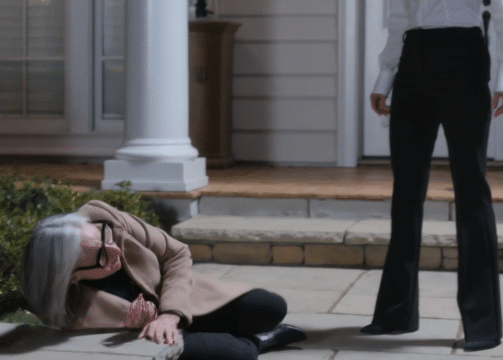
A dark red stream spilled from the crystal glass, sliding over Elena Marlowe’s hair, down her forehead, along her cheek, and onto the high collar of her dark blue satin dress. It ran in thin lines across the fabric, staining the front like a wound under the chandeliers.
The ballroom went silent.
Not completely.
There were still champagne flutes clinking somewhere near the back. A nervous cough. The faint scrape of a chair leg against polished marble. But the laughter that had filled the room only seconds earlier died as every guest turned toward the woman in the wheelchair.
Above her stood Celeste Arden.
Blonde, glittering, flawless in a strapless silver gown that caught the light from every angle. She held the empty wine glass like a trophy, her lips curved in a smile too cold to be mistaken for anything but cruelty.
“This party is for winners,” Celeste said.
She leaned closer.
“Not for pity cases.”
A few guests gasped. Someone whispered, “Oh my God, she actually did it?”
A phone lifted from the crowd, recording.
Elena remained still.
Wine dripped from her chin onto her lap. Her hands rested lightly on the arms of the wheelchair. Her long dark hair clung to the side of her face, but she did not wipe it away.
That bothered Celeste.
She had expected tears.
A public breakdown.
Maybe a trembling apology for existing in the wrong room.
Instead, Elena only breathed once, slow and measured, as if the humiliation had landed exactly where she expected it to.
Celeste’s smile sharpened.
“What are you gonna do about it?”
The question spread across the ballroom like perfume over rot.
The guests leaned in.
They had come to the Aurelia Grand for the kind of charity gala where rich people applauded themselves for writing checks. White-linen tables. Gold trim. Crystal chandeliers. Floral centerpieces. Speeches about courage and resilience from people who had never once been asked to prove either.
And now, beneath all that polished light, a woman in a wheelchair sat soaked in red wine while the hostess mocked her.
Elena slowly lifted her head.
Her eyes opened.
Calm.
Dark.
Unmoved.
“Are you absolutely sure,” she asked, “you want everyone here to know the truth?”
Celeste’s smile flickered.
Just for a second.
But Elena saw it.
So did the phone camera.
So did half the ballroom.
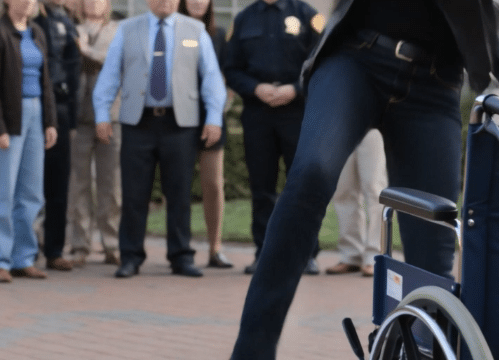
The wheelchair creaked softly as Elena placed both hands on its arms. She pressed down, rose from the seat, and stood on silver heels as if the room itself had been waiting for her to remember who she was.
The ballroom exploded in gasps.
“She can walk,” someone breathed.
Elena straightened her wine-stained dress, reached into the side pocket of the chair, and pulled out a white envelope.
Then she walked toward Celeste.
Slowly.
Confidently.
Every heel click on marble sounded like a verdict.
Celeste took one step back.
Elena stopped close enough for only the people nearest them to see the fear breaking through Celeste’s makeup.
Then she raised the envelope between them and smiled.
“Then let’s tell them whose husband spent last night with me.”
And that was when Celeste Arden’s perfect face finally fell apart.
Act II
A year earlier, Celeste had called Elena brave.
She had done it onstage, of course.
Celeste never wasted praise unless there was a camera nearby.
The event had been smaller then, held in a private dining room overlooking the city. Elena sat in the same wheelchair, recovering from the accident that had nearly ended her career, her body still thin from surgery, her right leg braced beneath the folds of her dress.
Celeste stood beside her with one hand resting lightly on Elena’s shoulder.
“My dear friend Elena Marlowe,” Celeste said into the microphone, “is proof that even when life knocks a woman down, grace can still make her shine.”
The room applauded.
Elena smiled because she had been trained since childhood to be gracious in rooms that wanted her pain to be decorative.
She was thirty-two then, already known as the youngest managing partner at Marlowe Capital, a private investment firm built by her grandfather and sharpened by her own instincts. She had spent years being called too cold, too young, too ambitious, then watched those same men ask for meetings when her deals outperformed theirs.
The accident changed everything.
A rain-slick road. A faulty brake line. A hillside guardrail that folded too easily. Three months in hospitals. Seven surgeries. A body that no longer obeyed her on command.
The world changed how it looked at her overnight.
Before the wheelchair, people feared her.
After it, they pitied her.
Celeste was the first to turn pity into profit.
She invited Elena onto boards, charity committees, public panels about “women overcoming hardship.” She placed Elena near donors, then spoke for her. She called her inspiring, then ignored her suggestions. She made the wheelchair the centerpiece of every photograph and slowly pushed Elena out of every decision that mattered.
At first, Elena told herself Celeste meant well.
That was the polite lie people offer themselves when rudeness arrives wearing diamonds.
But Celeste did not mean well.
She meant to win.
Her charity, the Arden Victory Foundation, claimed to support women recovering from serious injuries and medical trauma. It held galas, sponsored glossy videos, and collected enormous donations from people who liked their compassion served with champagne.
Elena had donated the first million.
Then another.
Then offered to audit the foundation’s spending when grant recipients began quietly reaching out to her.
One woman never received the mobility equipment Celeste’s foundation announced it had funded.
Another was promised rent assistance after surgery and got nothing but a branded tote bag.
A third sent Elena an email with one sentence that changed everything.
They use our stories, then stop answering our calls.
Elena began digging.
Celeste began smiling harder.
The deeper Elena looked, the uglier the numbers became. Vendor payments routed through shell companies. Luxury travel listed as outreach. Private spa weekends disguised as donor retreats. A penthouse renovation coded as an accessibility initiative.
And there was one more name in the records.
Andrew Arden.
Celeste’s husband.
Quiet, handsome, and almost always standing half a step behind her in public photographs.
Andrew had been the foundation’s treasurer on paper, but anyone who knew Celeste understood that paper was often where she placed blame before she needed it. If the charity collapsed, Andrew would take the fall. Celeste would cry beautifully on television and claim betrayal.
Elena saw the trap before Andrew did.
But Andrew began to see it too.
Three nights before the gala, he called Elena from an unknown number. His voice was thin with panic.
“She’s moving money tonight,” he said. “And tomorrow she’s going to announce you as honorary chair so your name lands on everything.”
Elena closed her eyes.
Of course.
Celeste did not just want Elena humiliated.
She wanted Elena implicated.
“Where are you?” Elena asked.
“In my car.”
“Is she with you?”
“No.”
“Then drive to my attorney’s office. Now.”
He arrived shaking, carrying a laptop, a folder of bank statements, and the look of a man who had been silent too long and had finally heard the lock turn behind him.
That night, Andrew Arden did spend the night with Elena.
Not in her bed.
Not in her arms.
In a conference room under fluorescent lights, drinking burnt coffee while attorneys took his sworn statement and forensic accountants copied every file he had stolen from Celeste’s private office.
By dawn, Elena had the truth in an envelope.
By evening, she had a plan.
Celeste wanted a public victory.
Elena decided to give her one.
Right up until the moment it became a public execution.
Act III
Celeste stared at the envelope like it was alive.
The ballroom had narrowed around them. Guests pushed closer, careful not to look too eager while angling their phones for a better shot. The string quartet near the far wall had stopped playing. Even the waiters stood frozen with trays of champagne suspended at their sides.
Elena held the envelope steady.
Red wine still dripped from the ends of her hair.
That detail mattered.
The room could see the stain. The insult. The proof of who had started this.
Celeste lifted her chin.
“My husband was at home last night,” she said.
Her voice was smooth.
Too smooth.
Elena tilted her head.
“Was he?”
A murmur moved through the crowd.
Celeste laughed, but the sound cracked at the edge.
“This is pathetic. You stand up from that chair and suddenly expect everyone to believe you’re some mastermind?”
Elena looked back at the wheelchair.
Then at Celeste.
“I never said I couldn’t stand.”
“You let people think it.”
“No,” Elena said. “People assumed. You most of all.”
Celeste’s eyes flashed.
“You fraud.”
That word was a mistake.
Elena’s smile disappeared.
“Careful.”
The warning was quiet enough that only Celeste and the first row of guests heard it clearly. But the way Celeste went still told everyone else it had landed.
Elena opened the envelope.
Celeste reached for it.
Elena stepped back.
“Don’t.”
The command stopped her.
It was not loud. It did not need to be. Elena had spent years learning how to speak in rooms where powerful people mistook volume for authority.
She removed the first page.
“A sworn statement from Andrew Arden,” Elena said, turning slightly so the nearest cameras could see the heading. “Signed at 4:42 this morning.”
Celeste’s face lost color.
The crowd erupted into whispers.
Elena continued.
“Bank transfers from the Arden Victory Foundation to three shell companies controlled by Celeste’s private accountant.”
A man near the champagne table whispered, “No way.”
Elena lifted another page.
“Internal emails discussing how to use my accident, my wheelchair, and my donor profile to increase tonight’s pledge totals while naming me honorary chair of a foundation already under investigation.”
Celeste moved closer, her voice dropping into something sharp and private.
“You have no idea what you’re doing.”
Elena met her eyes.
“I know exactly what I’m doing. That’s why you’re scared.”
At the back of the ballroom, a set of double doors opened.
Andrew Arden entered.
For the first time all night, Celeste looked truly terrified.
He wore a black tuxedo, but his bow tie was undone, and his face carried the exhaustion of a man who had not slept. Two attorneys walked behind him. Beside them came a woman in a navy suit carrying a sealed evidence box.
Elena did not turn.
She had heard the doors.
She knew he had come.
Celeste’s lips barely moved.
“Andrew.”
He stopped several feet away from her.
Not close enough to touch.
That distance said more than any accusation.
Celeste tried to smile at him.
It was painful to watch.
“Tell them,” she said. “Tell them this is insane.”
Andrew looked at the wine on Elena’s dress.
Then at the empty glass still dangling from Celeste’s hand.
“I told them everything,” he said.
The ballroom gasped again.
Celeste’s hand tightened around the glass until her knuckles whitened.
“You weak little man.”
Andrew flinched.
Elena saw it.
So did everyone else.
The mask had slipped.
There was no gracious wife now. No dazzling philanthropist. No polished hostess. Only a woman furious that her husband had stepped out of the role she assigned him.
Elena folded the papers neatly.
Then she turned to the guests.
“For those who donated tonight,” she said, “your money will not pass through Celeste Arden’s hands.”
Celeste spun toward her.
“You don’t get to decide that.”
Elena’s gaze stayed level.
“I already did.”
Act IV
The first donor to walk away was an elderly woman in emerald silk.
Her name was Beatrice Lang, and her family name appeared on museum wings, hospital plaques, and half the buildings where people went to pretend wealth had a conscience.
She set her champagne glass on a waiter’s tray.
Then she looked at Celeste.
“My pledge is withdrawn.”
Celeste’s mouth opened.
No sound came.
A man near the front followed.
“Mine too.”
Then another.
“And mine.”
The words moved around the ballroom like matches touching dry paper.
Withdrawn.
Suspended.
Pending review.
Not tonight.
Call my office.
Celeste stood beneath the chandeliers watching her empire rot in real time.
Elena walked to the microphone near the stage. Every eye followed her. The wheelchair remained behind her, empty and wine-specked, no longer a symbol of pity but a witness.
She tapped the microphone once.
The sound cracked through the ballroom.
“I came tonight prepared to expose financial misconduct,” she said. “I did not come prepared to be publicly assaulted with wine.”
A few guests lowered their eyes.
Good.
Elena wanted them uncomfortable.
“You all saw what happened when Celeste believed I was powerless. Some of you gasped. Some recorded. Some waited to see whether someone with more authority would intervene.”
The room went painfully quiet.
“That is how cruelty survives in expensive rooms. Not because everyone agrees with it. Because too many people wait for permission to object.”
No one moved.
Even Celeste seemed unable to interrupt.
Elena looked toward the cameras still raised.
“Keep recording.”
The phones lifted higher.
Celeste looked around as if betrayed by the very audience she had tried to entertain.
Elena continued.
“The Arden Victory Foundation will be frozen pending legal review. All future donations will be redirected through an independent trust administered by Marlowe Capital and audited publicly. Every woman whose story was used to raise funds will be contacted. Every missing grant will be paid before one more gala flower is ordered.”
The applause began in a small corner.
One person.
Then three.
Then twenty.
Soon it filled the ballroom, not joyful exactly, but fierce. Embarrassed. Relieved. The applause of people trying to clap loudly enough to erase their own silence.
Celeste stepped toward the stage.
“You can’t do this to me.”
Elena looked down at her.
There was something almost tragic in Celeste now, but only almost. Tragedy required remorse. Celeste had only fear.
“I didn’t do this to you,” Elena said. “I gave you a glass of wine and a room full of witnesses. You chose the rest.”
Andrew moved then, stopping near Elena but not touching her.
“I’ll cooperate fully,” he said into the microphone.
Celeste laughed, harsh and broken.
“You think they’ll forgive you?”
Andrew’s face tightened.
“No. I think they’ll know what I helped hide.”
That was the first honest sentence Elena had ever heard him say in public.
Celeste turned to the crowd.
“You’re all enjoying this, aren’t you?” she snapped. “You loved me five minutes ago.”
Beatrice Lang answered from the front.
“No, dear. We admired the performance. There’s a difference.”
A ripple moved through the ballroom.
Not laughter.
Something sharper.
Celeste looked suddenly smaller in her glittering gown.
Her silver sequins still caught every chandelier. Her earrings still sparkled. Her makeup was still perfect.
But the illusion had gone.
And without illusion, glamour looked very much like costume.
A security director approached quietly with two staff members behind him.
“Mrs. Arden,” he said, “we need you to come with us.”
Celeste stared at him.
“You work for me.”
He glanced at Elena.
“No, ma’am. I don’t.”
That was the final blow.
Not the documents.
Not Andrew.
Not even the donors.
It was the realization that the room had changed owners while she was still standing in it.
Act V
The headlines the next morning were merciless.
Not because the press suddenly cared about the women Celeste had exploited. Public outrage often arrives late and overdressed.
But there was video.
There was always video.
The clip of Celeste pouring wine over Elena’s head spread first. Then the moment Elena stood. Then the envelope. Then Andrew’s entrance. Then Elena at the microphone, wine-stained and unshaken, telling a ballroom full of millionaires that silence had helped cruelty survive.
By noon, Celeste Arden’s name had become a scandal.
By sunset, the foundation’s board had dissolved.
By the end of the week, investigators had seized records from its offices.
Andrew gave testimony that would not save his reputation but might save him from becoming Celeste’s only scapegoat. Elena did not comfort him. She did not punish him either. His guilt was no longer hers to manage.
She had other work.
The first grant was paid ten days later.
A woman named Tasha Bell received the adaptive van Celeste’s foundation had promised six months earlier. She called Elena crying, then laughing, then crying again. Elena listened from her office window overlooking the city, one hand braced on her cane, the other pressed lightly against the edge of her desk.
“I thought they forgot me,” Tasha said.
“They didn’t forget,” Elena replied. “They chose not to remember. We’re correcting that.”
There were many corrections.
Rent payments.
Medical equipment.
Rehabilitation costs.
Legal assistance.
Childcare.
Transportation.
The unglamorous things no one applauds at galas because they do not sparkle beneath chandeliers.
Elena made sure they happened anyway.
Three months after the scandal, she returned to the Aurelia Grand.
Not for a gala.
For a meeting.
The ballroom had been reset for a corporate conference, stripped of flowers and champagne towers. In daylight, it looked less magical. More honest. Marble floors. Gold trim. Chandeliers waiting for night to make them important again.
Elena walked in with a cane.
Slowly.
Carefully.
Some days she used the wheelchair. Some days she walked. Some days pain made every step feel like negotiating with fire. She had stopped caring whether people understood the difference.
Her body was not evidence for strangers.
It was simply hers.
Near the stage, the staff had missed one tiny stain between marble tiles.
A faint red shadow where the wine had splashed.
Elena stood over it for a long moment.
Her assistant, Mara, noticed.
“Do you want me to ask them to clean that?”
Elena smiled faintly.
“No.”
Mara blinked.
“No?”
“Leave it for today.”
“Why?”
Elena looked around the empty ballroom.
“Because I want to remember exactly where she thought I ended.”
Mara did not answer.
She did not need to.
That evening, Elena hosted the first board meeting of the new trust. No sequins. No photographers. No champagne fountain. Just recipients, auditors, advocates, and people who knew the difference between charity and repair.
At the end of the meeting, Beatrice Lang approached her.
“I owe you an apology,” the older woman said.
Elena studied her.
“For what?”
“For watching too long before I withdrew my pledge.”
Elena appreciated the honesty more than the apology.
“Yes,” she said. “You do.”
Beatrice nodded.
“I’ll do better.”
“Good.”
There was no hug. No dramatic forgiveness. Elena had learned that powerful people often wanted absolution faster than change.
She preferred change.
Weeks later, a letter arrived from Celeste.
Cream paper. Expensive envelope. Perfect handwriting.
Elena almost threw it away unopened.
Instead, she read it once.
Celeste claimed she had been under pressure. Misled by accountants. Betrayed by Andrew. Addicted to expectations. Frightened of losing status. Sorry for how things appeared.
Appeared.
That word told Elena everything.
She placed the letter in a drawer with the others from lawyers, donors, journalists, and former friends of Celeste who now wanted Elena to know they had always suspected something.
Then she closed the drawer.
Some stories do not deserve a reply.
A year later, the trust held its first public event.
Not in the Aurelia ballroom.
In a rehabilitation center with scuffed floors, bright windows, and a courtyard full of folding chairs. The flowers came from a local market. The food was cooked by volunteers. The guests wore whatever made them comfortable.
Elena stood at the front in a deep blue dress.
Not the same one.
She had kept the wine-stained dress, though.
Not as a wound.
As evidence.
Behind her, on a large screen, were the names of every woman the trust had helped in its first year. Not donor names. Not society names. Recipient names, if they wanted to be listed. Stories, if they chose to tell them.
Tasha Bell rolled into the front row in her new van’s bright yellow jacket and waved like she owned the room.
Elena laughed.
A real laugh.
Free of marble echoes.
When she began to speak, she did not mention Celeste by name.
She did not need to.
“Some people believe winning means standing above someone else,” Elena said. “But real victory is quieter than that. It is getting your life back. It is being believed. It is receiving what you were promised. It is entering a room and not having to prove you deserve dignity before anyone offers it.”
The room applauded.
Not politely.
Honestly.
Elena looked at the faces in front of her and felt something inside her settle.
For months, strangers had called her comeback iconic. Savage. Legendary. They loved the moment she stood from the wheelchair because they thought that was the reversal.
They were wrong.
Standing had never been the victory.
Exposing Celeste had not even been the victory.
The victory was this room.
This trust.
These names.
This work continuing long after the gossip had moved on.
After the event, Elena sat alone for a while in the courtyard as the sun lowered behind the city. Her cane rested beside her chair. A paper cup of coffee cooled in her hands.
Mara came outside.
“Ready to go?”
Elena looked through the glass doors at the people still talking inside.
“Almost.”
Her phone buzzed with an alert. Another article about Celeste’s trial. Another headline. Another reminder that the world still loved a fallen queen.
Elena turned the phone face down.
She had no interest in watching Celeste fall forever.
She was too busy building something that would stand.
Finally, Elena rose carefully, took her cane, and walked back toward the lighted room.
No chandeliers.
No champagne.
No silver gown trembling in disgrace.
Just people who had been used as stories finally becoming authors of their own.
And for Elena, that was the only kind of winning that mattered.