Act I
The first thing Mara heard was water.
Cold drops splashed across her forehead, ran into her lashes, and slid down the tear tracks already dried on her cheeks.
She gasped awake.
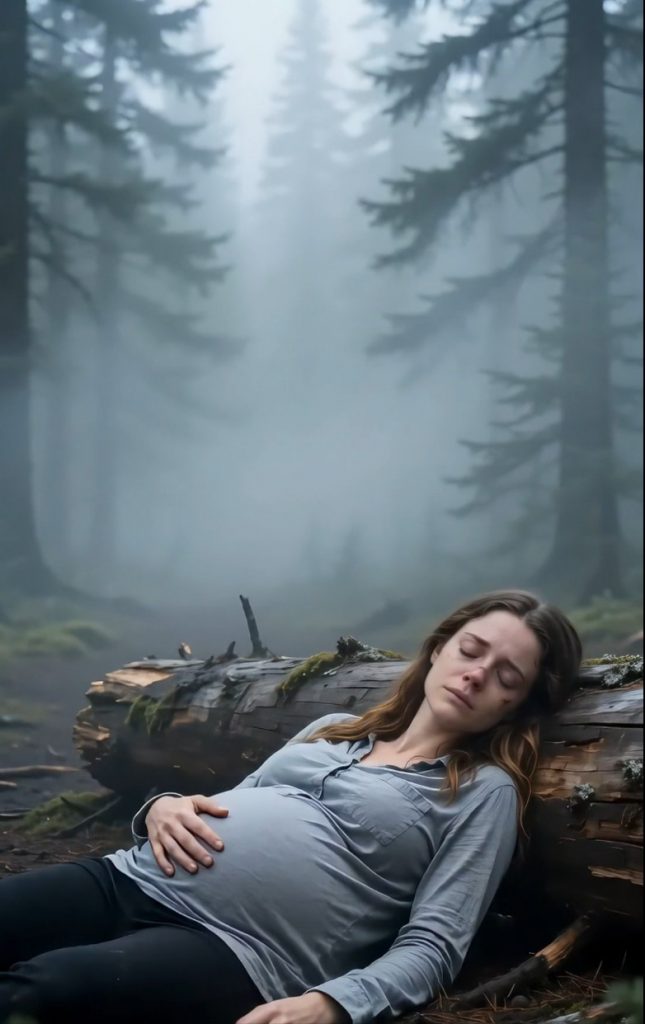
For one terrifying second, she did not know where she was. The world above her was gray fog and black pine branches. Damp earth pressed into her back. A fallen tree trunk held her upright just enough to keep her from sliding fully onto the forest floor.
Then she saw the wolf.
It stood over her with a clear plastic water bottle clenched carefully between its teeth.
Mara froze.
Her right hand tightened over her pregnant belly.
The wolf’s fur was thick and wild, gray and brown and black blending into the mist. Its amber eyes did not look hungry. They looked focused. Almost worried.
Mara tried to move, but pain and exhaustion pulled her back against the log.
“No,” she whispered, though she did not know whether she was speaking to the wolf, the forest, or the fear rising in her throat.
The wolf tilted its head again.
More water spilled from the bottle onto her face.
Mara blinked hard. Her mouth was dry. Her lips trembled. She could taste rain, dirt, and panic.
The last thing she remembered was running.
Branches slapping her arms. Her shoes slipping in mud. Her phone dead in her coat pocket. The baby shifting low inside her as she tried to stay upright.
Then the cramp in her side.
The fall.
The darkness.
Now the wolf had found her.
Or maybe, impossible as it seemed, the wolf had saved her.
It stepped back, dropped the crinkled bottle near her hand, and watched her.
Mara stared at it, breathing in broken bursts.
“Why?” she whispered.
The wolf turned away.
Just like that.
It began walking into the mist, its paws quiet on the pine needles, its body fading between the trees as if it had never meant to stay.
Panic tore through Mara.
“No,” she sobbed.
She reached one arm toward it while the other stayed wrapped around her stomach.
“Please, don’t go. Don’t leave me alone.”
The wolf stopped.
For a moment, only the wind moved.
Then it turned its head over one shoulder.
Those amber eyes found hers again.
And somewhere deep in the forest behind her, a man’s voice shouted her name.
Not with love.
With fury.
Act II
Mara Whitfield had grown up believing forests remembered kindness.
Her father told her that.
He was a wildlife veterinarian, the kind of man who could kneel beside a wounded animal for hours without once raising his voice. He treated foxes hit near back roads, owls tangled in fencing, and once, when Mara was eleven, a wolf pup caught in an illegal trap.
The pup had been small then, all trembling legs and furious eyes.
Mara named him Ash.
Her father had laughed. “He is not a pet, Mara.”
“I know.”
“You cannot keep him.”
“I know.”
But every morning, she carried water to the recovery pen. Every evening, she sat outside the fence and read her schoolbooks aloud because she thought silence might make him lonely.
Ash healed.
Then he was released into the northern preserve.
Mara cried for two days.
Her father told her love was not possession. Love was knowing when to open the gate.
Years later, after her father died, Mara inherited the Whitfield preserve. Three thousand acres of pine forest, wetlands, cold streams, and protected denning grounds that developers had wanted for decades.
Mara refused every offer.
Then she met Adrian Vale.
He was charming in the way polished men often are when they want something. Soft voice. Expensive coat. Patient smile. He praised her father’s work. He said he admired women who protected old things in a world obsessed with profit.
By the time Mara saw the hunger under the charm, she was already married.
By the time she learned about the debts, she was pregnant.
Adrian wanted the preserve sold.
He called it practical.
Mara called it betrayal.
The fighting got worse after she found the first forged document in his desk. A land transfer request with her signature copied from an old hospital form. A buyer listed under a shell company. A closing date scheduled before the baby was due.
When she confronted him, his face did not change.
That frightened her more than shouting would have.
“Mara,” he said softly, “you are emotional. You are tired. You are not thinking clearly.”
She left that night.
Not for good, she told herself. Just long enough to reach her lawyer. Long enough to get help. Long enough to protect the preserve and the child moving under her ribs.
But Adrian followed.
His headlights appeared behind her on the old forest road, cutting through the fog.
Mara drove too fast.
A deer flashed across the road.
She swerved.
The car slid into a ditch.
The airbag burst. Her phone cracked. The world rang.
She crawled out through the passenger side before Adrian reached the bend.
She heard his car stop.
He called her name once.
Then she heard him speak to another man.
“Find her before morning. She signs nothing if she makes it to town.”
That was when Mara ran.
Into the trees.
Into the fog.
Into the land her father had spent his life saving.
She ran until her body could not carry both fear and pregnancy any farther.
And when she fell beside the old tree trunk, she thought of her father’s voice.
Forests remember kindness.
Now, as the wolf looked back at her through the mist, Mara noticed something near its left shoulder.
A pale scar beneath the fur.
Old.
Curved.
Familiar.
Her breath caught.
“Ash?” she whispered.
The wolf stared at her.
Then it stepped toward her again.
Act III
Mara should not have been able to stand.
Every part of her body argued against it. Her legs shook. Her lungs burned. Her belly tightened with each frightened breath.
But the voice behind her was closer now.
“Mara!”
Adrian.
The wolf’s ears flattened.
It moved to her side, not touching her, but close enough that she understood.
Follow.
Mara gripped the fallen trunk and forced herself upright.
“I can’t run,” she whispered.
The wolf gave one low breath and turned down a narrow path between the pines.
Not the main trail.
Not the direction of the road.
A deer path, almost invisible beneath moss and needles.
Mara stumbled after it.
The wolf did not rush. It moved ahead, stopped, looked back, waited. Again and again. Like it knew she was carrying more than herself.
Behind them, branches snapped.
Another voice cursed.
“Tracks go this way!”
Mara’s heart pounded.
Adrian had not come alone.
The wolf led her through a curtain of fog to a low ridge where the trees opened around a moss-covered stone marker. Mara recognized it dimly from childhood.
Her father’s old field station was nearby.
Or what remained of it.
He had built it before the preserve gained funding, back when his work was paid in grants, favors, and stubbornness. It was a one-room shelter with a tin roof, a radio, and emergency supplies for injured hikers or stranded rangers.
Mara had not been there in years.
She thought it had collapsed.
The wolf stopped beside a rock wall half-hidden under fern growth.
Mara pushed through the brush and saw the cabin.
Small.
Weathered.
Still standing.
Warmth nearly broke her.
She limped to the door and found it barred from the outside by a fallen branch. The wolf seized the branch in its teeth and pulled. Mara pushed with one hand while holding her belly with the other.
The branch gave way.
The door opened with a groan.
Inside, the cabin smelled of dust, old wood, and dry canvas.
Mara found the emergency radio mounted above a shelf.
Her hands shook so badly she nearly dropped the receiver.
Static filled the room.
“Please,” she whispered. “Please work.”
The wolf stood in the doorway, facing the forest.
Mara turned the dial.
Static.
A burst of sound.
Then a faint voice.
“Ranger station north, identify.”
Mara sobbed.
“This is Mara Whitfield. I’m in the old field station near Ridge Three. I’m pregnant. I need help. My husband is chasing me.”
The radio crackled.
“Mara, repeat your location.”
She repeated it.
A pause.
Then the voice returned, sharper now.
“Stay inside. Lock the door if you can. Sheriff’s office is being notified. Rangers are moving.”
Mara let the receiver fall against her chest.
The wolf still had not moved.
Outside, Adrian’s voice cut through the trees.
“Mara! I know you’re in there.”
The wolf lowered its head.
A low warning growl filled the cabin doorway.
And Mara realized the animal was not leading her to safety.
It was preparing to defend the door until safety arrived.
Act IV
Adrian appeared through the fog wearing the same dark coat he had worn the night he proposed.
For a moment, that detail seemed impossible.
Mara remembered candlelight, rain against restaurant windows, his hand closing around hers as he promised forever.
Now he stood between pine trees with mud on his trousers and rage stripped bare across his face.
“Mara,” he said, breathing hard. “You scared me.”
She almost laughed.
The wolf growled.
Adrian stopped.
His eyes moved from Mara to the animal blocking the cabin entrance.
“What is this?” he snapped.
Mara kept one hand on the radio shelf. “Leave.”
His expression shifted.
Softened.
Performed.
“You’re not well. You hit your head. Let me take you home.”
“Home?” Her voice shook, but she did not lower it. “You forged my signature.”
His jaw tightened.
The man behind him stepped into view. Mara recognized him as Colin Briggs, one of Adrian’s contractors. He would not meet her eyes.
Adrian lowered his voice. “You don’t understand what’s at stake.”
“I do now.”
“This preserve is rotting money in the ground,” he said, anger finally breaking through. “Do you know what people would pay for this land?”
“My father knew.”
“Your father wasted his life on animals.”
The wolf’s growl deepened.
Mara felt something cold and steady settle inside her.
“No,” she said. “He saved one.”
Adrian looked at the wolf again.
Then, impossibly, he understood.
His face paled.
“You’re joking.”
Mara’s eyes burned. “Ash.”
The wolf did not look away from Adrian.
Colin took a step back. “I didn’t sign up for this.”
Adrian turned on him. “Shut up.”
The radio crackled behind Mara.
“Units approaching Ridge Three. Stay on channel.”
Adrian heard it.
Everything changed.
The softness vanished from him completely.
He lunged toward the cabin.
Ash moved first.
The wolf sprang into the doorway with a force that drove Adrian backward before he could reach Mara. It did not maul. It did not lose control. It simply knocked him off balance and stood over the threshold, teeth bared, a wall of fur and warning.
Adrian fell hard into the pine needles.
Colin raised both hands. “I’m done. I’m done.”
From the forest came shouts.
“Sheriff’s office!”
“Ranger service!”
Flashlights cut through the fog.
Adrian tried to stand, but Ash stepped closer, silent now. That silence frightened him more than the growl.
“Call it off,” Adrian hissed at Mara.
Mara stared at the man who had tried to turn her fear into a signature.
“No.”
It was one small word.
It changed the forest.
Rangers burst into the clearing. A deputy followed with one hand near his radio. Colin dropped to his knees before anyone told him to. Adrian started talking at once, claiming confusion, concern, panic, love.
Mara stood in the cabin doorway with one hand over her belly and the wolf at her side.
For the first time all night, Adrian’s words did not reach her.
The deputy looked from Mara to the wolf.
“Ma’am,” he said carefully, “is that animal with you?”
Mara looked down.
Ash’s amber eyes lifted to hers.
“No,” she whispered.
Then she remembered her father.
Love is knowing when to open the gate.
Mara swallowed hard.
“He’s free.”
Act V
Mara’s daughter was born three weeks early and perfectly furious.
She came into the world at Whitfield County Hospital during a spring storm, screaming before the doctor could finish saying she had a strong heart.
Mara named her Clara.
After her father, whose full name had been Clarence Whitfield, though he hated it enough to make everyone call him Whit.
The nurses said Clara had her mother’s eyes.
Mara thought she had the forest’s timing.
Adrian did not see her.
By then, he had been charged with fraud, coercion, and conspiracy related to the illegal land transfer. Colin Briggs cooperated before the week was over. The forged paperwork led investigators to two shell companies, three hidden accounts, and a developer who suddenly forgot ever admiring Adrian Vale.
Mara signed nothing except a restraining order, a corrected trust document, and later, a permanent conservation agreement protecting the Whitfield Preserve from sale.
Reporters wanted the wolf story.
Mara refused most interviews.
The ones she gave were careful.
A wolf had helped her.
A radio had saved her.
Rangers had arrived in time.
That was all.
People wanted magic. They wanted a miracle with teeth and amber eyes. They wanted to name Ash, track him, photograph him, turn him into proof that the world was kinder than it often is.
Mara would not give them that.
Some rescues deserved privacy.
Still, the legend spread.
Hikers claimed they saw a large gray wolf near Ridge Three. A ranger found a plastic water bottle beside the old field station, tooth-marked but intact. A child on a school nature trip said a wolf watched from the trees and then vanished when adults turned around.
Mara never corrected the stories.
She knew what she had seen.
Months later, after her body healed and Clara was strong enough to ride wrapped against her chest, Mara returned to the forest.
Not alone.
A ranger walked with her until the old path narrowed, then waited behind when Mara asked for a moment.
The air smelled of pine and damp earth. Sunlight filtered through the branches in soft gold shafts. The fallen tree trunk was still there, moss growing brighter over the bark, as if the forest had already begun covering the place where fear had nearly ended her story.
Mara stood beside it and closed her eyes.
She could still feel the cold water.
The scratch of bark against her shoulder.
The terror of begging not to be left alone.
Clara stirred against her chest, making a tiny sound.
Mara kissed the top of her daughter’s head.
“I thought I was alone,” she whispered.
The trees answered with wind.
Then something moved between the pines.
Mara looked up.
Ash stood at the edge of the clearing.
Older than she remembered from childhood. Larger than memory. Realer than any legend.
His amber eyes held hers.
Mara did not move toward him.
She understood now what her father had understood.
Wildness was not distance.
It was respect.
“Thank you,” she said.
The wolf blinked slowly.
Clara made another soft sound, and Ash’s ears shifted toward the baby.
For a long moment, the three of them remained still in the quiet forest: the woman who had survived, the child who had arrived, and the wolf who had remembered a kindness from another lifetime.
Then Ash turned.
This time, Mara did not beg him to stay.
She watched him walk into the mist between the trees, his body fading into the preserve her father had saved, the preserve he had saved again through a creature no human could command.
Mara returned to the field station once a year after that.
She repaired the roof. Replaced the radio. Stocked water, blankets, and medical kits for anyone who might stumble through the trees with no strength left.
Above the shelf, she hung a small wooden sign carved with her father’s old words.
Forests remember kindness.
People thought it meant be gentle with the land.
It did.
But Mara knew it meant more.
Kindness was not weak. It was not soft in the way cruel people believed. Kindness could grow teeth. It could cross years. It could return from the fog carrying water in its mouth and stand between a frightened woman and the person who wanted to own her fear.
One autumn evening, when Clara was old enough to walk, Mara brought her to the edge of Ridge Three.
The little girl held her hand and pointed into the trees.
“Wolf?” she asked.
Mara smiled.
“Maybe.”
“Scary?”
Mara looked toward the darkening pines.
She remembered amber eyes turning back.
“No,” she said softly. “Not to us.”
The wind moved through the branches.
Somewhere far beyond the ridge, a wolf howled once.
Clara leaned against her mother’s leg.
Mara lifted her daughter into her arms and held her close, not because she was afraid, but because she could.
Because both of them were alive.
Because the land was still whole.
Because once, in the cold gray fog, a wolf had looked back when she begged not to be left alone.
And that had made all the difference.