Act I
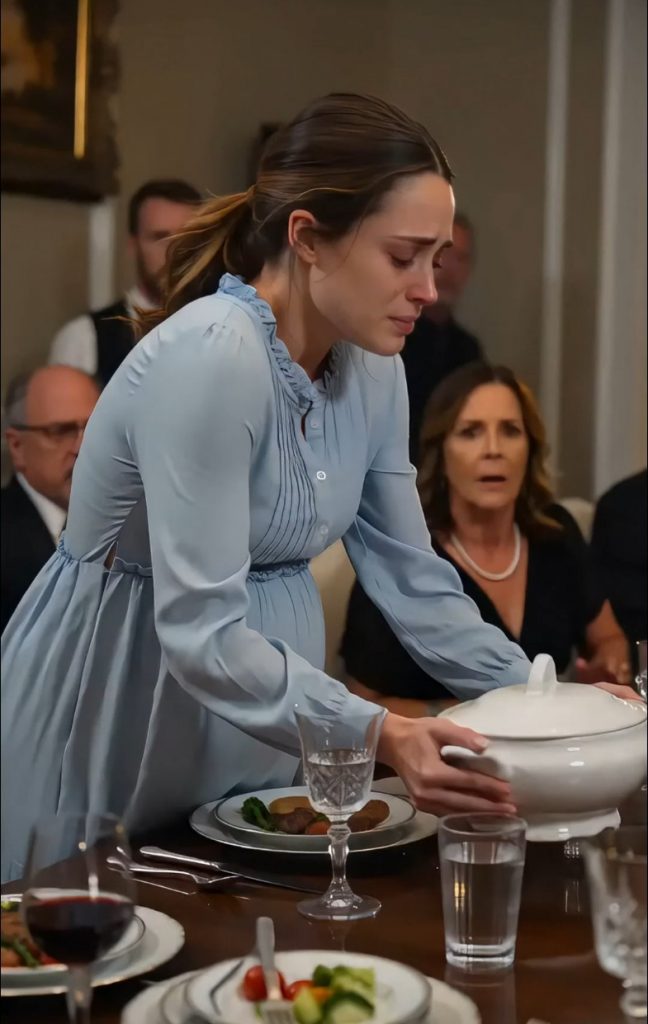
The white porcelain dish hit the table with a heavy thud.
Everyone heard it.
The crystal glasses trembled. The candle flame jumped. A thin line of gravy slipped down the side of the tureen and onto the polished oval table, but the woman who had placed it there barely noticed.
Grace Miller was eight months pregnant.
Her light blue maternity dress pulled tight over her belly as she leaned forward, one hand braced against the table, the other pressing into her lower back. Her face was pale from exhaustion. Loose strands of brown hair had fallen from her messy ponytail and stuck to her damp temples.
She had been on her feet since morning.
Cooking. Setting plates. Smiling when she wanted to cry.
Trying to make her husband’s family believe she was grateful to be tolerated in her own home.
At the far end of the table, Patricia Voss slowly set down her fork.
She was a polished woman in her late sixties, with short blonde hair styled perfectly and a dark blouse that made her look severe under the chandelier light. Her eyes swept over the tureen, then over Grace’s swollen belly, then up to Grace’s face.
Her mouth twisted.
“You clumsy, useless girl.”
The room went silent.
Grace looked down.
Around the table, guests shifted uncomfortably. A cousin in a vest froze with his knife halfway to his plate. A woman in black lowered her gaze as if she could make the insult disappear by refusing to witness it.
Grace placed both hands over her belly.
For months, she had swallowed comments like that.
Too slow. Too emotional. Too big. Too dramatic. Too lucky my son married you.
But something in her broke open that night.
Maybe it was the baby kicking beneath her hand.
Maybe it was the laughter Patricia expected to follow.
Grace lifted her head.
Her eyes shone with tears, but her voice did not vanish.
“I am eight months pregnant,” she said, trembling. “You will not speak to me like that.”
Patricia stared at her.
Then she stood.
The slap cracked across the room before anyone moved.
Grace’s head turned from the force. She gasped, hands flying toward her stomach. Patricia shoved her backward, hard enough that Grace lost her balance beside the dining table.
A chair scraped.
Someone gasped.
Grace hit the floor on her side, curling around her belly as tears spilled down her face.
No one reached her fast enough.
Patricia stood over her, chest rising, fury still bright in her eyes.
Then a man appeared in the doorway.
He was holding a white dish covered in foil.
Grace turned her tear-streaked face toward him.
“Dad.”
Thomas Miller stopped dead.
He had come carrying dessert.
He found his daughter on the floor.
His eyes moved from Grace’s trembling hands to Patricia’s raised posture.
Then his voice cut through the dining room like a door slamming shut.
“Step away from my daughter.”
And for the first time that evening, Patricia looked afraid.
Act II
Thomas had never liked that house.
It was too polished. Too quiet. Too proud of itself.
The dining room looked like something from a magazine: gold chandelier, fine china, crystal glasses, embroidered napkins no one seemed allowed to touch without permission. But every time Thomas visited, he felt the cold beneath the shine.
Grace used to fill rooms with noise.
As a little girl, she talked through breakfast, sang while brushing her hair, asked questions until Thomas pretended to faint from exhaustion just to make her laugh. After her mother died, that laughter had become the sound that kept their house alive.
Then she married Evan Voss.
Evan came from money, or at least from a family that spoke as if money were proof of moral superiority. He was handsome, smooth, and careful around Thomas at first. He called him “sir.” He brought flowers. He promised Grace would never want for anything.
Thomas wanted to trust him.
Not because Evan deserved it.
Because Grace loved him.
But after the wedding, small things changed.
Grace stopped dropping by unannounced. Then she stopped calling late at night. When Thomas asked if she wanted to come over for Sunday breakfast, she would say, “I should check with Evan first.”
That sentence stayed with him.
I should check.
Not “I’ll ask.”
Not “Let me see.”
Check.
As if permission had become part of marriage.
Patricia’s influence arrived like frost.
She corrected Grace’s clothes. Her recipes. Her tone. Her posture at family events. When Grace became pregnant, Patricia shifted from criticism to ownership. She bought nursery furniture without asking. She argued over the baby’s name. She told relatives the child would “bring refinement” to Grace’s side of the family.
Grace laughed it off.
“I’m just tired, Dad.”
“She doesn’t mean it like that.”
“Evan says I need to stop taking things personally.”
Thomas heard the words beneath the words.
But every time he pushed, Grace pulled away.
That night, Patricia had invited him to dinner as an afterthought. “Bring something if you insist,” she had said over the phone, her voice too sweet to be kind.
So Thomas brought his late wife’s apple pie.
Grace’s favorite.
He was five minutes late because the roads were wet and he had stopped to buy vanilla ice cream. He came through the hallway quietly, balancing the dish in both hands, expecting the usual strained smiles and formal hellos.
Instead, he heard Patricia’s voice.
You clumsy, useless girl.
Thomas stopped before the dining room entrance.
Then he heard Grace answer.
Not loudly.
Not rudely.
With dignity.
You will not speak to me like that.
For half a second, pride rose in his chest.
Then came the slap.
The sound erased everything else.
Thomas stepped into the doorway just as Grace fell.
He saw her curl around her belly.
He saw the guests frozen in their chairs.
He saw Patricia standing over her like she had every right to decide how much pain a pregnant woman should endure.
And Thomas understood in one terrible rush that his daughter had not been dramatic.
She had been alone.
Until now.
Act III
No one spoke after Thomas’s command.
Even the candle seemed to burn quieter.
Patricia turned toward him slowly, trying to rebuild herself into the woman who had ruled the table only seconds earlier.
“Thomas,” she said, breathless. “You don’t understand what happened.”
He set the pie dish down on the sideboard with careful hands.
That frightened her more than if he had thrown it.
“I understand enough.”
Grace tried to sit up, but pain and fear kept her curled on the floor. Thomas crossed the room and knelt beside her.
“Don’t move too fast,” he said, his voice softening only for her. “Are you hurt?”
Grace shook her head, then nodded, then started sobbing harder.
“I don’t know.”
That answer changed the room.
A guest finally stood.
“We should call a doctor,” she whispered.
Thomas looked up sharply.
“Yes. You should have done that already.”
The woman flushed and grabbed her phone.
Patricia’s face tightened.
“Oh, for heaven’s sake. She fell. She’s being hysterical.”
Thomas stood.
The tenderness vanished from his expression.
“She was struck and shoved.”
“She insulted me at my own table.”
Grace looked up, stunned through tears.
“Your table?” Thomas said.
Patricia lifted her chin. “This is my son’s home.”
From the far side of the room, Evan finally entered.
He had been in the kitchen when the slap happened, or so he later claimed. He appeared with his sleeves rolled up and irritation already on his face, as if the most inconvenient part of the evening was that everyone had stopped eating.
“What is going on?”
Grace stared at him.
His eyes went to her on the floor.
Then to his mother.
Then to Thomas.
He did not rush to Grace.
Thomas noticed.
Everyone noticed.
Patricia spoke first.
“She raised her voice to me.”
Evan exhaled, embarrassed. “Grace.”
That one word nearly destroyed her.
Not Mom, what did you do?
Not Are you okay?
Just her name, spoken like a warning.
Thomas stepped between them.
“Choose your next sentence carefully.”
Evan blinked. “Excuse me?”
“My daughter is on the floor, eight months pregnant, after your mother hit her. So choose carefully.”
Evan’s face flushed.
“Dad, maybe this isn’t your place.”
Grace’s breath caught.
Thomas looked at him with a coldness that made the table go still.
“I was there the day she was born,” he said. “I held her mother’s hand while Grace took her first breath. Don’t tell me where my place is.”
The room seemed to shrink around Evan.
The woman on the phone whispered urgently to emergency services.
Patricia’s confidence began to crack.
Thomas turned back to Grace and helped her sit upright slowly. She clung to his sleeve like she was five years old again, hiding from thunder.
Only this time, the storm was sitting at the dinner table wearing pearls.
Then Grace whispered something so softly only Thomas heard.
“She’s done it before.”
Thomas froze.
His hand tightened around hers.
And the evening became something much larger than one slap.
Act IV
The ambulance arrived first.
Then the police.
By then, Patricia had tried to turn the room back in her favor three separate times.
She called Grace unstable.
She said pregnancy had made her emotional.
She said Thomas was exaggerating because he had always resented the Voss family.
But the guests had gone too quiet to help her.
Shame had settled over them like dust.
They had watched Patricia insult Grace. They had watched her strike her. They had watched her push her. Their silence was no longer a hiding place; it was evidence.
A paramedic checked Grace’s vitals while another asked questions. Grace answered in a small, shaking voice, one hand never leaving her belly.
When they said she should go to the hospital to be monitored, Evan finally moved closer.
“I’ll come with you.”
Grace looked at him.
For a moment, Thomas saw the old hope in her eyes—the desperate wish that the man she married would still choose her when it mattered.
Then Evan glanced at his mother.
That was all it took.
Grace saw it too.
“No,” she said.
Evan stared. “What?”
“I want my dad.”
Patricia scoffed. “Don’t be ridiculous.”
Grace flinched, but this time she did not fold.
“I want my dad,” she repeated.
Thomas stood beside the stretcher.
“She answered.”
At the hospital, the baby’s heartbeat filled the small exam room like a miracle.
Fast. Strong. Alive.
Grace covered her face and cried.
Thomas turned away so she would not see his own tears, but she reached for him anyway.
He took her hand.
“I should have told you,” she whispered.
“You don’t have to explain tonight.”
“Yes, I do.” Her voice cracked. “Because if I don’t say it now, I’ll talk myself out of it tomorrow.”
So she said it.
She told him Patricia had slapped her once before, not hard enough to leave a mark, but hard enough to teach her what could happen if she talked back.
She told him Evan had never hit her, but he had blocked doors, taken her phone during arguments, and told her she was lucky he was patient.
She told him Patricia had been trying to control the birth plan.
The baby’s name.
Who would be in the delivery room.
Even whether Grace’s father should be called when labor began.
Thomas felt each word like a stone placed on his chest.
“I thought if I kept peace until the baby came, things would get better,” Grace said.
Thomas shook his head gently.
“Peace that only works when you’re silent isn’t peace.”
Grace stared at him.
Then she broke.
Not dramatically.
Quietly.
Like a person finally setting down a weight she had been told was love.
The next morning, Thomas took her home.
Not to Evan.
To the small blue house where she grew up.
The nursery there was not ready. The guest room smelled faintly of old books and cedar. The crib had to be assembled, the closet cleared, the carpet cleaned.
But when Grace stepped inside, she saw her mother’s old quilt folded across the back of the sofa and the apple pie still sitting on the counter, untouched from the night before.
For the first time in months, she felt safe enough to sleep.
Evan came by that evening.
He brought flowers.
Thomas met him on the porch.
“Where is she?” Evan demanded.
“Resting.”
“I need to speak to my wife.”
“She doesn’t want to speak to you.”
Evan’s charm vanished.
“You can’t keep her from me.”
Thomas opened the screen door just enough for Evan to see the police report copy on the hallway table.
“I’m not keeping her,” he said. “I’m protecting her choices.”
Evan looked past him, angry and desperate.
Then he saw Grace standing in the hallway behind her father.
Her face was pale.
But she was upright.
“I’m filing for a protection order,” she said.
Evan’s mouth opened.
Grace’s hand settled over her belly.
“And your mother will not be near me when this baby is born.”
That was the moment Evan understood the dinner had not ended when Thomas walked in.
It had only begun.
Act V
Patricia tried to deny everything.
That failed quickly.
One guest had recorded part of the dinner after the first insult, thinking it would become gossip. Instead, it became proof. The video showed Grace standing up for herself. It showed Patricia’s slap. It showed the shove.
It also showed the table full of people doing nothing.
Some apologized later.
Grace accepted very few apologies.
She was too busy surviving the consequences of finally being believed.
The protection order was granted. Evan was ordered to communicate only through attorneys. Patricia was barred from contacting Grace or appearing at the hospital. The divorce filing followed soon after.
Patricia called it betrayal.
Evan called it overreaction.
Thomas called it Tuesday and made Grace pancakes.
The baby arrived four weeks later on a bright morning after a night of rain.
A boy.
Grace named him Noah Thomas Miller.
Not Voss.
Miller.
When the nurse placed him in her arms, Grace looked down at his tiny face and understood something with a clarity sharper than fear.
She would never teach her son that love sounded like shouting.
She would never teach him that family meant ownership.
She would never teach him that silence was respect.
Thomas stood beside the bed, one hand over his mouth, crying openly.
Grace laughed through tears.
“You’re worse than I am.”
He nodded, unable to speak.
Noah yawned.
That ruined both of them.
Life after that was not instantly easy.
There were court dates. Late-night feedings. Legal bills. Days when Grace felt strong in the morning and broken by afternoon. Days when she missed the version of Evan she thought she had married, and then hated herself for missing him.
Thomas never rushed her grief.
He just stayed.
He learned how to warm bottles, though he overheated them twice. He walked Noah around the living room at 3 a.m., whispering old baseball scores as lullabies. He installed a better lock on the front door and hung soft curtains in the nursery.
And every Sunday, he baked.
Apple pie became the joke of the house. The pie he had carried into the dining room that terrible night had never been eaten, but Grace insisted it had still done its job.
“It brought you through the door,” she said.
Thomas always answered the same way.
“No. You did.”
Months later, Grace returned to the old dining room one final time—not for dinner, but for a scheduled property exchange with her attorney present.
The chandelier still hung above the oval table. The polished wood still shone. The crystal glasses were gone, packed away or hidden.
Patricia was not there.
Evan stood near the doorway, thinner now, his confidence worn down by consequences.
He looked at Noah in Grace’s arms.
“Can I hold him?”
Grace paused.
Then shook her head.
“Not today.”
His face tightened, but he did not argue.
He knew too many people were watching now.
Grace collected the last box of her belongings. Inside were baby clothes, a framed wedding photo she planned to throw away, and a small recipe card in her mother’s handwriting that Patricia had once mocked as “common.”
At the door, Evan said, “I never wanted it to get this far.”
Grace turned.
“That’s the problem. You thought the damage only mattered when there were consequences for you.”
Evan had no answer.
She left without looking back.
A year after the dinner, Noah took his first steps in Thomas’s living room.
Three wobbly steps from the coffee table to Grace’s open arms.
Thomas cheered so loudly Noah sat down in surprise and cried.
Grace laughed until tears ran down her face.
Later, after Noah fell asleep, Grace stood in the kitchen washing a single blue bowl while Thomas dried it beside her.
“You ever think about that night?” she asked.
Thomas looked at her.
“Every day.”
“Me too.”
He set the towel down.
“I still wish I had gotten there sooner.”
Grace leaned against the counter.
“I used to think that. But now I think you came at the exact moment I needed to see it clearly.”
“What?”
“That I wasn’t overreacting. That it was real. That if someone who loved me walked in and saw it, they would call it what it was.”
Thomas’s face softened.
“And what was it?”
Grace looked toward the living room, where Noah slept beneath her mother’s quilt.
“Abuse,” she said.
The word no longer shook when she said it.
That was its own kind of freedom.
Thomas nodded.
“Yes.”
Grace turned off the kitchen light.
The house settled around them, warm and ordinary.
No chandelier. No polished oval table. No guests pretending not to see.
Just a father, a daughter, and a baby sleeping safely down the hall.
Patricia had tried to make Grace feel small in front of everyone.
Instead, she exposed herself.
Evan had tried to stand in the middle, loyal to cruelty while calling it family.
Instead, he lost the family he should have protected.
And Thomas, who had walked in carrying a pie, found his daughter on the floor and changed the course of her life with one sentence.
Step away from my daughter.
It was not loud.
It was not polished.
But it was the first honest thing anyone had said in that dining room all night.
And after that, Grace never knelt in that house again.