Act I
Renee did not even wait for the rain to slow.
She stood on the shoulder of the cemetery road in black gloves and a black pea coat, looking down at the little girl as if grief were a stain she wanted off her shoes.
“Your father is gone,” she said. “You’re not my problem anymore. Goodbye.”
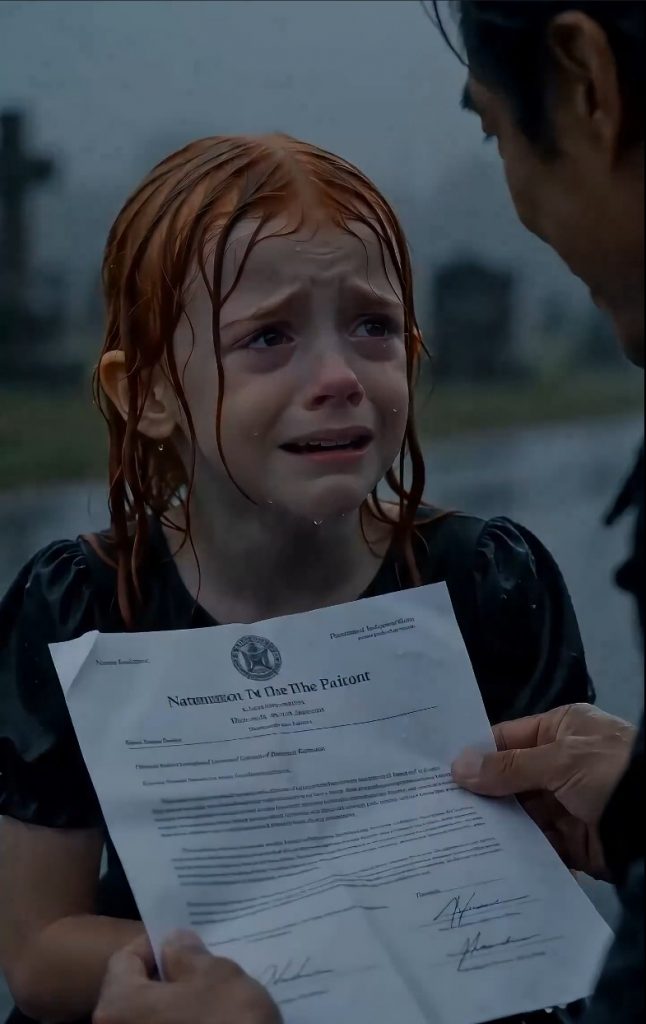
Nataly stared up at her, soaked red hair clinging to her cheeks, her black funeral dress heavy with rain.
For a moment, she did not understand.
Children understand death before they understand abandonment. Death is terrible, but people gather around it. They bring flowers. They lower their voices. They say things like sorry and he loved you and we’re here.
Nobody had prepared Nataly for a woman turning away after the cemetery service and leaving her beside the road with a pink bag and nowhere to go.
“Renee?” she whispered.
The older woman did not answer.
She opened the door of the black Chevrolet SUV and climbed inside.
Nataly stepped forward, panic breaking through her frozen face.
“Please, Renee!” she screamed. “Don’t leave me! I have nowhere to go!”
The SUV door slammed.
The sound echoed across the wet road.
Tires hissed through rainwater as the vehicle pulled away.
Nataly ran two steps after it, then slipped to her knees on the slick asphalt. Her pink bag fell beside her with a soft, helpless thud. The SUV grew smaller through the rain, its red taillights blurring until they looked like two wounds disappearing into the gray.
She screamed until her voice broke.
Behind her, tombstones stood in rows beneath the overcast sky. Far away, a few mourners under black umbrellas moved toward their cars, unaware that the dead man’s daughter had just been discarded on the road outside his own burial.
Nataly folded over herself and sobbed.
Then footsteps splashed through the puddles.
Fast.
A man in a black trench coat ran toward her from down the road, rain darkening his shoulders. He was Asian, perhaps in his forties, with dark hair plastered slightly to his forehead and a face sharpened by alarm.
He slowed before he reached her, lowering himself to her level instead of towering over her.
“Nataly, sweetheart,” he said gently. “You’re not alone.”
She lifted her face.
Her eyes were red, terrified, and empty in the way children’s eyes become when adults break the world too quickly.
“Who are you?” she whispered.
The man pulled a rain-damp document from inside his coat and held it carefully between them.
“Someone your father trusted,” he said. “And this is your future.”
Nataly looked down at the paper.
Renee’s SUV was gone.
But her father’s last protection had just arrived in the rain.
Act II
Before the cemetery, before the rain, before Renee’s cold goodbye, Nataly believed her father had fixed everything.
Thomas Marlow had always fixed things.
Broken dolls. Leaky faucets. School projects that collapsed at midnight. Pancakes shaped badly like animals because Nataly had once asked for a giraffe and he refused to admit he did not know how to make one.
He was not rich in the way Renee wanted him to be, but Nataly never felt poor with him. Their house had books stacked on windowsills, mismatched mugs in the kitchen, and a porch swing that groaned every time Thomas sat beside her after work.
He called her Nat.
Only him.
Her mother had died when Nataly was too young to keep more than flashes. A yellow scarf. A soft laugh. Hands smelling like vanilla soap. Thomas never tried to replace her memory. He kept it alive gently, the way people keep candles burning in windows.
Then he married Renee.
At first, Nataly tried.
Renee was beautiful in a severe way, always neat, always polished, always aware of who was watching. She smiled at teachers. She brought expensive cupcakes to school events. She touched Nataly’s shoulder in public and removed her hand the moment nobody important was looking.
Thomas wanted peace.
Nataly saw that.
So she tried harder.
She said thank you when Renee chose clothes she did not like. She stayed quiet when Renee moved her mother’s photos into a hallway drawer. She pretended not to hear when Renee told a friend, “The child is very attached to him. It’s exhausting.”
Thomas heard more than Renee thought.
That was why, six months before he died, he started making calls from the back porch.
Nataly remembered his voice, low and serious.
“No, I want it in writing.”
“She is my daughter. Everything goes through the trust.”
“If something happens to me, I don’t want Renee making decisions out of anger.”
Nataly asked him once who he was talking to.
He put his phone away and smiled too quickly.
“An old friend.”
That old friend was Daniel Cho.
Thomas and Daniel met twenty years earlier in law school, before Thomas left to become a public defender and Daniel built a quiet, respected practice handling estates and guardianship cases. They were not brothers by blood, but they had been through enough together to become something sturdier than friendship.
Daniel was there when Thomas’s first wife was buried.
He was there when Nataly was born.
He was the first person Thomas called when the doctors said the word cancer.
Renee never liked Daniel.
“He acts like he knows this family better than I do,” she once snapped.
Thomas answered, “He knows me better than almost anyone.”
That frightened her.
Because Renee had married Thomas late, when his illness was still private and his savings looked larger from a distance. She believed grief would make him easy to guide. She believed a sick man would sign whatever kept the house quiet.
Thomas signed things.
Just not the things Renee expected.
Act III
Daniel did not arrive late by choice.
He had been held at the courthouse by a judge who insisted on confirming the emergency guardianship packet before releasing certified copies. Thomas had filed everything weeks earlier, but death turns even prepared documents into locked doors, and Daniel had spent the morning forcing them open.
By the time he reached the cemetery, the service was ending.
He saw Renee at the edge of the crowd, dry-eyed, checking her phone beneath a black umbrella. He saw Nataly near the grave, small and stunned, gripping a pink bag in both hands because she had refused to leave it in the car.
Daniel tried to reach them after the final prayer.
Renee moved first.
She took Nataly by the wrist, not gently, and led her toward the SUV.
Daniel had to push past mourners, mud, umbrellas, and the old cemetery gate. By the time he reached the road, the SUV had already stopped on the shoulder.
Then he heard Renee’s voice.
Your father is gone. You’re not my problem anymore.
Daniel froze.
The sentence was so cruel that, for half a second, his mind refused to accept it.
Then the SUV door slammed.
Nataly screamed.
Daniel ran.
Now he knelt beside her on the wet asphalt, keeping his hands visible, close enough to help but not close enough to scare her.
The document trembled slightly in the rain.
Nataly stared at it through tears.
“What is that?”
“Your father’s guardianship directive,” Daniel said. “And part of his will.”
She blinked.
The words were too large for the moment.
Daniel softened his voice.
“Your dad asked me to take care of you if Renee refused to.”
Nataly looked toward the road where the SUV had vanished.
“She did refuse.”
“I know.”
“She said I’m not her problem.”
Daniel’s jaw tightened.
“No child is a problem.”
Nataly’s face crumpled again.
The rain fell harder.
Daniel removed his coat and draped it over her shoulders without wrapping her too tightly. She clutched the edge of it, shivering. Her black dress stuck to her knees. Her pink bag lay in a puddle beside them.
Daniel picked it up and set it carefully in her lap.
“We’re going to get you warm,” he said. “Then we’re going to make sure she can’t do this again.”
Nataly looked at the paper.
“Is she going to come back?”
Daniel looked down the road.
Renee was gone.
For now.
“She will,” he said. “When she realizes what she left behind.”
Nataly’s voice shook.
“Me?”
Daniel’s expression changed.
“Yes,” he said. “But not only you.”
Act IV
Renee returned within the hour.
Not out of guilt.
Out of calculation.
She came back to the cemetery road in the same black Chevrolet SUV, driving fast enough that water sprayed from the tires. By then, Daniel had moved Nataly beneath the small stone shelter near the cemetery entrance. A police cruiser was parked nearby, lights flashing softly through the rain.
Nataly sat wrapped in Daniel’s coat with a foil blanket over her shoulders, holding a paper cup of hot chocolate a paramedic had given her. Her face was pale, but she was no longer kneeling in the road.
Renee stepped from the SUV, furious.
“What is this?”
Daniel stood.
“Careful,” he said quietly.
She ignored him and looked toward Nataly.
“Get in the car.”
Nataly flinched.
Daniel moved one step, not in front of Nataly like she was helpless, but beside her like she had someone.
“She’s not going with you.”
Renee laughed, sharp and disbelieving.
“You have no authority here.”
Daniel held up the document.
“I do.”
Her eyes went to the paper.
For the first time that day, fear touched her face.
The officer approached.
“Mrs. Marlow, we need to ask you some questions about why a minor was left unattended on a public road after a funeral.”
Renee’s voice changed instantly.
Soft. Wounded. Polished.
“This is a misunderstanding. Nataly was emotional. She ran out of the car.”
Nataly looked up.
The lie landed harder than the rain.
Daniel saw her small hand tighten around the hot chocolate cup.
“She didn’t run,” he said.
Renee’s eyes cut to him.
“You weren’t there.”
“No,” Daniel said. “But the cemetery camera was.”
Renee went still.
The cemetery gate had a security camera mounted above the stone arch, installed after vandalism the previous year. Daniel had noticed it while calling the police. So had the officer, who had already requested the footage from the caretaker.
The officer’s radio crackled.
Then he listened.
Then he looked at Renee.
“Ma’am,” he said, “the footage shows you leaving the child on the road.”
Renee’s face hardened.
“She is not my child.”
Nataly lowered her eyes.
Daniel’s voice became colder than the rain.
“No. She’s Thomas’s child. Which is why he made sure you could not touch her inheritance, her home, or her future.”
Renee stared at him.
“What inheritance?”
Daniel unfolded the second page.
There it was.
The part Renee had not known.
Thomas had placed the house, life insurance, education fund, and a small but valuable parcel of land inherited from Nataly’s mother into an irrevocable trust for Nataly. Daniel was named trustee. Temporary guardianship transferred to him upon Renee’s refusal or proven neglect.
Renee had believed Thomas died with debts and sentimental junk.
She had believed abandoning Nataly would free her from responsibility.
Instead, it activated every protection Thomas had built.
“You tricked me,” Renee whispered.
Daniel shook his head.
“Thomas knew you.”
That was worse.
Renee lunged for the paper, but the officer caught her wrist before she reached it.
“Do not,” he said.
Nataly watched from beneath the blanket.
For the first time since the funeral, she saw Renee not as the woman who decided her fate, but as someone her father had already seen clearly and planned around.
Her father had not left her unprotected.
He had just needed someone to arrive with the proof.
Act V
Nataly did not cry when Renee was taken away.
She thought she would.
Instead, she felt tired in a way tears could not reach.
Daniel sat beside her in the back of the ambulance while the paramedic checked her temperature and asked gentle questions. Had she eaten? Did she feel dizzy? Did anything hurt?
Nataly answered softly.
Daniel did not answer for her.
That mattered more than she could explain.
Afterward, he drove her not to a stranger’s office or a shelter, but to his own house on a quiet street lined with wet maple trees. His wife, Mei, opened the door before they reached the porch. She had warm towels ready, soup on the stove, and eyes full of grief she did not force onto Nataly.
“You can call me Mei,” she said. “Or nothing at all until you want to.”
Nataly nodded.
That first night, she slept in a guest room with yellow curtains and a small lamp shaped like a moon. Her pink bag sat beside the bed. Inside were three things: a folded funeral program, a hair ribbon, and the small wooden bird her father had carved for her when she was seven.
She held the bird until she fell asleep.
The legal process unfolded slowly.
Renee tried to challenge the documents.
Then the cemetery footage appeared.
Then witnesses confirmed she had refused responsibility for Nataly during the funeral reception. Then Daniel produced emails from Thomas, medical notes, signed directives, trust papers, and one final video Thomas had recorded two days before he died.
Nataly watched it with Daniel and Mei in the living room, wrapped in a blanket, the remote in her own hand so she could stop whenever she needed to.
Thomas appeared on screen thinner than she remembered, but his smile was the same.
“Hi, Nat.”
She pressed both hands over her mouth.
The video continued.
“I hope Daniel never has to show you this. If he does, it means I’m not there to explain things myself, and I’m sorry. I’m so sorry, sweetheart.”
Nataly paused it.
Mei asked softly, “Do you want to stop?”
Nataly shook her head after a moment.
She pressed play.
Thomas looked straight into the camera.
“None of this is your fault. Not my illness. Not Renee’s choices. Not any adult’s failure to be kind. You are my daughter. My best thing. I made plans because loving you means protecting you, even from people I once hoped would do better.”
Nataly cried then.
Not like on the road.
Not with panic.
This grief was different. It had somewhere to go.
The court granted Daniel permanent guardianship three months later.
Nataly kept her father’s last name. She kept her room in Thomas’s old house exactly as it was for a while, then slowly began choosing what to move into Daniel and Mei’s home. First the books. Then the moon lamp. Then the porch blanket. Last, after nearly a year, the framed photo of her father from the living room wall.
Renee disappeared from town after losing her challenge.
People still spoke of her sometimes in the hushed, fascinated tone reserved for cruelty that had been witnessed too clearly to deny. Nataly did not ask where she went.
She had learned that not everyone who leaves deserves to be followed.
On the anniversary of Thomas’s funeral, Daniel drove Nataly back to the cemetery.
This time, there was no black SUV.
No screaming.
No rain, at first.
They stood by Thomas’s grave under a pale gray sky. Nataly placed a small wooden bird beside the stone, the one he had carved for her. She had kept it long enough to know she could let it stay with him.
Daniel stood a few steps away, giving her privacy.
Nataly touched the top of the headstone.
“I thought you left me,” she whispered.
The wind moved through the wet grass.
A drop of rain hit her hand.
Then another.
She looked down the road where Renee had abandoned her and where Daniel had come running with the document folded inside his coat.
For months, that road had lived in her memory as the place she lost everything.
Now she understood it differently.
It was the place where a lie ended.
The place where her father’s love arrived late but not too late.
The place where a man knelt in the rain and told her she was not alone, then proved it with more than words.
Daniel approached when she turned.
“You ready?”
Nataly nodded.
He offered his hand but did not grab hers.
She took it.
Together, they walked back toward the car as the rain softened around them.
Her pink bag was gone now, replaced by a dark school backpack covered in tiny star pins. Inside were homework, a sketchbook, and a copy of the legal document Daniel had laminated for her because she once admitted she liked knowing it existed.
Not because paper could love her.
But because her father had.
And because, on the worst day of her life, when someone tried to throw her away in the rain, that paper became proof of the truth Renee never understood.
Nataly was not a burden.
She was not an inconvenience.
She was not a problem left on the side of the road.
She was Thomas Marlow’s daughter.
And he had left the world making sure someone would come back for her.