Act I
The first thing Warren Rourke saw was the hand.
It slid out from beneath the metal maintenance door like something the darkness had pushed into daylight. Pale fingers scraped across dust and gravel, trembling, careful, desperate not to make too much noise.
Then came the necklace.
A thin silver chain. A small metal pendant. The faintest clink against the gravel.
Warren stopped so suddenly the heel of his boot dug into the dirt.
Behind him, the motorcycles sat in a crooked line under the harsh afternoon sun, chrome hot enough to sting and leather seats shining with dust. The old industrial lot was supposed to be empty except for the men gathering for a charity ride.
But the maintenance room was not empty.
Someone was inside.
Warren crouched slowly, his knees cracking beneath his denim vest and green hoodie. The faded orange-red word MAINTENANCE stretched across the door above him. Below it, in the narrow strip of shadow, the hand twitched once and tried to retreat.
“Hey,” he said, voice low. “Someone in there?”
A sound came from behind the metal door.
Not a clear answer.
A muffled sob.
Warren’s fingers closed around the necklace.
The pendant was cold.
He turned it over in his palm, and the air changed.
It was an anchor.
Small. Silver. Scratched along one edge. Almost identical to the charm hanging from the chain on his right boot.
His heart hit his ribs once, hard.
No.
He leaned closer to the bottom of the door.
“Can you hear me?”
Inside, a woman’s breath shook in the dark.
“Please…” she whispered, barely audible through the metal. “Help me.”
Warren’s face went still.
He looked down at the necklace again.
There were initials engraved on the back.
S.R.
His daughter’s initials.
For a moment, the lot disappeared. The motorcycles, the gravel, the sun, the dust. All of it pulled away until there was only that silver pendant in his hand and the voice behind the door.
Then footsteps crunched across the gravel behind him.
Slow.
Heavy.
Possessive.
Warren rose halfway and turned.
A man in a grease-stained work jacket stepped into the space between him and the maintenance door. He was broad, hard-faced, with oil under his fingernails and suspicion already burning in his eyes.
“What are you doing,” the man asked, “in front of my shed?”
Warren did not answer.
He only tightened his fist around the necklace.
Because the last time he had seen it, it had been around his daughter’s neck.
Act II
Warren Rourke had given Sophie the necklace on her sixteenth birthday.
She had hated most sentimental things back then. Birthday cards embarrassed her. Public hugs made her roll her eyes. Anything that looked too sweet was immediately suspicious.
But when Warren placed the little silver anchor in her hand, Sophie went quiet.
“It’s not fancy,” he said, suddenly self-conscious.
She ran her thumb over the pendant.
“It’s like yours.”
Warren lifted one boot, showing her the tiny anchor charm clipped to the chain across the leather.
“Mine’s uglier.”
“That’s because you’re old.”
He laughed so hard she finally smiled.
Her mother had died three years earlier, and after that, laughter became rare in their house. Warren did his best, but grief had made him clumsy. He could fix engines, rebuild carburetors, weld broken frames, and ride through rain without blinking.
But he did not know how to raise a daughter who woke up some nights crying into her pillow and pretended the next morning that she had only been tired.
The anchor became their silent promise.
No matter how rough the water got, no one drifted too far.
For a while, it worked.
Sophie grew up sharp, stubborn, and impossible to intimidate. She studied criminal justice, then switched to investigative journalism because, as she told Warren, “Courts move too slowly and newspapers make cowards nervous.”
Warren hated that sentence.
He was proud of it too.
Their last real argument happened eight months before the maintenance door.
Sophie had been investigating Mercer Demolition, a private contractor buying up old industrial properties around the county. Officially, the company specialized in cleanup and redevelopment. Unofficially, people whispered about forged permits, unsafe demolitions, missing inspection logs, and low-income tenants pushed out of buildings days before they were condemned.
The man who ran the company was Dale Mercer.
Grease-stained jacket. Dead eyes. A handshake that made honest men want to count their fingers afterward.
Warren told Sophie to leave it alone.
She told him fear was not wisdom.
He told her she sounded like her mother when she wanted to win.
She told him that was the first smart thing he had said all night.
Then she left.
They did not speak for nine days.
On the tenth, Sophie sent a message.
Dad, I found something bigger than permits.
Then nothing.
No call.
No follow-up.
No apology.
At first, Warren thought she was still angry. Then he drove to her apartment and found her laptop gone, her coffee cold in the sink, and the anchor necklace missing from the little dish by her bed.
The police treated it as a missing adult case.
Warren treated it as war against time.
For seven months, he searched junkyards, roadside motels, demolition offices, records rooms, and every rumor that crossed the county line. His motorcycle club, the Harbor Saints, helped him without being asked. They printed flyers. Rode search routes. Talked to truckers, tow-yard workers, late-shift clerks, and anyone else who saw what respectable people missed.
Dale Mercer’s name kept circling the edges.
Never close enough to grab.
Always there.
The old industrial lot was supposed to be the next charity ride staging point. Warren had rented it for the weekend because it was wide, cheap, and close to the highway.
He did not know Mercer still used the maintenance shed.
He did not know the lock had been changed.
He did not know his daughter was inside until her hand slipped through the gap and gave him back the promise he had once placed around her neck.
Now Dale Mercer stood between him and the door.
“My shed,” Dale repeated, eyes flicking to Warren’s closed fist. “You deaf?”
Warren looked past him toward the metal door.
From inside came the faintest sound.
A restrained breath.
Then a whisper, small enough that the wrong man might miss it.
“Dad?”
And every piece of Warren Rourke that had been dead for seven months came roaring back to life.
Act III
Dale heard it too.
His shoulders stiffened.
Warren saw the reaction and knew.
Not guessed.
Knew.
The woman behind the door was Sophie. Dale knew she was there. And the only reason he looked frightened now was because the wrong person had found her.
Warren’s voice dropped.
“Move.”
Dale’s mouth twisted.
“You don’t want to do this.”
“No,” Warren said. “You don’t.”
Behind him, a few of the Harbor Saints had begun to notice the stillness near the maintenance door. Men who had been joking by their bikes slowly turned. One killed the music coming from a portable speaker. Another stepped away from his motorcycle and began walking across the gravel.
Dale glanced at them.
His confidence faltered for half a second.
Then he leaned closer to Warren.
“That girl is confused,” he said quietly. “She broke into my property. She’s been stealing from me. I was waiting for the sheriff.”
Warren held up the necklace.
“With her locked inside?”
Dale’s eyes hardened.
“You don’t know what you’re holding.”
“I know exactly what I’m holding.”
Warren opened his palm.
The silver anchor rested there, dusty and trembling slightly because his hand would not stay still.
“My daughter wore this.”
Dale’s face changed.
Not shock.
Calculation.
That was worse.
Warren had spent too many years reading men outside bars, courtrooms, hospitals, and police stations. There were men who lied because they were scared. Men who lied because they were ashamed. Men who lied because lying had become the only language they trusted.
Dale Mercer lied like a man buying seconds.
“You need to calm down,” Dale said.
Inside the room, metal shifted faintly.
Warren looked at the door.
“Sophie,” he called, forcing his voice not to break. “It’s me.”
A sob answered.
Dale moved.
Not toward Warren.
Toward the door.
Warren stepped into his path.
The two men stood close enough for Warren to smell motor oil and stale cigarettes on Dale’s jacket.
“You touch that door,” Warren said, “and every man in this lot will know why.”
Dale’s eyes flicked to the approaching bikers.
There were six now. Then eight. Then more. They did not run. They did not shout. They simply formed a loose half-circle behind Warren, boots planted in gravel, faces hard with the kind of patience that made threats unnecessary.
One of them, a gray-bearded man named Knox, lifted his phone.
“Sheriff’s on the line,” he said.
Dale’s jaw tightened.
Warren kept his eyes on him.
“You can walk away from the door, or you can explain to the sheriff why a missing woman is inside a locked room on property I rented this morning.”
Dale blinked.
“You rented?”
Warren’s expression did not move.
“The lot. The office. The exterior buildings. Signed at 8:10 a.m.”
For the first time, Dale looked fully afraid.
Because “my shed” had just become a lie with witnesses.
A muffled cry came from inside again.
Warren turned toward the door.
“Sophie, can you move?”
“No,” she whispered. “My ankles.”
The words cut through him, but he did not let rage take the wheel. Rage was easy. Rage was fast. Rage made mistakes.
His daughter needed him clear.
Knox spoke into the phone, giving the location. Another rider ran to the main gate to guide emergency crews. Someone else found the site manager’s number from the rental paperwork.
Dale watched the organized movement around him, and panic began to leak through his anger.
“You people have no authority,” he snapped.
Warren looked at him.
“You should have worried about authority before you locked my daughter in a maintenance room.”
Dale took one step backward.
Then, from inside the shed, Sophie raised her voice just enough for everyone to hear.
“He has the files.”
Dale froze.
Warren’s eyes narrowed.
“What files?”
Sophie’s voice shook, but she forced the words out.
“In the wall cabinet. Behind the copper pipes. Everything Mercer hid.”
Dale lunged toward the door handle.
Three bikers moved at once and blocked him without laying a hand on him.
Warren stared at the faded MAINTENANCE sign.
Suddenly, the room behind that door was no longer just a prison.
It was the reason Sophie had disappeared.
Act IV
The sheriff arrived with two deputies and a fire-rescue unit twelve minutes later.
To Warren, it felt like twelve years.
Sophie stayed quiet after that last warning. Every few seconds, Warren spoke to her through the door, saying her name, telling her help was there, telling her to keep breathing. He did not know if she believed him.
He barely believed it himself.
Dale tried to talk over everyone.
He claimed Sophie had broken in. He claimed he had found her unstable and contained her for her own safety. He claimed the room was dangerous, the door was jammed, the whole thing was a misunderstanding.
Nobody believed him.
Not after Sophie’s missing person alert came up on the deputy’s screen.
Not after Warren showed the necklace.
Not after the site manager confirmed Mercer Demolition had lost access to the lot months earlier and had no legal right to that shed.
The rescue crew opened the door with controlled, professional care.
When the metal finally gave way, daylight fell into the maintenance room in a long white blade.
Warren saw the copper pipes first.
Then the dust.
Then Sophie.
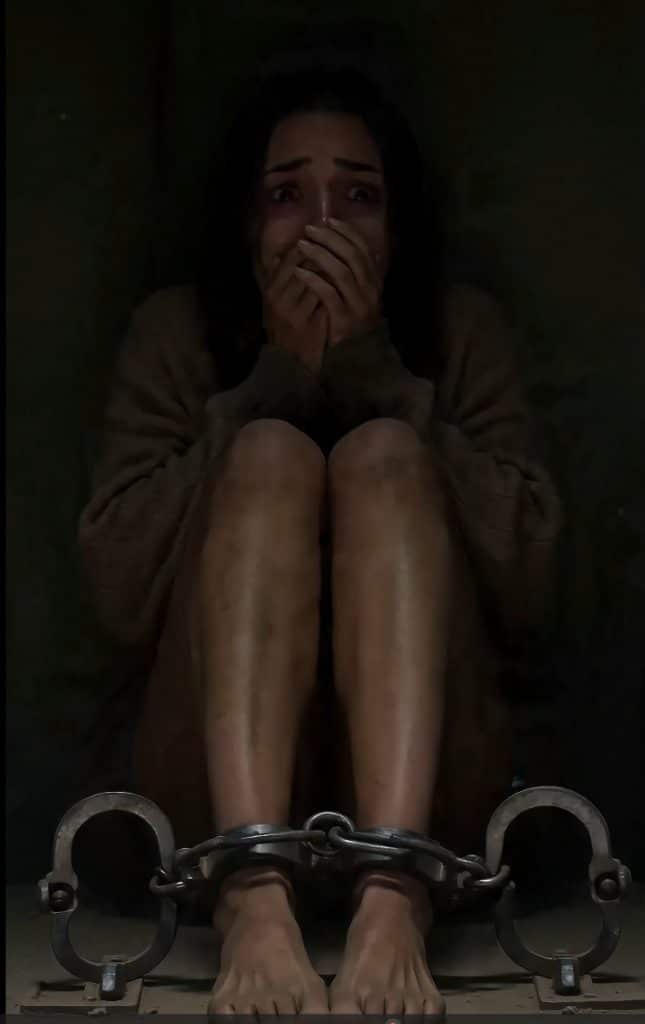
She was huddled against the wall in a brown knit sweater, barefoot, her hair tangled, her face streaked with dirt and tears. Metal restraints held her ankles close enough that she could not stand properly. She flinched when the door opened, then blinked into the sunlight.
Warren stepped forward.
A deputy held him back gently.
“Let medical check her first.”
Warren almost argued.
Then Sophie looked up.
“Dad?”
That one word broke him.
He dropped to his knees at the doorway, close enough for her to see him, far enough not to crowd the rescue workers.
“I’m here,” he said.
Sophie started crying then, not quietly, not carefully, but like someone whose body had been waiting too long for permission to believe she was safe.
Warren cried too.
He did not hide it.
Outside, Dale Mercer stopped talking.
One of the deputies moved him away from the door. Dale’s eyes kept darting toward the back wall of the room.
The sheriff noticed.
So did Warren.
While the medical team helped Sophie, Knox pointed toward the copper pipes.
“She said wall cabinet.”
A deputy opened it.
At first, there were only old rags, rusted fittings, and a cracked plastic toolbox.
Then the deputy removed the false back.
Inside were folders sealed in plastic, a hard drive, stacks of permits, and photographs of buildings marked for demolition before residents had been notified. There were payment records. Inspection reports. City emails. A list of names.
Sophie’s investigation.
Dale Mercer’s empire, hidden behind a wall of copper pipes.
The sheriff looked through the first folder, then the second.
His face hardened.
Dale said, “Those are stolen.”
Sophie lifted her head from the stretcher.
Her voice was weak but clear.
“No,” she said. “They’re copied.”
Dale’s eyes snapped to her.
Sophie looked at Warren.
“I sent backups,” she whispered. “The night I disappeared. I just didn’t know if anyone got them.”
Warren remembered the message.
Dad, I found something bigger than permits.
He had thought it was the last thing she managed to send.
It had been the first move in a fight she refused to lose.
The sheriff turned to Dale.
“You’re going to come with us.”
Dale’s face collapsed into rage.
“You don’t understand what she did. She was going to ruin contracts worth millions.”
Warren stood slowly.
His voice was quiet.
“She was going to tell the truth.”
Dale looked at him with pure hatred.
“You think that makes her a hero?”
Warren glanced at Sophie, pale and shaking but alive under the sunlight.
“No,” he said. “Being afraid and doing it anyway does.”
The deputies led Dale across the gravel.
No dramatic struggle. No speech. No final victory from him.
Just boots grinding through dust as every lie he had built began to lose weight.
Sophie reached toward Warren.
He took her hand.
Her fingers closed weakly around his.
The anchor charm on his boot caught the sunlight at the same moment the necklace chain rested in his palm.
For the first time in seven months, both anchors were in the same place.
And neither one had drifted away.
Act V
Sophie spent three days in the hospital.
Warren spent every hour he was allowed beside her bed.
He sat in the chair with his vest folded over his lap, hands rough and still, watching the monitors blink softly in the quiet. He had imagined finding her a thousand times. In every version, he knew exactly what to say.
In real life, he mostly said nothing.
He held her hand.
That was enough for the first day.
On the second day, Sophie woke after a long sleep and looked toward the window.
“You were right,” she said.
Warren frowned.
“About what?”
“I should have been more careful.”
The words hurt him.
He leaned forward.
“No.”
She looked at him.
“I walked into it.”
“You followed evidence. He committed the crime.”
Sophie’s eyes filled.
“I didn’t call you because I thought you’d try to stop me.”
“I would have.”
“I know.”
Warren swallowed.
“I was scared.”
“I was too.”
That was the first honest thing between them in months.
Maybe years.
Before Sophie disappeared, they had both mistaken love for control. Warren wanted to protect her so badly that he tried to shrink the world around her. Sophie wanted to prove she could stand on her own so badly that she stopped letting anyone stand near her.
Dale Mercer had used the space between them.
Now that space was gone.
The investigation spread fast.
Mercer Demolition lost every contract within a week. City officials who had ignored complaints suddenly found the courage to cooperate. Families who had been pushed from condemned buildings came forward. Inspectors admitted reports had been altered. Former employees surrendered copies of emails they had kept hidden for years.
Sophie’s files did not just expose one man.
They exposed a machine.
Dale Mercer had built his fortune on dirty permits, unsafe sites, and people nobody powerful cared to hear. He had assumed a young reporter could be frightened into silence. Then he assumed a locked maintenance room would hold the truth long enough for him to destroy it.
He had not counted on a necklace.
He had not counted on a father who never stopped looking.
And he definitely had not counted on a biker lot full of men who knew the difference between intimidation and courage.
A month later, Warren brought Sophie back to the old industrial lot.
She walked slowly, still recovering, one hand wrapped around the silver anchor necklace at her throat. The maintenance door had been removed. Yellow tape marked the entrance. The word MAINTENANCE was still visible on the metal slab lying against the wall, faded and harmless now.
The room looked smaller in daylight.
That surprised her.
Fear had made it huge.
Warren stood beside her, saying nothing.
Sophie looked at the gap beneath the doorframe where she had pushed her hand through with the last strength she had left.
“I didn’t know it was you outside,” she said.
Warren’s jaw worked.
“I didn’t know it was you inside.”
She smiled faintly.
“But you stopped.”
He looked down at his boot, at the matching anchor charm.
“I heard metal hit gravel.”
Sophie touched her necklace.
“Mom used to say you could hear a loose bolt from across a highway.”
“She exaggerated.”
“No, she didn’t.”
For a moment, the lot was quiet.
Then motorcycles began rolling in.
One after another, the Harbor Saints parked in a clean line near the gate. Knox climbed off first, carrying a cardboard box. Others followed with paint, lumber, tools, and a new sign wrapped in brown paper.
Sophie looked confused.
Warren cleared his throat.
“We talked to the county.”
“About what?”
“The lot.”
She turned to him.
Warren nodded toward the old maintenance building.
“We’re turning it into a reporting office. Legal aid, whistleblower support, missing persons resources. Your idea, mostly.”
“My idea?”
“You always said people needed somewhere safe to bring ugly truths.”
Sophie stared at him.
Then the tears came, quiet and immediate.
Warren looked away fast, pretending to check the sign, because he still did not know what to do with too much emotion in public.
Knox unwrapped the board.
The new name was painted in deep blue letters.
Anchor House.
Beneath it, in smaller script, were the words:
No one disappears quietly.
Sophie covered her mouth.
Warren’s voice was rough.
“I should have listened better before.”
She leaned into him, carefully at first, then fully.
“You found me.”
He wrapped both arms around her.
Not too tight.
Just enough.
The trial took nearly a year.
Sophie testified. So did Warren. So did former workers, tenants, inspectors, and families who had lived for too long beneath the weight of Mercer’s threats. Dale’s lawyers tried to call Sophie reckless. Confused. Ambitious. Angry.
She answered every question.
When the verdict came, Warren was sitting behind her in the courtroom, one boot planted firmly on the floor, the anchor charm resting against the leather.
Sophie reached back without looking.
He took her hand.
Afterward, reporters crowded the courthouse steps, shouting questions about corruption, contracts, and the dramatic rescue at the maintenance shed.
Sophie ignored most of them.
One reporter asked what had saved her.
She looked at Warren.
Then at the necklace.
“A promise,” she said.
That night, Warren rode home slower than usual.
Sophie followed in a car with Knox, refusing to let her father ride alone because, as she put it, “You’re old and dramatic.”
Warren pretended to be offended.
He smiled the whole way.
The gravel lot changed over the next year. The dusty shed became a clean office with warm lights, donated desks, secure filing cabinets, and a coffee machine that worked only when it felt like it. The motorcycles still came on weekends. So did people carrying folders, photographs, old fears, and stories they had been told were too dangerous to say aloud.
Some arrived shaking.
Some arrived angry.
Some arrived with nothing but one small object they believed might prove someone was still out there.
A ring.
A key.
A ribbon.
A necklace.
Sophie listened to every one of them.
Warren usually stood near the door.
Not because she needed guarding.
Because some promises are not about control.
They are about staying close enough to hear the signal when it comes.
Years later, Warren would still remember the sound of that silver chain touching gravel.
A tiny clink beneath a heavy metal door.
Almost nothing.
Almost lost under boots, motorcycles, sunlight, and dust.
But not lost.
Never lost.
Because sometimes the smallest sound in the world is the one that brings the truth back into daylight.