Act I
“Watch this.”
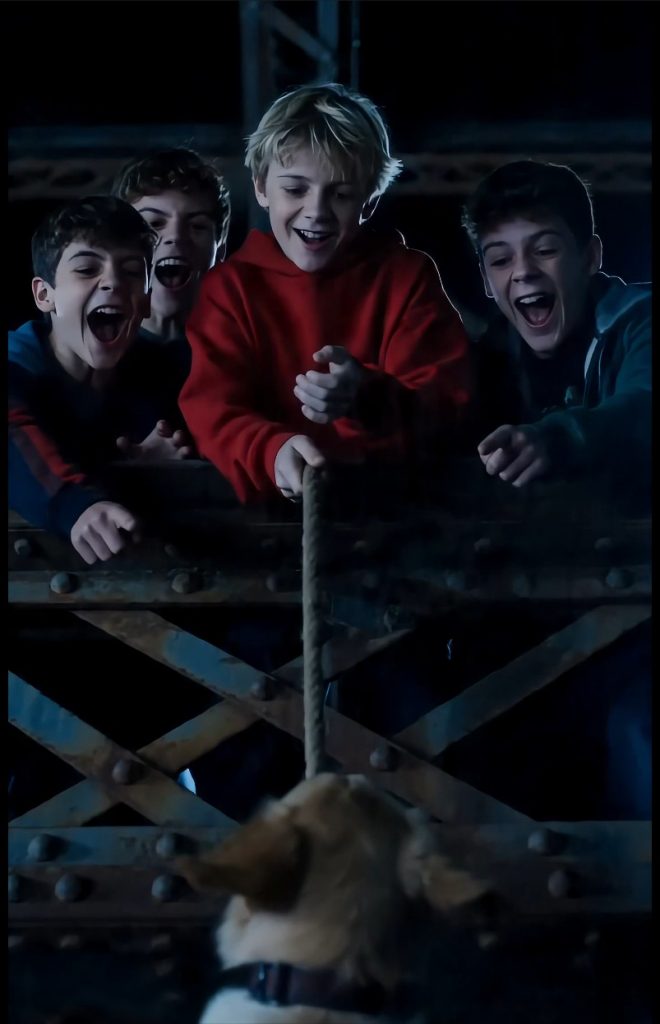
The boy in the red hoodie said it like he was about to perform a magic trick.
The bridge around him was old, rusted, and empty, its metal beams groaning softly under the night wind. Below, the water moved black and cold, swallowing the faint reflections of distant lights.
Three boys stood behind him, laughing too loudly for a place that felt abandoned.
And at the end of the rope was a puppy.
A small Golden Retriever, light-colored and trembling, with a dark collar half-hidden in its soft fur. Its paws scrambled against the metal edge as the boy in the red hoodie pulled the rope toward the railing.
The puppy whimpered.
The boys laughed harder.
“Tyler, come on,” one of them said, but his voice carried excitement, not mercy.
Tyler Knox turned his head, grinning.
“What? You scared?”
No one answered.
That was all the permission he needed.
He fed the rope over the side of the bridge.
Slowly.
The puppy dropped out of view, dangling beneath the railing, legs moving in frantic little kicks above the dark water. Its cries rose into the wind, thin and terrified, while the boys leaned over to watch.
Tyler’s red hoodie glowed like a wound against the night.
He looked down at the puppy and smirked.
“See ya.”
Then he let go.
The rope slid from his hands.
There was a brief, awful cry.
Then a splash rose from the black water below.
For a second, the bridge went silent.
Even the boys stopped laughing.
Then one of them gasped, half-shocked, half-thrilled. Another slapped the railing with his palm. Tyler stood with both hands empty, breathing fast, waiting for the rush of power to return.
It did not.
Because from beneath the bridge, a harsh white light exploded upward.
The boys recoiled, shielding their eyes.
Metal clicked somewhere below.
A voice thundered through the dark.
“Hold it right there!”
Tyler stumbled back from the railing, his smirk gone.
The spotlight pinned him in place, bright enough to show the fear breaking across his face.
And below the bridge, in the water he thought had hidden everything, someone was already moving toward the puppy.
Tyler Knox had not just been caught.
He had been watched from the beginning.
Act II
The puppy’s name was Scout.
He had not been born in a shelter or found wandering some alley in the rain. He came from a rescue training program three towns over, where patient volunteers raised puppies to become comfort dogs for children, veterans, and elderly patients who needed something warm and living beside them when the world felt too heavy.
Scout was only four months old.
Too young to understand cruelty.
Old enough to understand fear.
That afternoon, he had been at the home of Nora Whitcomb, a retired school librarian who fostered rescue dogs until permanent families were ready for them. Nora lived alone in a white cottage near the old mill road, with a porch full of wind chimes and a kitchen that always smelled faintly of cinnamon.
Scout had followed her everywhere.
To the mailbox.
To the garden.
To the laundry room, where he stole one sock every Tuesday and looked deeply offended when asked to return it.
Nora had laughed more in the two weeks since Scout arrived than she had in the year after her husband died.
Then Scout vanished.
The back gate was open.
His blue blanket lay near the porch steps.
Nora searched until her voice broke.
By sunset, half the town knew. By dusk, Officer Ray Alvarez knew too.
Ray was not technically on duty that night. He worked animal control and river patrol in a county too small to separate jobs neatly. He knew the rusted bridge because teenagers had been using it for dares, parties, and late-night videos for years.
He also knew Tyler Knox.
Everybody did.
Tyler was the son of Councilman Grant Knox, a man who gave speeches about family values while making sure his own son never faced the full weight of consequences. Tyler had been caught smashing mailbox flags, harassing younger kids, throwing rocks at an abandoned greenhouse, and once locking a stray cat in a storage shed until a janitor found it.
Every time, the same thing happened.
Boys will be boys.
No real harm done.
He’s from a good family.
Ray hated that phrase.
Good families did not produce boys who mistook helplessness for entertainment.
Scout’s collar changed everything.
Nora had clipped a small tracker to it after a foster dog went missing the previous year. When she called Ray, the signal was faint but moving. First toward the old mill road. Then toward the industrial bridge.
Ray did not wait for backup before heading toward the river.
But he did call someone.
His daughter, Emma.
Emma was a veterinary technician, and she kept an emergency kit in her truck because people had a way of hurting animals first and asking for help later. When Ray told her the tracker had stopped near the bridge, she did not ask questions.
She just drove.
Ray reached the riverbank beneath the bridge before the boys knew anyone was there. He killed his headlights, pulled the patrol skiff under the shadow of the beams, and followed the sound of laughter above him.
Then he heard the puppy.
Not barking.
Whimpering.
Ray lifted the spotlight but did not switch it on yet.
He needed to know what they were doing.
He needed proof strong enough that no father, no councilman, no lawyer could smooth it into a misunderstanding.
Above him, Tyler said, “Watch this.”
Ray’s hand tightened around the light.
Emma whispered from behind him, “Dad.”
Ray heard the rope scrape over metal.
He heard the puppy cry.
And in that moment, the night stopped being an investigation.
It became a rescue.
Act III
Scout hit the water only a few yards from the patrol skiff.
Ray moved before the splash settled.
He grabbed the rescue pole while Emma leaned over the side with a blanket already in her hands. The puppy’s light fur flashed briefly in the beam of a smaller deck light, then dipped under a ripple and surfaced again, paddling in panic.
“Easy, baby,” Emma whispered, her voice shaking. “We’ve got you.”
Ray hooked the rope carefully and pulled Scout closer without jerking him.
The puppy coughed and cried, still fighting the water, until Emma caught him under the chest and lifted him into the boat. He collapsed into the blanket, soaked, shaking, but alive.
Emma wrapped him immediately.
“Breathe, Scout,” she said. “Come on. Stay with me.”
Scout made a soft sound and pressed his wet nose against her wrist.
That tiny movement nearly broke Ray.
Only then did he switch on the spotlight.
The white beam shot upward through mist and metal, catching Tyler and his friends at the railing like insects under glass.
“Hold it right there!”
The boys froze.
Ray could see them clearly now.
Three in dark clothes.
One in red.
Tyler Knox stood closest to the edge, his mouth open, one hand raised against the glare. For the first time in what was probably his entire life, he looked like a boy who had discovered the world did not belong to him.
Ray kept the light steady.
“Step away from the railing.”
No one moved.
“Now.”
The authority in his voice cut through the bridge.
The boys backed away.
One of Tyler’s friends started crying almost immediately. Another pulled out his phone, then thought better of it when Ray shouted for him to put it on the ground. The third kept whispering, “We didn’t do anything,” even though they all knew that sentence had already failed.
Tyler recovered first.
“My dad’s going to sue you,” he called down, voice cracking.
Ray looked at Scout trembling in Emma’s arms.
Then he looked back up.
“Tell him to bring a towel.”
Within minutes, red and blue lights washed across the bridge. Deputies arrived from both ends, blocking the boys before they could run. Their laughter was gone now, replaced by panicked excuses that contradicted each other before the handcuffs were even out.
“It was a joke.”
“We didn’t think it would fall.”
“It wasn’t my idea.”
“He was already near the edge.”
Tyler said nothing.
He only stared down at the boat, at the puppy wrapped in Emma’s blanket, at the spotlight that had turned his cruelty into evidence.
Then Ray climbed the steel ladder from the river access platform and stepped onto the bridge.
Water dripped from his sleeves.
His face was calm.
That calm frightened Tyler more than rage would have.
Ray stopped in front of him.
“Do you know what I heard before you dropped him?” he asked.
Tyler swallowed.
Ray leaned closer.
“I heard you laugh.”
Tyler looked away.
And that was the first honest thing he did all night.
Act IV
Councilman Grant Knox arrived before the ambulance for Scout had even left the riverbank.
He came in a black SUV with polished wheels and a coat thrown over his dress shirt, like a man interrupted on his way to something more important. He did not run to his son. He did not ask about the puppy.
He went straight to the sheriff.
“This is being blown out of proportion,” he said.
Ray stood nearby with Scout’s wet collar in one hand.
Emma had already taken the puppy to the emergency clinic, but the collar remained as evidence. So did the tracker. So did the rope. So did the camera from Ray’s skiff, which had recorded everything after they reached the bridge.
The sheriff looked tired.
“Grant, not tonight.”
“My son is a minor.”
“So was the animal he nearly killed,” Ray said.
Grant Knox turned toward him slowly.
Ray did not blink.
The councilman’s mouth tightened. “Officer Alvarez, I know you’re emotional—”
“No,” Ray said. “I’m clear.”
Tyler stood beside a deputy, pale and silent now. His friends were separated behind different patrol cars. One of them had already started telling the truth. Boys like that always did when consequence entered the room.
Grant lowered his voice.
“Ray, you have no idea how much trouble you’re creating.”
Ray almost laughed.
For years, men like Grant Knox had confused trouble with accountability.
They thought trouble was what happened when a powerful person was embarrassed. They never thought trouble was a puppy crying in the dark while four teenagers leaned over a bridge and laughed.
The sheriff stepped between them.
“That’s enough.”
But Grant was not finished.
He turned to Tyler.
“Don’t say another word.”
Tyler looked relieved.
That relief lasted exactly four seconds.
Because Nora Whitcomb arrived.
She came in the passenger seat of Emma’s truck, wrapped in an old cardigan, her white hair loose from its pins. She was not supposed to be there. Emma had tried to take her home after telling her Scout was alive, but Nora insisted.
She stepped out slowly, one hand on the truck door, eyes moving from the bridge to the boys to the rope coiled in an evidence bag.
Then she saw Tyler.
Recognition passed over her face like grief changing shape.
“You,” she whispered.
Tyler looked confused.
Grant frowned. “Ma’am, this is a police matter.”
Nora ignored him.
She walked toward Tyler until the deputy gently held out an arm to stop her from getting too close.
“You came to my porch last month,” Nora said. “You asked if I still lived alone.”
Tyler’s face changed.
Grant went still.
Nora’s voice shook, but it did not weaken.
“You said you were collecting signatures for the councilman’s youth program. You smiled at me.”
Ray looked at the sheriff.
The sheriff looked back.
The story widened in silence.
Nora pointed at Tyler with a trembling hand.
“You knew where Scout was.”
Tyler stared at the ground.
Grant said sharply, “Tyler.”
But the damage had already been done.
One of the boys near the patrol car broke.
“He said the old lady loved that dog,” he blurted out. “He said it would be funny to make her think it ran away.”
Nora closed her eyes.
Ray felt something inside him go cold.
This had never been random.
Not a prank.
Not a dare gone too far.
It had been targeted.
A lonely woman. A helpless puppy. A bridge dark enough to hide what kind of person Tyler Knox had become.
Grant Knox stopped talking after that.
No threats.
No speeches.
No talk of lawsuits.
Just a father staring at a son he had protected so many times that protection had turned into permission.
Tyler finally looked up at Nora.
For one brief second, he seemed almost small.
But Nora did not offer him comfort.
She only asked the question no one could answer for him.
“What did he ever do to you?”
Tyler’s face crumpled, not from remorse, but fear.
And that was when Ray knew the difference mattered.
Act V
Scout survived.
That was the sentence everyone in town needed to hear the next morning.
He was cold, shaken, and exhausted, but Emma’s clinic kept him warm through the night. By sunrise, he had lifted his head. By noon, he had eaten a little. By evening, his tail thumped once when Nora walked in.
Nora cried so hard Emma had to help her sit down.
Scout crawled into her lap as much as a growing Golden Retriever could, burying his face against her sweater. Nora held him with both arms and kept whispering, “You came back. You came back.”
Ray stood in the doorway and looked away.
He had seen plenty in his career.
Still, some rescues stayed with a person differently.
Not because of how close the loss came.
Because of how little it would have taken for the whole thing to be prevented.
One adult saying no sooner.
One friend refusing to laugh.
One parent letting a child face consequences before cruelty became a performance.
The town divided at first.
Towns always did when the person accused had the right last name.
Some people said Tyler was just a teenager. Some said the bridge was dangerous and boys made stupid choices. Some said social media had ruined kids, as if a phone had invented the absence of mercy.
Then the video came out in court.
Not publicly.
Not online.
The judge sealed most of it because of the boys’ ages and because nobody needed to watch Scout’s fear to understand the crime.
But enough details were reported.
The laughter.
The rope.
The words.
Watch this.
See ya.
The town stopped defending what it could no longer soften.
Tyler and his friends faced charges. They were ordered into counseling, community service, and strict probation, but Tyler received more. Not because he wore the red hoodie. Because he led it. Because he planned it. Because he targeted Nora and took Scout from a place where the puppy trusted the world.
Grant Knox lost the next election by the largest margin in county history.
He blamed the media.
Nobody believed him.
Nora brought Scout home three days after the bridge.
The first thing he did was steal a sock from the laundry room.
Nora laughed and cried at the same time.
After that, Scout slept beside her bed every night. He still flinched at sudden metal sounds for a while. He disliked bridges. He stayed closer to Nora on walks. But dogs carry pain differently than people. They do not pretend it did not happen, but they also do not worship it.
Given safety, they return to love.
Scout returned slowly.
Then fully.
By spring, he passed his first comfort-dog evaluation.
The trainer said he had an unusual instinct for fear. He knew when someone was sad before they spoke. He leaned gently against shaking hands. He rested his head on hospital beds without being asked.
Nora said, “He knows what it feels like to need someone to come.”
The following summer, the county replaced the rusted bridge railing and installed cameras and lights. Ray hated that it took cruelty to make people repair what they should have fixed years earlier, but he attended the reopening anyway.
Not for the bridge.
For the plaque.
It was small, mounted near the entrance where the metal path began.
For Scout, and for every helpless life worth protecting.
Nora stood beside Ray while Scout sat between them, older now, bigger, his golden coat shining in the sun. He wore a blue vest that read Comfort Dog in white letters.
“You think he remembers?” Nora asked softly.
Ray looked down at Scout.
The dog was watching a little boy near the railing, tail still, eyes alert but calm.
“Yes,” Ray said. “But I don’t think he’s afraid of the memory anymore.”
Nora touched Scout’s head.
Below, the water moved quietly in the daylight, no longer black, no longer hiding anything.
Ray thought of that night often.
The wind.
The laughter.
The splash.
The spotlight cutting upward.
People later called him a hero for being there, but Ray never liked that. He had simply followed a signal. He had listened when an old woman said her puppy was missing. He had believed danger could be happening even before someone important admitted it.
That was not heroism.
That was duty.
The real lesson belonged to everyone else.
Cruelty grows in audiences.
It gets braver when people laugh.
It becomes dangerous when friends watch and do nothing, when parents excuse it, when power teaches children that consequences are for other people.
But that night, on a rusted bridge over dark water, cruelty made one mistake.
It assumed the darkness was empty.
It wasn’t.
There was a man below with a spotlight.
A daughter with a blanket.
A camera recording the truth.
And a trembling puppy who, against every ugly thing done to him, still had a life waiting on the other side of fear.
Months later, Scout returned to the bridge with Nora and Ray for a school safety event.
Children gathered around him, petting his soft fur, asking why his vest had a little embroidered star near the shoulder.
Nora smiled sadly.
“That means he was very brave once.”
A little girl crouched in front of him.
“Was he scared?”
Nora looked at Ray.
Ray looked at Scout.
Scout leaned forward and licked the girl’s hand.
“Yes,” Nora said. “But someone came.”
The girl hugged the dog gently around the neck.
Scout closed his eyes.
Above them, the new lights glowed along the bridge before sunset, bright enough to reach every corner.
No shadows deep enough for laughter to hide in.
No dark railing without witness.
And no boy in a red hoodie powerful enough to erase what the spotlight had shown.