Act I
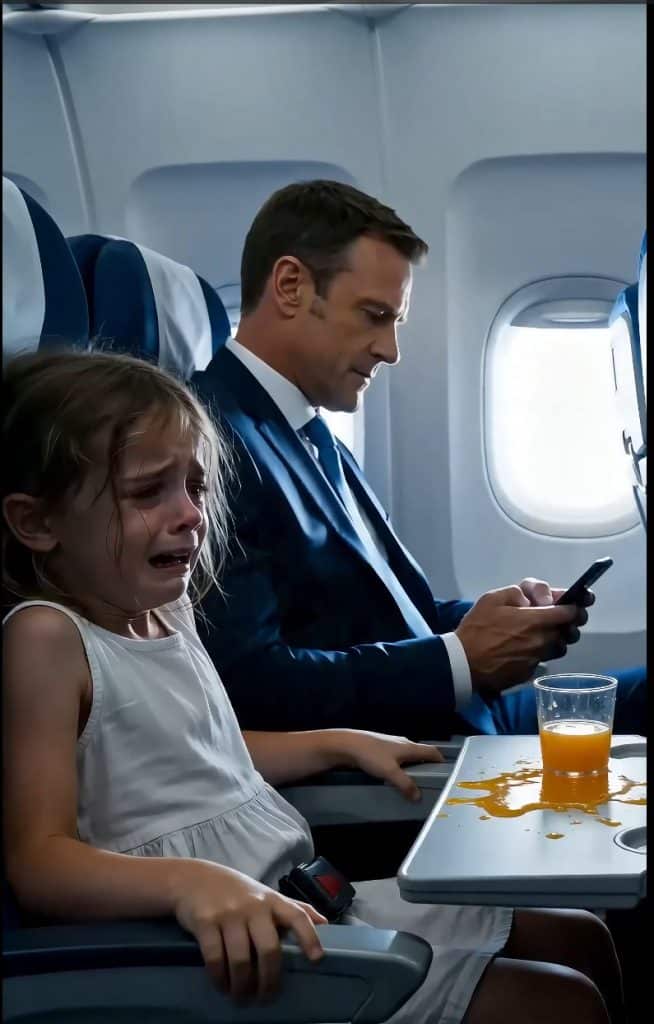
The little girl was crying so hard the orange juice shook on her tray table.
Then the cup tipped.
Bright liquid spread across the plastic tray, dripping over the edge, running toward her white dress as the airplane hummed steadily above the clouds. Passengers in nearby rows turned their heads, annoyed at first, then uneasy when the child’s sobs grew sharper.
She sat in the window seat, trapped between the cabin wall, the tray table, and the man beside her.
He did not comfort her.
He did not ask what was wrong.
He sat in a navy suit with a blue tie, tapping calmly on his phone as if the terrified child beside him were nothing more than bad weather.
The girl’s face was red and wet with tears. Her hair had come loose around her cheeks. Her small hands gripped the armrests so tightly her knuckles paled.
Then, without warning, she reached down.
Click.
The seatbelt latch snapped open.
The man looked up.
“Lily,” he said softly.
The sound of her name made her sob catch in her throat.
She did not answer.
Instead, she climbed onto her own seat cushion with both feet, shaking so badly that the tray table rattled against her knees. The orange juice sloshed again, splattering the seatback in front of her. A woman across the aisle gasped.
The girl turned sideways and squeezed over the armrest into the aisle.
“Hey,” the man said, still calm. Too calm. “Come back here.”
She ran.
Tiny footsteps thudded down the dark carpet. Passengers leaned away as she rushed past knees, bags, and elbows. At the front of the cabin, a blonde flight attendant stood beside a snack cart, sorting cups with practiced quiet.
The girl saw the white uniform and ran harder.
The cart blocked most of the aisle, but she slipped sideways around it, brushing against the metal edge. Snack packets rattled. The attendant spun toward her, startled.
The girl grabbed her hand with both of hers.
No words came out.
Only broken sobs.
The attendant stiffened. Her name tag read Mara Ellis, and she had worked long enough to know the difference between a child having a bad flight and a child begging without language.
“Sweetheart,” Mara whispered, lowering her voice. “Are you hurt?”
The girl shook her head.
Then she looked back.
The man in the navy suit was walking toward them.
Not rushing.
Not panicking.
Smiling.
“She’s just tired from the long flight,” he said smoothly when he reached them. “She’s terrified of flying.”
He placed a hand on the girl’s shoulder.
The child recoiled so violently that Mara felt it through her fingers.
Every alarm inside her woke up at once.
Because frightened children reach for familiar adults.
This one was trying to disappear behind a stranger in uniform.
And when Mara looked down, she saw what the girl had pressed into her palm.
A crumpled boarding pass.
With a name that did not match the man’s.
Act II
Mara did not move too quickly.
That was the first rule in the air.
Panic traveled faster in a cabin than smoke. One raised voice, one wrong gesture, one passenger filming without understanding, and a quiet emergency could become chaos at thirty thousand feet.
So Mara smiled.
It took everything in her to do it.
“Of course,” she said to the man. “Flying can be overwhelming for children.”
His smile widened slightly, relieved that she sounded agreeable.
The girl’s nails dug into Mara’s hand.
Mara felt the tremble in that grip and understood the message.
Don’t let go.
“What’s your name, sweetheart?” Mara asked gently.
The man answered first.
“Lily.”
Mara kept her eyes on the child.
“I’d like to hear her say it.”
The man’s expression did not change, but something tightened around his eyes.
The girl opened her mouth.
No sound came.
Mara glanced at the boarding pass again, folded beneath the child’s fingers.
The printed name was not Lily.
It was Ava Monroe.
Seat 18A.
The man had been seated in 18B.
Mara had served that row twenty minutes earlier. She remembered him because he had asked for black coffee with no sugar and smiled like a man who expected people to trust him. She remembered the girl because she had not touched her snack. She sat stiffly by the window, hands in her lap, staring at the clouds as if she were trying to leave her body behind.
Mara had asked, “Everything okay, honey?”
The man had answered, “She gets shy.”
At the time, Mara had moved on.
Now that moment returned like a slap.
The girl’s dress was damp from spilled juice. Her cheeks were streaked with tears. Her body leaned toward Mara and away from him with a clarity no adult explanation could erase.
“I can take her back,” the man said, extending his hand. “Sorry for the disruption.”
Ava shrank behind Mara’s arm.
Mara shifted her body a few inches, using the snack cart as a barrier.
“No trouble,” she said. “I’ll help her clean up first.”
“That’s not necessary.”
“It is for us,” Mara replied, still polite. “We don’t want juice on the seat tracks.”
For the first time, his smile flickered.
Passengers nearby had gone quiet. A college student in row 12 lowered one earbud. An older woman clutched her book without turning a page. A father traveling with two teenagers watched the man’s hand and frowned.
The man sensed the attention and softened his voice.
“Lily, come on. You’re scaring people.”
Ava closed her eyes.
That was when Mara noticed something else.
Not on the girl.
On the man.
His left hand hovered near Ava’s shoulder, but he never bent down to her level. He never touched her hair. He never said, “It’s okay.” He spoke around her, over her, like she was a situation to manage.
Mara had seen nervous fathers.
This was not one.
She turned slightly toward the galley and caught the eye of her coworker, Denise, two rows ahead.
Mara gave the smallest signal she could.
Two fingers against her wrist.
Then a glance toward the cockpit phone.
Denise’s expression did not change.
But she moved.
The man noticed.
“Is there a problem?” he asked.
Mara looked back at him.
“Not yet.”
Ava’s breathing changed beside her.
Because the child understood before anyone else did.
The attendant believed her.
And that meant the man’s story was already beginning to crack.
Act III
The man said his name was Daniel Pierce.
He said Ava was his daughter.
He said she was using her mother’s last name because of “family complications.” He gave the explanation smoothly, with just enough embarrassment to make nearby passengers uncomfortable for listening.
Mara had heard better lies.
She had also heard worse truths.
So she did what training had taught her to do.
She separated facts from performance.
“Mr. Pierce,” she said, “do you have identification for the child?”
His jaw shifted.
“It’s in my bag.”
“Great. We’ll check it together.”
“I don’t appreciate being treated like a criminal because my kid cried.”
Mara did not blink.
“No one said criminal.”
That word had come from him.
Ava stayed pressed against Mara’s side, trembling.
From the galley, Denise spoke quietly into the interphone. The snack cart remained in the aisle, now less of an inconvenience and more of a wall. The hum of the plane filled the silence between every word.
Daniel leaned closer.
“Lily,” he said softly, but his voice had sharpened beneath the softness. “Tell the nice lady you’re tired.”
Ava stared at the floor.
Mara crouched slightly, lowering herself until her face was level with the child’s.
“Sweetheart,” she said, “you don’t have to say anything you don’t want to say. But you can nod for yes or shake your head for no.”
Ava’s eyes lifted.
Mara kept her voice calm.
“Is your name Lily?”
Ava shook her head.
The cabin went still.
Daniel laughed once, short and forced.
“She’s confused.”
Mara looked at Ava.
“Is your name Ava?”
The girl nodded.
Daniel’s smile vanished.
Somewhere behind them, a passenger whispered, “Oh my God.”
Daniel turned sharply. “Mind your business.”
That was his second mistake.
The charm fell away too fast.
Mara rose slowly.
“Sir, please return to your seat.”
“I’m not leaving my daughter with you.”
Ava made a small choking sound.
Mara’s eyes flicked to the girl’s wrist.
There, under the edge of her white dress sleeve, was a thin hospital-style bracelet. Not new. Folded and refolded. Hidden beneath a ribbon bracelet, as if Ava had tried to keep it out of sight.
Mara gently touched the ribbon.
Ava flinched, then let her move it aside.
The bracelet had writing on it.
Ava Monroe.
And beneath the name, in smaller print:
If found, call Dr. Helen Monroe.
Mara’s heart tightened.
This was not a normal ID bracelet.
This was something a frightened adult had put on a child who might need to be found.
Daniel saw the bracelet at the same moment.
His face went flat.
Not angry.
Empty.
That was when Mara knew the danger had stopped pretending.
Denise returned from the galley with another flight attendant and a tall man from row 4 who moved with quiet authority. He did not announce who he was, but Daniel recognized something in his posture and stepped back half a foot.
Mara kept one hand on Ava’s shoulder.
“Sir,” she said, “we need you to take your seat now.”
Daniel looked down the aisle.
The snack cart blocked one direction.
Passengers blocked the other.
For the first time since he entered the aisle, he looked trapped.
And Ava, still crying, finally whispered her first words.
“He’s not my dad.”
Act IV
Nobody screamed.
That made it worse.
The cabin became a sealed room of held breaths.
Daniel’s eyes moved from Ava to Mara to the man from row 4. His polite mask was gone now, and without it he looked smaller, harder, more desperate.
“That child is upset,” he said. “She doesn’t know what she’s saying.”
Ava shook her head, tears falling again.
“He told me not to say my real name.”
Mara felt Denise step closer behind her.
The man from row 4 spoke for the first time.
“Sir, put your hands where we can see them.”
Daniel stared at him.
“You have no authority over me.”
The man showed his identification just long enough for Daniel to understand.
Air marshal.
A ripple moved through the cabin.
Mara kept Ava turned away so she would not have to watch more than necessary.
Daniel lowered his hands slowly, but his voice kept working.
“This is a custody dispute,” he said. “Her mother is unstable. I’m trying to get her away from a bad situation.”
Ava cried harder.
Mara knelt again, keeping her own body between the girl and the aisle.
“Is your mother Dr. Helen Monroe?”
Ava nodded quickly.
“Did she give you the bracelet?”
Another nod.
“Did she tell you to show it to a crew member?”
Ava swallowed.
“She said if I got scared, find a lady in uniform.”
Mara’s eyes burned, but her voice stayed steady.
“You did exactly right.”
Daniel’s face twisted.
“She is manipulating you.”
“No,” Mara said. “You are.”
The words came out before she could soften them.
For a moment, Daniel looked like he might lunge forward, but the air marshal moved faster. He stepped into the aisle with the controlled precision of someone who had already measured every inch of space.
“Turn around,” he said.
Daniel did not.
The captain’s voice came over the intercom then, calm and professional.
“Ladies and gentlemen, please remain seated with your seatbelts fastened. Cabin crew will be assisting a passenger at this time.”
The ordinary language somehow made the situation feel more frightening.
Assisting a passenger.
As if a little girl had not climbed over an armrest and spilled juice on herself just to escape the man sitting beside her.
Daniel looked at Ava one last time.
“Lily,” he said.
Ava squeezed Mara’s hand.
Mara answered for her.
“Her name is Ava.”
The air marshal moved in.
Daniel was restrained without shouting, without spectacle, without giving him the dramatic fight he seemed to want. Passengers watched in stunned silence as he was guided toward the rear jump seat area, away from Ava, away from the lie he had carried onto the plane.
Only when he was gone did Ava collapse against Mara.
Her sobs were smaller now.
Exhausted.
Mara wrapped both arms around her carefully.
“You’re safe,” she whispered. “You’re safe with me.”
Ava shook her head against her uniform.
“He said nobody would believe me.”
Mara closed her eyes.
Then she looked down the aisle at every passenger who had seen the girl run, seen the man smile, seen the truth break open at thirty thousand feet.
“We believe you,” Mara said.
And for Ava Monroe, those three words were the first solid ground she had felt since the airport.
Act V
The plane did not continue to its original destination.
It diverted.
The captain announced a medical and security situation, and nobody complained. Not even the businessman who had sighed loudly during boarding. Not even the woman who had been irritated by the spilled orange juice.
When the plane landed, officers came aboard first.
Then a woman in a dark coat appeared at the front of the cabin, hair loose, face pale, one hand pressed over her mouth as if she were afraid to breathe the wrong way and wake up from the sight in front of her.
Ava saw her.
For one second, she froze.
Then she screamed, “Mom!”
This time, the scream did not sound like terror.
It sounded like a child finding the door back to the world.
Dr. Helen Monroe dropped to her knees in the aisle as Ava ran into her arms. She held her daughter so tightly that Mara had to look away.
There are reunions people clap for in movies.
This one was too raw.
Too private.
Too full of the hours that came before it.
Helen kept whispering, “I’m here. I’m here. I’m here.”
Ava buried her face in her mother’s neck and cried until she had no sound left.
Later, Mara learned the story in pieces.
Daniel Pierce was not Ava’s father. He had worked with Helen at a children’s clinic, charming staff, memorizing routines, learning schedules. When Helen rejected him and reported him for falsifying records, he disappeared from the clinic.
Then he waited.
Ava had been taken during a chaotic airport transfer while traveling with a family friend. Daniel had used altered documents and confidence, the two tools dangerous men often trusted most.
He almost made it work.
Almost.
But Helen had taught Ava something after years of working with frightened children.
Do not argue with a dangerous adult if you cannot safely leave.
Find another adult.
Give them your real name.
Show the bracelet.
Ava remembered the instructions even while terrified.
She spilled the juice when Daniel reached for her boarding pass. She used the mess and the tray table to create confusion. She climbed over the armrest because he blocked the aisle. She ran to the first woman in uniform she could reach.
A seven-year-old child had built a rescue out of seconds.
The airline later praised Mara for her calm response.
The passengers called her a hero.
Mara accepted none of that easily.
She kept thinking of the moment Ava grabbed her hand. The pressure of those tiny fingers. The way the child’s whole body had asked a question before her mouth could form one.
Will you help me?
Mara had simply answered correctly.
Weeks later, a letter arrived at the airline office.
It was written in blue crayon on folded paper.
Dear Miss Mara,
Thank you for not making me go back to him. My mom says I was brave but I think you were brave too. I still don’t like orange juice anymore. I like apple juice now.
Love,
Ava
Mara cried in the crew lounge.
She folded the letter carefully and kept it in the pocket of her suitcase for every flight after that.
Not because she wanted to remember fear.
Because she wanted to remember the exact shape of trust.
Months passed.
The story faded from the news, as stories do. Passengers forgot the flight number. The airline replaced the snack cart with a newer model. The stain from the orange juice was cleaned before the aircraft returned to service.
But Mara never forgot row 18.
She never forgot the man’s smooth voice.
She never forgot the way the child recoiled under his hand while he smiled at everyone else.
And she never again accepted the first explanation simply because it was delivered calmly.
One evening, on another flight, Mara saw a little boy crying in a middle seat while his grandmother searched frantically for a toy under the row. The boy looked up at Mara with wet eyes, embarrassed by his own tears.
Mara smiled gently and handed him a napkin.
“Take your time,” she said. “I’m listening.”
The grandmother thanked her.
The boy stopped crying.
It was nothing.
It was everything.
Because sometimes danger announces itself with shouting.
Sometimes it wears a navy suit and speaks politely.
Sometimes a child cannot explain the whole truth. Sometimes all she can do is unbuckle her seatbelt, climb over an armrest, squeeze past a snack cart, and hold on to the nearest hand that feels safe.
Ava Monroe did not save herself because she was fearless.
She saved herself because, even through terror, she believed one adult might still listen.
And Mara Ellis did.
That was why the man’s lie failed.
Not because the cabin was full of people.
But because one little girl refused to go back to the window seat.
And one flight attendant noticed she was not afraid of flying.
She was afraid of him.