Act I
The cathedral was silent when the bride began to walk.
Sunlight poured through the stained-glass windows in soft red and blue ribbons, falling across the long aisle like something holy. The organ played low and gentle. Guests turned in the pews, smiling as Isabel Whitmore stepped forward in her white satin gown, her veil drifting behind her, her hand trembling around the bouquet.
At the altar, Daniel Vale stood waiting.
His mother dabbed at her eyes with a lace handkerchief.
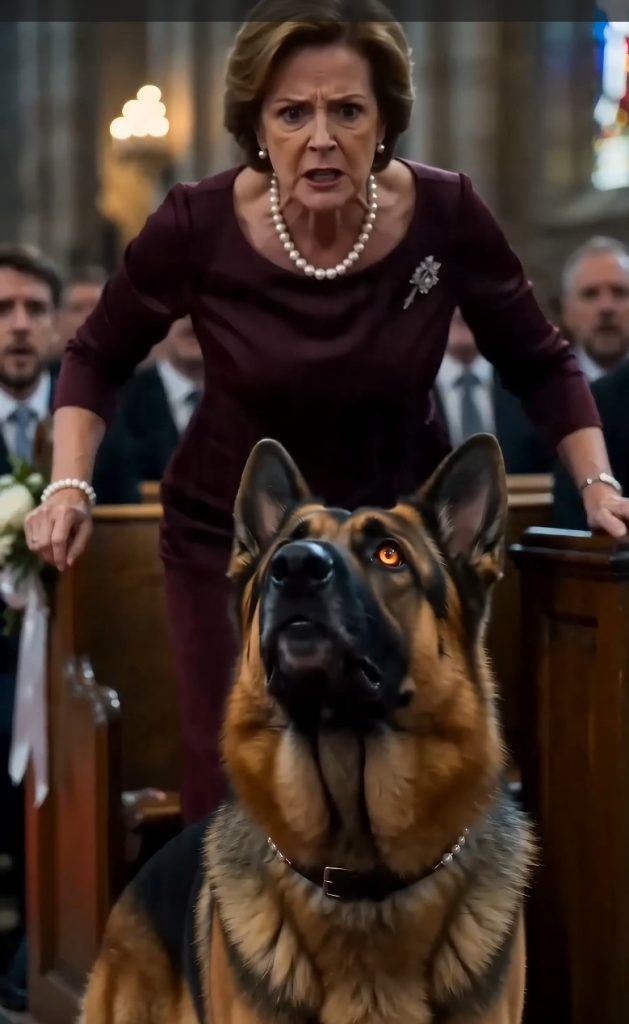
Isabel’s mother, Eleanor, sat rigid in the front pew, pearls at her throat, face arranged into the careful pride of a woman who had planned every flower, every song, every candle.
Then the cathedral doors shifted behind the bride.
A German Shepherd rushed onto the red carpet.
Gasps rose from the pews.
Before Isabel could turn, the dog caught the train of her gown between his teeth and pulled with all his strength.
The satin snapped tight.
Isabel cried out.
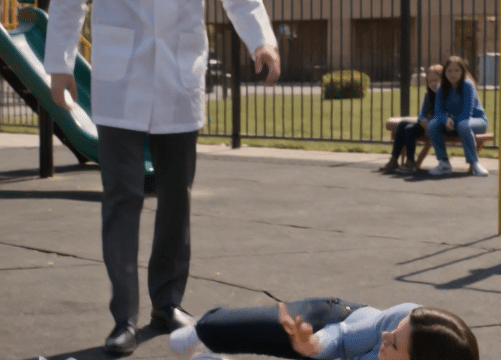
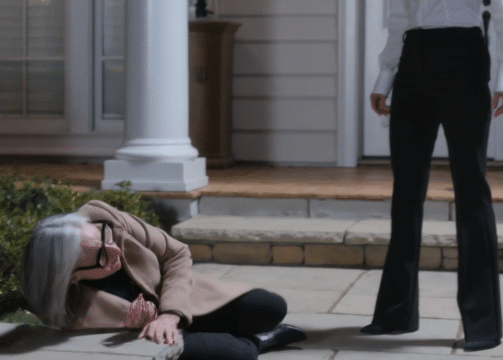
Her bouquet flew from her hands. Her shoes scraped against the runner. The veil slipped sideways as she stumbled, twisted, and fell hard onto the aisle.
The music broke apart.
Guests shouted.
A man in a tuxedo lifted his phone to record.
The dog released the fabric immediately, but he did not run. He planted himself beside the fallen bride, body tense, ears forward, a low growl vibrating in his chest.
Isabel pushed herself up on trembling hands, tears spilling down her face.
“What is happening?” she sobbed.
Eleanor rose from the front pew, fury burning through her shock.
“Get that filthy mutt out of my church!”
The dog did not even look at her.
His amber eyes were fixed upward.
At first, no one understood.
Then General Thomas Harlan, seated three rows back in full dress uniform, followed the dog’s gaze toward the high cathedral ceiling.
His face changed.
The medals on his chest clinked as he stood.
“Stop!” he thundered down the aisle. “Nobody take another step!”
Every guest froze.
Above them, hidden among flowers, ribbons, and old stone, something groaned.
And the dog growled again.
Act II
His name was Atlas.
He had not been invited to the wedding.
No dog had.
Eleanor Whitmore had been very clear about that.
“No animals in the cathedral,” she said three weeks before the ceremony, while reviewing the final guest list with the wedding planner. “This is not a barn. It is a sacred space.”
Isabel had not argued.
She should have.
Atlas had belonged to her father.
Captain Michael Whitmore trained military working dogs before a roadside explosion overseas ended his career and changed the way he moved through the world. He came home with a limp, a deep silence, and Atlas, the young German Shepherd who refused to leave his side.
At first, Eleanor hated the dog.
Not openly. Eleanor never hated openly. She simply called him inconvenient. Too large. Too intense. Too much hair on the carpets. Too much of a reminder that Michael had returned from service different from the man she had sent away.
But Isabel loved Atlas.
When Michael woke from nightmares, Atlas leaned against him until his breathing slowed. When Isabel cried over college rejection letters, Atlas rested his head in her lap. When Eleanor hosted perfect dinners with people who spoke in polished phrases and shallow concerns, Atlas lay at Michael’s feet and watched every guest as if he could smell dishonesty beneath perfume.
Michael used to say Atlas trusted three things.
Scent.
Pressure.
And silence.
“If Atlas warns,” he told Isabel once, “don’t ask whether it embarrasses the room. Ask what the room is missing.”
Michael died two years before the wedding.
A heart failure no one expected.
At the funeral, Atlas lay beside the coffin until the priest gently asked Isabel to move him. She could not. General Harlan did it instead. He had served with Michael, trusted him, and understood that the dog was not being difficult.
He was saying goodbye.
After that, Eleanor sold the country house and moved Isabel into the city, claiming grief required a fresh beginning. Atlas was sent to General Harlan’s training estate “temporarily.”
Temporarily became two years.
Isabel visited when she could, but Eleanor always found reasons to make it hard.
Daniel was patient about it at first. He said Atlas was part of her past, and he respected that. But as the wedding approached, he grew quieter whenever she mentioned bringing the dog.
“My mother thinks it would cause tension,” he said once.
“Your mother?”
“Our families are trying to make this day beautiful.”
Isabel heard what he did not say.
Controlled.
Not beautiful.
Controlled.
The cathedral had been Eleanor’s choice. So were the roses, the seating chart, the strict camera policy, the silk aisle runner, and the massive floral installation hanging from the crossing above the center of the nave.
Isabel had asked if it was safe.
Eleanor smiled.
“Darling, professionals are handling it.”
But Michael’s voice lived somewhere in Isabel’s memory.
Ask what the room is missing.
On the morning of the wedding, Isabel woke from a nightmare of barking.
At the time, she thought it was grief.
She did not know Atlas had broken through a side gate at General Harlan’s estate at dawn.
She did not know he had tracked her scent across twelve miles.
And she did not know he would reach the cathedral only seconds before the ceiling gave its first warning.
Act III
The groan above the aisle was low enough that some guests mistook it for the organ.
General Harlan did not.
Men like him learned to hear danger in small changes: a snapped wire, a stressed beam, the wrong silence before impact. He moved down the aisle with one hand raised, stopping a groomsman who had started toward Isabel.
“Back,” he ordered.
The groomsman hesitated.
Harlan’s voice sharpened.
“Back now.”
Atlas growled again, his eyes reflecting stained-glass light so brightly they seemed almost unnatural. He stood over Isabel’s fallen train, not touching her now, only blocking the path ahead.
Isabel looked up.
At first she saw only the cathedral’s beauty.
Stone ribs arching toward the ceiling. Flowers draped from wrought iron. White ribbons hanging like soft rain from the enormous suspended arrangement above the aisle.
Then she saw the movement.
One of the anchor chains trembled.
The floral installation was not just flowers.
It held a metal frame.
Lights.
Candles in glass cylinders.
A decorative chandelier section borrowed from the cathedral’s old storage and wrapped in roses so completely it looked weightless.
It was not weightless.
Another sound cracked through the air.
This one everyone heard.
A woman screamed.
Eleanor turned pale.
The groomsmen backed away from the altar.
Daniel finally moved, rushing toward Isabel.
Harlan caught him by the arm.
“Do not step under it.”
“That’s my bride!”
“Then stay alive long enough to reach her.”
Daniel froze.
Atlas lowered his head and barked once toward the ceiling.
Sharp.
Commanding.
The chain slipped another inch.
The old beam above it splintered where a new bracket had been drilled into aging wood. Fine dust drifted down through the colored light.
Isabel stared at it, unable to breathe.
Had she taken three more steps, she would have been directly beneath it.
Had Atlas not pulled her down, she would have been standing under hundreds of pounds of iron, glass, flowers, and wire when the support failed.
A cathedral staff member ran toward the electrical panel. Another guest shouted for everyone to move slowly out of the pews.
But panic had already begun.
People rose too fast. A child cried. Chairs scraped in the side aisle. Someone dropped a phone.
Harlan’s voice cut through everything.
“Stay low. Move to the side aisles. Slowly.”
The authority in him steadied the room.
Then the first chain snapped.
The floral rig lurched downward.
Atlas grabbed Isabel’s veil and pulled again, dragging her another foot away from the center line.
A second later, the entire structure crashed onto the red carpet where she had been walking.
Act IV
The sound shook the cathedral.
Roses exploded across the aisle. Glass shattered against stone. Metal twisted into the carpet with a violent thud that silenced the room more completely than any scream could have.
For a moment, no one moved.
Then Daniel broke free and ran to Isabel.
He dropped beside her, hands hovering as if he was afraid to touch her and find her broken.
“Isabel. Isabel, look at me.”
She was shaking so hard she could barely speak.
“I’m okay.”
His eyes filled.
Atlas stood between them and the wreckage, still growling at the fallen frame as if the danger might rise again.
Daniel looked at the dog.
Then at the crushed flowers.
Then at the exact place Isabel would have been.
His face crumpled.
“Oh God.”
Eleanor stood near the front pew, one hand over her mouth. The woman who had commanded decorators, florists, priests, musicians, and daughters now looked at the wreckage as if it had betrayed her personally.
General Harlan knelt beside Atlas.
The dog’s mouth was still clamped around a strip of torn veil. Harlan gently removed it and placed a hand on the dog’s neck.
“Good boy,” he murmured. “You stubborn old soldier.”
Atlas leaned into him for half a second, then turned his head toward Isabel.
Checking.
Always checking.
The cathedral maintenance chief arrived moments later, breathless and horrified. He crouched near the fallen frame, examined the broken bracket, and went still.
“This wasn’t installed by our team.”
Eleanor’s head snapped up.
“What does that mean?”
He lifted one piece of hardware from the carpet.
“This clamp is temporary rigging. Not cathedral-approved. Someone altered the support after inspection.”
A murmur moved through the pews.
Daniel looked at his mother.
“Who had access?”
Eleanor’s lips parted.
“I don’t know.”
But her eyes flicked toward the side door.
Harlan saw it.
So did Isabel.
A young event assistant near the sacristy began crying. Not loudly. Not dramatically. Just a frightened, helpless sound that drew everyone’s attention.
Harlan stood.
“Miss,” he said, “what do you know?”
The assistant looked at Eleanor.
Eleanor’s voice turned cold.
“Clara, say nothing.”
That was enough.
The entire cathedral felt the shift.
Clara’s face collapsed.
“I’m sorry,” she whispered. “I didn’t know it would fall. She said it only needed to look grander for the photographs.”
Isabel turned slowly toward her mother.
Eleanor’s eyes hardened.
“This is not the time.”
“No,” Isabel said, voice breaking. “This is exactly the time.”
Clara pointed toward the wreckage.
“Mrs. Whitmore said the original flowers looked cheap. She told Mr. Vale’s decorator to add the old chandelier pieces after the inspection. The cathedral refused, so she brought in someone else last night.”
Daniel stared at Eleanor.
“You changed the rigging?”
Eleanor straightened, trying to gather dignity around herself like a shawl.
“I improved the design.”
“You nearly killed her.”
Her face twisted.
“Don’t be vulgar.”
Isabel flinched.
Not at the words.
At the familiarity of them.
Her mother had always called truth vulgar when it arrived without permission.
Harlan’s expression became stone.
“Mrs. Whitmore, no one leaves until police and structural inspectors arrive.”
Eleanor laughed once.
“You cannot detain guests at my daughter’s wedding.”
Harlan looked at Atlas, then at the wreckage, then back at her.
“Madam, your daughter’s wedding just became an emergency scene.”
Act V
The ceremony did not continue.
No one suggested it.
Even Eleanor, stripped of audience and authority, could not force vows over broken glass and crushed roses.
Police arrived within fifteen minutes. Structural inspectors followed. The cathedral was cleared row by row, guests whispering into phones despite the staff begging for discretion. The man who had recorded the fall tried to sell the clip to a gossip page before he reached the parking lot.
Daniel took his phone and handed it to police as evidence.
That was the first thing he did right.
Isabel sat in the side chapel with a blanket around her shoulders, Atlas pressed against her knees, and General Harlan standing at the doorway like no harm would pass him twice.
Daniel entered quietly.
His tuxedo was dusty at the cuffs. His face looked years older.
“May I sit?”
Isabel looked at him.
The question mattered.
Before, he might have assumed.
Now he asked.
She nodded.
He sat beside her, leaving space.
“I’m sorry,” he said.
She closed her eyes.
“For what?”
He understood the test.
“For not fighting harder when they pushed Atlas away. For letting your mother turn our wedding into a performance. For waiting until the ceiling fell to understand you were afraid.”
Isabel looked down at Atlas.
The dog rested his chin on her gown as if nothing in the world mattered more than keeping her still.
“You weren’t the one who changed the rigging.”
“No,” Daniel said. “But I let everyone else decide what mattered.”
Isabel’s laugh was soft and sad.
“That seems to be the theme of the day.”
Outside the chapel, Eleanor was speaking loudly to an officer about reputation, misunderstanding, and emotional overreaction. Her voice had the brittle edge of someone still trying to command a room that had stopped obeying.
Then Clara’s statement was taken.
Then the unauthorized decorator was found.
Then the invoice appeared.
Paid from Eleanor’s private account.
The truth did not need drama after that.
It had paperwork.
Eleanor claimed she never meant harm. She had wanted beauty. She had wanted photographs worthy of the family name. She had wanted the cathedral to look less “provincial,” less restrained, less like Michael Whitmore’s quiet daughter had chosen sincerity over spectacle.
Inspectors disagreed with her version of harmlessness.
The altered rig had been unsafe. The weight exceeded the approved limit. The bracket had been drilled into old wood never meant to carry it. Had Atlas not pulled Isabel down, the wedding would have ended in tragedy.
Eleanor faced charges connected to reckless endangerment and unauthorized alteration of a protected historic site. Her social circle called it unfortunate. The cathedral called it desecration. Isabel called it the last time her mother would decide what safety was worth.
Weeks passed before Isabel could look at her wedding dress without shaking.
The satin train was torn where Atlas had bitten it.
Eleanor’s lawyer offered to replace it.
Isabel refused.
Instead, she took the dress to an old seamstress who had once worked with her father on military formal uniforms. The woman examined the torn train and asked gently, “Do you want the damage hidden?”
Isabel touched the marks left by Atlas’s teeth.
“No,” she said. “I want it remembered.”
The seamstress repaired the dress with a narrow line of silver thread following the tear.
Not invisible.
Beautiful.
A scar made honest.
Three months later, Isabel and Daniel married in the garden at General Harlan’s estate.
There were no chandeliers.
No suspended flowers.
No cathedral arches.
Only grass, wooden chairs, a small table of wild roses, and Atlas walking beside Isabel down the aisle with his black collar polished and a blue ribbon tied to it.
When they reached Daniel, the dog stopped between them.
The guests laughed softly.
Daniel crouched.
“I know,” he said to Atlas. “You’re in charge.”
Atlas stared at him for a long second.
Then sat.
Permission granted.
General Harlan officiated, because after what had happened in the cathedral, no one trusted anyone else to command a ceremony.
Isabel’s mother was not invited.
That decision hurt.
Freedom often does when it is cut from family.
But as Isabel stood beneath open sky, holding Daniel’s hands while Atlas leaned against her gown, she felt no emptiness where Eleanor should have been.
She felt space.
Space to breathe.
Space to choose.
Space to hear herself think without someone calling her fear embarrassing.
When vows were spoken, Daniel’s voice shook.
“I promise to look where you look,” he said. “To listen when you say something is wrong. To never again mistake silence for peace or beauty for safety.”
Isabel cried then.
Not because the words were perfect.
Because he finally understood what love had almost cost them.
After the ceremony, Harlan raised a toast to Captain Michael Whitmore.
He spoke of courage, loyalty, and dogs who heard warnings before pride did.
Then he looked at Atlas.
“To the best soldier in the room.”
Atlas sneezed.
Everyone applauded.
Years later, people still talked about the cathedral wedding where the German Shepherd dragged the bride to the floor.
Some told it like a ghost story.
The glowing eyes.
The fallen flowers.
The officer’s booming command.
But Isabel never called it supernatural.
She called it loyalty.
Atlas had smelled fresh metal dust where old stone should have been. Heard the strained creak of weight shifting above the music. Felt danger in a room too busy admiring itself to notice.
He did what truth often does.
He ruined the perfect moment to save the people inside it.
Isabel kept the repaired dress in a cedar box, silver thread shining along the train. When her daughter was old enough to ask about it, she traced the stitched line with tiny fingers.
“Did the dog break your dress?” the child asked.
Isabel smiled.
“No. He saved it from being buried under something much heavier.”
Atlas, old now and gray around the muzzle, lifted his head from the rug as if he had heard his name inside the story.
Daniel looked down at him.
“We know, commander.”
The dog sighed and went back to sleep.
The cathedral was eventually repaired. The chandelier pieces were removed forever. A small plaque was installed near the side entrance, not naming Eleanor, not describing scandal, only stating that all ceremonial installations must be inspected and approved.
General Harlan visited once and laughed.
“Atlas should have signed that policy.”
Isabel agreed.
Because in the end, the lesson was not about weddings or flowers or mothers who confused control with love.
It was about a room full of people who saw a dog pull a bride down and thought only of scandal.
Until one soldier looked where the dog was looking.
That was all it took.
One person willing to stop the performance.
One voice loud enough to freeze the room.
One loyal animal refusing to let the bride take another step toward danger.
And a command that arrived just in time.
Stop. Nobody take another step.