Act I
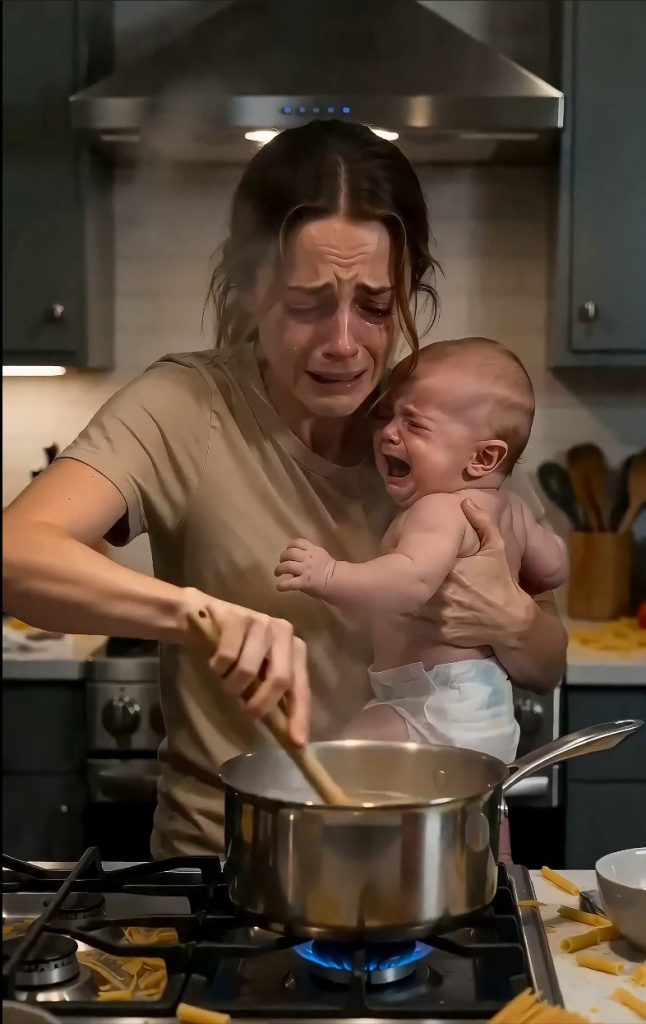
The baby was screaming, the water was boiling, and Claire Bennett was crying so quietly that no one in the living room bothered to look up.
She stood at the stove with one arm wrapped around her infant son and the other hand stirring pasta she no longer had the strength to finish. Steam rose into her face. Her tan T-shirt clung to her shoulder where the baby’s tears had soaked through. The wooden spoon tapped the pot in small, desperate circles.
Behind her, on the gray sofa, Margaret Bennett reclined in a blue cardigan with a tablet in her lap.
“Is dinner almost ready?” she called. “We’re starving.”
Claire closed her eyes.
Her sister-in-law, Tessa, smirked without looking up from her phone.
The baby cried harder.
Claire shifted him on her hip, trying to keep his bare little legs away from the hot stove. He wore only a diaper because she had not been given five uninterrupted minutes to dress him after his bath. His cheeks were red. His tiny fists opened and closed against her collarbone.
“I’m trying,” Claire whispered.
Nobody heard her.
Or worse, they did and did not care.
The pasta bubbled up. Claire reached for the knob, missed, then caught the pot handle with shaking fingers. Her body had been running on broken sleep, cold coffee, and swallowed humiliation for weeks.
Her husband, Andrew, was at work.
Margaret and Tessa were “helping.”
That was the word they used when they moved into the guest room after the baby was born. Helping meant sitting on the sofa while Claire cooked. Helping meant criticizing how she folded blankets. Helping meant taking pictures with the baby after Claire had fed, changed, bathed, and rocked him for hours.
Helping meant telling her she was too sensitive when she cried.
The baby wailed against her ear.
Claire stepped back from the stove and finally broke.
“I can’t,” she said, voice cracking. “I can’t do this.”
The room fell silent for half a second.
Margaret sighed.
“Oh, don’t be dramatic.”
Then the front door opened.
Claire did not turn.
She was too tired to hope.
A man stepped into the entryway holding a bright plastic stacking-ring toy, the kind babies chew, throw, and love for no reason adults understand. He had silver-gray hair, broad shoulders, a navy jacket, and the weathered, kind face of someone who had driven two hours just to surprise his first grandchild.
Tom Harris stopped dead.
He saw his daughter crying beside a boiling pot.
He saw the baby shaking in her arms.
He saw Margaret and Tessa sitting comfortably ten feet away.
The toy slipped from his hand.
It hit the floor with a loud plastic clatter, rings scattering across the hardwood like the sound of something innocent breaking.
Margaret sat up.
Tessa lowered her phone.
Claire turned.
“Dad?”
Tom did not answer.
He walked straight to the stove, turned the burner off, and gently took the baby from Claire’s exhausted arms.
“I got it,” he said.
The baby’s crying softened almost immediately against his chest.
Then Tom turned toward the sofa.
And the look on his face made Margaret Bennett go pale.
Act II
Tom Harris had not raised his daughter to apologize for existing.
That was why the scene in Andrew Bennett’s kitchen hit him like a betrayal.
Claire had been a bright child, stubborn in the best way, the kind who fixed her own bike chain at ten and argued with teachers only when she was right. Her mother, Elise, used to say Claire carried her heart in both hands and offered it too easily.
After Elise died, Tom became careful with that heart.
He packed lunches with handwritten notes. Learned how to braid hair badly. Sat through dance recitals, science fairs, fever nights, college applications, heartbreak, and the day Claire came home glowing because Andrew Bennett had asked her to marry him.
Tom had liked Andrew.
Not completely.
No father ever likes the man taking his daughter into a new life completely.
But Andrew seemed gentle. Polite. Ambitious. A little too eager to keep peace with his mother, maybe, but Tom had told himself marriage would teach him spine.
Then came the baby.
Claire named him Oliver.
Tom cried the first time he held him, though he claimed allergies.
For the first week, Claire sent photos every morning. Oliver sleeping. Oliver yawning. Oliver’s tiny hand around her finger. Then the photos slowed. Her calls grew shorter. Her voice became thinner.
“I’m just tired, Dad.”
“You sure?”
“Yeah. Margaret’s here helping.”
Tom heard the strain in the word helping.
He asked if he should visit.
Claire said no too quickly.
So Tom waited three days, then ignored her and drove over anyway with a toy, a casserole, and a box of old baby blankets Elise had saved in the attic.
On the drive, he imagined exhaustion. Dishes. Laundry. A crying baby. Normal new-parent chaos.
He did not imagine his daughter standing at a stove, holding an infant inches from boiling water while two healthy adults treated her breakdown like an inconvenience.
Now Oliver rested against Tom’s shoulder, hiccupping through the last of his cries.
Claire stood beside the counter, empty-armed and shaking, as if she no longer knew what to do with a body that was not carrying someone else.
Tom looked at Margaret.
“Why was she cooking with the baby in her arms?”
Margaret lifted her chin.
“She insists on doing everything herself.”
Claire flinched.
Tom saw it.
Tessa tucked her phone under her thigh.
That small movement drew his eyes.
“What were you recording?” he asked.
Tessa blinked. “Nothing.”
Tom shifted Oliver higher against his chest.
“Show me.”
Margaret stood.
“You don’t come into my son’s home and interrogate us.”
Tom looked around the kitchen.
The cluttered counters. The half-prepared dinner. The baby bottle untouched near the sink. Claire’s trembling hands. The sofa where Margaret had been seated like a queen waiting to be served.
Then his gaze returned to her.
“Your son’s home?”
Margaret’s mouth tightened.
Something in Tom’s face changed.
Not anger exactly.
Recognition.
Because he suddenly understood that what he had walked into was not one bad moment.
It was a system.
And his daughter had been trapped inside it long before the pasta boiled over.
Act III
Claire tried to speak, but only a sob came out.
Tom moved to her side without taking his eyes off Margaret.
“Sit down, honey.”
“I have to finish dinner.”
“No,” he said gently. “You don’t.”
That sentence broke something open in her.
Claire covered her face and cried into both hands.
Oliver whimpered at the sound, and Tom rocked him with the practiced motion of a man who had once walked hallways at 3 a.m. with a colicky baby and a broken heart.
Margaret crossed her arms.
“This is exactly what I mean. She gets hysterical over basic responsibilities.”
Tom’s voice stayed quiet.
“That is my daughter you’re talking about.”
“She is my son’s wife.”
“And Oliver’s mother.”
Tessa muttered, “Barely handling that.”
The room went still.
Claire lowered her hands.
Tom turned his head slowly toward Tessa.
“What did you say?”
Tessa’s confidence faltered.
Margaret stepped in. “Tessa didn’t mean anything.”
“Yes, she did,” Tom said. “That’s why she said it softly. Cruel people always hope volume changes intent.”
Margaret’s face hardened.
“You’re making a scene.”
Tom looked at the baby in his arms.
“No. I walked into one.”
Claire sank onto a kitchen chair. Her face was wet, her breathing uneven. For the first time since he arrived, Tom noticed how thin she looked, how hollow her eyes were, how she kept glancing toward the living room before every word as if asking permission from people who had none to give.
“What has been happening here?” he asked her.
Claire shook her head.
Margaret answered first.
“She’s overwhelmed. New mothers are. We came to help, but she resents advice.”
Tom ignored her.
“Claire.”
His daughter looked at him.
That was all it took.
Not the whole story. Not yet. But enough.
“They said I was doing everything wrong,” she whispered. “They said Andrew works too hard to come home to a messy house. They said if I really loved my baby, I wouldn’t need so much help.”
Tom closed his eyes once.
Margaret scoffed. “That is not what we said.”
Claire’s voice cracked.
“You said I was lazy because I slept when Oliver slept.”
Tessa looked away.
“You said Andrew should have married someone stronger.”
Margaret’s mouth opened, then closed.
Tom’s jaw tightened.
Claire kept going now, the words tumbling out after weeks of being trapped behind her teeth.
“You took Oliver from me when guests came over, but gave him back whenever he cried. You told everyone I was emotional. You hid my phone twice because you said I was complaining to my dad too much.”
Tom’s eyes snapped to Margaret.
Margaret’s face drained.
“I was protecting my son’s peace.”
Tom laughed once.
There was no humor in it.
“My daughter’s suffering was disturbing his peace?”
The front door opened again.
Andrew stepped in wearing his work badge, briefcase in hand, confusion on his face as he saw his father-in-law holding the baby, his wife crying at the kitchen table, and his mother standing rigid beside the sofa.
“What’s going on?”
Tom looked at him.
“That is exactly what you’re going to answer.”
Act IV
Andrew Bennett did what he had been trained to do first.
He looked at his mother.
That one glance told Tom more than any confession could have.
Margaret’s voice softened instantly.
“Andrew, thank God. Your father-in-law came in here yelling and upsetting Claire.”
Claire stared at her husband.
Waiting.
Hoping.
Terrified of hope.
Andrew looked at the kitchen. The turned-off stove. The scattered toy rings near the entryway. His son in Tom’s arms. His wife’s swollen eyes.
Then he looked at his sister, who still sat stiffly with her phone hidden under her leg.
“Tessa,” he said. “What did you record?”
Her face went pale.
Margaret snapped, “That is not important.”
Andrew’s voice changed.
“It is to me.”
Tessa tried to laugh, but it died immediately.
“I was just sending Mom a video earlier. Claire was crying because Oliver wouldn’t stop.”
Tom stepped forward.
“Show him.”
Tessa did not move.
Andrew crossed the room and held out his hand.
For once, he did not ask his mother for approval.
Tessa handed him the phone.
The video opened on Claire at the stove, baby crying in her arms, tears streaming down her face while Margaret’s voice from the sofa said, “Some women just aren’t natural mothers.”
Tessa had added a caption before sending it to a family group chat.
Queen of Meltdowns.
Andrew stared at the screen.
The color left his face.
Claire looked down at the table as if the shame belonged to her.
Tom saw that and felt something inside him go dangerously still.
Andrew played another video.
And another.
Claire trying to fold laundry while Oliver cried.
Claire eating cold toast over the sink while Margaret complained that dinner was late.
Claire asleep upright in a chair, baby on her chest, while Tessa whispered, “Pathetic.”
The room seemed to shrink around Andrew.
He looked at his mother.
“You knew?”
Margaret’s face tightened.
“I was trying to show you what you refused to see.”
“What?”
“That she is not capable.”
Claire made a small broken sound.
Andrew flinched like he had been struck.
Margaret stepped closer, lowering her voice into the tone she had used his whole life when she wanted obedience to feel like love.
“Sweetheart, you are exhausted. You work all day. You needed to understand what you were coming home to.”
Andrew stared at her.
Then at Claire.
Then at Oliver.
Something in him finally broke in the right direction.
“I came home to my wife asking for help,” he said. “And I told her you knew best.”
Margaret’s face changed.
Not with regret.
With alarm.
“Andrew.”
He held up the phone.
“You humiliated her and sent it to people.”
“She needed accountability.”
“She needed sleep.”
The words landed hard.
Tom shifted Oliver gently and looked at Andrew.
“You let them move in?”
Andrew swallowed.
“Yes.”
“You let them stay after Claire asked them to leave?”
Andrew’s eyes filled.
Claire looked up sharply.
Tom continued, voice controlled.
“You told my daughter she was overreacting?”
Andrew closed his eyes.
“Yes.”
The truth hurt him.
Good, Tom thought.
Let it.
Andrew turned to Claire.
“I’m sorry.”
She did not answer.
He deserved that too.
Margaret grabbed her purse from the sofa.
“This is absurd. I will not stand here and be insulted in a home my son pays for.”
Tom looked at her.
“No,” he said. “You won’t.”
Margaret froze.
Tom reached into the inside pocket of his navy jacket and removed a folded document.
Claire’s eyes widened.
“Dad?”
Tom placed the document on the counter.
“When Elise died, she left Claire money. Claire used part of it for the down payment on this house. I matched it. The deed is in Claire and Andrew’s names. Not yours. Not Tessa’s. And as of this moment, you are guests who have been asked to leave.”
Margaret stared at the paper.
For the first time all evening, she had no words.
Tom looked at Andrew.
“Unless your wife says otherwise.”
Everyone turned to Claire.
She sat at the kitchen table, shaking, exhausted, tearful, but no longer holding a baby, no longer standing near boiling water, no longer alone.
Her voice was barely above a whisper.
“I want them out.”
Act V
Margaret left with dignity only because she had no other option.
She packed loudly.
Tessa cried when Andrew told her she could not stay “just for the night.” Margaret called him ungrateful, manipulated, weak, cruel. She said Claire had ruined the family. She said Tom had poisoned the room. She said Oliver would grow up missing his grandmother.
Tom stood near the door with Oliver sleeping against his chest and said only one thing.
“Pack faster.”
By midnight, the guest room was empty.
The house felt strange afterward.
Not peaceful yet.
Peace takes time after a home has been trained for tension.
But the air changed.
Claire sat on the sofa under a blanket while Andrew cleaned the kitchen in silence. He threw away the cold pasta. Washed bottles. Wiped counters. Picked up the plastic stacking rings from the floor and reassembled them on the little yellow post.
When he placed the toy beside Claire, she looked at it and started crying again.
Andrew knelt in front of her.
“I didn’t see it,” he said.
Claire’s face crumpled.
“I told you.”
He lowered his head.
“I know.”
That mattered.
Not enough.
But it mattered.
Tom sat in the armchair holding Oliver, watching his daughter decide what to do with an apology that arrived late.
She did not forgive Andrew that night.
Tom was proud of her for that.
Forgiveness given too quickly often becomes a bandage over a wound that still needs cleaning.
But when Andrew asked, “What do you need right now?” Claire answered.
“Sleep.”
So she slept.
Six hours.
The longest stretch since Oliver had been born.
Tom slept on the sofa with one ear open. Andrew took the baby monitor and stayed in the nursery, stumbling through bottles, diapers, swaddles, and the humbling discovery that caring for a baby was not “helping” when the baby was yours.
It was parenting.
In the weeks that followed, the house rebuilt itself around new rules.
Margaret was not allowed over without Claire’s invitation. Tessa was blocked from the family chat after Andrew sent one final message:
The videos you shared were cruel. Do not contact Claire until she asks.
She did not ask.
Andrew started leaving work on time. He learned Oliver’s tired cry, hungry cry, and “I simply hate this sock” cry. He went to counseling with Claire, then alone, because loving his wife meant unlearning the habit of treating his mother’s comfort as law.
Tom visited every Sunday.
He cooked badly but enthusiastically. He folded laundry with military seriousness despite never having served. He took Oliver on long stroller walks so Claire could shower, nap, or sit in silence without being needed by anyone.
One afternoon, three months later, Margaret appeared at the door holding a bag of expensive baby clothes.
Claire opened it with Oliver on her hip.
Tom was in the kitchen making coffee.
Andrew stood beside Claire, not in front of her, not behind her.
Beside her.
Margaret looked smaller than before.
“I want to see my grandson.”
Claire’s hand tightened slightly around Oliver.
Andrew noticed.
Tom noticed.
Margaret noticed that they noticed.
Claire took a breath.
“Not today.”
Margaret’s face hardened out of habit, but the doorframe was no longer a throne she could command from.
“Claire—”
Andrew spoke.
“She said not today.”
Margaret looked at him like she did not recognize the man she had raised.
Maybe she didn’t.
That was the point.
Claire closed the door gently.
Then she stood there shaking, but upright.
Tom walked over and put one hand on her shoulder.
“I’m proud of you.”
She laughed weakly.
“For closing a door?”
“For knowing it was yours to close.”
Oliver babbled and grabbed at her hair.
Claire kissed his forehead.
For the first time in months, the kitchen smelled like coffee instead of panic.
The stove was off.
The counters were clean enough.
The toy rings sat on the floor where Oliver had knocked them over himself, bright circles scattered in the sunlight.
A year later, Tom still remembered the sound of that toy hitting the floor.
The clatter had been the moment his heart understood before his mind did. The gift he brought for his grandson had become the alarm bell that announced the truth: his daughter was drowning in plain sight, and everyone in that room had expected her to keep serving dinner.
Claire remembered it differently.
She remembered the burner clicking off.
The sudden quiet when Oliver settled against her father’s chest.
The first time someone looked at her exhaustion and did not call it weakness.
She remembered her father saying, “I got it,” and realizing those three words meant more than the baby.
They meant the stove.
The room.
The truth.
Her.
And from that night on, whenever Claire felt herself apologizing for needing help, she pictured the colorful rings bouncing across the floor.
Proof that someone had walked in.
Someone had seen.
And someone had finally made the cruelty stop.