Act I
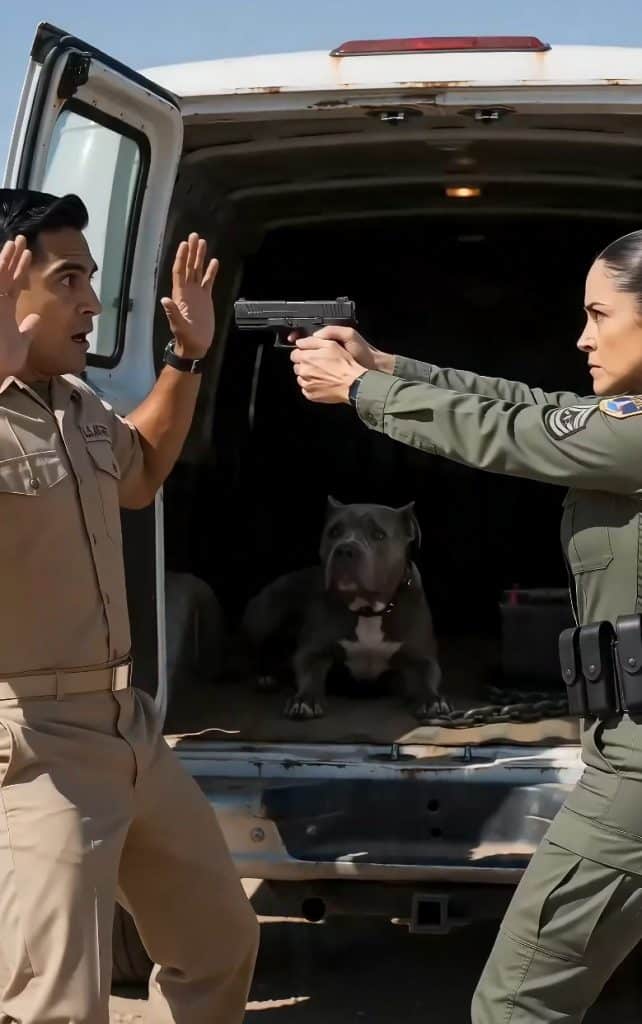
The rear doors of the white cargo van screamed when Officer Maya Reyes pulled them open.
The sound cut across the dusty roadside like metal begging not to be touched.
Sunlight struck peeling paint, rusted hinges, and the dented license plate marked DNB. The van had been parked behind an abandoned service station for nearly twenty minutes, engine off, windows up, driver leaning against the side like a man waiting for someone else to get nervous first.
Maya had learned not to trust men who smiled too easily beside locked doors.
She planted both boots in the dirt, gripped the handles, and swung the doors wide.
Inside, the air was hot and stale.
A large gray dog lay on the bare metal floor.
He did not bark.
Did not growl.
Did not lunge.
He only lifted his head and looked at her with eyes so tired they made Maya’s throat tighten.
A heavy chain rested near his front paw. A black battery sat against the left wall of the van, cables coiled beside it. The floor was scratched in half-moon patterns, as if something had been dragged back and forth too many times.
Maya’s eyes moved over every detail.
The driver laughed behind her.
“Just a stray,” he said.
She turned her head slightly.
The man wore a tan work shirt with a U.S. AIR FORCE patch sewn crookedly over the chest. His hair was slicked back. His grin was wide. Too wide.
“A stray,” Maya repeated.
“Yeah. Found him out by the highway. Figured I’d drop him somewhere.”
Maya looked back into the van.
The dog was watching the driver now.
Not like a stray.
Like a prisoner watching the hand that closed the cage.
A chain clinked softly.
Maya saw the dog flinch.
Her jaw set.
“Face down,” she ordered. “Now.”
The smile vanished from the driver’s face.
“What?”
Maya drew her sidearm and held her stance steady.
“Face down. Hands where I can see them.”
The driver raised his hands slowly, eyes wide with a panic that looked almost convincing.
Almost.
Then his breathing steadied.
His chin lowered.
The fear drained out of his face, leaving something colder behind.
Maya saw the shift before he moved.
So did the dog.
The gray dog lifted his head higher and stared at the man with sudden, trembling recognition.
And Maya realized the van was not the crime.
It was only the first door.
Act II
The traffic stop began with a missing plate light.
That was how most dangerous things announced themselves in Maya’s experience.
Small.
Ordinary.
Boring enough that people ignored them.
She had seen the van rolling west on County Road 14, back doors rattling, one brake light flickering like it was trying to warn her. When she ran the plate, the registration came back to a construction company that had closed two years earlier.
The driver pulled over without argument.
That made her more cautious, not less.
He was cheerful when she approached. Said his name was Calvin Rusk. Said he did hauling work. Said the Air Force patch was from his cousin because he “liked the look of it.”
Maya disliked him before she had a reason.
Not because of the patch.
Because of the sound from inside the van.
Soft.
Almost hidden.
A single scrape.
Then silence.
“What are you carrying?” she asked.
“Old equipment.”
“Open the back.”
His smile twitched.
“Doors stick.”
“I’ll manage.”
That was when he laughed.
Not nervously.
Mockingly.
Maya had joined the AODL unit after eight years in county patrol. Officially, it stood for Animal Operations and Domestic Logistics, a dry name for a unit that handled the ugly intersections between animal cruelty, trafficking, illegal transport, and crimes people tried to hide behind rural roads and locked barns.
She had seen enough to know animals were rarely the only victims.
Dogs were used to scare people.
To move contraband.
To silence witnesses.
To train violence into places where violence could later be sold.
Maya hated how often cruelty toward animals sat near cruelty toward children, elders, workers, and spouses. People who could ignore suffering in one form usually practiced ignoring it in others.
The gray dog in the van was not just neglected.
He was familiar.
Not personally.
Professionally.
His ears were cropped unevenly. His coat was dusty. He had a small white blaze at the chest shaped almost like a torn star.
Maya had seen that star on a missing report three days earlier.
A Cane Corso mix named Bishop.
Stolen from the porch of a foster home outside Mill Creek.
The foster mother said Bishop had been adopted from a rescue after a raid the year before. He was gentle with children, frightened of raised voices, and trained to alert when a person was in distress.
There had been another detail in the report.
Bishop refused to leave the side of a boy named Eli.
Seven years old.
Nonverbal.
Missing since the night Bishop was taken.
The official missing child report said Eli may have wandered.
Maya had never believed that.
Now Bishop lay in the back of a rusted van with chains, a battery, and a driver wearing a fake military patch.
And the dog was looking at Calvin Rusk like the man held more than a leash.
Act III
Calvin lowered himself halfway toward the ground.
Then stopped.
Maya did not blink.
“All the way down.”
He tilted his head.
“You really going to point that at a guy over a dog?”
Maya’s voice stayed flat.
“No. I’m pointing it at a guy who lied to me.”
His smile tried to return.
“About what?”
“The dog’s not a stray.”
For the first time, his eyes flicked toward the van.
Just once.
Too quick.
But enough.
Maya spoke into her shoulder mic.
“Unit 12 requesting backup and animal medical response at County Road 14, old Garner Station. Possible stolen animal connected to active missing child case. Suspect noncompliant.”
Calvin’s face hardened.
“You don’t know what you’re talking about.”
“Hands out. Face down.”
The dog shifted inside the van.
His chain clinked again, and Maya saw what she had missed before.
The chain was not attached to the dog’s collar.
It ran beneath the floor panel.
The dog was not simply restrained.
He was lying beside something hidden.
Maya adjusted her stance but kept her eyes on Calvin.
“Do not move.”
Calvin laughed under his breath.
“You people always think you found the whole story.”
“No,” Maya said. “That’s why I keep looking.”
The sound came again.
Not from the dog.
From under the van floor.
A dull, faint knock.
Maya’s blood went cold.
Bishop lifted his head fully now. His breathing changed. He looked from Maya to the floor, then back to Calvin.
The dog knew.
Whatever was beneath that panel, Bishop had been trying to tell someone.
Calvin’s raised hands curled slightly.
Maya saw the tension move through his shoulders.
“Don’t,” she said.
He lunged sideways.
Not far.
Not well.
Panic makes men fast but careless.
Maya stepped back, kept distance, and shouted his name hard enough that he froze as the sound of another engine tore down the road.
Backup.
Two patrol vehicles pulled in behind her cruiser, dust rising in bright clouds. Calvin dropped to his knees then, not because he surrendered to Maya, but because he saw witnesses arrive.
His malice vanished again.
The fear returned like a mask snapped into place.
“I didn’t do anything,” he shouted. “She’s crazy. It’s just a dog.”
Bishop barked once.
Hoarse.
Sharp.
Then he struck his paw against the floor panel.
The deputies heard it.
Everyone heard what came after.
A small muffled cry from beneath the metal.
Act IV
They opened the hidden compartment with bolt cutters and shaking hands.
Maya kept Calvin on the ground while Deputy Harris secured him. Another deputy worked the rusted floor panel loose. The black battery had powered a crude locking mechanism connected to the concealed space beneath the cargo floor.
The chain had not been for Bishop.
It had been placed there to make the van look like the dog was the only thing being held.
When the panel came up, the smell of heat and fear rose from the dark.
Inside was Eli.
Small.
Curled tight.
Alive.
Maya lowered her weapon and moved in carefully as the medic climbed into the van. Bishop whined, dragging himself toward the opening until Maya placed a hand near his shoulder.
“Easy,” she whispered. “We see him. We’ve got him.”
The boy blinked up at the daylight, face streaked with dust, one hand clutching a piece of Bishop’s torn collar.
He did not speak.
But when Bishop lowered his head toward him, Eli reached with weak fingers and touched the white star on the dog’s chest.
The medic’s voice broke.
“He’s breathing. We need water and a stretcher.”
Calvin shouted from the ground.
“I didn’t put him there!”
Maya turned slowly.
Deputy Harris pulled a set of keys from Calvin’s pocket. One of them fit the hidden floor lock.
Calvin stopped shouting.
That silence was confession enough for the moment.
But the full truth came later, piece by piece.
Calvin Rusk was not a hauler.
He had worked for a private security contractor that lost its license after several complaints involving intimidation and illegal evictions. The Air Force patch was not his. It belonged to a stolen uniform shirt, one he used to make people trust him at checkpoints, shelters, and rural homes.
Eli’s foster mother had seen the van two nights before the boy disappeared.
She told investigators Bishop had gone wild at the porch window, barking toward the driveway. Minutes later, the power cut out. By morning, the dog was gone.
Everyone assumed Eli ran after him.
He had not.
Calvin had taken Bishop first because the dog would have protected the child.
Then he took Eli because Eli had seen too much.
A week earlier, Eli had been hiding under the table when Calvin and another man threatened the foster mother’s brother over property records tied to an illegal land sale. Eli could not speak, but he could draw. He had drawn the van. The patch. The man’s face.
Calvin found the drawings.
That was why the boy became a target.
Bishop had been kept alive for one reason.
Eli stayed calmer when he could hear the dog breathing above him.
Maya listened to that detail later and had to leave the interview room.
Not because she could not handle it.
Because she could.
Because she had to.
Because if she let herself feel all of it at once, she would not be useful to anyone.
When she returned, Bishop was lying on a blanket near the ambulance, too exhausted to stand but refusing to take his eyes off Eli’s stretcher.
Maya crouched beside him.
“You did your job,” she said.
The dog’s tail moved once.
Small.
Enough.
Act V
The story did not end at the roadside.
Stories like that never do.
They spread backward.
Into paperwork.
Phone records.
Property deeds.
Deleted messages.
Places where crimes dressed themselves as business.
Calvin Rusk tried to make a deal within forty-eight hours. Men like him often turned brave only when cruelty had witnesses, and cowardly the moment a prosecutor opened a folder.
He named the contractor who hired him.
The land broker who wanted the foster family frightened away.
The former deputy who supplied old uniforms and patches.
The warehouse where two other stolen dogs were being held.
Maya’s unit raided the warehouse with county deputies and federal agents two days later. The dogs were found alive. Frightened, thin, and silent in ways that made every rescuer furious, but alive.
The land scheme collapsed after investigators found Eli’s drawings in Calvin’s glove box, folded and hidden under registration papers. One drawing showed Bishop beside the white van. Another showed the patch on Calvin’s shirt. Another showed a dark square under the van floor with a small figure inside.
A child who could not speak had been documenting everything.
Adults had nearly missed it.
Bishop had not.
Eli recovered slowly.
He spent three days in the hospital, then returned to his foster mother’s home under police protection. His first calm night came only after Bishop was allowed into the room. The dog limped to the side of the bed, lowered himself carefully, and rested his head against the mattress.
Eli slept with one hand on the white star.
Maya visited once.
Only once at first.
She told herself it was to collect a statement update.
The truth was that she needed to see them both breathing.
Eli’s foster mother, Grace, met her at the door with tired eyes and a strength that looked like it had been assembled from broken pieces.
“He drew you,” Grace said.
Maya blinked.
“Me?”
Grace handed her a sheet of paper.
The drawing was simple.
A white van.
A gray dog.
A woman in green standing behind open doors.
Beside her, in Eli’s careful lines, was a star.
Not on her collar.
In her hand.
Maya looked at it for a long time.
“He saw the star on your uniform,” Grace said softly. “I think he decided you were safe.”
Maya swallowed.
“I almost didn’t stop the van.”
“But you did.”
That was the problem with almost.
It could haunt a person even when the ending turned out right.
For weeks afterward, Maya saw rusted white vans in every parking lot. Heard chain clinks in dreams. Checked hidden compartments twice even when logic said once was enough. Her captain suggested time off.
She refused.
Then Bishop came to the AODL office wearing a blue rescue vest and a new collar.
Grace had brought him with Eli.
The boy walked slowly beside the dog, one hand resting on Bishop’s back. When he saw Maya, he did not speak. He simply held out another drawing.
This one showed a door opening.
Behind it was sunlight.
Maya bent to his level.
“Is this for me?”
Eli nodded.
Bishop leaned gently against Maya’s knee.
The office went quiet.
Not awkward quiet.
Respectful quiet.
Everyone there knew that some medals were made of metal and pinned to uniforms.
Others were drawn in crayon by children who survived.
Calvin Rusk and the men behind him went to trial the next year. The charges ranged from kidnapping and unlawful confinement to animal cruelty, impersonation, obstruction, and conspiracy connected to the land fraud scheme. The fake military patch became a symbol in the case, not because it fooled everyone, but because it revealed the kind of cowardice that hides behind borrowed honor.
During testimony, Calvin’s attorney tried to suggest Bishop had been dangerous.
Maya answered before the prosecutor could object.
“That dog was the reason we found the child.”
The courtroom stilled.
She continued.
“He was frightened, overheated, and restrained near a hidden compartment. He still alerted. He still focused on the person responsible. He still tried to make us understand.”
The judge allowed the answer.
Calvin looked down.
Bishop was not in court, of course. But Eli was in the back row with Grace, drawing quietly. When Maya stepped down from the witness stand, he lifted one page just enough for her to see.
It was Bishop.
Standing in front of a door.
After the convictions, the old van was crushed for scrap.
Maya asked to keep the rear license plate.
DNB.
Her captain thought it was strange, but he approved it.
She mounted it in the AODL training room beside a photograph of Bishop and Eli.
Under it, she placed a line new officers were required to read before fieldwork:
Look again. The first thing you find may be protecting the thing you missed.
Years later, recruits would ask about the plate.
Maya never gave them the dramatic version first.
Not the gun.
Not the fake surrender.
Not Calvin’s cold stare when he thought he could still scare his way out.
She told them about the dog.
The quiet breathing inside the van.
The way Bishop did not bark at her when the doors opened, because he had learned that noise could be punished.
The way he watched the driver instead.
The way his paw struck the floor when words were impossible.
Only after that did she tell them about the hidden panel.
The child.
The drawings.
The rescue.
Because the lesson was not that officers should expect danger behind every door, though they should.
It was that suffering often learns to stay quiet.
And silence is not the same as nothing.
Bishop lived with Eli and Grace after the trial. He grew heavier, softer, stubborn about bath time, and deeply suspicious of delivery drivers. Eli eventually began speaking in short phrases, though he still preferred drawing when feelings became too large.
His first full sentence, according to Grace, came on a spring morning when Bishop refused to get off the couch.
“Bishop saved me,” Eli said.
Grace cried for an hour.
Maya kept that sentence written on a note inside her locker.
On difficult days, she read it once before shift.
Bishop saved me.
Three words.
Enough reason to open another door.
Enough reason to distrust a mocking laugh.
Enough reason to look past the obvious dog, past the chain, past the lie of “just a stray,” and ask what else the van was hiding.
The day Maya opened the rusted cargo doors, Calvin Rusk thought he had staged the scene perfectly.
A neglected dog.
A fake patch.
A casual smile.
A surrender he could turn into another trap.
But he forgot that victims remember.
Dogs remember.
And good officers do not stop looking just because a liar tells them the story is simple.
The van was old.
The paint was peeling.
The ground was dusty and bright.
Inside, a gray dog lifted his head and showed Maya where the truth was buried.
And because she listened before it was too late, a child came back into the sun.