Act I
The wolf should have terrified her.
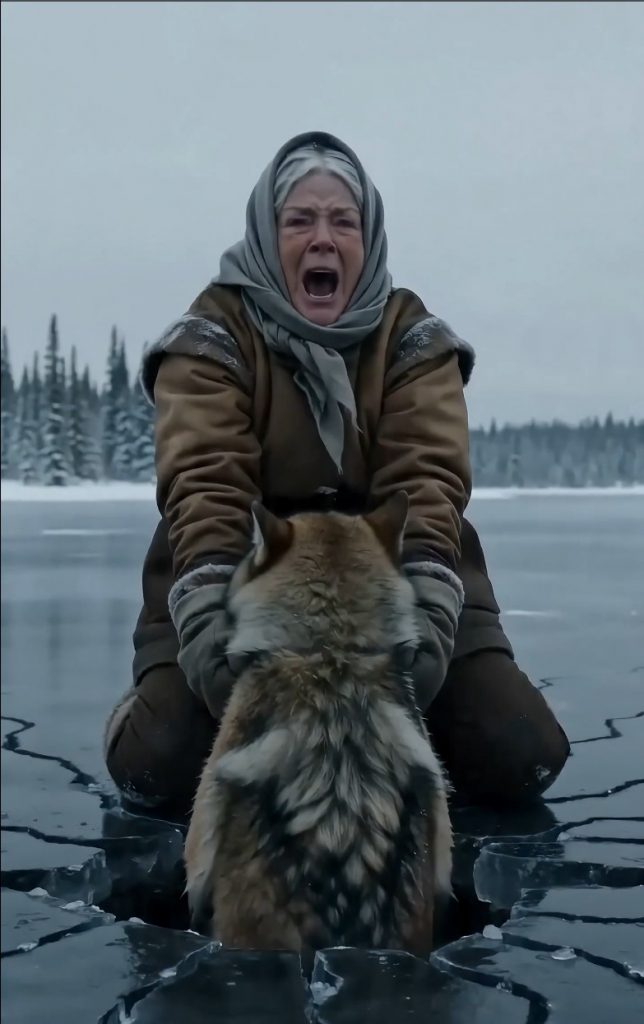
It was huge, wild, and desperate, thrashing in the black water at the center of the frozen lake. Its soaked gray-brown fur clung to its body, making it look smaller than it should have, almost broken beneath the weight of the freezing water.
But Ruth Calder did not step back.
She dropped to her knees on the cracked ice and reached for it.
The wind tore across the lake so hard it pushed loose snow along the surface in ghostly white ribbons. Far beyond the open hole, pine trees stood beneath a gray sky, silent and buried in winter.
The wolf’s claws scraped the edge again and again.
Each time, they slipped.
Ruth grabbed the animal by the scruff and shoulder, her mittened hands sinking into wet fur. Cold shot up both arms so violently her breath caught, but she held on.
“Come on,” she gasped.
The wolf kicked harder, water churning around its body. Its eyes were wide, not with anger, but panic. Survival had burned every wild instinct down to one need.
Get out.
Ruth leaned back, using all the weight left in her old body. Her knees slid. The ice groaned beneath her.
A sharp crack snapped somewhere to her right.
She froze.
The wolf did not understand the danger under her. It only fought the hole. Its front paws slapped the ice, claws screaming across the slick surface as chunks broke away beneath it.
Ruth tightened her grip.
“No,” she whispered, though she did not know whether she was speaking to the wolf, the lake, or the memory of every living thing she had already lost.
She pulled again.
The wolf’s chest came up over the edge.
For one wild second, Ruth thought she had done it.
Then the ice flexed.
A dark crack opened between her knees and raced outward like lightning trapped beneath glass.
Ruth’s face lifted in horror.
The wolf’s body sagged back toward the water. Its breath came in harsh bursts. Ruth’s sleeves were soaked past the elbows, her hands going numb, her shoulders burning.
Still, she refused to let go.
“Hold on!” she screamed.
Her voice vanished into the wind.
From high above, she would have looked like nothing more than a brown dot beside a black hole in an endless frozen world. An old woman kneeling on ice too thin to trust, holding onto a wolf too exhausted to save itself.
Then she saw something tangled deep in the wolf’s wet fur.
Not ice.
Not weeds.
A strip of red cloth.
Ruth’s heart stopped.
She knew that color.
She had tied the same red scarf around her grandson’s neck the morning he disappeared.
And suddenly, saving the wolf was no longer just mercy.
It was the only way to find out what had happened to the boy everyone said the lake had swallowed.
Act II
Three weeks earlier, Ruth’s grandson had vanished on the north side of Calder Lake.
Eli was seventeen, tall and restless, with his mother’s eyes and his grandfather’s stubbornness. He came to Ruth’s cabin every winter break, not because there was much for a teenager to do in the wilderness, but because he said the world felt quieter there.
Ruth knew what he really meant.
At her cabin, no one asked him to be normal.
Eli had lost his father young. Ruth had lost her son in the same year. Grief had settled between them like snow, soft at first, then heavy enough to bend everything.
So they made rituals.
Morning coffee for Ruth, hot chocolate for Eli. Firewood stacked by the shed. Chess after dinner. Long walks along the frozen lake where Ruth taught him how to read wind, tracks, and clouds.
He always wore the red scarf she had knitted him.
“Grandma,” he teased once, “I look like a traffic cone.”
“You look visible,” Ruth said. “That is the point.”
The morning he disappeared, Eli had gone out before sunrise with his camera, hoping to photograph the wolf pack that sometimes crossed the far ridge. He left a note on the kitchen table.
Back before breakfast. Don’t worry.
But breakfast came and went.
By noon, Ruth had called the sheriff.
By nightfall, search teams were sweeping the lake road, the forest edge, and the frozen inlet. They found Eli’s camera strap near the north trail. They found boot tracks leading toward the ice.
Then a storm came in and erased everything else.
After two days, Sheriff Dalton told Ruth what people always say when they have run out of answers.
“We’re doing everything we can.”
By the end of the week, the search slowed.
By the second week, people began speaking about Eli in the past tense.
Ruth refused.
She walked the shoreline every morning. She checked the pines. She scanned the ice through binoculars until her eyes watered from the glare. At night, she listened for wolves, for engines, for anything that might explain why a boy who knew the lake had not come home.
The town pitied her.
Some avoided her in the grocery store. Others squeezed her shoulder too tightly and said Eli was “with his father now,” as if that comforted anyone.
Only one person made Ruth angry enough to speak sharply.
Graham Voss.
He owned the timber company that had been fighting for rights to expand across the north ridge. The same ridge Ruth’s late husband had helped protect years earlier. The same ridge where Eli had hoped to photograph the wolves.
Graham came to her cabin after the search ended, standing on the porch in a black coat too clean for winter work.
“I’m sorry about the boy,” he said.
Ruth stared at him.
He did not look sorry.
His eyes moved past her, toward the lake, toward the forest, toward the land he had wanted for years.
“Tragedy changes things,” he continued. “You may want to reconsider my offer for the property. This place can’t be easy for you now.”
Ruth closed the door in his face.
That night, she sat beside the stove with Eli’s empty mug on the table and felt something colder than grief enter the room.
Suspicion.
Because Eli had not only gone out to photograph wolves.
He had gone out after hearing machines in the protected forest the night before.
And if Eli had seen something he should not have seen, then the lake had not taken him by accident.
Someone had needed him gone.
The next morning, Ruth went back onto the ice alone.
She carried rope, a walking stick, and the red scarf’s twin wrapped around her own throat.
She expected to find tracks.
Instead, she heard splashing.
And when she reached the broken hole at the center of the cracked lake, she found a wolf fighting for its life.
A wolf carrying Eli’s scarf.
Act III
Ruth pulled until her vision blurred.
The wolf’s front legs finally slid onto the ice, its claws digging shallow lines into the frozen surface. Its body shook violently, but it was no longer sinking.
“Again,” Ruth rasped. “Help me.”
As if it understood, the wolf kicked hard with its back legs.
Ruth leaned backward with everything she had left.
The ice screamed beneath them.
A long crack split past her hip and shot toward the open water. Ruth felt the surface drop, just an inch, but enough to make the terror in her chest flare bright.
If the ice broke now, they would both go in.
She could let go.
A reasonable person would let go.
But Ruth had buried her husband. She had buried her son. She had stood in a doorway waiting for a grandson who never returned.
She was done letting the cold take what it wanted.
With one final pull, the wolf slid out of the hole and collapsed beside her.
For a moment, neither moved.
The wolf lay on the ice, chest heaving, water streaming from its fur. Ruth fell onto her side, arms useless, lungs burning. The wind moved around them like the lake itself was breathing.
Then the crack beneath Ruth widened.
The wolf’s head lifted.
Its ears pinned back. It staggered to its feet, weak but alert, and gave a rough bark that sounded wrong coming from a wild animal.
Ruth looked down.
The ice under her elbow had turned dark.
The wolf limped toward her, lowered its head, and seized the sleeve of her coat between its teeth.
Ruth went still.
It did not bite down hard.
It pulled.
“Okay,” Ruth whispered. “Okay.”
She rolled onto her stomach and crawled after it, dragging herself away from the hole inch by inch. The wolf backed up slowly, tugging her sleeve, then releasing, then tugging again.
Behind her, the ice snapped.
A sheet near the hole dropped into the black water with a heavy splash.
Ruth did not look back.
She crawled until the ice turned white and thick beneath her. Only then did she collapse against a frozen ridge of snow, shaking so violently she could barely breathe.
The wolf stood a few feet away.
It should have run.
Instead, it turned toward the northern forest.
The red cloth tangled in its fur fluttered in the wind.
Ruth forced herself upright. Her legs trembled. Her hands had gone clumsy inside her soaked mittens. Every sensible part of her screamed to return to the cabin.
But the wolf took three steps toward the trees, stopped, and looked back.
Ruth knew that look.
It was the same look Eli used to give her when he had found something interesting and wanted her to follow.
“No,” Ruth breathed. “You know where he is?”
The wolf turned and limped toward the shore.
Ruth followed.
The journey across the lake felt endless. The wolf moved slowly, weakened from the water, but it never lost direction. It led her off the ice, through a break in the pines, and up a narrow trail Ruth had not used in years.
Then she saw smoke.
Not from her cabin.
From an old hunting shack near the ridge.
Ruth ducked behind a tree.
Two snowmobiles were parked outside. Fresh tire marks cut through the snow. A yellow company logo had been painted on a fuel can near the door.
Voss Timber.
Ruth’s breath turned thin.
The wolf lowered its body and growled.
From inside the shack came a sound.
A cough.
Then a boy’s voice, faint but alive.
“Hello?”
Ruth pressed one hand to her mouth.
Eli.
Act IV
Ruth wanted to run to the door, but the wolf blocked her path.
It stepped in front of her, weak and soaked, yet suddenly fierce. Its eyes fixed beyond the shack toward the trees.
Then Ruth heard men speaking.
Two voices.
One was Graham Voss.
“The old woman won’t last another week out here,” he said. “Once she signs, the ridge is ours.”
Another man answered, nervous. “And the kid?”
There was a pause.
Ruth’s fingers tightened around her walking stick.
Graham’s voice dropped.
“He should’ve stayed out of the woods.”
The words struck Ruth so hard the forest seemed to tilt.
Eli had not fallen through the lake.
He had not wandered off.
He had seen something.
Illegal cutting. Hidden roads. Maybe the poisoned bait Ruth had found near the ridge months ago and reported to a sheriff’s office that never called back.
Graham had kept him hidden while the town mourned him.
Alive, but erased.
Ruth backed away slowly and reached for her phone. Her hands were numb. The screen barely responded. One bar flickered in the corner.
She dialed Sheriff Dalton first.
No answer.
Then she dialed Mara Jensen, a retired dispatcher who still lived two miles from the lake and had never trusted Graham Voss.
Mara picked up on the second ring.
“Ruth?”
Ruth kept her voice low. “Eli is alive.”
Silence.
Then Mara said, “Where are you?”
“North ridge shack. Voss is here. Bring everyone you trust. Not just the sheriff.”
Ruth ended the call before fear could enter her voice.
Inside the shack, Eli coughed again.
The sound shattered her patience.
She moved.
The wolf moved with her.
Ruth reached the side window and wiped frost from the glass. Eli sat tied to a heavy chair near an old stove, pale and exhausted, but alive. A bruise shadowed one cheek. His red scarf was gone from his neck.
The wolf’s ears flattened when it saw him.
Ruth understood then.
Eli had not dropped the scarf.
He had used it.
He must have torn it loose and tied it around the wolf somehow when the animal came near the shack, maybe drawn by food scraps, maybe trapped by the same men. A message without words.
Find her.
The wolf had tried.
And somewhere between the shack and the lake, it had broken through the ice.
Ruth stepped to the door and lifted the latch.
It was locked from the outside with a metal hook.
A simple lock.
A cruel one.
She raised her walking stick and struck it.
The first blow rang through the trees.
Inside, the men stopped talking.
Ruth struck again.
The hook bent.
“Who’s there?” Graham shouted.
The wolf lunged at the door and barked, deep and furious.
Ruth hit the latch one final time. It snapped free.
She threw the door open.
Eli looked up.
“Grandma?”
Ruth crossed the room faster than she had moved in twenty years.
Graham reached for her, but the wolf surged between them, teeth bared, not attacking, only warning. Graham stumbled back into the table.
Ruth cut Eli’s bindings with the small knife she carried for kindling.
The second man bolted out the back door and straight into the headlights of Mara Jensen’s truck.
Mara had not come alone.
Behind her were three neighbors, two volunteer firefighters, and Deputy Hall, the only officer Ruth had ever fully trusted. Their vehicles blocked the snowmobile trail. Phone cameras were already raised.
Graham looked from the wolf to Ruth to the crowd outside.
His face changed as he realized the old woman was not alone anymore.
Deputy Hall stepped into the shack.
“Graham Voss,” he said, “keep your hands where I can see them.”
Graham tried to speak.
Nobody listened.
For years, his money had made people patient with him. His promises had made officials look away. His threats had made witnesses doubt themselves.
But this time, the witness was a shivering boy in a chair.
And an old woman with ice still frozen to her sleeves.
And a wolf standing at her side like the forest itself had come to testify.
Act V
Eli survived.
That was the sentence Ruth repeated to herself in the hospital until she finally believed it.
He had been held in the shack for seventeen days, kept alive only because Graham wanted Ruth broken, not investigated. Eli had heard enough from inside that room to understand the truth. Voss Timber had been cutting illegally beyond the ridge, dumping waste near the creek, and setting traps to drive wolves away before environmental inspectors returned in spring.
Eli had photographed it.
That was why they took him.
The camera was found buried beneath loose floorboards in the shack, exactly where Eli had kicked it after pretending the battery was dead. Its memory card held everything. Trucks moving at night. Marked trees. Men in Voss jackets hauling equipment through protected land.
The evidence did what grief alone could not.
It forced the town to look.
Graham Voss was arrested, then indicted. The sheriff who had ignored Ruth’s calls resigned before the inquiry reached his desk. Voss Timber lost its permits. The north ridge was placed under emergency protection before spring thaw.
But Ruth cared about only one thing at first.
Eli breathing.
Eli sleeping.
Eli waking up and asking for pancakes like he was six again and the world had not tried to steal him.
The wolf disappeared the night of the rescue.
After Graham was taken away and Eli was wrapped in blankets, the animal stood at the edge of the treeline, still wet, still limping. Ruth tried to approach, but it backed away.
Not afraid.
Finished.
It looked once at Eli.
Then at Ruth.
Then it vanished between the pines.
For weeks, Ruth thought she would never see it again.
Winter loosened slowly. The lake remained dangerous, scarred by dark seams where the ice had cracked. Ruth refused to step onto it, though she stood at the shore often, watching the place where she had nearly vanished into the cold.
Eli healed in pieces.
Some days he talked too much. Some days he said nothing at all. Ruth did not rush him. She had learned long ago that survival was not the same as being fine.
One evening, as the sky turned violet over the pines, Eli joined her on the porch with two mugs of tea.
“You saved him,” he said.
Ruth knew who he meant.
“He saved me too.”
Eli looked toward the ridge. “I tied my scarf to his fur when he came near the shack. I thought maybe he’d run. Maybe someone would see it.”
“He did more than run,” Ruth said.
Eli’s eyes lowered.
“I heard him fall through the ice,” he whispered. “I thought I’d killed him.”
Ruth reached for his hand.
“No. You gave him a reason to fight.”
That night, the wolves howled.
The sound rose from the north ridge, low and layered, moving through the trees like a memory older than the town itself. Eli stepped onto the porch barefoot before Ruth could scold him.
At the edge of the clearing stood the gray-brown wolf.
Thinner now. Alive.
Behind it, half hidden among the pines, were others.
A pack.
The rescued wolf watched Ruth from the snow. For a long moment, nothing moved. Then it lowered its head once, not tame, not grateful in any human way, but aware.
Ruth held her breath.
Eli whispered, “That’s him.”
The wolf turned and disappeared with the others.
After that, Ruth never called it hers.
Wild things did not belong to people. Her husband had taught her that. The best you could do was protect the space they needed to remain free.
So she did.
When spring came, Ruth attended the county hearing wearing her gray headscarf and carrying Eli’s recovered camera in a canvas bag. She spoke for five minutes. Her voice was quiet, but the room listened.
She spoke about the ridge.
The wolves.
Her grandson.
The lake.
She did not cry until she read Walter Calder’s old field note from thirty years earlier, written by her late husband in pencil on weathered paper.
A forest does not ask us to love it loudly. Only to leave it living.
By unanimous vote, the north ridge became protected wilderness.
Months later, a small sign appeared near the lake trail.
CALDER RIDGE WILDLIFE SANCTUARY
Below it, someone had carved a wolf into the wood.
Ruth pretended not to know Eli had done it.
The lake froze again the next winter, but Ruth no longer saw it as a grave waiting beneath snow. She saw the place where everything had almost ended, and where everything had been returned.
On the first clear morning after Christmas, she and Eli walked the shoreline together. He wore a new red scarf. She had knitted it herself, thicker this time, brighter against the white.
They stopped near the place where the ice had broken.
Far across the lake, near the dark line of pines, a wolf appeared.
Then another.
Then the gray-brown one stepped into view.
Eli lifted his hand.
Ruth did not.
She simply stood there, old bones aching in the cold, heart full enough to hurt, and watched the animal who had carried her grandson’s last hope across a frozen lake.
The wolf stared back for a moment.
Then it turned into the trees.
Ruth smiled through her tears.
The world had tried to bury the truth under ice, fear, and silence.
But one desperate wolf had broken through.
And one old woman had held on.