Act I
The mop hit the dojo floor before anyone understood what it meant.
It clattered across the polished wood, the long handle bouncing once, twice, then rolling to a stop between the cleaner and the man wearing the black belt.
The students stopped whispering.
Sunlight poured through the tall windows. White uniforms lined the back wall, young men sitting on their knees with straight backs and uncertain eyes. The room smelled faintly of floor polish, sweat, and old discipline.
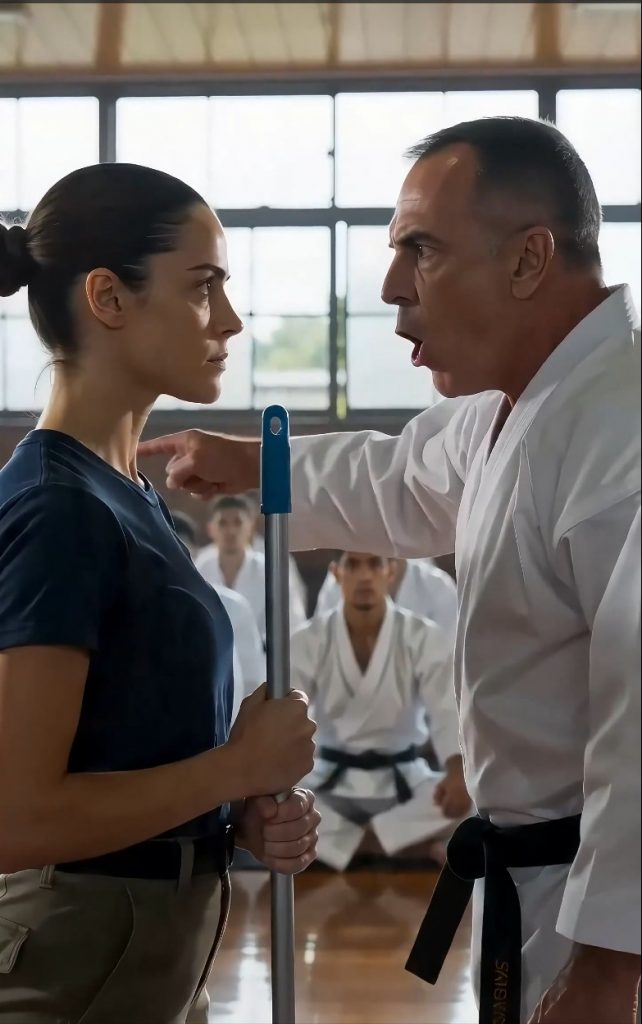
In the center of it all stood Sensei Grant Mercer, chest lifted, jaw tight, his finger still pointed inches from the cleaner’s face.
“Get out of here,” he barked. “Or you’ll regret it.”
The young woman did not move.
Her name was Elise Tan.
At least, that was the name stitched onto the cleaning company badge clipped to her navy T-shirt. Her dark hair was tied into a simple bun. Olive cargo pants hung loose at her ankles. She looked like someone hired to mop sweat from the floor after class and disappear before anyone important noticed her.
Grant had noticed her.
That was the problem.
She had been cleaning near the edge of the mat when he ordered her to leave. Not asked. Ordered. He did it loudly, in front of the students, as if humiliation were part of the lesson plan.
Elise looked at him, calm as stone.
“No,” she said.
The word echoed longer than the mop.
Grant blinked once.
Nobody refused him in his dojo.
He reached down and grabbed his black belt with both hands, pulling it tight around his waist like it was proof of something sacred.
“You see this?” he said, his voice low and mocking.
Elise’s eyes did not drop to the belt.
They stayed on his shoulders. His hips. His feet.
She was not looking at rank.
She was reading movement.
That made Grant angrier.
He lunged forward and shoved her hard in the chest with both hands.
Elise’s feet slid across the polished floor. Her body struck the wood with a heavy sound that made every student flinch. A gasp broke from the back row.
For a moment, she lay still.
Grant stood over her, breathing heavily, eyes burning with the satisfaction of a man who thought he had restored order.
Then Elise turned her face toward him.
Her hands tightened against the floor.
The coldness in her eyes made one student slowly sit back.
Grant’s smirk faded.
Because the woman on the floor was not afraid.
She looked like someone who had finally been given permission to stop pretending.
And the black belt around Grant Mercer’s waist was about to become the least important thing in the room.
Act II
Three months earlier, Elise Tan had stood outside that same dojo in the rain and almost walked away.
The sign above the door still read Mercer Martial Arts Academy, but the name under it hurt more.
Founded by Master Daniel Tan.
Her father.
The letters had faded slightly, but she remembered when they were new. She remembered standing on a ladder at twelve years old, holding screws in her palm while her father lifted the sign into place.
“This place is not mine,” he had told her. “It belongs to everyone who comes here to become less afraid.”
That was what the dojo had once been.
A refuge.
Kids came in shy and left standing taller. Adults came in carrying grief, anger, fear, and exhaustion, and her father taught them how to breathe before he taught them how to strike. He believed martial arts without humility was just violence wearing a uniform.
Elise grew up on those floors.
She learned to fall before she learned algebra. She learned to bow before she learned to drive. Her father never let her believe skill made her better than anyone else.
“The strongest person in the room,” he used to say, “should be the safest person to stand beside.”
Then Daniel Tan got sick.
Grant Mercer had been one of his senior students, charming when parents watched, obedient when Daniel was in the room, patient until patience no longer served him. When Daniel’s illness worsened, Grant offered to manage the business.
Elise had been overseas then, competing, teaching seminars, running from the slow heartbreak of watching her father disappear piece by piece.
By the time she returned, Daniel was gone.
And the dojo had changed.
At first, people spoke gently. They said Grant was strict. They said the old warmth had faded, but perhaps every school changed after its founder died. They said enrollment was up, competition medals were coming in, and the academy looked successful from the outside.
Then the messages began.
A mother wrote that her son quit after Grant mocked him in front of class.
A former assistant instructor said Grant punished students with humiliating drills until they cried.
A teenage girl said he told her she was “too soft” after she reported an injury.
The worst message came from a boy named Noah.
He wrote only one sentence.
Your father would be ashamed of what he made this place into.
Elise read it at 2:14 in the morning.
Then she sat on her kitchen floor until sunrise.
The next week, she contacted the building owner, the insurance agent, two former instructors, and the accountant her father had trusted for thirty years. What she learned was worse than rumor.
Grant had never owned the dojo.
Daniel Tan’s will left the property and academy license to Elise.
Grant had been operating under a management agreement, one Elise had been too grief-stricken to review closely. It gave him control only as long as he maintained Daniel’s teaching standards and protected student welfare.
Grant had done neither.
But Elise knew that walking in as the owner would only make him perform.
Men like Grant bowed beautifully when the right people watched.
So she entered through the service door.
A friend ran the cleaning company that handled the building. Elise asked for a uniform, a fake schedule, and two weeks where no one in the dojo would know who she was.
For twelve days, she cleaned floors, emptied trash, and listened.
She watched Grant bark at children for flinching. She watched him humiliate beginners for asking questions. She watched students stiffen whenever his voice rose.
And she watched the black belt become a weapon.
Not around his waist.
In his mind.
By the thirteenth day, Elise had enough evidence to remove him.
By the fourteenth, she planned to walk into the office with documents, witnesses, and a lawyer waiting on video call.
But Grant saw her mopping near the training floor before class ended.
And because he thought she was only a cleaner, he showed every student the truth Elise had been waiting for.
He showed them who he was when he believed there would be no consequences.
Act III
Elise rose slowly.
Not dramatically. Not with rage pouring out of her.
Slowly.
That frightened the students more than if she had jumped up swinging.
She placed one palm on the floor, then one knee beneath her. Her face remained still, but something in her silence made the room feel smaller.
Grant scoffed, though his voice came out thinner than before.
“Stay down.”
Elise stood.
The students watched her dust one sleeve, then straighten her shirt. Her mop lay across the floor behind her like a line she had already crossed.
Grant stepped forward again.
Elise did not step back.
“You don’t belong on this floor,” he said.
For the first time, she smiled.
It was small.
Cold.
“I was born on this floor.”
The words confused him.
Then she reached into the side pocket of her cargo pants and pulled out a folded document. She did not hand it to Grant. She held it up toward the students, toward the office camera in the corner, toward the framed photograph of Daniel Tan hanging near the entrance.
Grant’s eyes flicked to the paper.
“What is that?”
“The ownership deed,” Elise said.
A ripple moved through the students.
Grant’s jaw hardened. “You’re lying.”
Elise turned the page so the signature was visible.
“Daniel Tan was my father.”
The room changed instantly.
Some students looked toward the founder’s photograph. Others looked back at Elise, trying to find the resemblance they had never been told to see. The same quiet eyes. The same stillness. The same refusal to waste movement.
Grant’s face tightened.
“You’re Elise?”
She nodded.
The name traveled through the room in whispers.
Elise Tan.
Some had heard of her. Not from Grant. Never from Grant. But from old posters in the storage room, tournament clippings curling at the edges, a dusty trophy case Grant had shoved behind a vending machine.
National champion at sixteen.
World medalist at twenty-one.
Daniel Tan’s daughter.
The student named Noah stood near the back wall, pale and wide-eyed.
Elise saw him.
He saw her.
Something passed between them.
A promise kept.
Grant looked around and realized the room no longer belonged entirely to his voice.
So he reached for the only language he trusted.
Threat.
“You think a piece of paper makes you a teacher?” he snapped. “You walked away. I built this place.”
“No,” Elise said. “You occupied it.”
His face darkened.
She stepped closer, just enough to make him feel the distance vanish.
“My father built a school,” she said. “You built an audience.”
Grant’s hand twitched.
Every student saw it.
Elise did too.
“Don’t,” she said quietly.
But Grant was already committed to the lie he had told himself for years.
That rank made him righteous.
That fear made him respected.
That nobody he considered beneath him could ever stand above him.
He swung.
And this time, Elise was ready.
Act IV
The strike never reached her.
Elise shifted half a step.
That was all.
Grant’s hand cut through empty air, and before his weight settled, Elise caught his wrist, turned with it, and guided him down to one knee with a motion so smooth it looked almost gentle.
The students gasped.
Not because it was brutal.
Because it was effortless.
Grant tried to rip free. Elise released him before he could pretend he escaped.
He stumbled up, red-faced.
“Fight me properly,” he spat.
Elise’s expression did not change.
“This is not a fight,” she said. “It’s a correction.”
That sentence landed harder than any strike.
Grant rushed again, all power and embarrassment. Elise moved once more, redirecting him past her. His bare foot slid on the polished wood, and he caught himself just before falling into the trophy wall.
The students were no longer whispering.
They were watching.
Really watching.
For months, Grant had told them strength meant domination. He taught them that loudness was authority and pain was proof of discipline. Yet here was the woman he had shoved to the floor, controlling the room without raising her voice.
Grant’s breathing grew ragged.
“Stop looking at her!” he shouted at the students.
No one obeyed.
That broke something in him.
He grabbed the nearest training staff from the wall.
A wooden practice stick.
The students recoiled.
Elise’s eyes sharpened.
“Put it down,” she said.
Grant lifted it anyway.
Before he could swing, the door to the office opened.
Mara Klein, the academy’s longtime bookkeeper, stepped out with two adults behind her. One was a lawyer in a gray suit. The other was Sensei Aaron Bell, Daniel Tan’s oldest friend and the man who had taught Grant his first kata twenty-five years ago.
Aaron’s face was filled with grief.
“Grant,” he said. “Enough.”
Grant froze.
The stick remained in his hand.
Aaron looked at Elise, then at the students, then at the mop lying on the floor.
“I hoped the reports were exaggerated,” he said softly.
Elise did not look away from Grant.
“They weren’t.”
Mara lifted a tablet.
On the screen was footage from the dojo cameras. Grant pointing in Elise’s face. Grant threatening her. Grant shoving her to the floor. Grant reaching for the training weapon.
The lawyer spoke next.
“Mr. Mercer, your management contract is terminated effective immediately.”
Grant’s eyes widened.
“You can’t do that.”
Elise finally reached down and picked up the black belt he had loosened during the struggle. It had slipped partly from his waist, the knot hanging crooked now, stripped of the dignity he had tried to borrow from it.
She held it in both hands.
“My father used to say a belt only holds up your uniform,” she said. “The person wearing it gives it meaning.”
Then she let the belt fall at Grant’s feet.
The sound was soft.
But every student heard it.
Grant looked down at it as if she had dropped his entire life on the floor.
“You don’t get to take this from me,” he said.
“No,” Elise answered. “You gave it away every time you used it to scare someone.”
Noah stood.
His movement was small, but it cracked the room open.
Grant turned on him. “Sit down.”
Noah did not.
One by one, other students rose.
Not to fight.
To stand.
The youngest boy in the front row was crying quietly. A taller student put a hand on his shoulder. Two assistant instructors stepped away from Grant’s side and joined the students near the wall.
Grant looked around and saw the truth he had avoided.
He had never had loyalty.
Only fear.
And fear, once broken, does not bow on command.
Act V
Grant Mercer left the dojo without his black belt.
That was not the official punishment.
The official punishment came later through lawyers, revoked certifications, witness statements, insurance reports, and an ethics board that did not enjoy seeing camera footage of a senior instructor shoving a staff member to the floor.
But the students remembered the belt.
They remembered it lying on the polished wood near the mop.
Two objects Grant had misunderstood.
One he thought made him powerful.
One he thought made Elise powerless.
In the end, both proved him wrong.
Elise closed the dojo for one week.
Parents demanded answers. Some were angry. Some were ashamed. A few admitted they had suspected something was wrong but convinced themselves strict training was normal. Elise listened to all of them, even when the conversations hurt.
Especially then.
When the doors reopened, the sign had changed.
Mercer Martial Arts Academy was gone.
The new sign was simple.
Tan Dojo.
Below it, in smaller letters, was her father’s old saying.
The strongest person in the room should be the safest person to stand beside.
On the first day back, the students entered quietly.
Noah came last.
He stood near the doorway, backpack strap tight in one hand, eyes fixed on the floor where Elise had fallen.
“I’m sorry,” he said.
Elise turned from the front of the room.
“For what?”
“For not saying something sooner.”
She walked toward him.
The other students listened without pretending not to.
“Noah,” she said, “you did say something.”
His throat moved.
“I wrote one message.”
“One honest message can open a locked door.”
He looked up then.
For the first time since she had arrived, he seemed younger than the anger he carried.
Elise bowed to him.
Not a shallow nod.
A real bow.
The students stared.
Noah’s eyes filled as he bowed back.
Class began without shouting.
Elise made them sit in silence first. Some fidgeted. Some looked confused. They were used to noise filling every gap. Commands. Corrections. Insults dressed as motivation.
Elise let the silence stretch until the room softened around it.
Then she spoke.
“Discipline is not fear,” she said. “Respect is not obedience. Strength is not what you can do to someone. It is what you refuse to become.”
No one moved.
She walked to the center of the floor and picked up the old industrial mop.
A few students glanced at one another.
Elise smiled faintly.
“My father made every black belt clean the dojo,” she said. “Not as punishment. As gratitude.”
She handed the mop to the largest student in the room, a boy who had once laughed when Grant mocked beginners.
He took it carefully.
Then she handed towels to the others.
Together, they cleaned the floor.
Not because it was dirty.
Because it was theirs again.
Weeks passed.
The dojo changed slowly, then all at once.
Parents stayed to watch classes. Beginners stopped flinching when instructors walked near them. The trophy case returned to the front hall, but Elise added something new beside the medals.
A plain wooden frame.
Inside it was a photograph of Daniel Tan sweeping the floor in an old white gi, smiling at the camera with a mop in his hand.
Under the picture, Elise placed a small plaque.
No role is beneath a true teacher.
The students touched it sometimes before class.
Not for luck.
For reminder.
Grant tried once to return.
He came on a rainy evening, standing outside the glass door in a dark coat, his face thinner than before. Elise saw him from the office. So did Noah.
For a moment, the old fear flickered through the room.
Then Elise walked to the door.
She opened it only halfway.
Grant looked past her at the students training inside.
“You ruined me,” he said.
Elise studied him for a long moment.
“No,” she said. “You were witnessed.”
His mouth tightened.
There was no apology in him. Not yet. Maybe not ever.
But the dojo no longer needed his remorse to heal.
Elise closed the door.
Inside, Noah was helping a younger student adjust his stance. He spoke gently, patiently, the way Daniel Tan would have. The younger boy nodded, tried again, and smiled when he improved.
Elise watched them and felt her father in the room so strongly it nearly took her breath.
Not as a ghost.
As a standard.
The polished floor gleamed beneath the bright windows. Students moved across it with focus instead of fear. The old mop leaned in the corner, no longer a symbol of humiliation, but of the day the truth fell loudly enough for everyone to hear.
Elise stepped onto the floor.
The class turned toward her.
They bowed.
She bowed back.
And for the first time since her father died, the dojo felt like home again.